Global Engineering Plastics Market By Resin Type, By Processing Method, By Performance Grade, By End-Use Industry, By Region, Competition, Forecast & Opportunities, 2021-2034F
Market Definition
Engineering plastics are high-performance thermoplastic polymers engineered to deliver superior mechanical strength, thermal stability, dimensional accuracy, chemical resistance, and durability relative to conventional commodity plastics, enabling the substitution of metals, glass, and ceramics across demanding industrial applications. The Global Engineering Plastics Market encompasses the production, compounding, formulation, processing, and supply of polyamide, polycarbonate, acrylonitrile butadiene styrene, polyoxymethylene, thermoplastic polyesters, fluoropolymers, polyphenylene sulfide, and other advanced polymers used in load-bearing, heat-resistant, and precision components across automotive, electrical and electronics, packaging, construction, industrial, medical, and aerospace end uses.
The engineering plastics market covers virgin, bio-based, and recycled polymer grades supplied to injection molding, extrusion, blow molding, and other processing operations serving component manufacturers and original equipment manufacturers. Market participants within the engineering plastics market include petrochemical producers, resin manufacturers, compounders, masterbatch and additive suppliers, and distributors serving global and regional demand across multiple end-use industries. End users of the engineering plastics market span automotive and transportation, electrical and electronics, packaging, building and construction, industrial machinery, consumer goods, medical device, and aerospace manufacturers procuring high-performance polymers for structural, thermal, electrical, and precision applications. The engineering plastics market explicitly excludes commodity plastics such as standard polyethylene, polypropylene, and polyvinyl chloride used in non-engineering applications, thermoset composites, and elastomers, focusing exclusively on high-performance thermoplastic polymers consumed for demanding structural, thermal, electrical, and precision applications across global and regional demand centers.
Market Insights
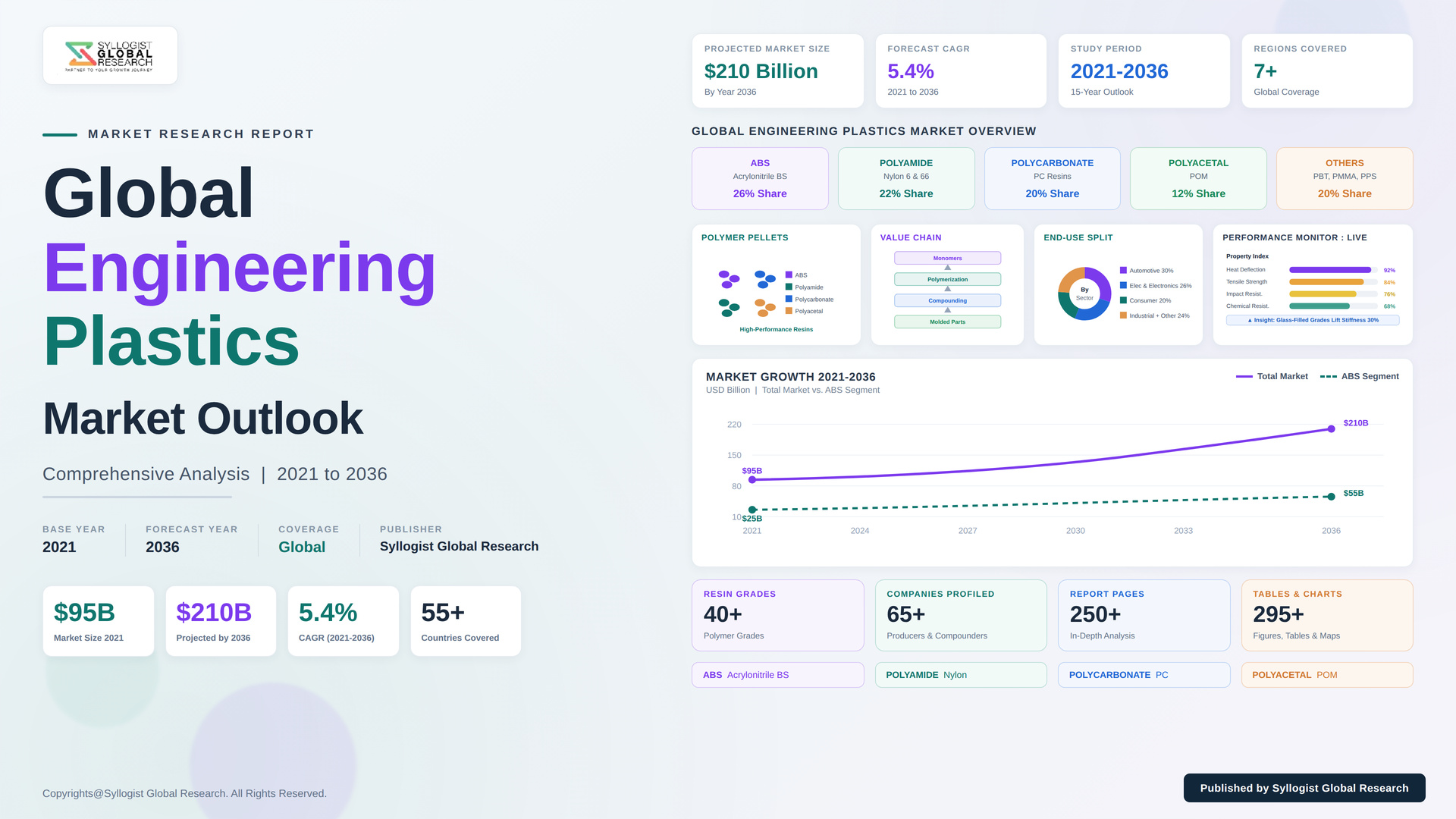
The global engineering plastics market is entering a sustained expansion phase, shaped by automotive lightweighting mandates, electric vehicle proliferation, electronics miniaturization, accelerating metal-to-plastic substitution, and rising demand for sustainable, bio-based, and recycled polymer grades. The engineering plastics market was valued at USD 138.0 billion in 2025 and is projected to reach USD 260.2 billion by 2034, advancing at a compound annual growth rate of 7.3% through the forecast period, as automotive, electronics, packaging, construction, and industrial manufacturers across Asia-Pacific, North America, Europe, the Middle East, and Latin America scale adoption of high-performance polymers. Sustained growth in electric mobility, semiconductor and electronics production, and lightweight component demand continues to widen the addressable base of the engineering plastics market across both mature and rapidly industrializing economies.
The engineering plastics market trajectory is being reshaped by the commercial maturation of bio-based and recycled resin grades, high-performance specialty polymers, and electric vehicle-specific formulations delivering flame retardancy, high dielectric strength, and thermal management. Polyamide accounts for the largest resin share within the engineering plastics market, supported by its mechanical strength, chemical resistance, and wide adoption across automotive under-the-hood and structural components. Polycarbonate and fluoropolymers represent the fastest expanding resin categories within the engineering plastics market, driven by demand for optical clarity, impact resistance, and high-temperature electrical performance across electronics, semiconductor, and electric vehicle applications. Bio-based and recycled engineering plastics are gaining rapid procurement traction as sustainability regulation and circular economy commitments reshape material selection across the engineering plastics market.
Polyamide represents the largest resin segment within the engineering plastics market, while fluoropolymers and polycarbonate record the fastest growth as electronics and electric vehicle demand scales globally. Injection molding remains the dominant processing method within the engineering plastics market, supported by its ability to produce complex, high-precision components efficiently and at scale, while extrusion records the fastest growth driven by tubing, profile, and film applications. Automotive and transportation constitutes the largest end-use industry within the engineering plastics market, propelled by lightweighting and electric vehicle component demand, while electrical and electronics represents the fastest expanding end-use segment within the engineering plastics market, driven by miniaturization, connectivity, and semiconductor growth. Packaging, building and construction, industrial machinery, and medical applications provide durable secondary demand across the engineering plastics market.
Asia-Pacific represents the largest regional market within the engineering plastics market, supported by large-scale automotive and electronics manufacturing, rapid industrialization, and expanding polymer production capacity across China, Japan, South Korea, and India, with China commanding the leading share and India recording the fastest regional growth within the engineering plastics market. North America occupies a substantial position within the engineering plastics market, propelled by advanced automotive, aerospace, and electronics manufacturing, alongside strong adoption of recycled and bio-based polymer grades across the United States, Canada, and Mexico. Europe holds a significant position within the engineering plastics market, supported by stringent sustainability regulation, automotive lightweighting, and circular economy programs across Germany, France, Italy, and the United Kingdom, while the Middle East, Africa, and Latin America record steady growth within the engineering plastics market driven by downstream petrochemical integration, construction demand, and expanding automotive assembly.
Key Drivers
Automotive Lightweighting Mandates, Electric Vehicle Proliferation, and Metal-to-Plastic Substitution Driving Sustained Engineering Plastics Demand
The structural shift toward automotive lightweighting, the rapid proliferation of electric vehicles, and accelerating metal-to-plastic substitution are generating durable demand growth across the engineering plastics market. Automakers are aggressively reducing vehicle weight to meet fuel efficiency and emissions targets, substituting metal components with high-performance polyamide, polycarbonate, and polyphenylene sulfide components that reduce mass while maintaining strength and durability within the engineering plastics market. The transition to electric mobility is intensifying this demand, as battery housings, connectors, thermal management systems, and high-voltage components require flame-retardant, high-dielectric, and heat-resistant engineering plastics that outperform conventional materials. Electric vehicle platforms are consuming rapidly rising volumes of specialty polymers, expanding the addressable base of the engineering plastics market across powertrain, interior, and structural applications. Metal-to-plastic substitution extends beyond automotive into industrial machinery, consumer goods, and aerospace, where weight reduction, corrosion resistance, and design flexibility drive adoption of engineering plastics over aluminum, steel, and cast components. The combination of tightening emissions regulation, electric vehicle scaling, and design freedom offered by high-performance polymers anchors long-duration demand visibility for resin producers, compounders, and component manufacturers operating across the engineering plastics market value chain globally. Rising vehicle electrification rates and stricter fuel economy standards across major automotive markets are expected to sustain this substitution momentum throughout the forecast period.
Electronics Miniaturization, Semiconductor Growth, and 5G Connectivity Driving High-Performance Polymer Consumption in Electrical and Electronics
The rapid miniaturization of electronics, sustained semiconductor industry growth, and the expansion of 5G and connected-device infrastructure are driving high-performance polymer consumption across the engineering plastics market. Shrinking component geometries and rising thermal loads in smartphones, wearables, and connected devices demand engineering plastics that combine dimensional precision, high dielectric strength, flame retardancy, and thermal stability within the engineering plastics market. Semiconductor and printed circuit board manufacturing consumes rising volumes of fluoropolymers, polyphenylene sulfide, and specialty grades that withstand high-temperature processing and aggressive chemical environments across the engineering plastics market. The rollout of 5G networks, data center expansion, and edge computing infrastructure is generating incremental demand for connectors, housings, and insulation components manufactured from high-performance engineering plastics. Growing adoption of electric and connected appliances, smart home devices, and industrial automation systems further expands electronics-driven demand within the engineering plastics market. As electronics manufacturers prioritize reliability, miniaturization, and thermal management, engineering plastics are displacing ceramics and metals in a widening range of electrical and electronic applications, supporting sustained volume and value growth for specialty polymer producers competing across the electronics segment of the engineering plastics market. Sustained growth in consumer electronics shipments and data infrastructure investment reinforces this demand across mature and emerging manufacturing hubs.
Rising Packaging, Construction, Medical, and Industrial Demand Broadening Application Reach Across the Engineering Plastics Market
Expanding demand across packaging, building and construction, medical, and industrial machinery applications is broadening the application reach and diversifying demand across the engineering plastics market. High-barrier, lightweight, and recyclable packaging requirements are driving adoption of thermoplastic polyesters and specialty grades that extend shelf life and improve product safety within the engineering plastics market. In building and construction, engineering plastics are replacing metal and glass in glazing, fittings, insulation, and structural components, supported by durability, weather resistance, and design flexibility across the engineering plastics market. The medical device sector is generating rising demand for biocompatible, sterilizable, and high-purity engineering plastics used in surgical instruments, diagnostic equipment, and implantable components, expanding high-value demand across the engineering plastics market. Industrial machinery, robotics, and automation applications increasingly rely on wear-resistant, self-lubricating, and dimensionally stable polymers such as polyoxymethylene and polyamide, reinforcing industrial demand within the engineering plastics market. Growing infrastructure investment, consumer goods production, and equipment manufacturing across emerging economies further amplify demand. This diversification across multiple end-use industries reduces cyclicality and supports resilient, broad-based revenue growth for participants competing across the engineering plastics market. Expanding healthcare access and infrastructure modernization across developing economies are expected to add further breadth to this multi-industry demand base.
Key Challenges
Volatile Feedstock and Raw Material Costs, Crude Oil Price Linkage, and Margin Pressure Constraining Engineering Plastics Producers
Volatility in feedstock and raw material costs, the linkage of polymer pricing to crude oil and petrochemical markets, and the resulting margin pressure are generating substantial financial challenges across the engineering plastics market. Most engineering plastics are derived from petrochemical feedstocks whose prices fluctuate with crude oil, natural gas, and naphtha markets, exposing producers to input cost volatility that compresses margins across the engineering plastics market. Geopolitical disruption, supply chain constraints, and energy price swings amplify feedstock cost uncertainty, complicating pricing strategy and long-term supply contracts within the engineering plastics market. Producers face difficulty passing rising input costs through to price-sensitive customers in competitive end-use industries, squeezing profitability across the engineering plastics market. Specialty additives, colorants, flame retardants, and reinforcing agents add further cost exposure, particularly as supply of certain specialty inputs remains concentrated among limited suppliers. Currency volatility affecting imported feedstocks and finished resins introduces additional margin risk for regional producers and compounders. Managing these input cost pressures requires hedging, supply diversification, backward integration, and continuous process efficiency improvement, raising the operating complexity and capital requirements for participants competing across the cost-sensitive engineering plastics market. Periods of sharp energy and feedstock inflation can materially disrupt production economics and delay capacity decisions across the engineering plastics market.
Stringent Plastic Waste Regulation, Recycling Complexity, and Sustainability Compliance Burden Reshaping the Engineering Plastics Market
Tightening plastic waste regulation, the technical complexity of recycling engineering plastics, and the rising sustainability compliance burden are reshaping and constraining growth across the engineering plastics market. Governments across major regions are enacting stringent regulation targeting plastic waste, single-use materials, and extended producer responsibility, increasing compliance obligations for participants across the engineering plastics market. Engineering plastics are technically difficult to recycle without degrading mechanical and thermal performance, and the presence of additives, reinforcements, and multi-material assemblies complicates end-of-life recovery within the engineering plastics market. Establishing reliable supply of high-quality recycled engineering plastics that meet demanding performance specifications requires substantial investment in collection, sorting, and advanced recycling infrastructure across the engineering plastics market. Customer and regulatory demand for recycled content, carbon footprint reduction, and circular economy alignment is raising the cost and complexity of product development and certification. Producers must invest in chemical recycling, bio-based feedstocks, and design-for-recyclability initiatives to remain compliant and competitive within the engineering plastics market. These sustainability pressures, while opening opportunities, raise near-term costs and operational complexity for producers navigating regulatory transition across the engineering plastics market. Divergent regional recycling standards and evolving carbon disclosure requirements add further compliance uncertainty and reporting overhead for globally active engineering plastics producers.
High Production Costs, Competition from Metals and Composites, and Technical Substitution Barriers Limiting Adoption
High production costs, ongoing competition from metals and advanced composites, and technical substitution barriers are limiting adoption and constraining penetration across the engineering plastics market. High-performance engineering plastics carry significantly higher unit costs than commodity plastics and, in some applications, than competing metals, restraining adoption among cost-sensitive manufacturers within the engineering plastics market. In demanding structural, high-temperature, and high-load applications, metals and fiber-reinforced composites continue to offer performance advantages that limit the substitution potential of engineering plastics. Qualifying engineering plastics for safety-critical automotive, aerospace, and medical applications requires extensive testing, validation, and certification, elongating adoption cycles and raising switching costs across the engineering plastics market. Established design, tooling, and manufacturing infrastructure built around metals creates inertia that slows conversion to polymer alternatives within the engineering plastics market. Concerns regarding long-term durability, creep, fatigue, and thermal performance under extreme conditions further constrain adoption in the most demanding applications. Overcoming these barriers requires sustained investment in material innovation, application engineering, and customer education, raising the technical and commercial effort required for participants seeking to expand penetration across the engineering plastics market. In highly regulated sectors, extended qualification timelines can defer revenue realization and slow the pace of material conversion within the engineering plastics market.
Market Segmentation
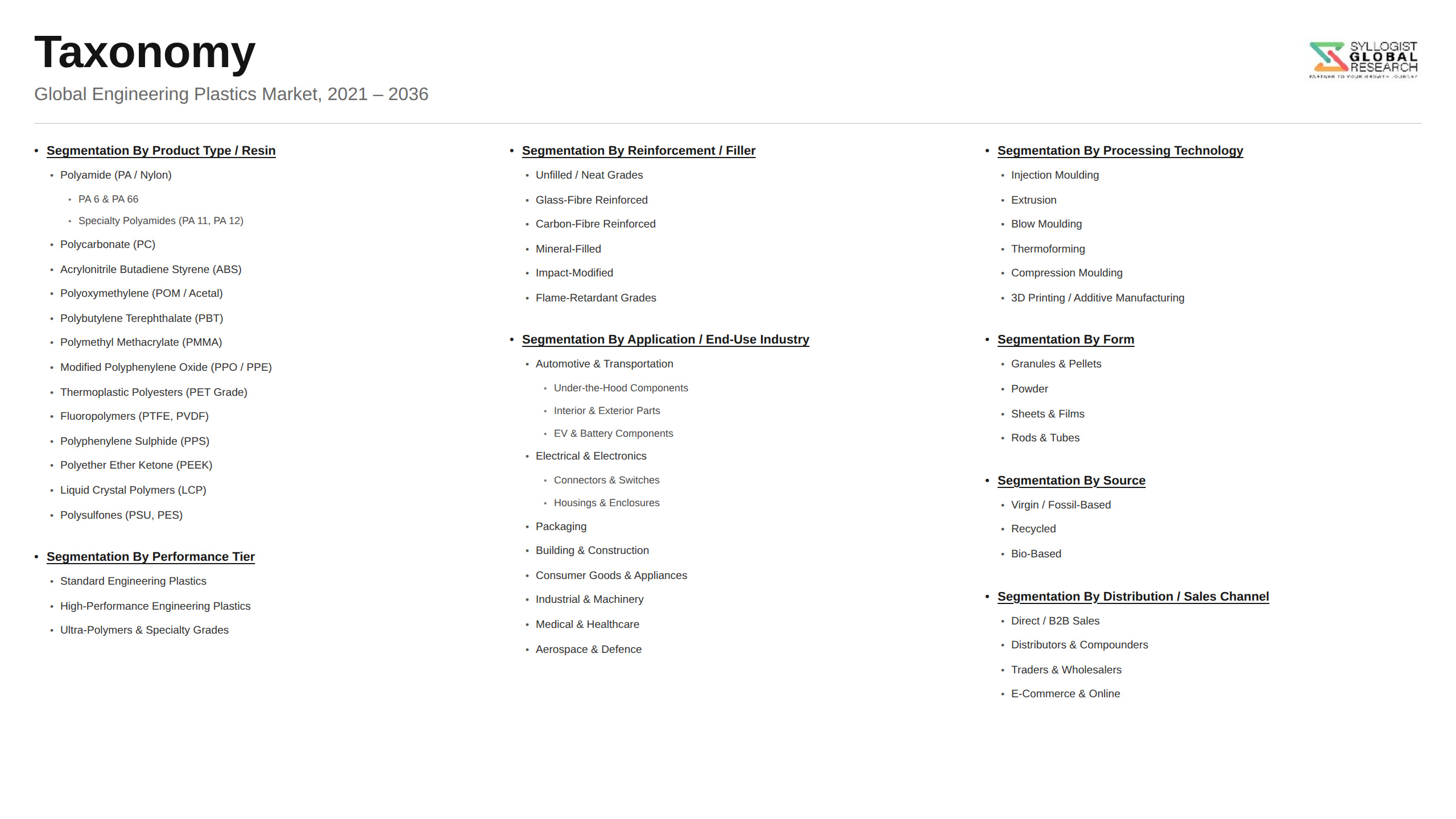
- Segmentation By Resin Type
- Polyamide (PA)
- Polycarbonate (PC)
- Acrylonitrile Butadiene Styrene (ABS)
- Polyoxymethylene (POM)
- Thermoplastic Polyesters (PBT and PET)
- Fluoropolymers
- Polyphenylene Sulfide (PPS)
- Others
- Segmentation By Processing Method
- Injection Molding
- Extrusion
- Blow Molding
- Others
- Segmentation By Performance Grade
- High-Performance Engineering Plastics
- Standard Engineering Plastics
- Segmentation By End-Use Industry
- Automotive and Transportation
- Electrical and Electronics
- Packaging
- Building and Construction
- Industrial and Machinery
- Consumer Goods
- Medical and Healthcare
- Aerospace
- Others
- Segmentation By Region
- North America
- Europe
- Asia-Pacific
- Middle East and Africa
- Latin America
All market revenues are presented in USD
Historical Year: 2021-2024 | Base Year: 2025 | Estimated Year: 2026 | Forecast Period: 2027-2034
Key Questions this Study Will Answer
- What is the total global market valuation of the Engineering Plastics Market in 2025, projected through 2034, segmented by resin type, processing method, performance grade, and end-use industry, enabling resin producers, compounders, component manufacturers, and material investors to identify highest-growth segments and the most durable revenue opportunities across the engineering plastics market?
- How are automotive lightweighting, electric vehicle proliferation, and metal-to-plastic substitution dynamics shaping the pace and geographic distribution of demand across mature and rapidly industrializing regions of the engineering plastics market through 2034?
- Which resin types, including polyamide, polycarbonate, fluoropolymers, polyoxymethylene, and thermoplastic polyesters, are gaining the strongest procurement traction across automotive, electronics, packaging, and medical applications, and what mechanical, thermal, and sustainability factors are shaping material selection within the engineering plastics market?
- How are electronics miniaturization, semiconductor growth, and 5G and connected-device expansion reshaping high-performance polymer demand, product innovation, and specialty grade development across the engineering plastics market?
- How is the competitive structure organized among petrochemical producers, resin manufacturers, compounders, additive and masterbatch suppliers, and distributors within the engineering plastics market, and what partnership, acquisition, capacity expansion, and sustainability strategies are enabling participants to strengthen competitive position?
- What feedstock cost volatility, plastic waste regulation, recycling complexity, and metal and composite competition factors are shaping pricing power, margin resilience, and adoption barriers across the engineering plastics market, and how are leading producers mitigating these challenges?
- Which regional markets, including Asia-Pacific, North America, Europe, the Middle East and Africa, and Latin America, are projected to generate the largest incremental revenue opportunities through 2034, and what manufacturing base, industrialization, sustainability regulation, and end-use demand factors are shaping investment priorities and competitive positioning in each regional engineering plastics market?
- Product Definition
- Research Methodology
- Research Design & Framework
- Overall Research Approach: Descriptive, Exploratory & Quantitative Mixed-Method Design
- Market Definition & Scope Boundaries: What is Included and Excluded
- Segmentation Framework
- Key Research Assumptions & Limitations
- Secondary Research
- Primary Research Design & Execution
- Data Triangulation & Validation
- Market Sizing & Forecasting Methodology
- Competitive Intelligence Methodology
- Quality Assurance & Peer Review
- Definitions, Abbreviations & Data Notes
- Executive Summary
- Market Snapshot & Headline Numbers
- Key Findings & Research Highlights
- Market Dynamics
- Regional Market Summary
- Competitive Landscape Snapshot
- Technology & Innovation Highlights
- Market Dynamics
- Drivers
- Restraints
- Opportunities
- Challenges
- Porter’s Five Forces Analysis
- PESTLE Analysis
- Market Trends & Developments
- Emerging Trends
- Technological Developments
- Regulatory & Policy Changes
- Supply Chain & Sourcing Trends
- Manufacturing & Process Trends
- Investment & Funding Activity
- Sustainability & ESG Trends
- Risk Assessment Framework
- Petrochemical Feedstock Price Volatility & Resin Input Cost Escalation Risk
- Automotive and Electronics Demand Cyclicality & Volume Volatility Risk
- Global Overcapacity, Asian Competition & Margin Compression Risk
- Feedstock Supply Concentration & Specialty Monomer Dependence Risk
- Substitution by Metals, Composites & Alternative Materials Risk
- Regulatory Framework & Standards
- REACH, TSCA Chemical Registration & Hazardous Substance Compliance Standards
- Food-Contact, Medical & Biocompatibility Grade Approval Standards
- Flame Retardancy, RoHS & Electrical Safety Compliance Regulations
- Recycled Content, Circular Economy & Plastic Waste Regulations
- Automotive, UL & Industry-Specific Material Certification Frameworks
- Global Engineering Plastics Market Outlook
- Market Size & Forecast by Value
- Market Size & Forecast by Volume (Engineering Plastics Consumed in Kilo Tonnes per Year and Nameplate Compounding Capacity in Million Tonnes per Year)
- Market Size & Forecast by Resin Type
- Acrylonitrile Butadiene Styrene (ABS)
- Polycarbonate (PC)
- Polyamide (Nylon)
- Polymethyl Methacrylate (PMMA)
- Polyoxymethylene (POM)
- Polybutylene Terephthalate (PBT)
- Thermoplastic Polyester (PET)
- Polyphenylene Oxide (PPO)
- Fluoropolymers
- Others
- Market Size & Forecast by End-Use Industry
- Automotive and Transportation
- Electrical and Electronics
- Consumer Goods and Appliances
- Industrial and Machinery
- Packaging
- Medical and Healthcare
- Aerospace and Defense
- Others
- Market Size & Forecast by Application
- Housings and Enclosures
- Gears and Bearings
- Connectors and Sockets
- Structural Components
- Films and Sheets
- Under-the-Hood Components
- Others
- Market Size & Forecast by Form
- Granules and Pellets
- Sheets
- Films
- Rods and Tubes
- Others
- Market Size & Forecast by Processing Technology
- Injection Moulding
- Extrusion
- Blow Moulding
- Thermoforming
- Compression Moulding
- Others
- Market Size & Forecast by Reinforcement
- Unfilled
- Glass-Fibre Reinforced
- Mineral-Filled
- Carbon-Fibre Reinforced
- Others
- Market Size & Forecast by Source
- Virgin
- Recycled
- Bio-Based
- Others
- Market Size & Forecast by Sales Channel
- Direct Sales to OEMs
- Distributor and Compounder Channel
- Merchant and Trader Channel
- Online and Retail Channel
- Others
- North America Engineering Plastics Market Outlook
- Market Size & Forecast
- By Value
- By Volume (Engineering Plastics Consumed in Kilo Tonnes per Year and Nameplate Compounding Capacity in Million Tonnes per Year)
- By Resin Type
- By End-Use Industry
- By Application
- By Form
- By Processing Technology
- By Reinforcement
- By Source
- By Country
- By Sales Channel
- Europe Engineering Plastics Market Outlook
- Market Size & Forecast
- By Value
- By Volume (Engineering Plastics Consumed in Kilo Tonnes per Year and Nameplate Compounding Capacity in Million Tonnes per Year)
- By Resin Type
- By End-Use Industry
- By Application
- By Form
- By Processing Technology
- By Reinforcement
- By Source
- By Country
- By Sales Channel
- Asia-Pacific Engineering Plastics Market Outlook
- Market Size & Forecast
- By Value
- By Volume (Engineering Plastics Consumed in Kilo Tonnes per Year and Nameplate Compounding Capacity in Million Tonnes per Year)
- By Resin Type
- By End-Use Industry
- By Application
- By Form
- By Processing Technology
- By Reinforcement
- By Source
- By Country
- By Sales Channel
- Latin America Engineering Plastics Market Outlook
- Market Size & Forecast
- By Value
- By Volume (Engineering Plastics Consumed in Kilo Tonnes per Year and Nameplate Compounding Capacity in Million Tonnes per Year)
- By Resin Type
- By End-Use Industry
- By Application
- By Form
- By Processing Technology
- By Reinforcement
- By Source
- By Country
- By Sales Channel
- Middle East & Africa Engineering Plastics Market Outlook
- Market Size & Forecast
- By Value
- By Volume (Engineering Plastics Consumed in Kilo Tonnes per Year and Nameplate Compounding Capacity in Million Tonnes per Year)
- By Resin Type
- By End-Use Industry
- By Application
- By Form
- By Processing Technology
- By Reinforcement
- By Source
- By Country
- By Sales Channel
- Country-Wise* Engineering Plastics Market Outlook
- Market Size & Forecast
- By Value
- By Volume (Engineering Plastics Consumed in Kilo Tonnes per Year and Nameplate Compounding Capacity in Million Tonnes per Year)
- By Resin Type
- By End-Use Industry
- By Application
- By Form
- By Processing Technology
- By Reinforcement
- By Source
- By Country
- By Sales Channel
- Market Size & Forecast
- Market Size & Forecast
- Market Size & Forecast
- Market Size & Forecast
- Market Size & Forecast
- Market Size & Forecast
*Countries Analysed in the Global Research Portfolio: United States, Canada, Mexico, Germany, France, United Kingdom, Netherlands, Spain, Italy, Norway, Sweden, China, Japan, India, Australia, South Korea, Singapore, Brazil, Chile, Saudi Arabia, UAE, Egypt, South Africa, Israel
- Technology Landscape & Innovation Analysis
- High-Performance Polymer (PEEK, PPS, LCP) & Specialty Grade Technology Deep-Dive
- Glass and Carbon-Fibre Reinforced Compounding Technology
- Bio-Based, Recycled & Circular Engineering Plastic Technology
- Metal Replacement, Lightweighting & Structural Polymer Technology
- Flame-Retardant, Halogen-Free & High-Temperature Grade Technology
- Additive Manufacturing, 3D Printing & Advanced Processing Technology
- Compounding, Alloying & Polymer Blend Technology
- Patent & IP Landscape in Engineering Plastics Technologies
- Value Chain & Supply Chain Analysis
- Petrochemical Monomer & Feedstock Supply Chain
- Base Resin Polymerisation & Production Supply Chain
- Compounding, Reinforcement & Additive Formulation Supply Chain
- Distributor, Compounder & Merchant Channel Network
- OEM and Converter Customer Channel (Automotive, Electronics, Industrial)
- Injection Moulding, Extrusion & Processing Network
- Recycled Feedstock Collection, Reprocessing & Circular Supply Network
- Pricing Analysis
- Commodity Engineering Resin (ABS, PC, Nylon) Pricing Across Contract & Spot Tiers
- High-Performance Polymer (PEEK, PPS, LCP) Pricing Economics
- Glass-Fibre Reinforced vs Unfilled Grade Pricing Differentials
- Feedstock-Linked Pricing & Monomer Cost Pass-Through Analysis
- Recycled vs Virgin Resin Pricing & Sustainability Premium Analysis
- Regional Pricing Benchmarks Across North America, Europe & Asia
- Total Delivered Cost, Compounding Margin & Value-in-Use Pricing Models
- Sustainability & Environmental Analysis
- Lifecycle Assessment (LCA) of Engineering Plastics Across Production & Use
- Recycled Content, Chemical Recycling & Circular Economy Performance
- Bio-Based and Renewable Feedstock Engineering Plastic Performance
- Lightweighting, Metal Replacement & CO2 Reduction Performance
- Regulatory-Driven Sustainability, SDG 9 (Industry, Innovation) & SDG 12 (Responsible Consumption) Alignment & Green Finance Eligibility
- Competitive Landscape
- Market Structure & Concentration
- Market Consolidation Level (Fragmented vs. Consolidated by Resin Type & Geography)
- Top 10 Players Market Share
- HHI (Herfindahl-Hirschman Index) Concentration Analysis
- Competitive Intensity Map by Resin Type, Application & Geography
- Player Classification
- Integrated Petrochemical and Resin Producers
- Specialty and High-Performance Polymer Producers
- Compounders and Formulators
- Automotive and Electronics Grade Specialists
- Bio-Based and Recycled Resin Producers
- Regional and Independent Resin Producers
- Reinforcement and Additive Suppliers
- Distributors and Merchant Traders
- Competitive Analysis Frameworks
- Market Share Analysis by Resin Type, Application & Region
- Company Profile
- Company Overview & Headquarters
- Engineering Plastics Product Portfolio
- Key Customer Relationships & Reference OEM Accounts
- Production Footprint & Nameplate Capacity Coverage
- Revenue (Engineering Plastics Segment) & Order Backlog
- Technology Differentiators & IP
- Key Strategic Partnerships, JVs & M&A Activity
- Recent Developments (Capacity Additions, Product Launches, Contract Wins)
- SWOT Analysis
- Strategic Focus Areas & Roadmap
- Competitive Positioning Map (Technology Capability vs. Market Penetration)
- Key Company Profiles
- Market Structure & Concentration
- Technology Landscape & Innovation Analysis
- Strategic Output
- Market Opportunity Matrix: By Resin Type, Application, End-Use Industry, Reinforcement & Geography
- White Space Opportunity Analysis
- Strategic Recommendations
- Product Portfolio & Grade Innovation Strategy
- Manufacturing Excellence & Capacity Expansion Strategy
- Geographic Expansion & Localisation Strategy
- Customer & OEM Account Engagement Strategy
- Partnership, M&A & Ecosystem Strategy
- Sustainability & Circular Economy Strategy
- Risk Mitigation & Future Roadmap
- Strategic Priority Matrix & Roadmap
- Near-term (2025-2028)
- Mid-term (2029-2032)
- Long-term (2033-2037)