Global Ethanol Market By Type, By Source, By Purity, By Application, By End User, By Region, Competition, Forecast & Opportunities, 2021-2034F
Market Definition
Ethanol is a colorless, volatile, water-miscible alcohol with the chemical formula C2H5OH, produced primarily through the fermentation of sugars and starches or through the catalytic hydration of ethylene, and valued as a renewable transportation fuel, a versatile industrial solvent, a chemical intermediate, and a key ingredient across beverages, pharmaceuticals, and personal care products. The Global Ethanol Market covers the production, blending, distribution, and consumption of fuel ethanol, industrial ethanol, and beverage-grade ethanol manufactured from corn, sugarcane, wheat, other grains, molasses, and cellulosic and second-generation feedstocks, as well as synthetic ethanol produced from petrochemical routes. The ethanol market spans denatured and undenatured grades supplied for gasoline blending and flex-fuel use, extra-neutral alcohol and potable spirit production, high-purity solvents for pharmaceutical and cosmetic manufacturing, disinfectants and sanitizers, and feedstock for downstream chemicals including ethyl acetate, ethylene, acetaldehyde, and ethyl tertiary butyl ether. Market participants include grain and sugarcane ethanol producers, integrated biorefineries, synthetic ethanol manufacturers, distillers, blenders, and specialty distributors that supply fuel, industrial, and beverage value chains. End users span the transportation fuel sector, beverage and distilled spirits producers, pharmaceutical and healthcare manufacturers, cosmetics and personal care formulators, and industrial chemical and solvent consumers. The ethanol market excludes methanol, butanol, and higher alcohols sold outside ethanol supply routes, along with non-alcohol biofuels such as biodiesel, concentrating on fuel, industrial, and beverage ethanol volumes that serve energy, solvent, intermediate, and consumable roles across regulated and industrial applications worldwide.
Market Insights
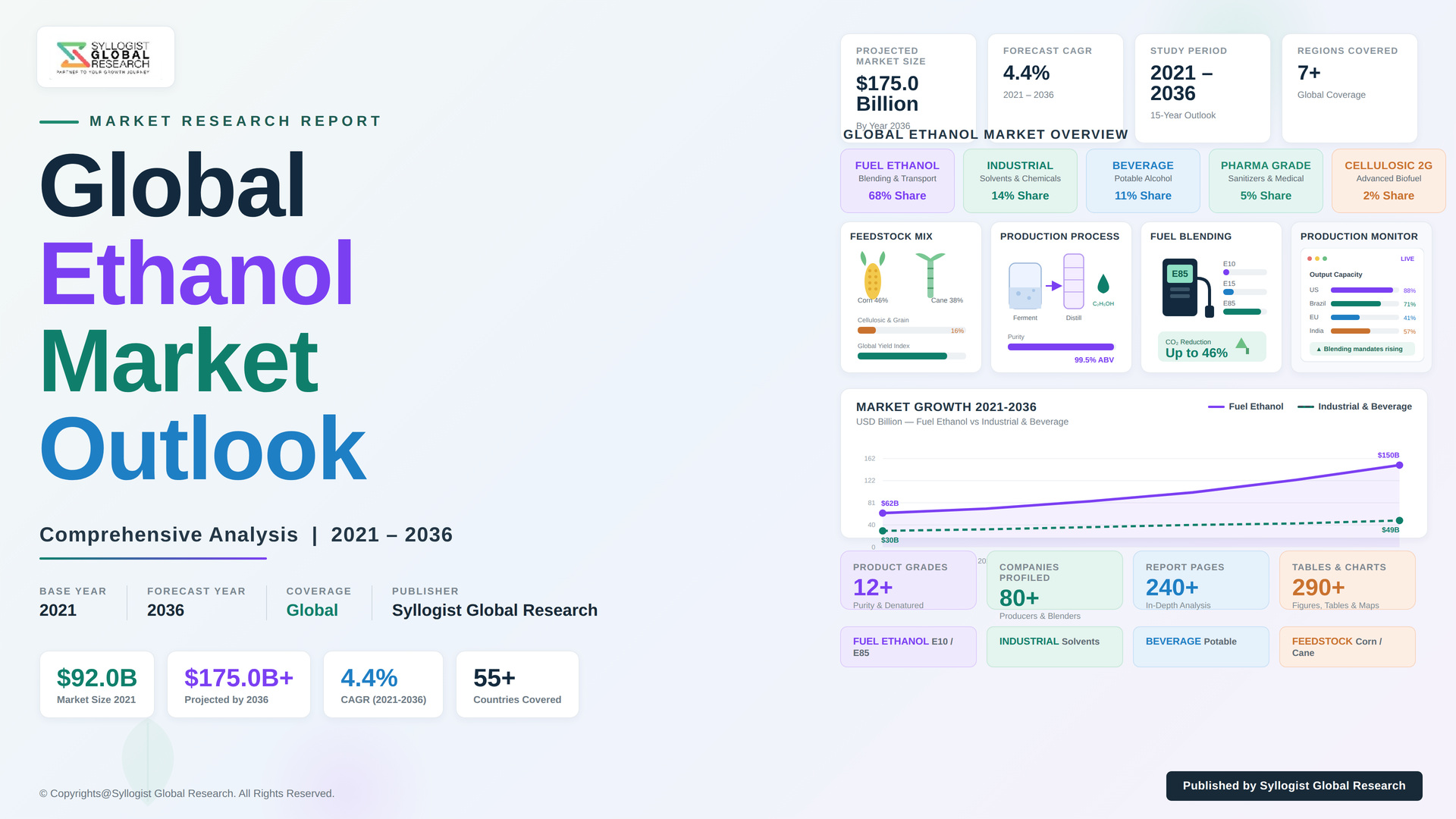
The global ethanol market is moving through a sustained expansion phase, shaped by rising fuel ethanol blending mandates, national decarbonization and energy security goals, growing beverage and industrial alcohol consumption, and accelerating investment in cellulosic and low-carbon ethanol capacity across major producing economies. The global ethanol market was valued at USD 108.4 billion in 2025 and is projected to reach USD 162.7 billion by 2034, advancing at a compound annual growth rate of 4.6% through the forecast period, as fuel blenders, beverage producers, pharmaceutical manufacturers, and industrial solvent consumers scale ethanol procurement across North America, Europe, Asia-Pacific, Latin America, and the Middle East and Africa.
The ethanol market trajectory is being reshaped by the scaling of higher gasoline blending ratios, the commercialization of cellulosic and second-generation ethanol, and the emergence of ethanol as a feedstock for sustainable aviation fuel through alcohol-to-jet conversion. Fuel ethanol accounts for close to 68% of total global ethanol demand, driven by blending programs such as E10, E15, and E85 in the United States, sustained E27 blending in Brazil, and India accelerating toward a 20% ethanol blending target across its gasoline pool. Alcohol-to-jet pathways are attracting sustained investment within the ethanol market, with sustainable aviation fuel producers securing low-carbon ethanol supply to meet aviation decarbonization mandates, while carbon capture and sequestration at corn ethanol plants is lowering the carbon intensity of fuel ethanol and opening access to premium low-carbon fuel markets.
Fuel ethanol remains the single largest application within the global ethanol market, sustained by mandatory gasoline blending programs, flex-fuel vehicle fleets, and octane enhancement demand across major consuming regions. Corn-based ethanol represents the largest production source within the ethanol market, anchored by the United States, while sugarcane ethanol dominates the Brazilian supply base and grain and molasses ethanol lead Indian production. Industrial and beverage ethanol applications are gaining strategic procurement traction within the ethanol market, propelled by rising demand for high-purity solvents in pharmaceuticals, disinfectants, and cosmetics, alongside steady growth in distilled spirits and extra-neutral alcohol consumption. Cellulosic and second-generation ethanol represents the fastest-growing production source within the ethanol market, propelled by policy incentives, waste-feedstock economics, and the search for lower-carbon supply to meet tightening lifecycle carbon requirements across fuel and aviation applications.
North America represents the largest regional market within the global ethanol market, anchored by the United States, which produces more than 15 billion gallons of fuel ethanol annually and operates the world’s largest corn ethanol industry supported by federal and state blending policy. Latin America occupies a leading regional position within the ethanol market, driven by Brazil’s sugarcane ethanol industry, high blending ratios, and an extensive flex-fuel vehicle fleet. Asia-Pacific represents the fastest-growing regional market within the ethanol market, propelled by India’s accelerating ethanol blending program, expanding Chinese fuel and industrial ethanol demand, and rising beverage and pharmaceutical alcohol consumption across Southeast Asia. Europe forms an established regional position within the ethanol market, supported by renewable energy directives and industrial solvent demand, while the Middle East and Africa represent emerging positions within the ethanol market driven by nascent blending policy and growing industrial and beverage consumption.
Key Drivers
Expanding Fuel Ethanol Blending Mandates, Energy Security Goals, and Gasoline Decarbonization Policy Driving Sustained Fuel Ethanol Demand
Expanding fuel ethanol blending mandates, national energy security priorities, and gasoline decarbonization policy are generating durable procurement demand for fuel ethanol across the global ethanol market. Governments across major economies are raising ethanol blending ratios to cut transport emissions, reduce crude oil import dependence, and support domestic agricultural income, creating a policy-backed demand base that is highly resilient to market cycles. The United States sustains large-scale ethanol blending through E10, E15, and E85 programs supported by the Renewable Fuel Standard, while Brazil maintains high mandatory blending and an extensive flex-fuel vehicle fleet that consumes hydrous and anhydrous ethanol. India is accelerating toward a 20% ethanol blending target, driving substantial new grain and sugarcane ethanol capacity investment and positioning the country as one of the fastest-growing fuel ethanol markets globally. Octane enhancement demand, as refiners phase out other octane boosters, further supports ethanol blending into gasoline pools. Because blending obligations are legally mandated rather than discretionary, fuel ethanol demand is structurally protected from short-term price competition, giving producers a regulation-backed baseline that expands as blending ratios rise and as additional countries introduce or strengthen blending policy, anchoring long-term volume growth across the global ethanol market and supporting sustained biorefinery capacity utilization worldwide.
Rising Industrial, Pharmaceutical, and Beverage Alcohol Consumption Driving High-Value Ethanol Demand Across Solvent, Sanitizer, and Spirit Applications
Growing industrial, pharmaceutical, and beverage alcohol consumption is driving high-value demand growth within the global ethanol market beyond the fuel segment. High-purity ethanol serves as a core solvent and processing aid in pharmaceutical manufacturing, personal care, cosmetics, and industrial coatings, with demand supported by rising global pharmaceutical output and expanding consumer product manufacturing. Ethanol-based disinfectants and hand sanitizers retained elevated demand following heightened hygiene awareness, sustaining a structural increase in industrial ethanol consumption relative to pre-pandemic levels. Beverage ethanol, in the form of extra-neutral alcohol and rectified spirit, continues to grow with rising distilled spirit consumption, premiumization of alcoholic beverages, and expanding middle-class demand across emerging economies in Asia and Africa. Ethanol also functions as a chemical intermediate for ethyl acetate, acetaldehyde, and bio-ethylene, linking ethanol demand to broader specialty and green chemical value chains. These non-fuel applications command higher purity specifications and premium pricing, raising the average value captured per liter and diversifying the ethanol market away from commodity fuel economics. The breadth of solvent, sanitizer, beverage, and intermediate demand provides producers with a resilient, higher-margin consumption base that supports capacity investment in high-purity distillation and value-added ethanol grades across major producing regions worldwide, sustaining premium demand growth independent of fuel market cycles.
Cellulosic Ethanol, Sustainable Aviation Fuel Pathways, and Low-Carbon Ethanol Investment Driven by Decarbonization Commitments
Investment in cellulosic ethanol, sustainable aviation fuel pathways, and low-carbon ethanol production is driving new demand categories and premium value within the global ethanol market. Cellulosic and second-generation ethanol, produced from agricultural residues, energy crops, and waste feedstocks, is attracting policy incentives and capacity investment as producers seek lower-carbon supply that qualifies for renewable fuel credits and tightening lifecycle carbon requirements. Sustainable aviation fuel is emerging as a major new ethanol demand driver, with alcohol-to-jet conversion pathways enabling low-carbon ethanol to be upgraded into jet fuel, supported by aviation decarbonization mandates and airline offtake commitments. Carbon capture and sequestration at corn ethanol plants is lowering the carbon intensity of conventional fuel ethanol, unlocking access to low-carbon fuel standards and premium markets in regions with lifecycle emission scoring. These decarbonization-linked pathways extend the ethanol demand runway well beyond conventional gasoline blending, positioning ethanol as a strategic feedstock in aviation and low-carbon fuel value chains. The convergence of cellulosic investment, alcohol-to-jet demand, and carbon-reduction economics raises the strategic value of ethanol, attracts new capital into advanced biorefining, and creates a durable, policy-supported growth avenue that broadens the ethanol market beyond established fuel and industrial applications across major regions worldwide, attracting long-term offtake commitments and reinforcing ethanol’s role in transport and aviation decarbonization strategies.
Key Challenges
Feedstock Price Volatility, Crop Dependence, and Agricultural Supply Risk Constraining Ethanol Production Economics
Volatility in agricultural feedstock prices, heavy dependence on corn, sugarcane, and grain crops, and exposure to weather and harvest risk generate persistent margin instability that constrains the global ethanol market. Ethanol production economics are tightly linked to feedstock cost, which often represents more than 60% of total production cost, exposing producers to sharp margin compression when grain and sugar prices rise. Corn, sugarcane, and wheat prices swing with weather, planting decisions, export dynamics, and competing food and feed demand, making ethanol margins difficult to forecast and manage. Drought, floods, and adverse harvests can tighten feedstock supply and drive input costs sharply higher, as seen during periods of extreme weather across major producing regions. Because ethanol feedstocks compete with food and animal feed uses, the food-versus-fuel dynamic can amplify price volatility and attract regulatory scrutiny during periods of food inflation. Producers without feedstock integration or hedging capability face particular exposure, as they must absorb crop price swings while selling into fuel markets often linked to gasoline pricing. These dynamics complicate capacity planning, compress margins during feedstock inflation, and leave the ethanol market vulnerable to agricultural cycles and climate variability across key producing regions worldwide, keeping profitability tightly coupled to unpredictable harvest outcomes and commodity crop pricing.
Policy Dependence, Blending Mandate Uncertainty, and Long-Term Fuel Demand Erosion From Vehicle Electrification
Heavy dependence on government blending policy, uncertainty over mandate continuity, and the long-term erosion of gasoline demand from vehicle electrification generate strategic risk that constrains the global ethanol market. Fuel ethanol demand, which forms the largest share of ethanol consumption, is structurally dependent on blending mandates and renewable fuel policy that can shift with political cycles, budget pressures, and changing energy priorities, creating uncertainty for long-term capacity investment. Changes to blending ratios, tax credits, or renewable fuel obligations can materially alter ethanol demand and pricing, exposing producers to policy risk beyond their control. Over the longer term, accelerating electric vehicle adoption threatens to erode gasoline consumption and the blended ethanol volume attached to it, with global electric vehicle sales surpassing 17 million units in 2024 and signaling a structural shift in transport energy demand. Producers weighing multi-decade biorefinery investments face difficulty sizing future fuel ethanol demand when gasoline consumption trajectories diverge sharply across regions and scenarios. While aviation and industrial applications offer alternative demand, their scale and timing remain uncertain, leaving producers to balance investment in policy-dependent fuel segments against emerging low-carbon categories whose commercial maturity within the ethanol market remains difficult to forecast with confidence, complicating long-horizon capital allocation for biorefinery operators exposed to shifting transport energy policy.
Water and Land Use Pressure, Lifecycle Carbon Scrutiny, and Sustainability Compliance Complexity Across the Ethanol Value Chain
Water and land use pressure, intensifying lifecycle carbon scrutiny, and rising sustainability compliance requirements add environmental and regulatory complexity that constrains the global ethanol market. Ethanol production is water and land intensive, with feedstock cultivation and distillation requiring significant water resources and arable land, generating sustainability concerns in water-stressed regions and inviting regulatory and public scrutiny over resource use. Lifecycle carbon accounting has become central to fuel ethanol market access, with low-carbon fuel standards and renewable fuel programs scoring ethanol on full lifecycle emissions, including land-use change, fertilizer use, and process energy, exposing higher-carbon ethanol to market exclusion or reduced credit value. Producers must invest in carbon capture, renewable process energy, and improved agricultural practices to lower carbon intensity and retain access to premium low-carbon markets, raising capital and operating costs. Indirect land-use change concerns and deforestation-linked feedstock scrutiny add reputational and regulatory risk, particularly for sugarcane and grain expansion in sensitive regions. Meeting these sustainability, water, and lifecycle carbon requirements raises the cost and complexity of participation, creates barriers for producers unable to document low-carbon credentials, and pressures the ethanol market to continuously improve its environmental footprint across major producing regions worldwide, adding ongoing capital and monitoring obligations for producers competing in carbon-scored fuel markets.
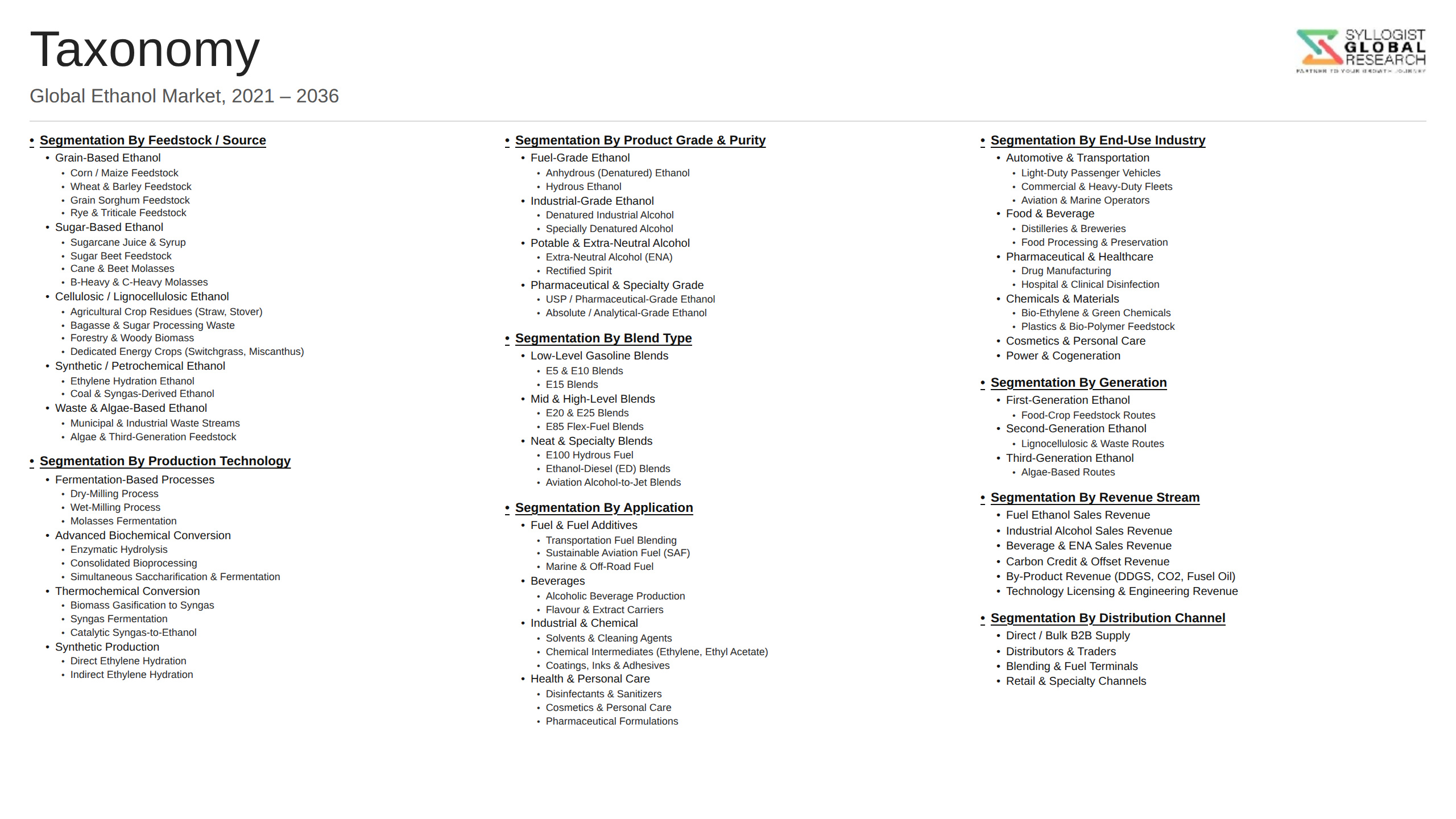
Market Segmentation
- Segmentation By Type
- Fuel Ethanol
- Industrial Ethanol
- Beverage Ethanol
- Segmentation By Source
- Corn (Grain-Based)
- Sugarcane
- Wheat and Other Grains
- Molasses
- Cellulosic and Second-Generation
- Synthetic (Petrochemical)
- Segmentation By Purity
- Denatured
- Undenatured
- Segmentation By Application
- Gasoline Blending and Fuel
- Solvents
- Disinfectants and Sanitizers
- Beverages and Distilled Spirits
- Pharmaceuticals
- Cosmetics and Personal Care
- Chemical Intermediates
- Sustainable Aviation Fuel
- Others
- Segmentation By End User
- Transportation and Fuel
- Food and Beverage
- Pharmaceutical and Healthcare
- Cosmetics and Personal Care
- Industrial and Chemicals
- Others
- Segmentation By Region
- North America
- Europe
- Asia-Pacific
- Latin America
- Middle East and Africa
All market revenues are presented in USD
Historical Year: 2021-2024 | Base Year: 2025 | Estimated Year: 2026 | Forecast Period: 2027-2034
Key Questions this Study Will Answer
- What is the total global market valuation of the Ethanol Market in 2025, projected through 2034, segmented by type, source, purity, application, and end user, enabling ethanol producers, fuel blenders, beverage and pharmaceutical manufacturers, and chemical industry investors to identify highest-growth segments and the most durable revenue opportunities across the global ethanol market?
- How are fuel blenders, beverage producers, pharmaceutical manufacturers, and industrial solvent consumers structuring ethanol procurement, feedstock sourcing, and supplier qualification, and which commercial models, including integrated biorefinery supply, merchant purchase, and long-term offtake contracts, are shaping deployment economics within the ethanol market through 2034?
- What blending mandate expansion, energy security policy, and gasoline decarbonization trends are shaping the pace and geographic distribution of fuel ethanol demand across mature and emerging markets within the ethanol market?
- How are cellulosic ethanol, sustainable aviation fuel pathways, and low-carbon ethanol investment, driven by decarbonization commitments and lifecycle carbon requirements, reshaping capacity investment, feedstock strategy, and premium value capture within the ethanol market?
- How is the competitive structure organized among corn and sugarcane ethanol producers, integrated biorefineries, synthetic ethanol manufacturers, and specialty distributors within the ethanol market, and what integration, capacity expansion, acquisition, and decarbonization-linked strategies are enabling suppliers to defend and grow share across fuel, industrial, and beverage segments?
- How are feedstock price volatility, policy dependence, vehicle electrification, and lifecycle carbon scrutiny reshaping sourcing, investment, and sustainability strategies across the ethanol market?
- Which regional markets, including North America, Latin America, Asia-Pacific, Europe, and the Middle East and Africa, are projected to generate the largest incremental ethanol demand through 2034, and what blending policy, feedstock availability, industrial consumption, and low-carbon fuel adoption factors are shaping investment priorities and supplier selection decisions in each regional ethanol market?
- Product Definition
- Research Methodology
- Research Design & Framework
- Overall Research Approach: Descriptive, Exploratory & Quantitative Mixed-Method Design
- Market Definition & Scope Boundaries: What is Included and Excluded
- Segmentation Framework
- Key Research Assumptions & Limitations
- Secondary Research
- Primary Research Design & Execution
- Data Triangulation & Validation
- Market Sizing & Forecasting Methodology
- Competitive Intelligence Methodology
- Quality Assurance & Peer Review
- Definitions, Abbreviations & Data Notes
- Executive Summary
- Market Snapshot & Headline Numbers
- Key Findings & Research Highlights
- Market Dynamics
- Regional Market Summary
- Competitive Landscape Snapshot
- Technology & Innovation Highlights
- Market Dynamics
- Drivers
- Restraints
- Opportunities
- Challenges
- Porter’s Five Forces Analysis
- PESTLE Analysis
- Market Trends & Developments
- Emerging Trends
- Technological Developments
- Regulatory & Policy Changes
- Supply Chain & Sourcing Trends
- Manufacturing & Process Trends
- Investment & Funding Activity
- Sustainability & ESG Trends
- Risk Assessment Framework
- Feedstock (Corn, Sugarcane) Price Volatility & Production Cost Escalation Risk
- Blending Mandate Change, Fuel Policy & Regulatory Demand Risk
- Crude Oil and Gasoline Price Correlation & Fuel Ethanol Margin Risk
- Feedstock Availability, Crop Yield & Weather-Driven Supply Risk
- Food vs Fuel Debate, Land Use & Sustainability Scrutiny Risk
- Regulatory Framework & Standards
- Renewable Fuel Standard (RFS), Blending Mandate & Biofuel Policy
- Ethanol Fuel Specification, ASTM & Quality Standards
- Denaturing, Excise, Tax Credit & Alcohol Regulation Compliance
- Sustainability Certification, RED II & Low-Carbon Fuel Standards
- Food-Grade, Pharmaceutical & Beverage Alcohol Compliance Frameworks
- Global Ethanol Market Outlook
- Market Size & Forecast by Value
- Market Size & Forecast by Volume (Ethanol Consumed in Billion Litres per Year and Nameplate Production Capacity in Billion Litres per Year)
- Market Size & Forecast by Feedstock
- Corn (Maize)
- Sugarcane
- Wheat
- Molasses
- Cellulosic Biomass
- Cassava
- Sugar Beet
- Others
- Market Size & Forecast by Production Type
- Bioethanol (First-Generation)
- Bioethanol (Second-Generation / Cellulosic)
- Synthetic Ethanol
- Others
- Market Size & Forecast by Grade
- Fuel Grade
- Industrial Grade
- Food and Beverage Grade
- Pharmaceutical Grade
- Others
- Market Size & Forecast by Purity
- Anhydrous
- Hydrous
- Denatured
- Undenatured
- Others
- Market Size & Forecast by Application
- Fuel and Transportation
- Industrial Solvents
- Beverages
- Pharmaceuticals
- Personal Care and Cosmetics
- Chemical Intermediates
- Disinfectants and Sanitizers
- Others
- Market Size & Forecast by End-Use Industry
- Automotive and Transportation
- Chemicals
- Pharmaceuticals
- Food and Beverage
- Personal Care and Cosmetics
- Fuel and Energy
- Cleaning and Sanitation
- Others
- Market Size & Forecast by Blend
- E5
- E10
- E15
- E85 and Higher
- Others
- Market Size & Forecast by Sales Channel
- Direct Long-Term Supply Contract
- Distributor and Trader Channel
- Blender and Refiner Channel
- Export Trade Channel
- Others
- North America Ethanol Market Outlook
- Market Size & Forecast
- By Value
- By Volume (Ethanol Consumed in Billion Litres per Year and Nameplate Production Capacity in Billion Litres per Year)
- By Feedstock
- By Production Type
- By Grade
- By Purity
- By Application
- By End-Use Industry
- By Blend
- By Country
- By Sales Channel
- Europe Ethanol Market Outlook
- Market Size & Forecast
- By Value
- By Volume (Ethanol Consumed in Billion Litres per Year and Nameplate Production Capacity in Billion Litres per Year)
- By Feedstock
- By Production Type
- By Grade
- By Purity
- By Application
- By End-Use Industry
- By Blend
- By Country
- By Sales Channel
- Asia-Pacific Ethanol Market Outlook
- Market Size & Forecast
- By Value
- By Volume (Ethanol Consumed in Billion Litres per Year and Nameplate Production Capacity in Billion Litres per Year)
- By Feedstock
- By Production Type
- By Grade
- By Purity
- By Application
- By End-Use Industry
- By Blend
- By Country
- By Sales Channel
- Latin America Ethanol Market Outlook
- Market Size & Forecast
- By Value
- By Volume (Ethanol Consumed in Billion Litres per Year and Nameplate Production Capacity in Billion Litres per Year)
- By Feedstock
- By Production Type
- By Grade
- By Purity
- By Application
- By End-Use Industry
- By Blend
- By Country
- By Sales Channel
- Middle East & Africa Ethanol Market Outlook
- Market Size & Forecast
- By Value
- By Volume (Ethanol Consumed in Billion Litres per Year and Nameplate Production Capacity in Billion Litres per Year)
- By Feedstock
- By Production Type
- By Grade
- By Purity
- By Application
- By End-Use Industry
- By Blend
- By Country
- By Sales Channel
- Country-Wise* Ethanol Market Outlook
- Market Size & Forecast
- By Value
- By Volume (Ethanol Consumed in Billion Litres per Year and Nameplate Production Capacity in Billion Litres per Year)
- By Feedstock
- By Production Type
- By Grade
- By Purity
- By Application
- By End-Use Industry
- By Blend
- By Country
- By Sales Channel
- Market Size & Forecast
- Market Size & Forecast
- Market Size & Forecast
- Market Size & Forecast
- Market Size & Forecast
- Market Size & Forecast
*Countries Analysed in the Global Research Portfolio: United States, Canada, Mexico, Germany, France, United Kingdom, Netherlands, Spain, Italy, Norway, Sweden, China, Japan, India, Australia, South Korea, Singapore, Brazil, Chile, Saudi Arabia, UAE, Egypt, South Africa, Israel
- Technology Landscape & Innovation Analysis
- First-Generation Fermentation & Starch/Sugar Conversion Technology Deep-Dive
- Cellulosic (Second-Generation) Enzymatic Hydrolysis & Conversion Technology
- Advanced Distillation, Dehydration & Anhydrous Ethanol Technology
- Feedstock Flexibility, Co-Product & Yield Optimisation Technology
- Carbon Capture, Low-Carbon & Net-Zero Ethanol Production Technology
- Waste-to-Ethanol, Syngas Fermentation & Alternative Feedstock Technology
- Process Integration, Energy Efficiency & Biorefinery Technology
- Patent & IP Landscape in Ethanol Production Technologies
- Value Chain & Supply Chain Analysis
- Feedstock (Corn, Sugarcane, Biomass) Cultivation & Supply Chain
- Milling, Fermentation & Ethanol Production Supply Chain
- Distillation, Dehydration & Grade Separation Supply Chain
- Co-Product (DDGS, CO2) Recovery & Valorisation Supply Chain
- Blending, Refiner & Fuel Distribution Network
- Industrial, Beverage & Pharmaceutical Customer Channel
- Storage, Rail, Pipeline & Export Logistics Network
- Pricing Analysis
- Fuel Ethanol Pricing Across Contract & Spot Market Tiers
- Feedstock-Linked Pricing: Corn and Sugarcane Crush Margin Economics
- Industrial and Beverage Grade Ethanol Pricing Differentials
- Ethanol vs Gasoline Blending Economics & Spread Analysis
- Co-Product (DDGS) Value & Net Production Cost Analysis
- Regional Pricing Benchmarks Across US, Brazil & Europe
- Total Delivered Cost, Freight & Value-in-Use Pricing Models
- Sustainability & Environmental Analysis
- Lifecycle Assessment (LCA) of Ethanol Across Feedstock & Production Routes
- Carbon Intensity, Greenhouse Gas Reduction & Low-Carbon Fuel Performance
- Land Use, Water Footprint & Food vs Fuel Impact Assessment
- Carbon Capture, Co-Product Utilisation & Circular Biorefinery Performance
- Regulatory-Driven Sustainability, SDG 7 (Clean Energy) & SDG 13 (Climate Action) Alignment & Green Finance Eligibility
- Competitive Landscape
- Market Structure & Concentration
- Market Consolidation Level (Fragmented vs. Consolidated by Feedstock & Geography)
- Top 10 Players Market Share
- HHI (Herfindahl-Hirschman Index) Concentration Analysis
- Competitive Intensity Map by Feedstock, Application & Geography
- Player Classification
- Integrated Agribusiness and Ethanol Producers
- Corn-Based Fuel Ethanol Producers
- Sugarcane-Based Ethanol Producers
- Cellulosic and Advanced Biofuel Producers
- Synthetic and Industrial Ethanol Producers
- Beverage and Pharmaceutical Grade Producers
- Regional and Independent Distilleries
- Merchant Traders and Distributors
- Competitive Analysis Frameworks
- Market Share Analysis by Feedstock, Application & Region
- Company Profile
- Company Overview & Headquarters
- Ethanol Production Portfolio & Capacity
- Key Customer Relationships & Reference Blender Accounts
- Production Footprint & Nameplate Capacity Coverage
- Revenue (Ethanol Segment) & Offtake Contract Backlog
- Technology Differentiators & IP
- Key Strategic Partnerships, JVs & M&A Activity
- Recent Developments (Capacity Additions, Contract Wins, Project Launches)
- SWOT Analysis
- Strategic Focus Areas & Roadmap
- Competitive Positioning Map (Technology Capability vs. Market Penetration)
- Key Company Profiles
- Market Structure & Concentration
- Technology Landscape & Innovation Analysis
- Strategic Output
- Market Opportunity Matrix: By Feedstock, Production Type, Application, End-Use Industry & Geography
- White Space Opportunity Analysis
- Strategic Recommendations
- Feedstock Portfolio & Technology Investment Strategy
- Operational Excellence & Capacity Expansion Strategy
- Geographic Expansion & Export Market Strategy
- Customer & Blender Account Engagement Strategy
- Partnership, M&A & Ecosystem Strategy
- Sustainability & Low-Carbon Strategy
- Risk Mitigation & Future Roadmap
- Strategic Priority Matrix & Roadmap
- Near-term (2025-2028)
- Mid-term (2029-2032)
- Long-term (2033-2037)