Global Food Additives and Flavours Market By Type, By Source, By Form, By Flavour Type, By Application, By Region, Competition, Forecast & Opportunities, 2021-2034F
Market Definition
Food additives and flavours are substances added to food and beverage products during processing to preserve freshness, extend shelf life, improve safety, and enhance taste, aroma, texture, colour, and nutritional value. The global food additives and flavours market covers the production, formulation, and supply of sweeteners, flavours and flavour enhancers, emulsifiers, stabilizers and hydrocolloids, preservatives, antioxidants, acidulants, colourants, enzymes, dietary fibres, and fat replacers used across the food and beverage manufacturing chain. Market participants include ingredient producers, flavour houses, specialty ingredient manufacturers, fermentation and enzyme developers, and distributors supplying food and beverage processors with natural and synthetic additive and flavour solutions.
The food additives and flavours market spans dry and liquid formats supplied to beverages, bakery and confectionery, dairy and frozen desserts, convenience and processed foods, sauces and dressings, meat, poultry and seafood, snacks, and functional nutrition applications. End users span multinational food and beverage manufacturers, contract processors, foodservice suppliers, and emerging plant-based and functional food brands that depend on additives and flavours to deliver consistent quality, sensory appeal, and stability. The food additives and flavours market explicitly excludes bulk commodity ingredients such as flour, sugar, and edible oils used as primary recipe components, animal feed additives, pharmaceutical excipients, and cosmetic fragrance applications, concentrating on functional and sensory ingredients intentionally incorporated into food and beverage products at controlled levels across every regional market worldwide.
Market Insights
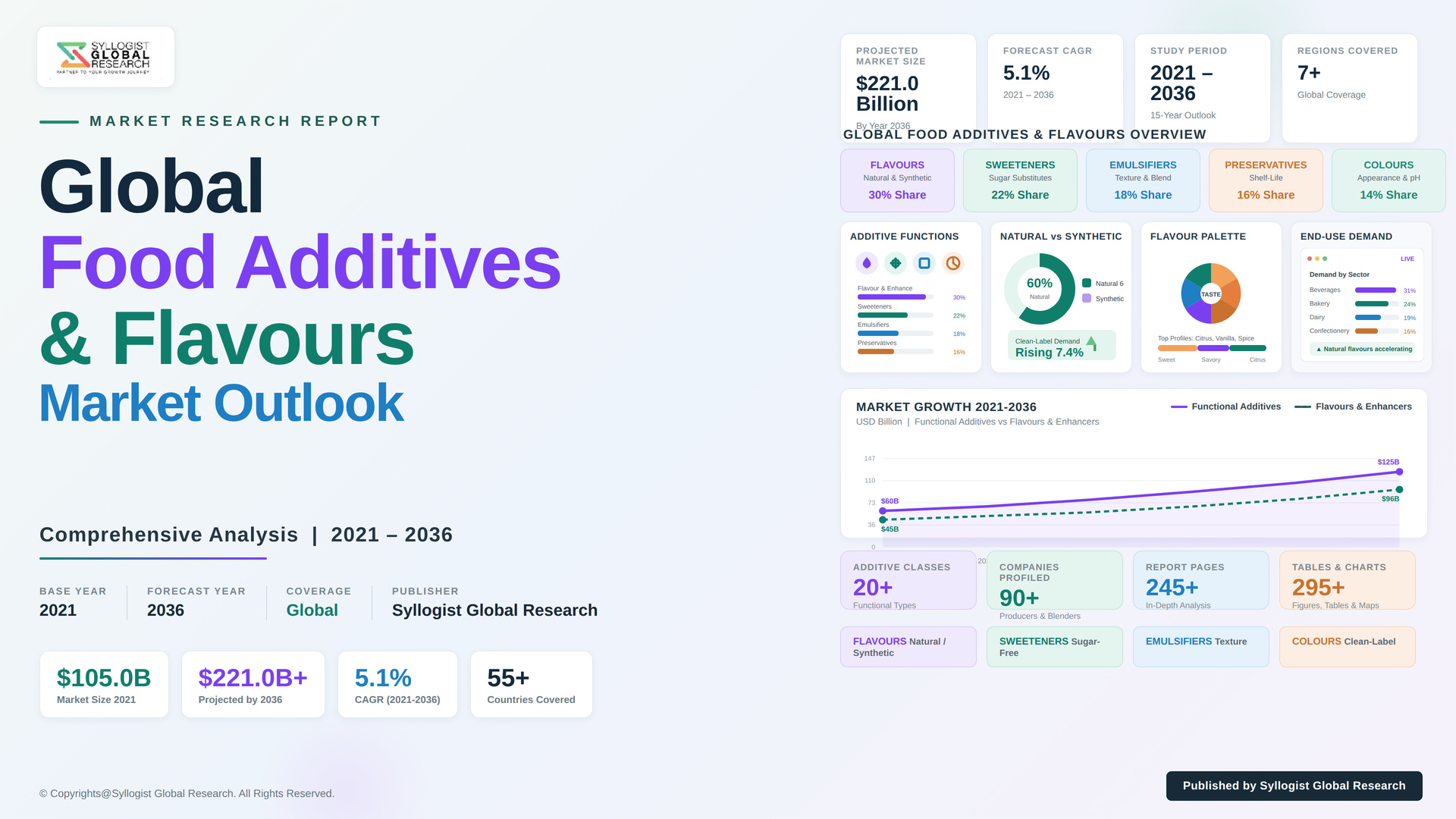
The global food additives and flavours market is moving through a sustained growth phase, propelled by rising consumption of processed and convenience foods, accelerating demand for clean-label and natural ingredients, expanding sugar-reduction and functional-nutrition programmes, and steady premiumization across beverages, bakery, dairy, and snacks. The food additives and flavours market was valued at USD 148 billion in 2025 and is projected to reach USD 251 billion by 2034, advancing at a compound annual growth rate of 6.0% through the forecast period, as food and beverage manufacturers, flavour houses, and ingredient producers scale natural and synthetic solutions across Asia-Pacific, North America, Europe, Latin America, and the Middle East and Africa. Urbanization, dual-income households, and rising demand for ready-to-eat meals continue to expand packaged food consumption, tying food additives and flavours market demand directly to global processed food and beverage output.
Clean-label reformulation is the single most influential trend reshaping the food additives and flavours market, as consumers increasingly scrutinize ingredient lists and favour natural, recognizable, and minimally processed additives over synthetic alternatives. Manufacturers are replacing artificial colourants, preservatives, and flavours with plant-derived, fermentation-based, and naturally sourced equivalents, driving premium demand within the food additives and flavours market even where natural ingredients carry higher cost. Natural flavours, natural colours from sources such as anthocyanins and carotenoids, and clean-label stabilizers are gaining share rapidly across the food additives and flavours market. Synthetic additives still hold the majority of volume on cost and functional grounds, but the natural segment is growing faster, and this transition is the defining competitive dynamic across the food additives and flavours market through the forecast period.
Sugar reduction and functional nutrition are powerful growth engines within the food additives and flavours market, as regulation, health awareness, and sugar taxes push manufacturers toward high-intensity and natural sweeteners including stevia, monk fruit, sucralose, and allulose. Reformulating sweetened products without compromising taste requires flavour-masking, flavour-modulation, and texture solutions, expanding demand for specialty flavours and additives across the food additives and flavours market. Functional and fortified foods add further pull, with prebiotics, dietary fibres, plant proteins, and bioactive ingredients requiring emulsifiers, stabilizers, and flavour systems to deliver acceptable taste and texture. Technology is accelerating this shift, as precision fermentation, enzyme engineering, and digital flavour formulation enable cleaner labels, multifunctional additives, and natural flavour compounds, positioning innovation as a central competitive lever across the food additives and flavours market.
Asia-Pacific represents the largest regional food additives and flavours market, supported by large populations, rapid urbanization, expanding middle classes, and rising packaged food and beverage consumption across China, India, Japan, and Southeast Asia, alongside strong regional ingredient manufacturing. North America holds a substantial position in the food additives and flavours market, led by high processed food consumption, advanced product innovation, and accelerating clean-label and sugar-reduction reformulation across the United States and Canada. Europe occupies a significant position in the food additives and flavours market, distinguished by strict regulation, strong natural and organic ingredient preference, and sustained demand for clean-label and functional solutions. The Middle East and Africa and Latin America are emerging as growth poles within the food additives and flavours market, driven by rising urban consumption, expanding modern retail, and growing local food and beverage manufacturing capacity.
Key Drivers
Rising Processed and Convenience Food Consumption, Urbanization, and Dual-Income Household Growth Driving Sustained Additive and Flavour Demand
Rising consumption of processed, packaged, and convenience foods is the central force driving the food additives and flavours market, as urbanization, busier lifestyles, and dual-income households increase reliance on ready-to-eat meals, packaged snacks, and bottled beverages. Processed and packaged foods depend on additives and flavours to deliver consistent taste, texture, colour, safety, and shelf life across long and complex distribution networks, tying baseline demand directly to food and beverage manufacturing volumes within the food additives and flavours market. Rapid urbanization across emerging economies is expanding modern retail, cold chain, and organized food distribution, increasing the share of diets met by packaged products that require preservatives, emulsifiers, stabilizers, and flavours. Growth in dual-income households reduces time available for home cooking, lifting demand for convenience foods, instant meals, and functional beverages that rely heavily on additive and flavour systems across the food additives and flavours market. Rising disposable incomes support premiumization and product proliferation, multiplying the number of formulations that require tailored additive and flavour solutions. This combination of urbanization, changing lifestyles, and expanding packaged food consumption underpins durable, multi-year demand growth across every regional food additives and flavours market and reinforces the sector’s structural role in the modern food and beverage supply chain.
Clean-Label and Natural Ingredient Shift Driving Premium Demand for Natural Flavours, Colours, and Preservatives
The consumer shift toward clean-label, natural, and recognizable ingredients is a defining growth driver across the food additives and flavours market, reshaping demand away from artificial additives toward naturally sourced alternatives. Consumers increasingly read ingredient labels and avoid products containing artificial colours, synthetic preservatives, and artificial flavours, pressuring manufacturers to reformulate with plant-derived and fermentation-based solutions across the food additives and flavours market. Natural flavours, natural colours from fruit, vegetable, and botanical sources, clean-label preservatives such as rosemary extract and cultured ingredients, and label-friendly stabilizers command premium pricing and rising volume within the food additives and flavours market. Regulatory action reinforces this trend, as bans and restrictions on certain synthetic colours and additives accelerate substitution toward natural equivalents. Meeting clean-label expectations while maintaining taste, colour stability, shelf life, and cost is technically demanding, creating opportunity for ingredient suppliers that can deliver natural solutions with comparable functionality across the food additives and flavours market. Because natural ingredients typically carry higher cost and supply variability, the transition supports value growth even where volumes shift, making clean-label reformulation the most important competitive and revenue dynamic across the food additives and flavours market throughout the forecast period. Brands that move early to credible natural and label-friendly ingredients are capturing share and pricing power across the food additives and flavours market.
Sugar Reduction, Functional Nutrition, and Health and Wellness Trends Expanding Demand for Sweeteners, Flavour Modulation, and Fortification Ingredients
Sugar reduction, functional nutrition, and broad health and wellness trends are powerful drivers expanding demand across the food additives and flavours market. Rising rates of obesity and diabetes, government sugar taxes, and consumer demand for lower-calorie products are pushing manufacturers to reduce added sugar using high-intensity and natural sweeteners including stevia, monk fruit, sucralose, and allulose across the food additives and flavours market. Removing or reducing sugar changes taste and mouthfeel, creating strong demand for flavour-modulation, bitterness-masking, and texture solutions that restore sensory quality, expanding the specialty flavour and additive opportunity. Functional and fortified foods add a second layer of growth, with dietary fibres, prebiotics, plant proteins, vitamins, minerals, and bioactive ingredients requiring emulsifiers, stabilizers, and flavour systems to deliver palatable products within the food additives and flavours market. Demand for immunity, gut health, energy, and protein-enriched products continues to rise, multiplying formulations that depend on additive and flavour support. As health-conscious consumption spreads across developed and emerging markets, sugar reduction and functional nutrition sustain durable, innovation-led demand growth across the food additives and flavours market. Beverage and dairy categories in particular are seeing intensive reformulation as brands cut sugar while protecting taste, and this reformulation activity continues to expand the specialty sweetener, flavour, and texture opportunity across the food additives and flavours market.
Key Challenges
Tightening Regulation, Additive and Colour Bans, and Divergent Global Approval Regimes Raising Compliance and Reformulation Burden
Tightening and divergent regulation is one of the most significant challenges across the food additives and flavours market, as authorities worldwide reassess the safety of established additives and impose new restrictions. Regulatory bodies have banned or restricted several synthetic colours and additives, forcing manufacturers to reformulate products and revalidate taste, colour, and shelf life within compressed timelines across the food additives and flavours market. Approval regimes differ substantially between regions, so an additive permitted in one market may be banned or capped in another, complicating global product formulation, labelling, and supply chain management for multinational manufacturers operating across the food additives and flavours market. Continuous scientific review of sweeteners, preservatives, and colourants creates ongoing uncertainty, since a single adverse ruling can strand inventory, trigger costly reformulation, and disrupt established supply within the food additives and flavours market. Meeting maximum-use limits, purity standards, and labelling requirements across jurisdictions demands substantial regulatory, scientific, and quality resources. This combination of shifting approvals, additive bans, and fragmented global regulation raises compliance cost, lengthens product development, and introduces material reformulation risk across the food additives and flavours market, particularly for suppliers dependent on ingredients under active regulatory scrutiny. Divergent national rules also force manufacturers to maintain multiple formulations of the same product for different markets, adding further complexity and cost across the food additives and flavours market.
Clean-Label Consumer Scrutiny, Negative Perception of Synthetic Additives, and Reformulation Complexity Pressuring Established Ingredients
Consumer scrutiny of ingredient lists and negative perception of synthetic additives present a persistent challenge across the food additives and flavours market, pressuring long-established and cost-effective ingredients. Growing consumer aversion to artificial colours, synthetic preservatives, artificial sweeteners, and chemical-sounding additive names is prompting manufacturers to remove or replace ingredients that remain scientifically approved and functionally effective, disrupting formulations across the food additives and flavours market. Reformulating away from synthetic additives is technically complex, since natural alternatives often deliver weaker functionality, shorter shelf life, less stable colour, or altered taste, requiring extensive development and testing within the food additives and flavours market. Social media, ingredient-rating apps, and health-focused messaging amplify negative perception, sometimes ahead of or contrary to scientific consensus, accelerating demand shifts that suppliers must respond to quickly across the food additives and flavours market. Balancing consumer expectations for clean, natural, and simple labels against the cost, functionality, and shelf-life advantages of established additives is a continuous challenge that shapes product development and portfolio strategy. Suppliers unable to reformulate quickly or offer credible natural alternatives risk losing share as brands prioritize label-friendly ingredients across the food additives and flavours market. This perception-driven pressure often moves faster than scientific review, forcing suppliers to reformulate reactively and defend established ingredients across the food additives and flavours market.
Natural Ingredient Cost, Supply Volatility, and Raw Material Price Fluctuation Compressing Margins and Complicating Sourcing
Natural ingredient cost, supply volatility, and raw material price fluctuation create significant margin and sourcing challenges across the food additives and flavours market, particularly as demand shifts toward natural additives and flavours. Natural colours, flavours, and preservatives are often derived from agricultural crops and botanicals subject to weather, harvest variability, disease, and geopolitical disruption, generating supply and price volatility that synthetic equivalents avoid within the food additives and flavours market. Natural ingredients typically cost more than synthetic counterparts and can require larger dosages to achieve comparable functionality, compressing manufacturer margins as brands absorb or pass through higher input costs across the food additives and flavours market. Securing consistent quality, purity, and volume of natural raw materials at scale is difficult, and supply shortages can disrupt production and delay reformulation programmes within the food additives and flavours market. Prices of key inputs, including specialty botanicals, sweetener feedstocks, and fermentation substrates, fluctuate with agricultural and energy markets, complicating budgeting and long-term contracting. Managing these cost, quality, and supply pressures while meeting rising demand for natural, clean-label solutions remains a persistent challenge that shapes sourcing, pricing, and innovation strategy across the food additives and flavours market. Suppliers are responding with backward integration, fermentation-based production, and long-term grower contracts to stabilize natural ingredient supply across the food additives and flavours market.
Market Segmentation
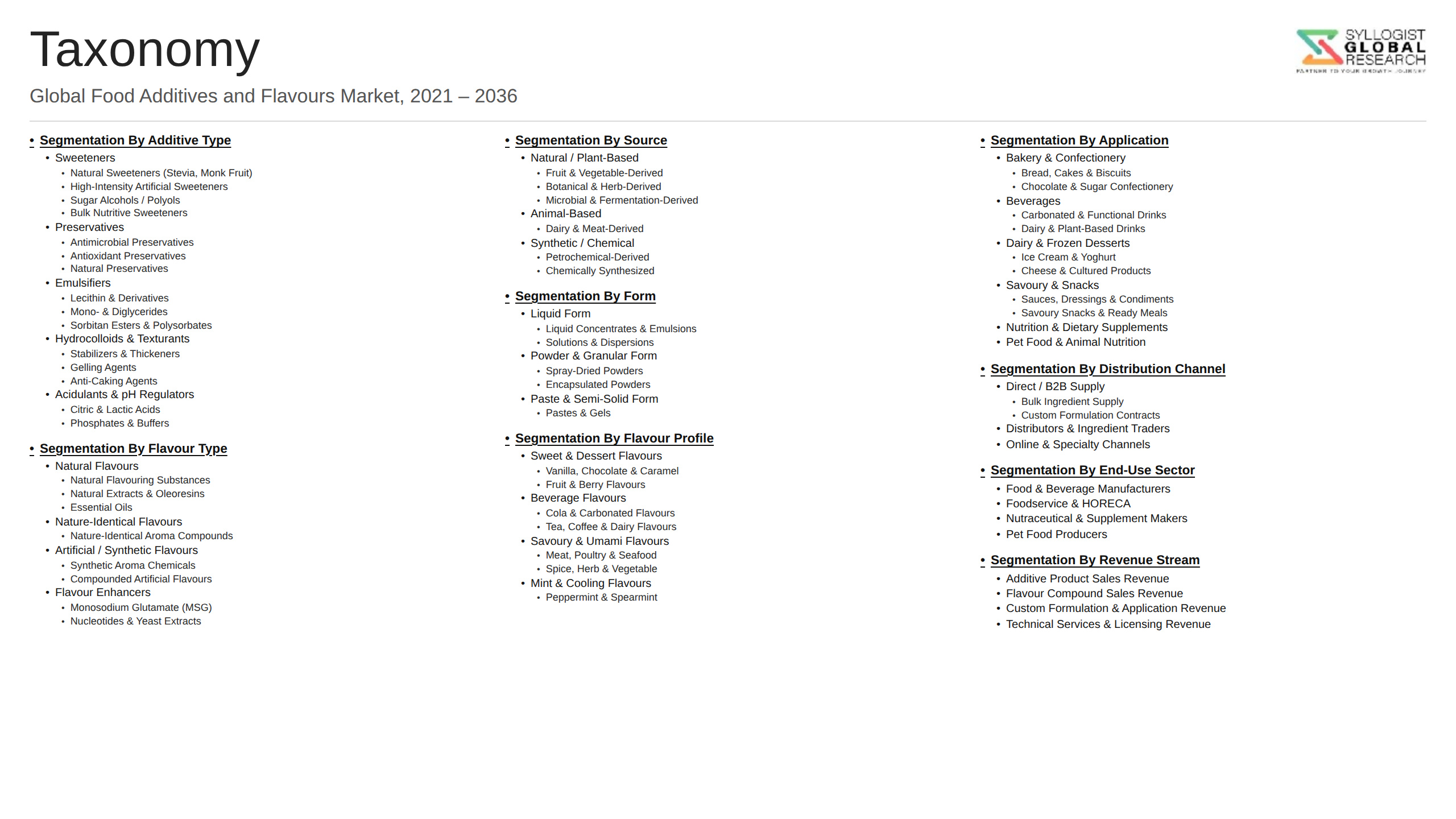
- Segmentation By Type
- Sweeteners
- Flavours and Flavour Enhancers
- Emulsifiers
- Stabilizers and Hydrocolloids
- Preservatives
- Antioxidants
- Acidulants
- Colourants
- Enzymes
- Dietary Fibres and Fat Replacers
- Others
- Segmentation By Source
- Natural
- Synthetic
- Segmentation By Form
- Dry
- Liquid
- Segmentation By Flavour Type
- Natural Flavours
- Nature-Identical Flavours
- Artificial Flavours
- Segmentation By Application
- Beverages
- Bakery and Confectionery
- Dairy and Frozen Desserts
- Convenience and Processed Foods
- Sauces, Dressings and Condiments
- Meat, Poultry and Seafood
- Snacks and Savoury Products
- Functional and Nutritional Foods
- Others
- Segmentation By Region
- North America
- Europe
- Asia-Pacific
- Middle East and Africa
- Latin America
All market revenues are presented in USD
Historical Year: 2021-2024 | Base Year: 2025 | Estimated Year: 2026 | Forecast Period: 2027-2034
Key Questions this Study Will Answer
- What is the total global market valuation of the food additives and flavours market in 2025, projected through 2034, segmented by type, source, form, flavour type, and application, enabling ingredient producers, flavour houses, food and beverage manufacturers, and investors to identify the highest-growth segments and most durable revenue opportunities across the food additives and flavours market?
- How are food and beverage manufacturers, flavour houses, and ingredient producers structuring clean-label reformulation, natural ingredient sourcing, and innovation programmes, and which product, portfolio, and supply strategies are shaping competitive positioning within the food additives and flavours market through 2034?
- What processed food consumption, urbanization, clean-label, and sugar-reduction dynamics are shaping the pace and geographic distribution of additive and flavour demand across mature and emerging food and beverage markets?
- Which ingredient categories, including sweeteners, natural flavours, emulsifiers, stabilizers, preservatives, colourants, and enzymes, are gaining the strongest demand traction across beverages, bakery, dairy, convenience, and functional food applications, and what taste, functionality, labelling, and cost metrics are shaping buyer selection?
- How is the competitive structure of the food additives and flavours market organized among ingredient producers, flavour houses, fermentation and enzyme developers, and specialty ingredient suppliers, and what acquisition, partnership, and natural-ingredient expansion strategies are enabling new entrants to compete against established suppliers?
- What regulatory change, additive and colour bans, sugar taxes, and clean-label trends are reshaping reformulation demand, ingredient specification, and product development timelines across major food and beverage markets within the food additives and flavours market?
- Which regional markets, including Asia-Pacific, North America, Europe, the Middle East and Africa, and Latin America, are projected to generate the largest incremental food additives and flavours opportunities through 2034, and what packaged food consumption, regulatory, clean-label, and manufacturing investment factors are shaping demand and supplier selection in each regional food additives and flavours market?
- Product Definition
- Research Methodology
- Research Design & Framework
- Overall Research Approach: Descriptive, Exploratory & Quantitative Mixed-Method Design
- Market Definition & Scope Boundaries: What is Included and Excluded
- Segmentation Framework
- Key Research Assumptions & Limitations
- Secondary Research
- Primary Research Design & Execution
- Data Triangulation & Validation
- Market Sizing & Forecasting Methodology
- Competitive Intelligence Methodology
- Quality Assurance & Peer Review
- Definitions, Abbreviations & Data Notes
- Executive Summary
- Market Snapshot & Headline Numbers
- Key Findings & Research Highlights
- Market Dynamics
- Regional Market Summary
- Competitive Landscape Snapshot
- Technology & Innovation Highlights
- Market Dynamics
- Drivers
- Restraints
- Opportunities
- Challenges
- Porter’s Five Forces Analysis
- PESTLE Analysis
- Market Trends & Developments
- Emerging Trends
- Technological Developments
- Regulatory & Policy Changes
- Supply Chain & Sourcing Trends
- Manufacturing & Process Trends
- Investment & Funding Activity
- Sustainability & ESG Trends
- Risk Assessment Framework
- Raw Material (Natural Extract, Flavour Compound) Price Volatility & Input Cost Escalation Risk
- Clean-Label Shift, Artificial Additive Scrutiny & Reformulation Risk
- Regulatory Approval, E-Number Restriction & Ingredient Ban Risk
- Natural Ingredient Supply Concentration & Crop-Based Sourcing Dependence Risk
- Food Safety, Contamination, Adulteration & Recall Liability Risk
- Regulatory Framework & Standards
- Food Additive Approval, FDA GRAS & EFSA E-Number Standards
- Natural and Organic Flavour Labelling & Clean-Label Regulations
- Maximum Usage Limits, Codex Alimentarius & Food Safety Standards
- Allergen, Contaminant & Ingredient Declaration Requirements
- Novel Ingredient, Cross-Border Trade & Import-Export Compliance Frameworks
- Global Food Additives and Flavours Market Outlook
- Market Size & Forecast by Value
- Market Size & Forecast by Volume (Food Additives and Flavours Consumed in Kilo Tonnes per Year and Product Units Supplied in Million Units per Year)
- Market Size & Forecast by Additive Type
- Preservatives
- Antioxidants
- Emulsifiers
- Stabilizers and Thickeners
- Sweeteners
- Acidulants
- Colours
- Flavours and Flavour Enhancers
- Enzymes
- Others
- Market Size & Forecast by Flavour Type
- Natural Flavours
- Nature-Identical Flavours
- Artificial (Synthetic) Flavours
- Others
- Market Size & Forecast by Source
- Natural
- Synthetic
- Microbial and Fermentation-Derived
- Others
- Market Size & Forecast by Form
- Powder
- Liquid
- Granule
- Paste and Gel
- Others
- Market Size & Forecast by Function
- Preservation
- Colouring
- Sweetening
- Texturising and Stabilising
- Flavouring
- Acidity Regulation
- Others
- Market Size & Forecast by Application
- Bakery and Confectionery
- Beverages
- Dairy and Frozen Desserts
- Snacks and Convenience Foods
- Meat, Poultry and Seafood
- Sauces, Dressings and Condiments
- Nutraceuticals and Dietary Supplements
- Infant and Baby Food
- Pet Food
- Others
- Market Size & Forecast by Nature
- Conventional
- Organic
- Clean-Label
- Others
- Market Size & Forecast by Sales Channel
- Direct Sales to Food Manufacturers (B2B)
- Distributor and Ingredient Supplier Channel
- Online and E-commerce
- Retail and Wholesale
- Others
- North America Food Additives and Flavours Market Outlook
- Market Size & Forecast
- By Value
- By Volume (Food Additives and Flavours Consumed in Kilo Tonnes per Year and Product Units Supplied in Million Units per Year)
- By Additive Type
- By Flavour Type
- By Source
- By Form
- By Function
- By Application
- By Nature
- By Country
- By Sales Channel
- Europe Food Additives and Flavours Market Outlook
- Market Size & Forecast
- By Value
- By Volume (Food Additives and Flavours Consumed in Kilo Tonnes per Year and Product Units Supplied in Million Units per Year)
- By Additive Type
- By Flavour Type
- By Source
- By Form
- By Function
- By Application
- By Nature
- By Country
- By Sales Channel
- Asia-Pacific Food Additives and Flavours Market Outlook
- Market Size & Forecast
- By Value
- By Volume (Food Additives and Flavours Consumed in Kilo Tonnes per Year and Product Units Supplied in Million Units per Year)
- By Additive Type
- By Flavour Type
- By Source
- By Form
- By Function
- By Application
- By Nature
- By Country
- By Sales Channel
- Latin America Food Additives and Flavours Market Outlook
- Market Size & Forecast
- By Value
- By Volume (Food Additives and Flavours Consumed in Kilo Tonnes per Year and Product Units Supplied in Million Units per Year)
- By Additive Type
- By Flavour Type
- By Source
- By Form
- By Function
- By Application
- By Nature
- By Country
- By Sales Channel
- Middle East & Africa Food Additives and Flavours Market Outlook
- Market Size & Forecast
- By Value
- By Volume (Food Additives and Flavours Consumed in Kilo Tonnes per Year and Product Units Supplied in Million Units per Year)
- By Additive Type
- By Flavour Type
- By Source
- By Form
- By Function
- By Application
- By Nature
- By Country
- By Sales Channel
- Country-Wise* Food Additives and Flavours Market Outlook
- Market Size & Forecast
- By Value
- By Volume (Food Additives and Flavours Consumed in Kilo Tonnes per Year and Product Units Supplied in Million Units per Year)
- By Additive Type
- By Flavour Type
- By Source
- By Form
- By Function
- By Application
- By Nature
- By Country
- By Sales Channel
- Market Size & Forecast
- Market Size & Forecast
- Market Size & Forecast
- Market Size & Forecast
- Market Size & Forecast
- Market Size & Forecast
*Countries Analysed in the Global Research Portfolio: United States, Canada, Mexico, Germany, France, United Kingdom, Netherlands, Spain, Italy, Norway, Sweden, China, Japan, India, Australia, South Korea, Singapore, Brazil, Chile, Saudi Arabia, UAE, Egypt, South Africa, Israel
- Technology Landscape & Innovation Analysis
- Natural Flavour Extraction, Distillation & Encapsulation Technology Deep-Dive
- Fermentation-Based & Bio-Sourced Flavour and Additive Technology
- Clean-Label, Natural Preservative & Antioxidant Technology
- Encapsulation, Controlled-Release & Flavour Stability Technology
- Sweetener Innovation, Sugar Reduction & Natural Sweetener Technology
- Enzyme, Texturiser & Functional Ingredient Technology
- Sensory Science, Flavour Modulation & Taste Masking Technology
- Patent & IP Landscape in Food Additives and Flavours Technologies
- Value Chain & Supply Chain Analysis
- Natural Extract, Botanical & Raw Material Supply Chain
- Flavour Compound, Aroma Chemical & Additive Manufacturing Supply Chain
- Blending, Formulation & Custom Solution Supply Chain
- Food and Beverage Manufacturer Customer Channel
- Distributor, Ingredient Supplier & Trader Network
- Retail, Wholesale & E-commerce Channel Network
- Cold Chain, Storage & Ingredient Logistics Network
- Pricing Analysis
- Natural vs Synthetic Flavour Pricing Differentials
- Sweetener and Sugar Substitute Pricing Economics
- Colour and Preservative Pricing Across Grade Tiers
- Clean-Label and Organic Additive Premium Pricing Analysis
- Custom Blend and Formulation Value-Added Pricing
- Raw Material Cost Pass-Through & Formulation Cost Economics
- Regional Pricing Benchmarks & Value-in-Use Pricing Models
- Sustainability & Environmental Analysis
- Lifecycle Assessment (LCA) of Food Additives and Flavours Across Sourcing & Production
- Sustainable Botanical Sourcing, Traceability & Ethical Supply Performance
- Natural, Clean-Label & Reduced-Additive Formulation Performance
- Fermentation, Upcycled Ingredient & Circular Economy Performance
- Regulatory-Driven Sustainability, SDG 2 (Zero Hunger) & SDG 12 (Responsible Consumption) Alignment & Green Finance Eligibility
- Competitive Landscape
- Market Structure & Concentration
- Market Consolidation Level (Fragmented vs. Consolidated by Additive Type & Geography)
- Top 10 Players Market Share
- HHI (Herfindahl-Hirschman Index) Concentration Analysis
- Competitive Intensity Map by Additive Type, Application & Geography
- Player Classification
- Integrated Flavour and Ingredient Houses
- Food Additive and Functional Ingredient Producers
- Natural and Organic Flavour Specialists
- Sweetener and Sugar Substitute Producers
- Colour and Preservative Manufacturers
- Enzyme and Fermentation Specialists
- Regional and Independent Ingredient Producers
- Distributors and Ingredient Traders
- Competitive Analysis Frameworks
- Market Share Analysis by Additive Type, Application & Region
- Company Profile
- Company Overview & Headquarters
- Food Additives and Flavours Product Portfolio
- Key Customer Relationships & Reference Food Manufacturer Accounts
- Manufacturing Footprint & Production Capacity Coverage
- Revenue (Food Additives and Flavours Segment) & Order Backlog
- Technology Differentiators & IP
- Key Strategic Partnerships, JVs & M&A Activity
- Recent Developments (Product Launches, Capacity Expansion, Contract Wins)
- SWOT Analysis
- Strategic Focus Areas & Roadmap
- Competitive Positioning Map (Technology Capability vs. Market Penetration)
- Key Company Profiles
- Market Structure & Concentration
- Technology Landscape & Innovation Analysis
- Strategic Output
- Market Opportunity Matrix: By Additive Type, Source, Application, Function & Geography
- White Space Opportunity Analysis
- Strategic Recommendations
- Product Portfolio & Flavour Innovation Strategy
- Manufacturing Excellence & Capacity Expansion Strategy
- Geographic Expansion & Localisation Strategy
- Customer & Food Manufacturer Engagement Strategy
- Partnership, M&A & Ecosystem Strategy
- Sustainability & Clean-Label Strategy
- Risk Mitigation & Future Roadmap
- Strategic Priority Matrix & Roadmap
- Near-term (2025-2028)
- Mid-term (2029-2032)
- Long-term (2033-2037)