Global Thermal Insulation Market By Material Type, By Form, By Application, By End Use, By Region, Competition, Forecast & Opportunities, 2021-2034F
Market Definition
Thermal insulation refers to materials, systems, and solutions engineered to reduce the transfer of heat between spaces, surfaces, and environments, improving energy efficiency, thermal comfort, process control, and operational safety across buildings, industrial facilities, and transportation applications. The Global Thermal Insulation Market encompasses the manufacturing, formulation, fabrication, and supply of mineral wool, glass wool, stone wool, expanded and extruded polystyrene, polyurethane and polyisocyanurate foam, aerogel, cellulose, and other insulating materials used to limit conductive, convective, and radiant heat flow in walls, roofs, floors, pipes, equipment, ducts, tanks, and vehicles across residential, commercial, and industrial end uses.
The thermal insulation market covers products supplied in blanket, board, spray foam, loose-fill, and pipe-section formats for new construction, retrofit, and industrial process applications. Market participants within the thermal insulation market include raw material suppliers, insulation manufacturers, foam and fiber producers, system integrators, contractors, and distributors serving building, industrial, oil and gas, and transportation demand. End users of the thermal insulation market span residential and commercial building owners, construction firms, industrial plant operators, oil and gas facilities, cold chain and district heating operators, and automotive and appliance manufacturers pursuing energy conservation and temperature control. The thermal insulation market explicitly excludes acoustic insulation used solely for sound control, electrical insulation for cabling, and standalone building materials without insulating function, focusing exclusively on materials and systems consumed to manage heat flow, reduce energy consumption, and support thermal performance across global and regional demand centers spanning construction, industrial, and infrastructure applications.
Market Insights
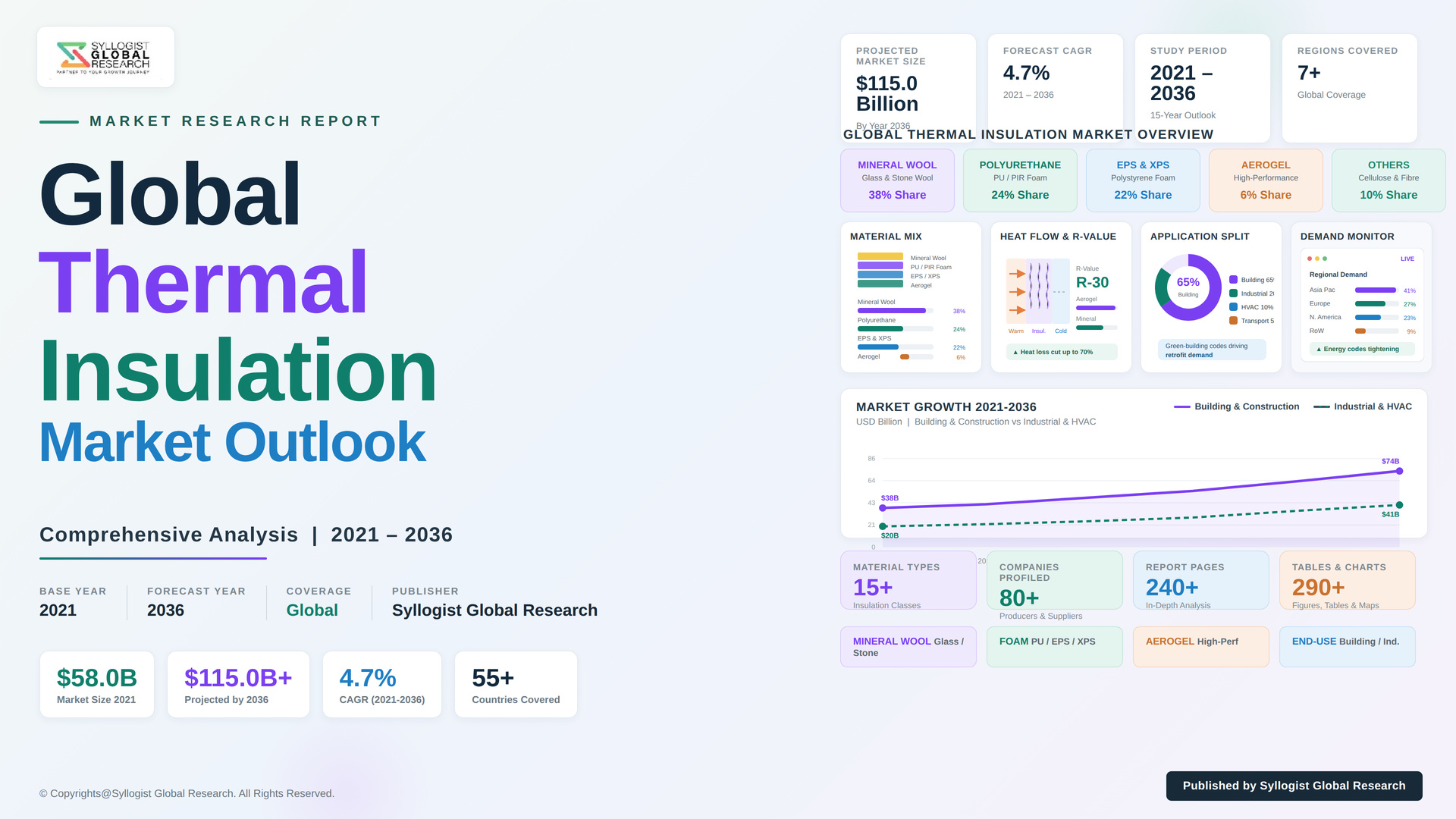
The global thermal insulation market is entering a sustained expansion phase, shaped by tightening energy efficiency regulation, accelerating green building adoption, rising construction and urbanization, expanding building retrofit demand, and growing industrial energy conservation requirements across process, oil and gas, and cold chain applications. The thermal insulation market was valued at USD 76.5 billion in 2025 and is projected to reach USD 132.6 billion by 2034, advancing at a compound annual growth rate of 6.3% through the forecast period, as building owners, construction firms, industrial operators, and infrastructure developers across Asia-Pacific, North America, Europe, the Middle East, and Latin America scale adoption of high-performance insulation. Rising energy prices, net-zero commitments, and stricter building codes continue to widen the addressable base of the thermal insulation market across both mature and rapidly urbanizing economies.
The thermal insulation market trajectory is being reshaped by the commercial maturation of high-performance and sustainable materials, including aerogel, vacuum insulation panels, bio-based fibers, and recycled-content products that deliver superior thermal resistance with reduced material thickness and lower embodied carbon. Mineral wool, comprising glass wool and stone wool, accounts for a leading material share within the thermal insulation market, supported by strong fire resistance, thermal performance, and wide adoption across residential, commercial, and industrial applications. Expanded and extruded polystyrene and polyurethane foam represent high-consumption categories within the thermal insulation market, valued for cost efficiency, moisture resistance, and high thermal resistance per unit thickness. Aerogel and vacuum insulation panels are gaining rapid procurement traction within the thermal insulation market where space-constrained, high-performance solutions are required.
Mineral wool represents a leading material segment within the thermal insulation market, while aerogel and advanced foam grades record the fastest growth as high-performance and space-efficient demand scales globally. Blanket formats, including batts and rolls, remain the largest form within the thermal insulation market, supported by ease of installation, cost efficiency, and versatility across building applications, while spray foam and board products capture accelerating demand for airtight, high-resistance solutions. Roof and wall insulation constitute the largest application areas within the thermal insulation market, propelled by building envelope energy performance requirements, while pipe and equipment insulation records strong industrial demand within the thermal insulation market. Building and construction constitutes the dominant end use within the thermal insulation market, while industrial, oil and gas, and transportation applications provide durable secondary demand across the thermal insulation market.
Asia-Pacific represents the largest regional market within the thermal insulation market, supported by rapid urbanization, large-scale construction, industrialization, and infrastructure development across China, India, and Southeast Asia, alongside rising energy efficiency awareness and cold storage demand within the thermal insulation market. North America occupies a substantial position within the thermal insulation market, propelled by stringent building energy codes, retrofit activity, and strong industrial, oil and gas, and HVAC demand across the United States, Canada, and Mexico. Europe holds a significant position within the thermal insulation market, supported by the Energy Performance of Buildings Directive, aging building retrofit programs, and sustainable material adoption across Germany, France, the United Kingdom, and Italy, while the Middle East, Africa, and Latin America record steady growth within the thermal insulation market driven by construction expansion, industrial investment, and rising demand for temperature management in hot climates.
Key Drivers
Tightening Energy Efficiency Regulations, Green Building Codes, and Net-Zero Construction Mandates Driving Sustained Thermal Insulation Demand
The tightening of energy efficiency regulation, the widespread adoption of green building codes, and the global push toward net-zero construction are generating durable demand growth across the thermal insulation market. Governments across major economies are mandating minimum thermal performance standards for building envelopes, requiring higher insulation levels in walls, roofs, and floors to reduce heating and cooling energy consumption within the thermal insulation market. Building energy codes, green certification programs, and performance-based standards are compelling developers and building owners to specify higher-performance insulation across new construction and renovation within the thermal insulation market. Net-zero and decarbonization commitments are elevating the role of the building envelope, as insulation offers one of the most cost-effective routes to reducing operational energy demand and carbon emissions across the thermal insulation market. Financial incentives, tax credits, and subsidy programs for energy-efficient upgrades are further accelerating adoption of thermal insulation across residential and commercial buildings. Rising energy prices reinforce the payback economics of insulation investment, shortening return periods and strengthening demand within the thermal insulation market. The combination of regulatory mandates, certification demand, and decarbonization goals anchors long-duration demand visibility for insulation manufacturers, contractors, and material suppliers operating across the thermal insulation market value chain globally.
Rising Construction Activity, Rapid Urbanization, and Expanding Building Retrofit and Renovation Demand Across the Thermal Insulation Market
Rising construction activity, rapid urbanization, and the expanding building retrofit and renovation market are broadening demand and diversifying application reach across the thermal insulation market. Sustained growth in residential and commercial construction across emerging economies is generating large-scale demand for thermal insulation in new building envelopes within the thermal insulation market. Rapid urbanization, particularly across Asia-Pacific, the Middle East, and Latin America, is driving high-volume housing, commercial, and infrastructure development that requires temperature management and energy efficiency across the thermal insulation market. The aging building stock across mature economies is fueling a substantial retrofit and renovation opportunity, as governments and building owners upgrade older, poorly insulated structures to meet modern energy standards within the thermal insulation market. Retrofit programs, deep renovation initiatives, and building modernization schemes are creating recurring, policy-supported demand that complements new construction across the thermal insulation market. Growing consumer awareness of energy costs, indoor comfort, and sustainability is further reinforcing insulation adoption in both new and existing buildings. This combination of new construction, urban growth, and retrofit demand supports resilient, broad-based revenue growth for participants competing across the thermal insulation market. Government-backed renovation targets and rising floor space per capita across developing economies further reinforce this long-term demand trajectory within the thermal insulation market.
Industrial Energy Conservation, Oil and Gas, Cold Chain, and District Heating Demand Expanding Industrial Thermal Insulation Consumption
Expanding industrial energy conservation requirements, sustained oil and gas activity, and growing cold chain and district heating infrastructure are driving industrial consumption across the thermal insulation market. Industrial facilities across power generation, chemicals, and manufacturing rely on thermal insulation for pipes, vessels, tanks, boilers, and equipment to conserve energy, control process temperatures, and improve operational safety within the thermal insulation market. Oil and gas operations, including refineries, LNG facilities, and pipelines, generate substantial demand for high-temperature and cryogenic insulation across the thermal insulation market, supported by continued energy infrastructure investment. The rapid expansion of cold chain logistics, refrigerated warehousing, and food and pharmaceutical storage is driving demand for low-temperature insulation solutions across the thermal insulation market. District heating and cooling networks, particularly across Europe and parts of Asia, require extensive pre-insulated piping and equipment insulation, adding durable infrastructure demand within the thermal insulation market. Rising industrial energy costs and corporate sustainability commitments are elevating the priority of insulation as an energy efficiency measure across process industries. This industrial and infrastructure demand diversifies the thermal insulation market beyond construction, supporting resilient, multi-sector revenue growth for insulation manufacturers and specialists competing across the thermal insulation market. Expanding LNG capacity and refrigerated logistics networks are expected to add further industrial demand within the thermal insulation market.
Key Challenges
High Material and Installation Costs, Skilled Labor Shortages, and Installation Quality Dependence Constraining Thermal Insulation Adoption
High material and installation costs, persistent skilled labor shortages, and strong dependence on installation quality are generating adoption challenges across the thermal insulation market. High-performance insulation materials such as aerogel and vacuum insulation panels carry significantly higher unit costs than conventional options, restraining adoption among cost-sensitive projects within the thermal insulation market. The upfront capital cost of insulation, particularly in retrofit applications requiring building modification, can extend payback periods and deter investment across segments of the thermal insulation market. The effectiveness of thermal insulation depends heavily on correct installation, and shortages of skilled installers can result in gaps, compression, and thermal bridging that undermine performance within the thermal insulation market. Poor installation quality erodes energy savings and consumer confidence, complicating value realization across the thermal insulation market. Retrofit projects face additional complexity, disruption, and cost relative to new construction, slowing the pace of building modernization within the thermal insulation market. Labor availability, rising installation wages, and quality assurance requirements collectively raise project costs and complexity, constraining the pace at which insulation adoption can scale across cost-sensitive residential, commercial, and industrial segments of the thermal insulation market. Training gaps and contractor capacity constraints in fast-growing regions can further slow the pace of large-scale insulation deployment within the thermal insulation market.
Health, Fire Safety, and Environmental Concerns over Certain Insulation Materials Reshaping Product Selection
Health, fire safety, and environmental concerns associated with certain insulation materials are reshaping product selection and constraining segments of the thermal insulation market. Certain fibrous and foam insulation materials have faced scrutiny over airborne fibers, formaldehyde binders, and volatile organic compound emissions, raising indoor air quality and occupational health concerns within the thermal insulation market. Fire safety performance has become a critical selection criterion, particularly following high-profile building fires, prompting stricter regulation of combustible foam insulation and driving demand toward non-combustible alternatives within the thermal insulation market. Environmental concerns surrounding certain blowing agents, petrochemical feedstocks, and end-of-life disposal are increasing regulatory and reputational pressure on parts of the thermal insulation market. Growing demand for low-carbon, recyclable, and bio-based materials is compelling manufacturers to reformulate products and invest in sustainable alternatives across the thermal insulation market. Navigating divergent regional regulations on fire performance, emissions, and material composition adds cost and complexity for producers operating across the thermal insulation market. These health, safety, and environmental pressures, while opening opportunities for advanced materials, raise reformulation costs and compliance complexity for participants across the thermal insulation market. Evolving green building rating systems and embodied carbon disclosure requirements add further pressure on material choice within the thermal insulation market.
Volatile Raw Material Costs, Construction Cycle Sensitivity, and Competition from Alternative Efficiency Solutions Pressuring the Thermal Insulation Market
Volatile raw material costs, sensitivity to construction cycles, and competition from alternative energy efficiency solutions are pressuring margins and demand stability across the thermal insulation market. Many insulation materials depend on petrochemical feedstocks, minerals, and energy-intensive manufacturing, exposing producers to raw material and energy cost volatility that compresses margins within the thermal insulation market. Fluctuations in the price of polymers, glass, and binders, driven by crude oil, energy, and supply chain dynamics, complicate pricing strategy across the thermal insulation market. Demand is closely tied to construction activity, leaving the thermal insulation market exposed to building cycle downturns, interest rate sensitivity, and macroeconomic slowdowns that reduce new construction and renovation volumes. Cyclical weakness in residential and commercial construction can materially soften near-term demand across the thermal insulation market. Competition from alternative efficiency measures, including advanced glazing, building management systems, and heat pump adoption, can shift investment priorities away from insulation in some projects within the thermal insulation market. Managing feedstock volatility, cyclical demand, and competing efficiency technologies requires cost discipline, product differentiation, and diversified end-use exposure for participants competing across the thermal insulation market. Prolonged periods of high interest rates or weak construction sentiment can amplify these pressures across the thermal insulation market.
Market Segmentation
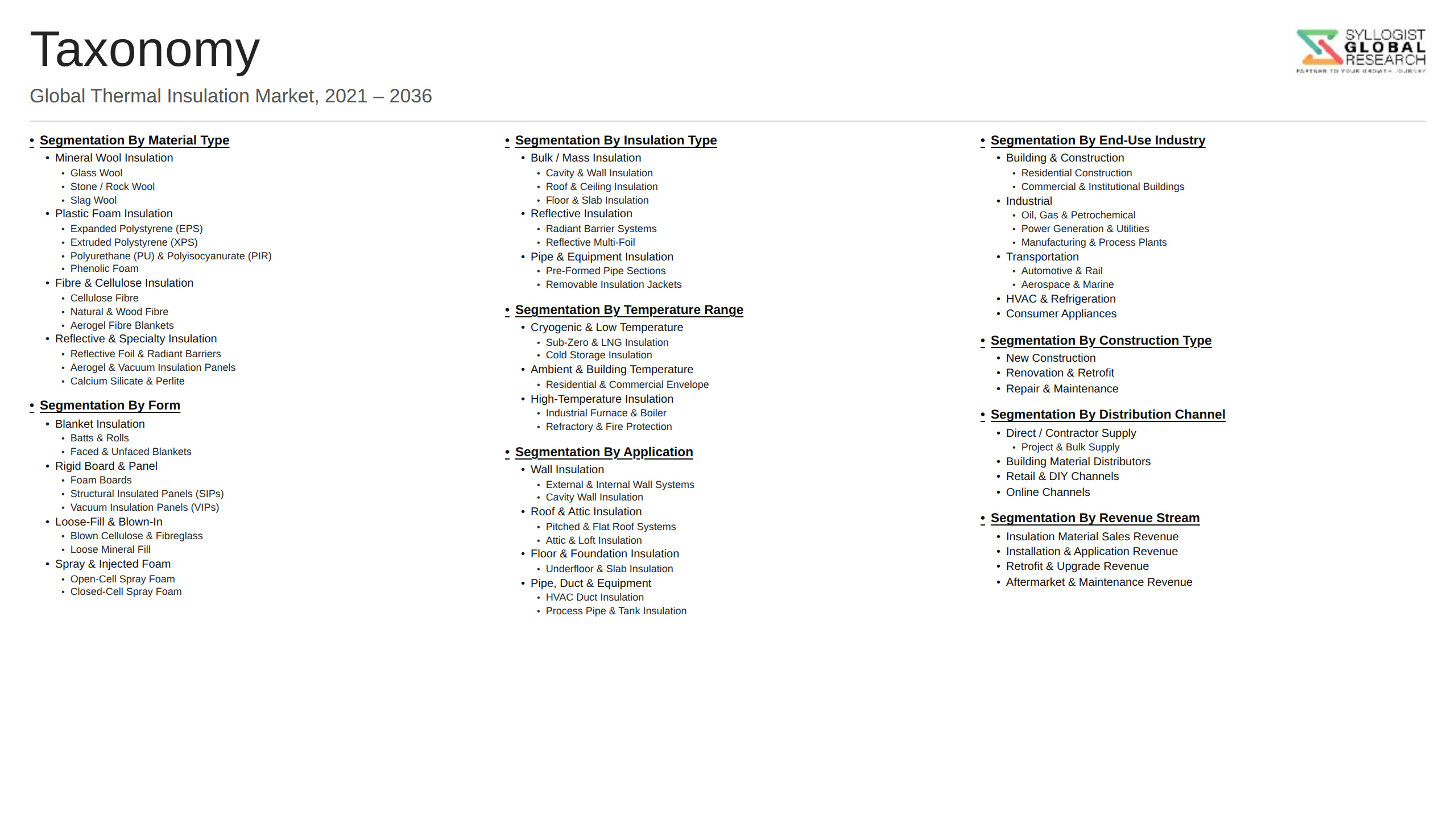
- Segmentation By Material Type
- Glass Wool
- Stone Wool
- Expanded Polystyrene (EPS)
- Extruded Polystyrene (XPS)
- Polyurethane and Polyisocyanurate (PU/PIR) Foam
- Aerogel
- Cellulose
- Others
- Segmentation By Form
- Blanket (Batts and Rolls)
- Board
- Spray Foam
- Loose-Fill
- Pipe Sections
- Others
- Segmentation By Application
- Wall Insulation
- Roof Insulation
- Floor Insulation
- Pipe and Equipment Insulation
- HVAC and Ductwork
- Others
- Segmentation By End Use
- Residential Construction
- Commercial Construction
- Industrial
- Oil and Gas
- Automotive and Transportation
- HVAC
- Others
- Segmentation By Region
- North America
- Europe
- Asia-Pacific
- Middle East and Africa
- Latin America
All market revenues are presented in USD
Historical Year: 2021-2024 | Base Year: 2025 | Estimated Year: 2026 | Forecast Period: 2027-2034
Key Questions this Study Will Answer
- What is the total global market valuation of the Thermal Insulation Market in 2025, projected through 2034, segmented by material type, form, application, and end use, enabling insulation manufacturers, material suppliers, contractors, and infrastructure investors to identify highest-growth segments and the most durable revenue opportunities across the thermal insulation market?
- How are energy efficiency regulation, green building codes, and net-zero construction mandates shaping the pace and geographic distribution of demand across mature and rapidly urbanizing regions of the thermal insulation market through 2034?
- Which material types, including glass wool, stone wool, polystyrene, polyurethane foam, and aerogel, are gaining the strongest procurement traction across building, industrial, and oil and gas applications, and what thermal performance, fire safety, and sustainability factors are shaping material selection within the thermal insulation market?
- How are construction activity, urbanization, and building retrofit and renovation demand reshaping application reach, product innovation, and volume growth across the thermal insulation market?
- How is the competitive structure organized among raw material suppliers, insulation manufacturers, foam and fiber producers, system integrators, and distributors within the thermal insulation market, and what partnership, acquisition, capacity expansion, and sustainability strategies are enabling participants to strengthen competitive position?
- What material and installation cost, fire safety, health, environmental, and raw material volatility factors are shaping product selection, pricing power, and adoption barriers across the thermal insulation market, and how are leading producers mitigating these challenges?
- Which regional markets, including Asia-Pacific, North America, Europe, the Middle East and Africa, and Latin America, are projected to generate the largest incremental revenue opportunities through 2034, and what construction activity, energy regulation, industrial demand, and climate factors are shaping investment priorities and competitive positioning in each regional thermal insulation market?
- Product Definition
- Research Methodology
- Research Design & Framework
- Overall Research Approach: Descriptive, Exploratory & Quantitative Mixed-Method Design
- Market Definition & Scope Boundaries: What is Included and Excluded
- Segmentation Framework
- Key Research Assumptions & Limitations
- Secondary Research
- Primary Research Design & Execution
- Data Triangulation & Validation
- Market Sizing & Forecasting Methodology
- Competitive Intelligence Methodology
- Quality Assurance & Peer Review
- Definitions, Abbreviations & Data Notes
- Executive Summary
- Market Snapshot & Headline Numbers
- Key Findings & Research Highlights
- Market Dynamics
- Regional Market Summary
- Competitive Landscape Snapshot
- Technology & Innovation Highlights
- Market Dynamics
- Drivers
- Restraints
- Opportunities
- Challenges
- Porter’s Five Forces Analysis
- PESTLE Analysis
- Market Trends & Developments
- Emerging Trends
- Technological Developments
- Regulatory & Policy Changes
- Supply Chain & Sourcing Trends
- Manufacturing & Process Trends
- Investment & Funding Activity
- Sustainability & ESG Trends
- Risk Assessment Framework
- Raw Material (Polymer, Mineral) Price Volatility & Input Cost Escalation Risk
- Construction Cyclicality, Building Slowdown & Demand Volatility Risk
- Fire Safety Scrutiny, Combustible Insulation Ban & Regulatory Risk
- Energy Price Correlation, Retrofit Demand & Policy Dependence Risk
- Substitution, Overcapacity & Margin Compression Risk
- Regulatory Framework & Standards
- Building Energy Code, Thermal Performance & Insulation Standards
- Fire Safety, Reaction-to-Fire & Combustibility Compliance Standards
- Building Envelope, Green Building & Energy Efficiency Regulations
- VOC Emission, Indoor Air Quality & Material Health Standards
- Recycled Content, Embodied Carbon & Circular Economy Standards
- Global Thermal Insulation Market Outlook
- Market Size & Forecast by Value
- Market Size & Forecast by Volume (Thermal Insulation Consumed in Million Cubic Metres per Year and Installed Coverage in Million Square Metres per Year)
- Market Size & Forecast by Material Type
- Stone Wool (Rock Wool)
- Glass Wool
- Expanded Polystyrene (EPS)
- Extruded Polystyrene (XPS)
- Polyurethane and PIR Foam
- Phenolic Foam
- Aerogel
- Cellulose
- Cellular Glass
- Others
- Market Size & Forecast by Product Form
- Blanket and Batt
- Board and Panel
- Loose-Fill and Blown
- Spray Foam
- Others
- Market Size & Forecast by Application
- Wall Insulation
- Roof and Ceiling Insulation
- Floor Insulation
- Pipe and Duct Insulation
- Tank and Equipment Insulation
- HVAC Insulation
- Others
- Market Size & Forecast by End-Use Industry
- Residential Construction
- Commercial Construction
- Industrial
- Oil and Gas
- Automotive and Transportation
- Appliances and Consumer
- HVAC and Building Services
- Others
- Market Size & Forecast by Temperature Range
- Cryogenic and Low-Temperature
- Ambient
- Medium-Temperature
- High-Temperature
- Others
- Market Size & Forecast by Insulation Type
- Thermal
- Acoustic
- Fire-Resistant
- Others
- Market Size & Forecast by Source
- Conventional (Synthetic)
- Bio-Based and Natural
- Recycled-Content
- Others
- Market Size & Forecast by Sales Channel
- Direct Sales to Contractors and OEMs
- Distributor and Dealer Channel
- Retail and DIY
- Project and Contract Channel
- Others
- North America Thermal Insulation Market Outlook
- Market Size & Forecast
- By Value
- By Volume (Thermal Insulation Consumed in Million Cubic Metres per Year and Installed Coverage in Million Square Metres per Year)
- By Material Type
- By Product Form
- By Application
- By End-Use Industry
- By Temperature Range
- By Insulation Type
- By Source
- By Country
- By Sales Channel
- Europe Thermal Insulation Market Outlook
- Market Size & Forecast
- By Value
- By Volume (Thermal Insulation Consumed in Million Cubic Metres per Year and Installed Coverage in Million Square Metres per Year)
- By Material Type
- By Product Form
- By Application
- By End-Use Industry
- By Temperature Range
- By Insulation Type
- By Source
- By Country
- By Sales Channel
- Asia-Pacific Thermal Insulation Market Outlook
- Market Size & Forecast
- By Value
- By Volume (Thermal Insulation Consumed in Million Cubic Metres per Year and Installed Coverage in Million Square Metres per Year)
- By Material Type
- By Product Form
- By Application
- By End-Use Industry
- By Temperature Range
- By Insulation Type
- By Source
- By Country
- By Sales Channel
- Latin America Thermal Insulation Market Outlook
- Market Size & Forecast
- By Value
- By Volume (Thermal Insulation Consumed in Million Cubic Metres per Year and Installed Coverage in Million Square Metres per Year)
- By Material Type
- By Product Form
- By Application
- By End-Use Industry
- By Temperature Range
- By Insulation Type
- By Source
- By Country
- By Sales Channel
- Middle East & Africa Thermal Insulation Market Outlook
- Market Size & Forecast
- By Value
- By Volume (Thermal Insulation Consumed in Million Cubic Metres per Year and Installed Coverage in Million Square Metres per Year)
- By Material Type
- By Product Form
- By Application
- By End-Use Industry
- By Temperature Range
- By Insulation Type
- By Source
- By Country
- By Sales Channel
- Country-Wise* Thermal Insulation Market Outlook
- Market Size & Forecast
- By Value
- By Volume (Thermal Insulation Consumed in Million Cubic Metres per Year and Installed Coverage in Million Square Metres per Year)
- By Material Type
- By Product Form
- By Application
- By End-Use Industry
- By Temperature Range
- By Insulation Type
- By Source
- By Country
- By Sales Channel
- Market Size & Forecast
- Market Size & Forecast
- Market Size & Forecast
- Market Size & Forecast
- Market Size & Forecast
- Market Size & Forecast
*Countries Analysed in the Global Research Portfolio: United States, Canada, Mexico, Germany, France, United Kingdom, Netherlands, Spain, Italy, Norway, Sweden, China, Japan, India, Australia, South Korea, Singapore, Brazil, Chile, Saudi Arabia, UAE, Egypt, South Africa, Israel
- Technology Landscape & Innovation Analysis
- High-Performance Aerogel & Vacuum Insulation Panel Technology Deep-Dive
- Bio-Based, Natural Fibre & Renewable Insulation Technology
- Low-GWP Blowing Agent & Sustainable Foam Technology
- Fire-Resistant, Non-Combustible & Safety-Enhanced Insulation Technology
- Reflective, Radiant Barrier & Multi-Layer Insulation Technology
- Prefabricated, Panelised & Off-Site Insulation System Technology
- Recycled-Content & Circular Insulation Material Technology
- Patent & IP Landscape in Thermal Insulation Technologies
- Value Chain & Supply Chain Analysis
- Polymer, Mineral & Raw Material Supply Chain
- Insulation Manufacturing, Forming & Fabrication Supply Chain
- Coating, Facing & Composite Processing Supply Chain
- Contractor, Installer & Applicator Channel
- Construction, Industrial & OEM Customer Channel
- Distributor, Dealer & Retail Network
- Recycled Material Collection & Circular Supply Network
- Pricing Analysis
- Mineral Wool Insulation Pricing Across Grade & Density Tiers
- Foam Insulation (EPS, XPS, PU) Pricing Economics
- High-Performance (Aerogel, VIP) Insulation Premium Pricing Analysis
- Blanket vs Board vs Spray Form Pricing Differentials
- Raw Material and Energy Cost Pass-Through Analysis
- Bio-Based and Recycled Insulation Pricing Analysis
- Regional Pricing Benchmarks & Value-in-Use Pricing Models
- Sustainability & Environmental Analysis
- Lifecycle Assessment (LCA) of Thermal Insulation Across Manufacture, Use & End-of-Life
- Embodied Carbon, Operational Energy Savings & Net Impact Performance
- Bio-Based, Natural & Recycled-Content Material Performance
- Low-GWP Blowing Agent, VOC Reduction & Indoor Air Performance
- Regulatory-Driven Sustainability, SDG 7 (Clean Energy) & SDG 12 (Responsible Consumption) Alignment & Green Finance Eligibility
- Competitive Landscape
- Market Structure & Concentration
- Market Consolidation Level (Fragmented vs. Consolidated by Material Type & Geography)
- Top 10 Players Market Share
- HHI (Herfindahl-Hirschman Index) Concentration Analysis
- Competitive Intensity Map by Material Type, Application & Geography
- Player Classification
- Integrated Insulation Material Manufacturers
- Mineral Wool Producers
- Foam and Polymer Insulation Producers
- High-Performance and Aerogel Specialists
- Bio-Based and Natural Insulation Producers
- Industrial and Technical Insulation Specialists
- Regional and Independent Manufacturers
- Distributors and Applicators
- Competitive Analysis Frameworks
- Market Share Analysis by Material Type, Application & Region
- Company Profile
- Company Overview & Headquarters
- Thermal Insulation Product Portfolio
- Key Customer Relationships & Reference Contractor Accounts
- Manufacturing Footprint & Production Capacity Coverage
- Revenue (Insulation Segment) & Order Backlog
- Technology Differentiators & IP
- Key Strategic Partnerships, JVs & M&A Activity
- Recent Developments (Capacity Additions, Product Launches, Contract Wins)
- SWOT Analysis
- Strategic Focus Areas & Roadmap
- Competitive Positioning Map (Technology Capability vs. Market Penetration)
- Key Company Profiles
- Market Structure & Concentration
- Technology Landscape & Innovation Analysis
- Strategic Output
- Market Opportunity Matrix: By Material Type, Product Form, Application, End-Use Industry & Geography
- White Space Opportunity Analysis
- Strategic Recommendations
- Product Portfolio & Technology Investment Strategy
- Manufacturing Excellence & Capacity Expansion Strategy
- Geographic Expansion & Localisation Strategy
- Customer & Contractor Engagement Strategy
- Partnership, M&A & Ecosystem Strategy
- Sustainability & Circular Economy Strategy
- Risk Mitigation & Future Roadmap
- Strategic Priority Matrix & Roadmap
- Near-term (2025-2028)
- Mid-term (2029-2032)
- Long-term (2033-2037)