Global Oleochemicals Market By Product Type, By Source, By Application, By End User, By Region, Competition, Forecast & Opportunities, 2021-2034F
Market Definition
Oleochemicals are chemical compounds derived from natural fats and oils of plant and animal origin, produced through processes such as hydrolysis, transesterification, hydrogenation, and fractionation, and valued as renewable, biodegradable building blocks that substitute for petroleum-based chemicals across surfactants, personal care, lubricants, polymers, and food applications. The Global Oleochemicals Market covers the production, distribution, and consumption of fatty acids, fatty alcohols, glycerol or glycerin, fatty amines, methyl esters, and other derivatives manufactured primarily from palm oil, palm kernel oil, coconut oil, soybean oil, rapeseed oil, and tallow and other animal fats. The oleochemicals market spans basic oleochemicals such as fatty acids, fatty alcohols, and glycerol, along with downstream derivatives including fatty acid methyl esters, fatty amines, fatty esters, and metallic soaps supplied to soaps and detergents, personal care and cosmetics, pharmaceuticals, food and beverage, lubricants and greases, plastics and polymer additives, rubber processing, and biodiesel applications. Market participants include integrated palm and vegetable oil processors, oleochemical producers, specialty derivative manufacturers, glycerin refiners, and distributors that convert natural oils into finished oleochemical products for downstream industries. End users span the soaps and home and personal care sector, food and beverage processing, pharmaceutical and nutraceutical manufacturing, lubricants and industrial chemicals, and plastics, rubber, and coatings producers. The oleochemicals market excludes crude vegetable oils sold as food commodities, petroleum-derived synthetic surfactants and alcohols produced outside oleochemical routes, and biodiesel marketed as a standalone fuel, concentrating on fatty acid, fatty alcohol, glycerin, and derivative volumes that serve surfactant, personal care, industrial, and food roles across regulated and industrial applications worldwide.
Market Insights
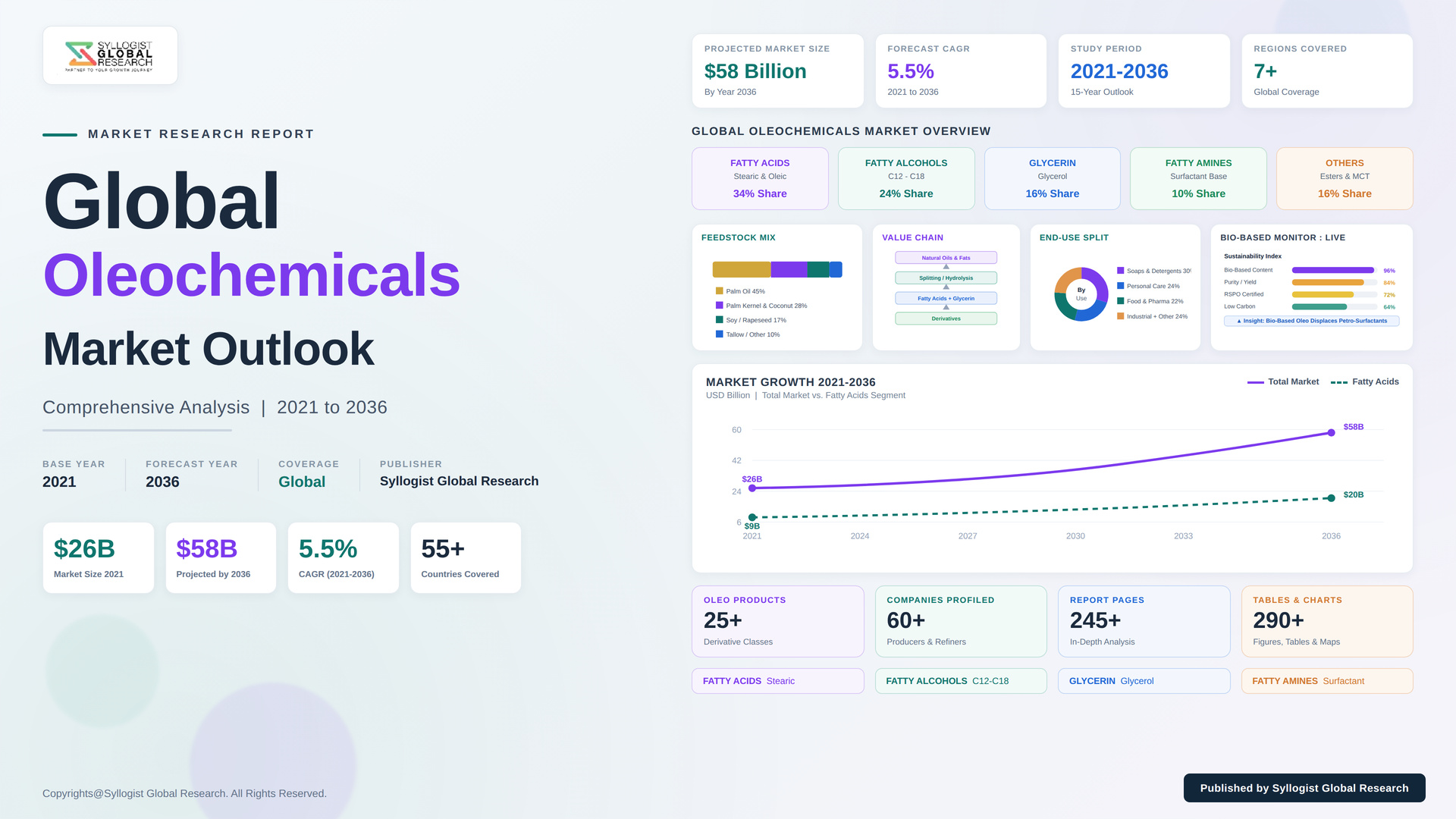
The global oleochemicals market is moving through a steady expansion phase, shaped by accelerating consumer and regulatory preference for bio-based and biodegradable ingredients, rising home and personal care demand, the shift away from petrochemical surfactants, and growing use of renewable oleochemical derivatives across lubricants, polymers, and pharmaceuticals. The global oleochemicals market was valued at USD 38.7 billion in 2025 and is projected to reach USD 62.9 billion by 2034, advancing at a compound annual growth rate of 5.6% through the forecast period, as home and personal care producers, food and pharmaceutical manufacturers, lubricant formulators, and polymer makers scale oleochemical procurement across Asia-Pacific, North America, Europe, the Middle East and Africa, and Latin America.
The oleochemicals market trajectory is being reshaped by the shift toward sustainable and certified feedstock, the substitution of petrochemical surfactants with fatty acid and fatty alcohol derivatives, and the growth of glycerin into high-value pharmaceutical and industrial applications. Fatty acids account for close to 42% of total global oleochemical demand, anchoring the market to soaps, detergents, rubber, and lubricant applications, while fatty alcohols are gaining share as key raw materials for biodegradable surfactants in home and personal care. Sustainable feedstock certification is scaling within the oleochemicals market, with producers securing certified sustainable palm oil supply to meet brand-owner and regulatory requirements, while glycerin, a co-product of oleochemical and biodiesel production, is being upgraded into refined pharmaceutical and industrial grades that command higher value across major consuming regions.
Fatty acids remain the single largest product category within the global oleochemicals market, sustained by soap, detergent, rubber processing, and lubricant demand across industrial and consumer value chains. Fatty alcohols represent the fastest-growing product category within the oleochemicals market, propelled by rising demand for biodegradable surfactants in detergents, shampoos, and personal care where petrochemical alcohols are being displaced. Glycerin is gaining strategic procurement traction within the oleochemicals market, driven by pharmaceutical, personal care, food, and industrial applications that value its humectant, solvent, and emollient properties. Palm and palm kernel oil represent the dominant feedstock source within the oleochemicals market, supported by high oil yield and established Southeast Asian processing capacity, while soaps and detergents form the largest application within the oleochemicals market, anchored by sustained home care demand. Personal care and cosmetics represent a fast-growing application within the oleochemicals market, propelled by clean-label and natural ingredient demand across skincare, haircare, and hygiene products globally.
Asia-Pacific represents the largest regional market within the global oleochemicals market, anchored by dominant palm and palm kernel oil feedstock supply, extensive processing capacity, and strong home and personal care demand across Indonesia, Malaysia, China, and India. Indonesia and Malaysia together account for more than 80% of global palm oil production and host large integrated oleochemical complexes. Europe occupies a leading regional position within the oleochemicals market, propelled by strong regulatory and consumer preference for bio-based and biodegradable ingredients, premium personal care demand, and sustainable feedstock requirements. North America represents an established regional market within the oleochemicals market, supported by home and personal care, lubricant, and industrial derivative demand alongside domestic tallow and soybean feedstock. The Middle East and Africa and Latin America form growing regional positions within the oleochemicals market, driven by rising home care consumption, expanding personal care markets, and vegetable oil feedstock availability across these regions.
Key Drivers
Accelerating Consumer and Regulatory Shift Toward Bio-Based, Biodegradable Ingredients Driving Substitution of Petrochemical Surfactants
The accelerating consumer and regulatory shift toward bio-based, biodegradable, and sustainable ingredients is driving substitution of petrochemical surfactants and generating durable demand within the global oleochemicals market. Consumers increasingly favor products formulated with natural, renewable, and biodegradable ingredients, pushing home care, personal care, and cosmetic brands to reformulate around fatty acid and fatty alcohol derivatives in place of petroleum-based surfactants. Regulatory pressure on petrochemical surfactants, restrictions on certain synthetic ingredients, and biodegradability requirements in detergents and cleaning products further reinforce the shift toward oleochemical-based alternatives within the oleochemicals market. Corporate sustainability commitments and clean-label positioning are prompting major fast-moving consumer goods companies to increase renewable ingredient content, directly lifting demand for fatty alcohols, fatty acids, and glycerin. The biodegradability and lower ecotoxicity of oleochemical surfactants make them well suited to tightening environmental standards for down-the -drain products. Because this substitution is driven by durable consumer preference, corporate sustainability targets, and tightening regulation rather than short-term price factors, it provides the oleochemicals market with a structural, long-term demand tailwind. This convergence of consumer, regulatory, and corporate sustainability drivers secures resilient volume growth for oleochemical producers and supports investment in fatty alcohol, fatty acid, and derivative capacity across major producing regions worldwide.
Rising Home and Personal Care Demand Across Emerging Economies Driving Surfactant and Derivative Consumption
Rising home and personal care demand across emerging economies is driving sustained surfactant and derivative consumption within the global oleochemicals market. Growing populations, rising disposable income, urbanization, and improving hygiene awareness across Asia, Africa, and Latin America are expanding consumption of soaps, detergents, shampoos, and personal care products that rely on oleochemical surfactants and emollients. Fatty alcohols and fatty acids are core raw materials for the surfactants used in laundry detergents, dishwashing liquids, and personal cleansing products, linking oleochemical demand directly to home and personal care market growth. Premiumization of personal care in emerging markets, along with rising demand for natural and specialty cosmetic ingredients, further increases oleochemical derivative consumption within the oleochemicals market. The large and growing middle-class consumer base in populous economies provides a structural demand engine, as per-capita consumption of home and personal care products rises with income. Multinational and regional consumer goods companies continue to expand manufacturing capacity in emerging markets to serve this demand, drawing on locally available oleochemical feedstock and derivatives. Because home and personal care consumption is closely tied to demographic and income growth, it provides the oleochemicals market with a resilient, expanding demand base that anchors long-term volume growth and supports investment in surfactant-grade fatty alcohol and fatty acid capacity across major producing and consuming regions worldwide.
Expanding Industrial, Lubricant, and Pharmaceutical Applications Driving High-Value Oleochemical Derivative and Glycerin Demand
Expanding industrial, lubricant, and pharmaceutical applications are driving high-value derivative and glycerin demand within the global oleochemicals market beyond traditional soap and detergent uses. Bio-based lubricants and greases derived from fatty acids and esters are gaining adoption in applications requiring biodegradability and low toxicity, including hydraulic fluids, metalworking fluids, and marine lubricants, supported by environmental regulation and sustainability goals. Oleochemical derivatives such as fatty amines, esters, and metallic soaps serve as additives, emulsifiers, and processing aids across plastics, rubber, coatings, and textiles, diversifying demand within the oleochemicals market. Glycerin, a major co-product of oleochemical and biodiesel production, is being upgraded into refined pharmaceutical and industrial grades used in medicines, personal care, food, and specialty applications, commanding premium value. Rising demand for pharmaceutical excipients, food emulsifiers, and nutraceutical ingredients further supports high-purity oleochemical derivative consumption within the oleochemicals market. These industrial and pharmaceutical applications require specialty and high-purity grades that command higher value than commodity oleochemicals, diversifying the market beyond home care and raising the average value captured per tonne. The breadth of lubricant, polymer, pharmaceutical, and food applications provides producers with a higher-margin demand stream that supports investment in specialty derivative and glycerin refining capacity across major producing regions worldwide.
Key Challenges
Feedstock Price Volatility and Palm Oil Supply Dependence Constraining Oleochemical Production Economics
Volatility in natural oil feedstock prices, heavy dependence on palm and palm kernel oil, and exposure to agricultural and weather cycles generate persistent margin instability that constrains the global oleochemicals market. Feedstock represents the dominant cost input in oleochemical production, often exceeding 60% of total production cost, exposing producers to sharp margin compression when palm, coconut, and other vegetable oil prices rise. Palm and palm kernel oil prices swing with weather, harvest cycles, biodiesel mandate-driven demand, export policy in producing countries, and competing food and fuel uses, making oleochemical margins difficult to forecast and manage. Because a large share of oleochemical feedstock originates from a small number of Southeast Asian producing countries, supply is geographically concentrated and exposed to weather, disease, labor, and policy disruption. Competition for palm oil between food, biodiesel, and oleochemical uses can tighten availability and drive price spikes within the oleochemicals market. Producers without feedstock integration or hedging capability face particular exposure, as they must absorb oil price swings while serving price-sensitive surfactant and detergent markets. These dynamics complicate capacity planning, compress margins during feedstock inflation, and leave the oleochemicals market vulnerable to agricultural cycles, competing demand, and policy shifts across key feedstock-producing regions worldwide, keeping profitability tightly coupled to unpredictable vegetable oil pricing and harvest outcomes.
Sustainability, Deforestation, and Certification Scrutiny of Palm Oil Feedstock Adding Compliance and Reputational Complexity
Intensifying sustainability, deforestation, and certification scrutiny of palm oil feedstock adds compliance and reputational complexity that constrains the global oleochemicals market. Palm oil, the dominant oleochemical feedstock, faces significant scrutiny over deforestation, biodiversity loss, peatland conversion, and labor practices, exposing oleochemical producers and their customers to reputational and regulatory risk. Brand owners and regulators increasingly require certified sustainable palm oil and full supply chain traceability, compelling producers to invest in certification, segregation, and documentation across complex feedstock supply chains within the oleochemicals market. Deforestation regulations in major markets, including import rules requiring proof that commodities are deforestation-free, raise compliance cost and administrative burden for oleochemical exporters. Certified sustainable feedstock often carries a price premium and limited availability, pressuring margins and complicating sourcing for producers serving sustainability -focused customers. Failure to demonstrate sustainable sourcing can result in loss of key customers, market access restrictions, and reputational damage within the oleochemicals market. Meeting these sustainability and certification requirements demands ongoing investment in traceability systems, supplier engagement, and certified supply, raising the cost and complexity of participation and creating barriers for producers unable to document sustainable and deforestation-free feedstock across major producing and consuming regions worldwide, adding persistent audit, certification, and traceability costs to the oleochemical supply chain.
Competition From Petrochemical Alternatives and Glycerin Oversupply Pressuring Pricing and Margins
Competition from petrochemical alternatives in price-sensitive applications and periodic glycerin oversupply generate pricing and margin pressure that constrains the global oleochemicals market. In cost-driven applications where biodegradability and renewable content are not binding requirements, petrochemical-derived surfactants, alcohols, and additives compete directly with oleochemicals, and shifts in crude oil and petrochemical pricing can make synthetic alternatives more competitive, capping oleochemical penetration where price is the primary selection criterion. When petrochemical feedstock prices fall relative to vegetable oils, the cost advantage of oleochemicals narrows, exposing volumes to substitution within the oleochemicals market. Glycerin, produced as a co-product of both oleochemical and biodiesel manufacturing, has periodically faced oversupply as biodiesel output has expanded, depressing glycerin prices and eroding a valuable revenue stream for oleochemical producers. Crude glycerin oversupply pressures the economics of integrated producers who rely on glycerin co-product value to support overall margins within the oleochemicals market. These competitive and co-product dynamics constrain pricing power, expose oleochemical producers to petrochemical and biodiesel market cycles, and require suppliers to compete on sustainability, performance, and integration rather than price alone, limiting the pace at which the oleochemicals market can capture volume in the most price-sensitive commodity segments across regions worldwide, keeping margins exposed to both petrochemical and biodiesel market swings.
Market Segmentation
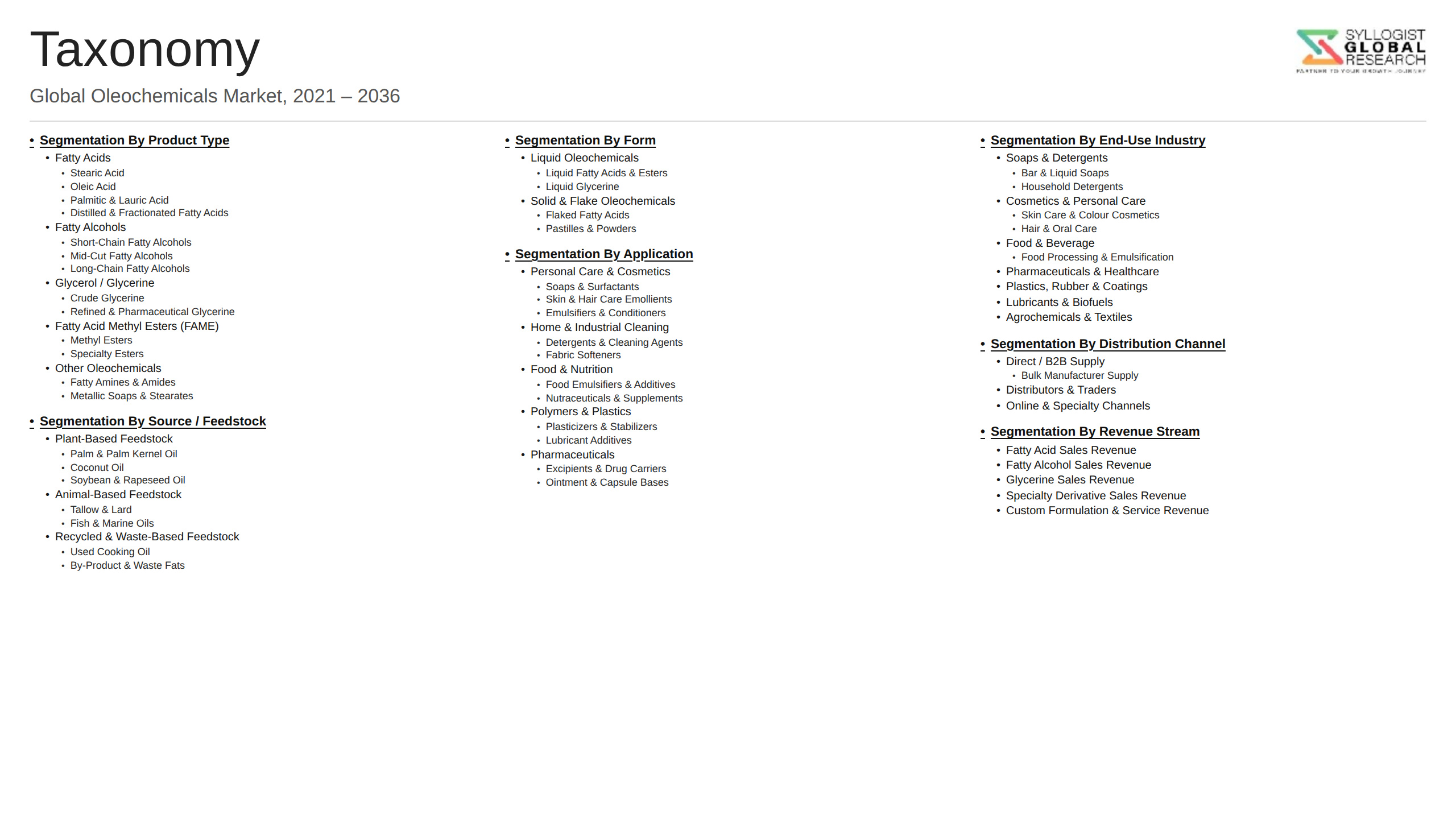
- Segmentation By Product Type
- Fatty Acids
- Fatty Alcohols
- Glycerol (Glycerin)
- Fatty Amines
- Fatty Acid Methyl Esters
- Fatty Esters
- Metallic Soaps
- Others
- Segmentation By Source
- Palm Oil
- Palm Kernel Oil
- Coconut Oil
- Soybean Oil
- Rapeseed Oil
- Tallow and Animal Fats
- Others
- Segmentation By Application
- Soaps and Detergents
- Personal Care and Cosmetics
- Pharmaceuticals and Nutraceuticals
- Food and Beverage
- Lubricants and Greases
- Plastics and Polymer Additives
- Rubber Processing
- Biodiesel
- Others
- Segmentation By End User
- Home and Personal Care
- Food and Beverage Processing
- Pharmaceutical and Healthcare
- Lubricants and Industrial Chemicals
- Plastics, Rubber, and Coatings
- Others
- Segmentation By Region
- North America
- Europe
- Asia-Pacific
- Middle East and Africa
- Latin America
All market revenues are presented in USD
Historical Year: 2021-2024 | Base Year: 2025 | Estimated Year: 2026 | Forecast Period: 2027-2034
Key Questions this Study Will Answer
- What is the total global market valuation of the Oleochemicals Market in 2025, projected through 2034, segmented by product type, source, application, and end user, enabling oleochemical producers, home and personal care manufacturers, lubricant formulators, and industry investors to identify highest-growth segments and the most durable revenue opportunities across the global oleochemicals market?
- How are home and personal care producers, food and pharmaceutical manufacturers, and lubricant and polymer makers structuring oleochemical procurement, feedstock sourcing, and supplier qualification, and which commercial models, including integrated palm and oleochemical supply, merchant purchase, and long-term contracts, are shaping deployment economics within the oleochemicals market through 2034?
- What bio-based ingredient demand, petrochemical surfactant substitution, and home and personal care growth trends are shaping the pace and geographic distribution of fatty acid, fatty alcohol, and glycerin demand across mature and emerging markets within the oleochemicals market?
- How is the shift toward certified sustainable feedstock, deforestation-free sourcing, and traceability, driven by consumer preference and regulation, reshaping feedstock strategy, certification investment, and cost structures within the oleochemicals market?
- How is the competitive structure organized among integrated palm and vegetable oil processors, oleochemical producers, specialty derivative manufacturers, and glycerin refiners within the oleochemicals market, and what integration, capacity expansion, acquisition, and sustainability -linked strategies are enabling suppliers to defend and grow share across surfactant, industrial, and specialty segments?
- How are feedstock price volatility, palm oil sustainability scrutiny, petrochemical competition, and glycerin oversupply reshaping sourcing, formulation, and margin management strategies across the oleochemicals market?
- Which regional markets, including Asia-Pacific, Europe, North America, the Middle East and Africa, and Latin America, are projected to generate the largest incremental oleochemical demand through 2034, and what feedstock availability, home and personal care growth, sustainability regulation, and industrial demand factors are shaping investment priorities and supplier selection decisions in each regional oleochemicals market?
- Product Definition
- Research Methodology
- Research Design & Framework
- Overall Research Approach: Descriptive, Exploratory & Quantitative Mixed-Method Design
- Market Definition & Scope Boundaries: What is Included and Excluded
- Segmentation Framework
- Key Research Assumptions & Limitations
- Secondary Research
- Primary Research Design & Execution
- Data Triangulation & Validation
- Market Sizing & Forecasting Methodology
- Competitive Intelligence Methodology
- Quality Assurance & Peer Review
- Definitions, Abbreviations & Data Notes
- Executive Summary
- Market Snapshot & Headline Numbers
- Key Findings & Research Highlights
- Market Dynamics
- Regional Market Summary
- Competitive Landscape Snapshot
- Technology & Innovation Highlights
- Market Dynamics
- Drivers
- Restraints
- Opportunities
- Challenges
- Porter’s Five Forces Analysis
- PESTLE Analysis
- Market Trends & Developments
- Emerging Trends
- Technological Developments
- Regulatory & Policy Changes
- Supply Chain & Sourcing Trends
- Manufacturing & Process Trends
- Investment & Funding Activity
- Sustainability & ESG Trends
- Risk Assessment Framework
- Feedstock (Palm, Coconut Oil) Price Volatility & Input Cost Escalation Risk
- Palm Oil Sustainability Scrutiny, Deforestation & Reputational Risk
- Petrochemical Substitute Competition & Margin Compression Risk
- Feedstock Supply Concentration & Agricultural Sourcing Dependence Risk
- Regulatory, Food Safety & Contaminant (3-MCPD) Compliance Risk
- Regulatory Framework & Standards
- REACH, Food-Contact & Cosmetic Ingredient Compliance Standards
- Sustainable Palm Oil (RSPO), Certification & Traceability Standards
- Food Safety, Pharmaceutical Grade & Purity Standards
- Contaminant (3-MCPD, Glycidyl Ester) & Quality Regulations
- Cross-Border Trade, Deforestation (EUDR) & Import-Export Frameworks
- Global Oleochemicals Market Outlook
- Market Size & Forecast by Value
- Market Size & Forecast by Volume (Oleochemicals Consumed in Million Tonnes per Year and Nameplate Production Capacity in Million Tonnes per Year)
- Market Size & Forecast by Product Type
- Fatty Acids
- Fatty Alcohols
- Glycerol (Glycerine)
- Fatty Amines
- Fatty Acid Methyl Esters (FAME)
- Fatty Acid Esters
- Soap Noodles
- Metallic Soaps and Stearates
- Alkoxylates
- Others
- Market Size & Forecast by Feedstock
- Palm Oil
- Palm Kernel Oil
- Coconut Oil
- Soybean Oil
- Rapeseed Oil
- Tallow (Animal Fat)
- Others
- Market Size & Forecast by Application
- Soaps and Detergents
- Personal Care and Cosmetics
- Food and Beverage
- Pharmaceuticals
- Plastics and Polymers
- Lubricants and Greases
- Surfactants
- Rubber Processing
- Paints and Coatings
- Others
- Market Size & Forecast by End-Use Industry
- Home Care and Detergents
- Personal Care and Cosmetics
- Food and Nutrition
- Pharmaceuticals and Healthcare
- Plastics and Polymers
- Automotive and Lubricants
- Textiles
- Others
- Market Size & Forecast by Function
- Surfactant
- Emulsifier
- Plasticiser
- Lubricant
- Stabiliser
- Others
- Market Size & Forecast by Grade
- Industrial Grade
- Food Grade
- Pharmaceutical Grade
- Cosmetic Grade
- Others
- Market Size & Forecast by Form
- Liquid
- Solid (Flakes and Pastilles)
- Powder
- Others
- Market Size & Forecast by Sales Channel
- Direct Sales to Manufacturers
- Distributor and Trader Channel
- Merchant Spot Market
- Online and Retail Channel
- Others
- North America Oleochemicals Market Outlook
- Market Size & Forecast
- By Value
- By Volume (Oleochemicals Consumed in Million Tonnes per Year and Nameplate Production Capacity in Million Tonnes per Year)
- By Product Type
- By Feedstock
- By Application
- By End-Use Industry
- By Function
- By Grade
- By Form
- By Country
- By Sales Channel
- Europe Oleochemicals Market Outlook
- Market Size & Forecast
- By Value
- By Volume (Oleochemicals Consumed in Million Tonnes per Year and Nameplate Production Capacity in Million Tonnes per Year)
- By Product Type
- By Feedstock
- By Application
- By End-Use Industry
- By Function
- By Grade
- By Form
- By Country
- By Sales Channel
- Asia-Pacific Oleochemicals Market Outlook
- Market Size & Forecast
- By Value
- By Volume (Oleochemicals Consumed in Million Tonnes per Year and Nameplate Production Capacity in Million Tonnes per Year)
- By Product Type
- By Feedstock
- By Application
- By End-Use Industry
- By Function
- By Grade
- By Form
- By Country
- By Sales Channel
- Latin America Oleochemicals Market Outlook
- Market Size & Forecast
- By Value
- By Volume (Oleochemicals Consumed in Million Tonnes per Year and Nameplate Production Capacity in Million Tonnes per Year)
- By Product Type
- By Feedstock
- By Application
- By End-Use Industry
- By Function
- By Grade
- By Form
- By Country
- By Sales Channel
- Middle East & Africa Oleochemicals Market Outlook
- Market Size & Forecast
- By Value
- By Volume (Oleochemicals Consumed in Million Tonnes per Year and Nameplate Production Capacity in Million Tonnes per Year)
- By Product Type
- By Feedstock
- By Application
- By End-Use Industry
- By Function
- By Grade
- By Form
- By Country
- By Sales Channel
- Country-Wise* Oleochemicals Market Outlook
- Market Size & Forecast
- By Value
- By Volume (Oleochemicals Consumed in Million Tonnes per Year and Nameplate Production Capacity in Million Tonnes per Year)
- By Product Type
- By Feedstock
- By Application
- By End-Use Industry
- By Function
- By Grade
- By Form
- By Country
- By Sales Channel
- Market Size & Forecast
- Market Size & Forecast
- Market Size & Forecast
- Market Size & Forecast
- Market Size & Forecast
- Market Size & Forecast
*Countries Analysed in the Global Research Portfolio: United States, Canada, Mexico, Germany, France, United Kingdom, Netherlands, Spain, Italy, Norway, Sweden, China, Japan, India, Australia, South Korea, Singapore, Brazil, Chile, Saudi Arabia, UAE, Egypt, South Africa, Israel
- Technology Landscape & Innovation Analysis
- Fat Splitting, Hydrolysis & Fatty Acid Production Technology Deep-Dive
- Hydrogenation, Fatty Alcohol & Ester Production Technology
- Glycerol Purification, Refining & Valorisation Technology
- Enzymatic, Biocatalytic & Green Oleochemical Technology
- Bio-Based Surfactant, Alkoxylation & Derivative Technology
- Feedstock Flexibility, Non-Palm & Alternative Oil Technology
- Sustainable Sourcing, Traceability & Circular Oleochemical Technology
- Patent & IP Landscape in Oleochemical Technologies
- Value Chain & Supply Chain Analysis
- Oilseed, Palm & Vegetable Oil Feedstock Supply Chain
- Fat Splitting, Refining & Basic Oleochemical Production Supply Chain
- Derivative, Ester & Surfactant Manufacturing Supply Chain
- Home Care, Detergent & Personal Care Customer Channel
- Food, Pharmaceutical & Industrial Customer Channel
- Distributor, Trader & Merchant Network
- Sustainable Sourcing, RSPO & Traceability Partner Network
- Pricing Analysis
- Fatty Acid Pricing Across Grade & Chain-Length Tiers
- Fatty Alcohol and Glycerine Pricing Economics
- Feedstock-Linked Pricing: Palm and Coconut Oil Correlation Analysis
- Bio-Based vs Petrochemical Surfactant Pricing Differentials
- Food and Pharmaceutical Grade Premium Pricing Analysis
- Sustainability-Certified (RSPO) Premium Pricing Analysis
- Regional Pricing Benchmarks & Value-in-Use Pricing Models
- Sustainability & Environmental Analysis
- Lifecycle Assessment (LCA) of Oleochemicals Across Feedstock & Production
- Sustainable Palm Oil, RSPO Certification & Deforestation-Free Performance
- Bio-Based, Renewable & Biodegradable Product Performance
- Carbon Footprint, Green Chemistry & Circular Economy Performance
- Regulatory-Driven Sustainability, EUDR, SDG 12 (Responsible Consumption) & SDG 15 (Life on Land) Alignment & Green Finance Eligibility
- Competitive Landscape
- Market Structure & Concentration
- Market Consolidation Level (Fragmented vs. Consolidated by Product Type & Geography)
- Top 10 Players Market Share
- HHI (Herfindahl-Hirschman Index) Concentration Analysis
- Competitive Intensity Map by Product Type, Application & Geography
- Player Classification
- Integrated Palm and Oleochemical Producers
- Fatty Acid and Fatty Alcohol Producers
- Glycerine and Derivative Specialists
- Surfactant and Personal Care Ingredient Producers
- Bio-Based and Green Oleochemical Producers
- Regional and Independent Producers
- Feedstock and Oil Suppliers
- Distributors and Traders
- Competitive Analysis Frameworks
- Market Share Analysis by Product Type, Application & Region
- Company Profile
- Company Overview & Headquarters
- Oleochemical Product Portfolio
- Key Customer Relationships & Reference End-Use Accounts
- Production Footprint & Nameplate Capacity Coverage
- Revenue (Oleochemical Segment) & Order Backlog
- Technology Differentiators & IP
- Key Strategic Partnerships, JVs & M&A Activity
- Recent Developments (Capacity Additions, Product Launches, Contract Wins)
- SWOT Analysis
- Strategic Focus Areas & Roadmap
- Competitive Positioning Map (Technology Capability vs. Market Penetration)
- Key Company Profiles
- Market Structure & Concentration
- Technology Landscape & Innovation Analysis
- Strategic Output
- Market Opportunity Matrix: By Product Type, Feedstock, Application, End-Use Industry & Geography
- White Space Opportunity Analysis
- Strategic Recommendations
- Product Portfolio & Technology Investment Strategy
- Manufacturing Excellence & Capacity Expansion Strategy
- Geographic Expansion & Feedstock Localisation Strategy
- Customer & End-Use Account Engagement Strategy
- Partnership, M&A & Ecosystem Strategy
- Sustainability & Responsible Sourcing Strategy
- Risk Mitigation & Future Roadmap
- Strategic Priority Matrix & Roadmap
- Near-term (2025-2028)
- Mid-term (2029-2032)
- Long-term (2033-2037)