Global Aircraft Actuation Systems Market By Technology, By Motion, By System, By Platform, By Aircraft Type, By Installation, By Region, Competition, Forecast & Opportunities, 2021-2034F
Market Definition
The Global Aircraft Actuation Systems Market encompasses the design, development, manufacture, integration, and aftermarket support of mechanical, hydraulic, pneumatic, electric, electromechanical, and electrohydrostatic actuator assemblies engineered to convert input control signals into precise motion across critical aircraft systems spanning flight control surfaces, landing gear, braking, thrust reversers, doors, cargo handling, engine bleed valves, fuel management, weapon bay deployment, and cabin functionality across commercial, military, business, general aviation, rotorcraft, unmanned, and emerging electric vertical take-off and landing platforms globally. Aircraft actuation systems include functional product categories such as primary flight control actuators (ailerons, elevators, rudders), secondary flight control actuators (flaps, slats, spoilers, trim), landing gear retraction and steering actuators, brake actuators, thrust reverser actuation systems, nose wheel steering, weapons bay and stores release actuators, fuel valve actuators, environmental control system actuators, cabin door and slide actuators, and integrated power transfer units engineered to operate reliably under extreme temperature, pressure, vibration, and certification-grade reliability envelopes. End-use customers span commercial airframe original equipment manufacturers, military prime contractors, business jet manufacturers, helicopter producers, eVTOL platform developers, unmanned aerial system designers, airlines and cargo carriers, defense ministries, maintenance, repair, and overhaul providers, and Tier 1 systems integrators delivering retrofit and aftermarket programs. Geographic deployment spans mature North American and European aerospace clusters, rapidly expanding Asia-Pacific manufacturing and assembly hubs, and growing Middle Eastern and Latin American MRO and fleet operating bases, with delivery models encompassing OEM line-fit installation, retrofit upgrade kits, performance-based logistics agreements, and digital health monitoring services, establishing aircraft actuation systems as a foundational technology platform underpinning flight safety, aircraft performance, fuel efficiency, and lifecycle reliability across global aviation and aerospace ecosystems.
Market Insights
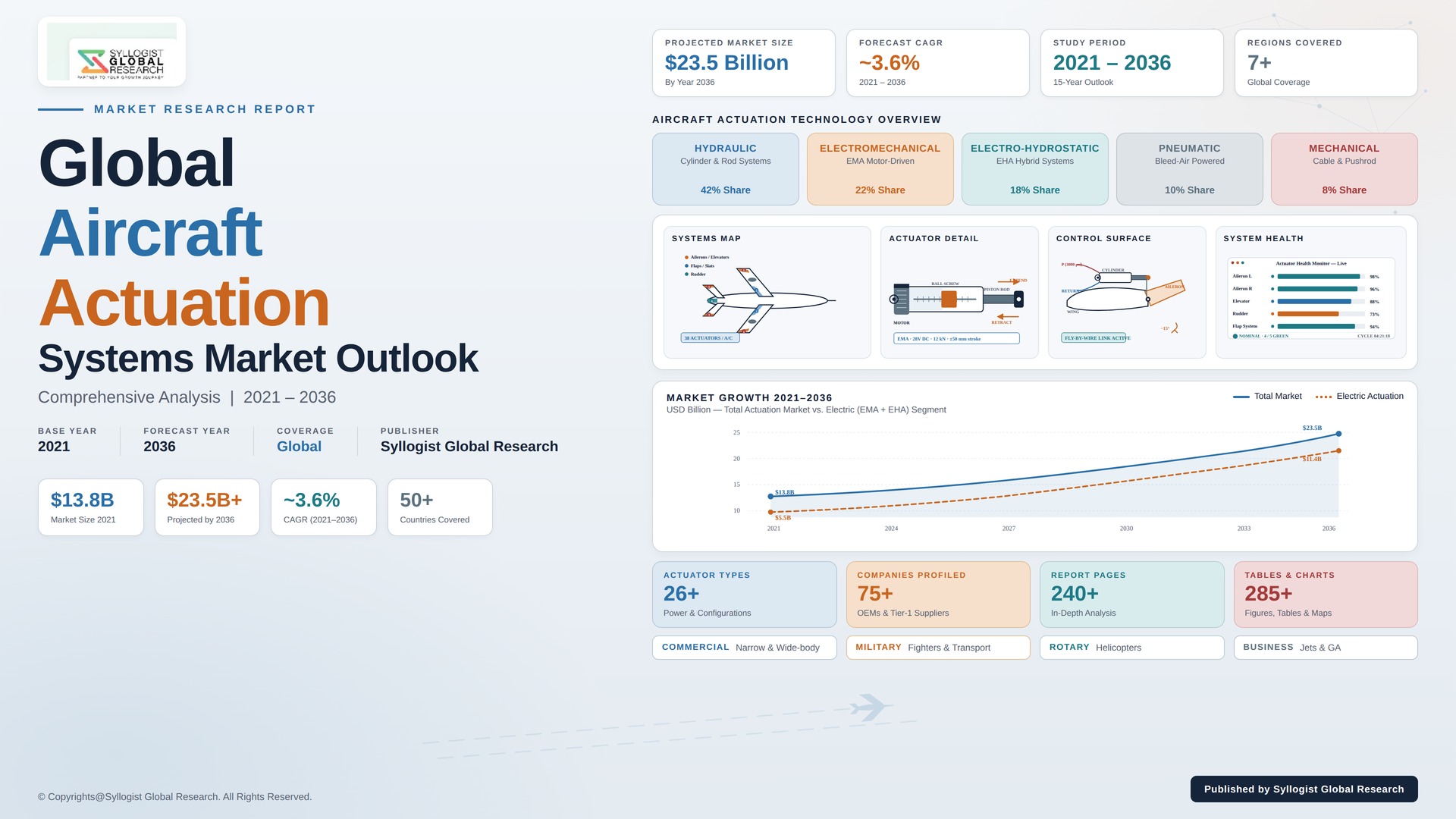
The global aircraft actuation systems market is moving through a structurally significant growth cycle propelled by sustained commercial aircraft production rate increases, robust defense aircraft modernization budgets, accelerating electrification of secondary and primary flight control architectures, and a record aircraft order backlog at Airbus and Boeing that is anchoring multi-decade demand visibility for actuator manufacturers and Tier 1 systems integrators worldwide. The market was valued at USD 18.0 billion in 2025 and is projected to reach USD 31.5 billion by 2034, advancing at a compound annual growth rate of 6.4% through the forecast window, supported by sustained narrow-body and wide-body production ramp commitments, strong aftermarket retrofit demand, accelerating More Electric Aircraft adoption replacing legacy hydraulic systems, and broadening deployment of next-generation actuation architectures across military fighter, transport, rotorcraft, unmanned aerial system, and emerging eVTOL urban air mobility platform segments globally.
The More Electric Aircraft transition is the strongest secular force restructuring the demand profile for aircraft actuation systems, as airframers progressively replace centralized hydraulic distribution architectures with localized electric, electromechanical, and electrohydrostatic actuator solutions delivering measurable weight reduction, fuel burn improvement, simplified maintenance, and improved health monitoring telemetry across new-generation aircraft platforms. The result is a measurable shift in revenue mix from conventional hydraulic actuators toward formulated electromechanical and electrohydrostatic systems incorporating advanced power electronics, prognostic health management software, brushless DC motors, and integrated fault-tolerant architectures engineered to meet stringent flight-critical certification requirements. Tier 1 systems integrators are simultaneously consolidating supply under integrated package contracts that bundle actuation, electronic control units, power electronics, and lifecycle health monitoring services, restructuring procurement economics in favor of suppliers offering measurable weight reduction, mission availability improvement, and verifiable maintenance cost reduction outcomes across complete fleet lifecycles globally.
Within the system taxonomy, flight control actuation, encompassing primary surfaces such as ailerons, elevators, and rudders, alongside secondary surfaces including flaps, slats, and spoilers, anchors the highest revenue concentration across modern commercial and military aircraft programs. Landing gear and braking actuation systems represent the second-largest application category, supported by sustained narrow-body production volumes, while thrust reverser actuation systems and engine bleed valve actuators continue to scale alongside global commercial aircraft fleet growth. Electromechanical actuators are recording the fastest forecast period growth rates, expanding at rates above 8% annually as airframers progressively integrate fly-by-wire architectures, while electrohydrostatic actuators are gaining traction in safety-critical primary flight control applications. Linear motion actuators dominate the motion taxonomy with approximately 65% revenue share, while rotary actuators are scaling rapidly across emerging eVTOL urban air mobility platforms reshaping competitive differentiation among integrated actuation system suppliers.
North America anchors the largest absolute revenue share of the global aircraft actuation systems market, valued near USD 7.6 billion in 2025 and underpinned by Boeing commercial aircraft production, Lockheed Martin F-35 program deliveries, sustained US Department of Defense aircraft modernization funding, and a deep ecosystem of Tier 1 actuation system integrators. Europe represents a structurally critical share driven by Airbus narrow-body and wide-body production rate ramps, GCAP and FCAS next-generation fighter development programs, and growing eVTOL platform certification across the United Kingdom, Germany, and France. Asia-Pacific is positioned to record the highest forecast period CAGR, supported by COMAC C919 and C929 production ramps in China, expanding indigenous fighter and helicopter programs across India, Japan, and South Korea, and accelerating regional commercial aviation fleet additions absorbing aircraft from global manufacturer backlogs. The Middle East contributes incremental demand through expanding airline fleets and growing MRO investment, while Latin America anchors regional demand through Embraer regional jet programs and aftermarket activity.
Key Drivers
Record Commercial Aircraft Order Backlogs and Sustained Production Rate Increases Anchoring Multi-Decade Actuation System Demand Visibility
Record commercial aircraft order backlogs at Airbus and Boeing exceeding 14,000 aircraft, alongside sustained production rate ramp commitments on the A320neo, A350, 737 MAX, and 787 platforms, are anchoring multi-decade demand visibility for primary flight control, landing gear, braking, thrust reverser, and door actuation systems across the global aerospace value chain. Tier 1 systems integrators and specialized actuator manufacturers are responding with capacity investment, vertical integration, and long-term supply agreements, supporting durable revenue trajectories across both line-fit OEM installation and aftermarket retrofit segments throughout the forecast horizon globally.
More Electric Aircraft Architecture Adoption Driving Accelerating Replacement of Hydraulic Systems with Electromechanical and Electrohydrostatic Actuation Solutions
The progressive industry-wide adoption of More Electric Aircraft architectures, where centralized hydraulic distribution systems are systematically replaced by localized electric, electromechanical, and electrohydrostatic actuators, is driving accelerating demand for next-generation actuation solutions delivering measurable weight reduction, fuel burn improvement, and simplified maintenance economics. Airframers are codifying More Electric Aircraft requirements into clean-sheet platforms including the Boeing 787, Airbus A350, F-35 Lightning II, and emerging eVTOL designs, anchoring durable demand for advanced actuator suppliers across both commercial and military aircraft segments globally throughout the forecast period.
Defense Modernization Programs, Next-Generation Fighter Development, and Rising Unmanned Aerial System Procurement Sustaining High-Margin Actuation Demand
Sustained defense aircraft modernization across the F-35 Lightning II, B-21 Raider, GCAP, FCAS, KF-21, AMCA, and next-generation rotorcraft programs, combined with rapidly expanding unmanned aerial system procurement and emerging eVTOL urban air mobility platform certification cycles, is anchoring high-margin demand for flight-critical, fault-tolerant actuation systems across global defense and advanced aerospace markets. Specialized actuator architectures incorporating triple-redundant electromechanical solutions, jam-tolerant designs, and integrated prognostic health management capabilities are commanding premium pricing across military and emerging mobility platform applications worldwide.
Key Challenges
Aerospace Certification Complexity, Extended Qualification Timelines, and Stringent Airworthiness Compliance Burdens Constraining Innovation Cycles
Aerospace certification frameworks governed by FAA, EASA, Transport Canada, and equivalent national airworthiness authorities impose multi-year qualification timelines, extensive flight-critical reliability testing, and stringent design assurance level documentation requirements that constrain actuator innovation cycles and elevate program development costs across both commercial and military aircraft applications. New entrant suppliers face prohibitive entry barriers, while incumbent manufacturers must invest substantial engineering, qualification, and certification resources spanning multiple years before commercial deployment, particularly for primary flight control, landing gear, and braking actuator architectures requiring the highest reliability and certification rigor globally.
Aerospace Supply Chain Disruption, Precision Component Lead Times, and Critical Material Procurement Constraints Pressuring Actuator Manufacturing Economics
Persistent aerospace supply chain disruption affecting precision bearings, gears, motors, hydraulic seals, electronic components, and specialty alloy raw materials including titanium, inconel, and rare earth permanent magnets is introducing material cost inflation, lengthening lead times, and elevating working capital requirements for aircraft actuation system manufacturers serving global airframer and Tier 1 customers. Geopolitical disruption affecting critical material sourcing, regional manufacturing concentration risks, and sustained component shortages compound procurement complexity across both commercial and defense aerospace actuator programs, pressuring delivery schedules and margin performance globally throughout the forecast period.
Weight, Thermal, and Reliability Trade-Offs in More Electric Aircraft Transition Limiting Pace of Hydraulic System Displacement Across Primary Flight Control Applications
The transition from conventional hydraulic actuation to electromechanical and electrohydrostatic systems within primary flight control applications faces persistent technical trade-offs spanning power density, thermal dissipation, jam fault management, and equivalent-level reliability demonstration that have limited the pace of hydraulic displacement across safety-critical primary surfaces. Suppliers must invest substantial research and development resources to overcome motor heat rejection challenges, achieve hydraulic-equivalent power density at acceptable system weight, and validate fault-tolerant architectures meeting Design Assurance Level A reliability requirements before broader adoption across new commercial and military aircraft programs globally.
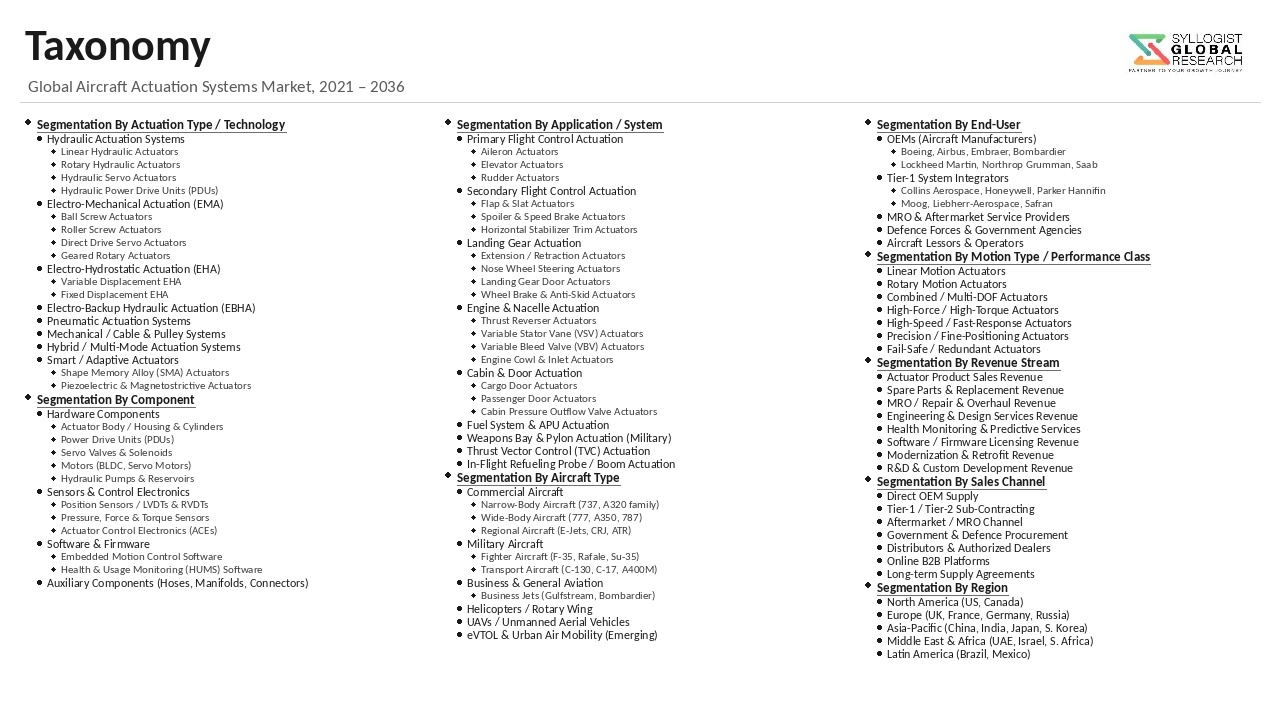
Market Segmentation
- Segmentation By Technology
- Hydraulic Actuators
- Pneumatic Actuators
- Electric Actuators
- Electromechanical Actuators
- Electrohydrostatic Actuators
- Mechanical Actuators
- Others
- Segmentation By Motion
- Linear
- Rotary
- Segmentation By System
- Flight Control System (Primary and Secondary)
- Landing Gear and Braking System
- Thrust Reverser Actuation System
- Engine Actuation and Bleed Valve System
- Fuel Distribution and Management System
- Door, Cargo, and Cabin Actuation System
- Weapons Bay and Stores Release Actuation
- Power Generation and Transmission System
- Others
- Segmentation By Platform
- Fixed Wing
- Rotary Wing
- Unmanned Aerial Systems (UAS)
- eVTOL and Urban Air Mobility
- Segmentation By Aircraft Type
- Commercial Aviation (Narrow-Body, Wide-Body, Regional)
- Military Aviation (Fighter, Transport, Trainer, ISR)
- Business and General Aviation
- Helicopters and Rotorcraft
- Unmanned Aerial Systems
- eVTOL Platforms
- Others
- Segmentation By Installation
- Original Equipment Manufacturer (OEM)
- Retrofit and Aftermarket
- Segmentation By Region
- North America
- Europe
- Asia-Pacific
- Middle East and Africa
- Latin America
All market revenues are presented in USD
Historical Year: 2021-2024 | Base Year: 2025 | Estimated Year: 2026 | Forecast Period: 2027-2034
Key Questions this Study Will Answer
- What is the total global market valuation of the Aircraft Actuation Systems Market in 2025, projected through 2034, disaggregated by technology, system, and aircraft platform, enabling actuator manufacturers, airframers, Tier 1 systems integrators, and investors to identify highest-growth segments and most durable revenue opportunities across the global aerospace actuation value chain?
- How is the More Electric Aircraft architecture transition reshaping demand mix across hydraulic, pneumatic, electric, electromechanical, and electrohydrostatic actuator categories, and which clean-sheet aircraft programs are setting the technical and procurement benchmarks shaping global actuation systems demand architecture through 2034?
- Which aircraft actuation system categories, including primary flight control, secondary flight control, landing gear, braking, thrust reverser, engine, and door actuation systems, are recording the highest forecast period growth rates, and what airframer production rate, retrofit, and aftermarket factors are shaping demand intensity within each segment?
- How are commercial aircraft order backlogs at Airbus, Boeing, COMAC, Embraer, and Bombardier translating into multi-decade actuation system demand visibility, and what production rate ramps, supply chain risks, and capacity investment decisions are most critical to fulfilling backlog commitments through the forecast horizon?
- How are next-generation defense programs including F-35 Lightning II, B-21 Raider, GCAP, FCAS, NGAD, KF-21, AMCA, and emerging unmanned aerial system and eVTOL platforms reshaping high-margin demand for flight-critical, fault-tolerant, and triple-redundant actuation architectures across global military and advanced mobility markets?
- What partnership, vertical integration, acquisition, and Tier 1 consolidation strategies are dominant aircraft actuation system manufacturers using to consolidate market positions, secure precision component supply continuity, and deepen long-cycle relationships with global airframers across commercial and military aerospace programs?
- Which regional markets, specifically Asia-Pacific, the Middle East, and Latin America, are expected to generate the most substantial incremental aircraft actuation system demand through 2034, and what indigenous aircraft programs, fleet expansion, and MRO investment factors are anchoring procurement growth in each regional market?
- Product Definition
- Research Methodology
- Research Design & Framework
- Overall Research Approach: Descriptive, Exploratory & Quantitative Mixed-Method Design
- Market Definition & Scope Boundaries: What is Included and Excluded
- Segmentation Framework
- Key Research Assumptions & Limitations
- Secondary Research
- Primary Research Design & Execution
- Data Triangulation & Validation
- Market Sizing & Forecasting Methodology
- Competitive Intelligence Methodology
- Quality Assurance & Peer Review
- Definitions, Abbreviations & Data Notes
- Research Design & Framework
- Executive Summary
- Market Snapshot & Headline Numbers
- Key Findings & Research Highlights
- Market Dynamics
- Regional Market Summary
- Competitive Landscape Snapshot
- Technology & Innovation Highlights
- Market Dynamics
- Drivers
- Restraints
- Opportunities
- Challenges
- Porter’s Five Forces Analysis
- PESTLE Analysis
- Market Trends & Developments
- Emerging Trends
- Technological Developments
- Regulatory & Policy Changes
- Supply Chain & Sourcing Trends
- Manufacturing & Process Trends
- Investment & Funding Activity
- Sustainability & ESG Trends
- Risk Assessment Framework
- Aircraft Production Rate Volatility, OEM Programme Delay & Supply Chain Disruption Risk
- Defence Procurement Cycle, Budget Volatility & Programme Cancellation Risk
- More Electric Aircraft Transition & Hydraulic-to-Electric Actuation Disruption Risk
- Certification, Airworthiness Delay (FAA, EASA) & Flight Test Programme Risk
- Raw Material (Titanium, Aluminium, Rare Earth Magnet) and Critical Component Price and Supply Risk
- Regulatory Framework & Standards
- FAA Part 23, Part 25, Part 27 and Part 29 Airworthiness & Civil Aviation Authority Frameworks
- EASA CS-23, CS-25, CS-27 and CS-29 Certification Specifications & Type Certification Standards
- DO-178C Software, DO-254 Hardware & ARP4754A System Development Standards for Fly-by-Wire Actuation
- AS9100, MIL-STD-810, MIL-STD-461 & Defence Quality Management Standards Applicable to Aerospace Actuators
- ITAR, EAR Export Controls & REACH, RoHS Material Disclosure Standards Applicable to Aerospace Actuators
- Global Aircraft Actuation Systems Market Outlook
- Market Size & Forecast by Value
- Market Size & Forecast by Volume (Units)
- Market Size & Forecast by Actuator Technology
- Hydraulic Actuators (Linear & Rotary)
- Electromechanical Actuator (EMA)
- Electrohydrostatic Actuator (EHA) & Electro-Backup Hydraulic Actuator (EBHA)
- Pneumatic Actuators
- Mechanical Actuators (Cable & Push-Rod Based)
- Smart & Integrated Actuators with Embedded Electronics and Health Monitoring
- Market Size & Forecast by System
- Primary Flight Control Actuation (Ailerons, Elevators, Rudder & Spoilers)
- Secondary Flight Control Actuation (Flaps, Slats, Trim & Horizontal Stabilizer)
- Landing Gear Actuation (Extension and Retraction, Steering & Braking)
- Engine & Nacelle Actuation (Thrust Reverser, Variable Stator Vane & Bleed Valve)
- Utility & Cabin Actuation (Cargo Door, Passenger Door & Overhead Bin)
- Weapons Bay, Mission Equipment & Wing Folding Actuation
- Tilt-Rotor, Tilt-Wing & eVTOL Lift-Cruise Actuation
- Market Size & Forecast by Aircraft Type
- Commercial Narrow-Body Aircraft
- Commercial Wide-Body Aircraft
- Regional & Business Jets
- Military Fixed-Wing (Fighter, Transport & Tanker)
- Helicopters (Commercial & Military)
- UAVs, UCAVs & Loitering Munitions
- eVTOL & Advanced Air Mobility (AAM)
- General Aviation & Trainer Aircraft
- Market Size & Forecast by Component
- Actuator Body, Cylinder & Mechanical Assembly
- Servo Valve, Control Electronics & Power Drive Unit (PDU)
- Motor (BLDC and Brushless) and Power Electronics
- Sensors (LVDT, RVDT, Position & Health Monitoring)
- Software, Firmware & Embedded Control
- Market Size & Forecast by End-User
- Aircraft OEMs (Line Fit & Forward Fit)
- Tier-1 System Integrators
- Aftermarket & MRO Operators
- Defence Forces & Direct Government Customers
- Market Size & Forecast by Sales Channel
- OEM Line Fit & Forward Fit Programme
- Aftermarket, Retrofit & Replacement Channel
- MRO Service Programme & Performance-Based Logistics (Power-by-the-Hour)
- Distributor, Authorised Reseller & Regional Partner Channel
- North America Aircraft Actuation Systems Market Outlook
- Market Size & Forecast
- By Value
- By Volume (Units)
- By Actuator Technology
- By System
- By Aircraft Type
- By Component
- By End-User
- By Country
- By Sales Channel
- Market Size & Forecast
- Europe Aircraft Actuation Systems Market Outlook
- Market Size & Forecast
- By Value
- By Volume (Units)
- By Actuator Technology
- By System
- By Aircraft Type
- By Component
- By End-User
- By Country
- By Sales Channel
- Market Size & Forecast
- Asia-Pacific Aircraft Actuation Systems Market Outlook
- Market Size & Forecast
- By Value
- By Volume (Units)
- By Actuator Technology
- By System
- By Aircraft Type
- By Component
- By End-User
- By Country
- By Sales Channel
- Market Size & Forecast
- Latin America Aircraft Actuation Systems Market Outlook
- Market Size & Forecast
- By Value
- By Volume (Units)
- By Actuator Technology
- By System
- By Aircraft Type
- By Component
- By End-User
- By Country
- By Sales Channel
- Market Size & Forecast
- Middle East & Africa Aircraft Actuation Systems Market Outlook
- Market Size & Forecast
- By Value
- By Volume (Units)
- By Actuator Technology
- By System
- By Aircraft Type
- By Component
- By End-User
- By Country
- By Sales Channel
- Market Size & Forecast
- Country-Wise* Aircraft Actuation Systems Market Outlook
- Market Size & Forecast
- By Value
- By Volume (Units)
- By Actuator Technology
- By System
- By Aircraft Type
- By Component
- By End-User
- By Country
- By Sales Channel
- Market Size & Forecast
- *Countries Analyzed in the Syllogist Global Research Portfolio: United States, Canada, Mexico, United Kingdom, Germany, France, Italy, Spain, Netherlands, Sweden, Poland, Russia, Turkey, China, Japan, India, South Korea, Singapore, Australia, Indonesia, Taiwan, Brazil, Argentina, Saudi Arabia, UAE, Qatar, Israel, Egypt, South Africa, Morocco
- Technology Landscape & Innovation Analysis
- More Electric Aircraft, Power-by-Wire & Hydraulic-to-Electric Actuation Migration Technology Deep-Dive
- Electromechanical Actuator (EMA), Direct-Drive Brushless Motor & Gearless Architecture Technology
- Electrohydrostatic Actuator (EHA) & Self-Contained Power-Pack Actuation Technology
- Smart Actuator, Embedded Health Monitoring & Prognostic Health Management (PHM) Technology
- Active Inceptor, Side-Stick & Pilot Control Loading Technology
- Fault-Tolerant, Triplex & Quadruplex Redundant Actuation Architecture Technology
- eVTOL, Advanced Air Mobility & Distributed Electric Propulsion Actuation Technology
- Patent & IP Landscape in Aircraft Actuation Technologies
- Value Chain & Supply Chain Analysis
- Forging, Titanium, Aluminium & Specialty Alloy Raw Material Supply Chain
- Servo Valve, Bearing, Seal & Mechanical Subcomponent Manufacturing Supply Chain
- Motor, Power Electronics & Embedded Software Supply Chain for Electric Actuation
- Tier-1 Actuator System Integrator & OEM Programme Landscape
- Aircraft OEM Procurement, Long-Term Agreement & Risk-Sharing Partnership Landscape
- Distributor, Authorised Reseller & Aftermarket Parts Supply Channel
- MRO Service Provider, Overhaul Facility & Spare Parts Pool Management
- Pricing Analysis
- Hydraulic Actuator Average Selling Price and Cost per Shipset Analysis
- Electromechanical Actuator (EMA) Pricing & Total Lifecycle Cost Analysis
- Electrohydrostatic Actuator (EHA) & Self-Contained Actuator Pricing Analysis
- Smart Actuator & Health Monitoring Capability Premium Pricing Analysis
- Long-Term Supply Agreement, Risk-Sharing & Power-by-the-Hour Pricing Analysis
- Total Aircraft Actuation Programme Economics: Cost per Shipset and Lifecycle Cost Co-Optimisation Analysis
- Sustainability & Environmental Analysis
- Lifecycle Assessment (LCA) of Aircraft Actuators: Carbon Footprint, Energy Intensity & Critical Material Intensity Across Actuation Routes
- More Electric Aircraft Contribution to Fuel Burn Reduction, Hydraulic Fluid Elimination & Aircraft Emission Reduction
- End-of-Life Actuator Recovery, Rare Earth and Titanium Reclamation and Closed-Loop Material Management
- Environmental Compliance, Hydraulic Fluid Disposal & Hazardous Material Consideration in Manufacturing and MRO
- Regulatory-Driven Sustainability, Aerospace Decarbonisation Alignment (CORSIA, ReFuelEU) & ESG Disclosure for Aerospace Programmes
- Competitive Landscape
- Market Structure & Concentration
- Market Consolidation Level (Fragmented vs. Consolidated by Actuator Technology & Geography)
- Top 10 Players Market Share
- HHI (Herfindahl-Hirschman Index) Concentration Analysis
- Competitive Intensity Map by Actuator Technology, System & Geography
- Player Classification
- Tier-1 Aerospace Actuation System Integrators with Integrated Portfolios
- Specialty Electric (EMA & EHA) Actuator Manufacturers & Pure-Play Producers
- Hydraulic Actuator & Servo Valve Specialists
- Aircraft OEM In-House Actuation Capability & Vertical Integration
- Sensor, Motor & Power Electronics Specialists Integrating into Actuation Solutions
- Software, Embedded Control & Health Monitoring Platform Providers
- MRO Service Providers & Aftermarket Specialists
- Distributors, Authorised Resellers & Component Supply Specialists
- Competitive Analysis Frameworks
- Market Share Analysis by Actuator Technology, System & Region
- Company Profile
- Company Overview & Headquarters
- Aircraft Actuation Products & Technology Portfolio
- Key Customer Relationships & Reference Aircraft Programme Installations
- Manufacturing Footprint & Production Capacity
- Revenue (Aircraft Actuation Segment) & Backlog
- Technology Differentiators & IP
- Key Strategic Partnerships, JVs & M&A Activity
- Recent Developments (Contract Wins, Capacity Expansion, Product Launches)
- SWOT Analysis
- Strategic Focus Areas & Roadmap
- Competitive Positioning Map (Actuator Performance vs. Market Penetration)
- Key Company Profiles
- Market Structure & Concentration
- Technology Landscape & Innovation Analysis
- Strategic Output
- Market Opportunity Matrix: By Actuator Technology, System, Aircraft Type, End-User & Geography
- White Space Opportunity Analysis
- Strategic Recommendations
- Product Portfolio & Technology Investment Strategy
- Manufacturing & Operational Excellence Strategy
- Geographic Expansion & Localisation Strategy
- Customer & End-User Engagement Strategy
- Partnership, M&A & Ecosystem Strategy
- Sustainability & Circular Economy Strategy
- Risk Mitigation & Future Roadmap
- Strategic Priority Matrix & Roadmap
- Near-term (2025-2028)
- Mid-term (2029-2032)
- Long-term (2033-2037)