India Aluminum Beverage Can Market By Product Type, By Material Type, By Beverage Type, By Capacity, By Distribution Channel, By End User, By Region, Competition, Forecast & Opportunities, 2021-2034F
Market Definition
Aluminum beverage cans are lightweight, fully recyclable, two-piece and three-piece rigid metal containers manufactured from aluminum sheet coil and engineered to fill, seal, protect, transport, and merchandise carbonated soft drinks, beer, energy drinks, packaged juices, flavored water, and ready-to-drink beverages across India. The India Aluminum Beverage Can Market covers the manufacturing, coating, printing, necking, seaming, and supply of drawn and wall-ironed aluminum cans, can ends, tabs, and easy-open lids consumed by beverage bottlers, breweries, contract fillers, and co-packers operating across urban, semi-urban, and organized retail beverage supply chains. The India aluminum beverage can market includes standard sleek, slim, and standard-format cans supplied in capacities below 200 ml, 200 ml to 330 ml, and above 330 ml, manufactured through high-speed body-maker, decorator, and inside-spray production lines aligned with beverage brand filling and canning schedules.
Market participants in the India aluminum beverage can market include aluminum sheet coil suppliers, can body and can end manufacturers, coating and ink suppliers, tooling providers, and turnkey canning line integrators supplying beverage filling operations. End users span carbonated soft drink bottlers, breweries and craft beer producers, energy drink brands, packaged juice fillers, and contract packaging operators serving alcoholic and non-alcoholic beverage categories. The India aluminum beverage can market excludes steel food cans, aerosol cans, aluminum foil containers, glass bottles, and polyethylene terephthalate beverage bottles, focusing exclusively on aluminum can packaging supplied to the Indian beverage industry across carbonated, alcoholic, and functional beverage applications nationwide.
Market Insights
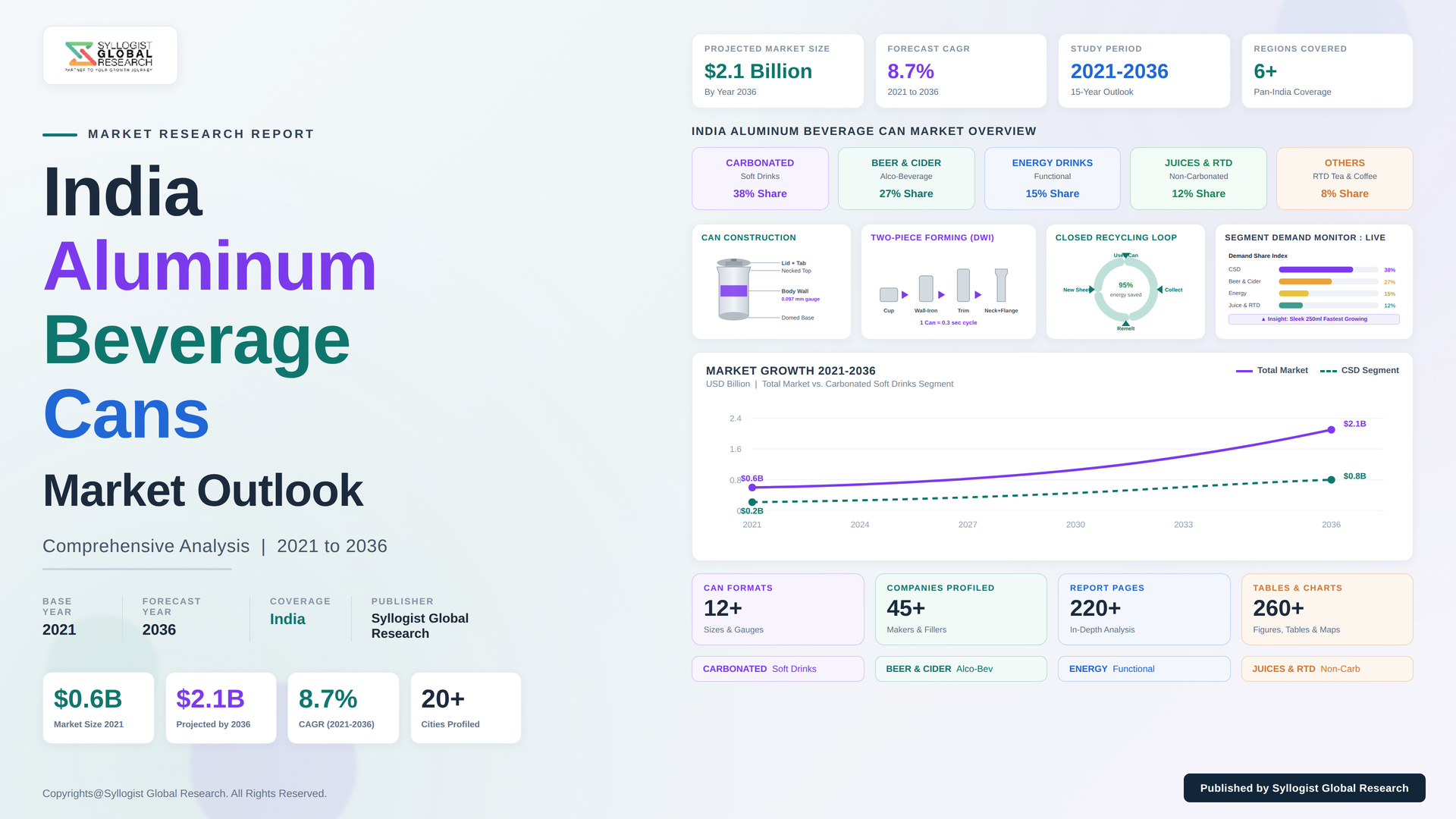
The India aluminum beverage can market is entering a durable expansion phase, shaped by rising per-capita packaged beverage consumption, accelerating craft beer and energy drink demand, sustained substitution of plastic packaging with recyclable aluminum, and rapid greenfield can manufacturing capacity additions across northern and western beverage clusters. The India aluminum beverage can market was valued at USD 412 million in 2025 and is projected to reach USD 968 million by 2034, advancing at a compound annual growth rate of 10.0% through the forecast period, as beverage bottlers, breweries, and contract fillers scale canned beverage volumes across urban and semi-urban consumption zones. Rising disposable income, expanding on-the-go consumption, and increasing preference for premium canned formats are reinforcing sustained demand within the India aluminum beverage can market.
The India aluminum beverage can market structure is being reshaped by high-speed two-piece drawn and wall-ironed can production, lightweight can wall engineering, sleek and slim can format proliferation, and advanced decoration technology enabling shelf differentiation for beverage brands. Two-piece aluminum cans account for 64% of India aluminum beverage can market volume in 2025, supported by seamless single-body construction that reduces leakage risk, improves pressure resistance for carbonated and beer applications, and lowers material consumption per can. Beverage brands are progressively adopting 250 ml sleek and 330 ml standard formats, while can makers are investing in inside-spray coating, high-resolution decoration, and necking technology that reduces aluminum content per can and improves packaging economics across the India aluminum beverage can market.
Alcoholic beverages represent the largest application segment within the India aluminum beverage can market, holding 57% of market value in 2025, propelled by expanding craft beer, mainstream lager, and ready-to-drink alcohol consumption among younger urban demographics entering the legal drinking age. Carbonated soft drinks constitute the second largest application within the India aluminum beverage can market, supported by sustained cola, flavored, and sparkling beverage demand across organized retail and convenience channels, while energy drinks and functional beverages represent the fastest-growing application segment, propelled by rising fitness consciousness, flavored water adoption, and probiotic drink launches. Beverage bottlers are increasingly specifying aluminum cans for new product launches within the India aluminum beverage can market, driven by superior branding surface, portability, and 100% recyclability.
West India represents the largest regional market within the India aluminum beverage can market, holding 34% of demand in 2025, anchored by beverage manufacturing clusters across Maharashtra and Gujarat and proximity to ports supporting aluminum sheet coil imports and can line supply. North India is emerging as the fastest-growing regional market within the India aluminum beverage can market, supported by greenfield can manufacturing investment including a USD 150 million aluminum beverage can plant commissioned in Uttar Pradesh, expanding urban populations, and rising organized retail penetration. South India occupies a strong regional position within the India aluminum beverage can market, supported by robust beverage filling capacity across Bengaluru and Chennai and a USD 60 million capacity expansion at a Sri City aluminum can plant, while East India is developing as an emerging consumption zone supported by rising disposable income and expanding beverage distribution across Kolkata and Bhubaneswar within the India aluminum beverage can market.
Key Drivers
Rising Packaged Beverage Consumption, Craft Beer Expansion, and On-the-Go Ready-to-Drink Demand Driving Aluminum Can Procurement Across Beverage Fillers
The structural rise in packaged beverage consumption, rapid craft beer and energy drink expansion, and accelerating on-the-go ready-to-drink demand are generating durable procurement demand for aluminum beverage cans across Indian bottlers, breweries, and contract fillers. India recorded total beverage alcohol volume growth of 7% year-on-year in the first half of 2025, ranking among the fastest-growing major alcohol markets globally, propelled by millions of consumers entering the legal drinking age each year and expanding the canned beverage consumer base. Craft beer, mainstream lager, and canned ready-to-drink alcohol are increasingly packaged in aluminum cans, supported by off-premise retail channels featuring higher canned beer availability across grocery, convenience, and modern trade formats. Non-alcoholic beverage volumes are also scaling, with soft drink consumption forecast to grow at double-digit rates in 2025 as market conditions normalize and energy drink adoption accelerates among younger consumers. Beverage brands increasingly prefer aluminum cans for new launches within the India aluminum beverage can market, given superior chill retention, portability, tamper resistance, faster shelf turnover, and product freshness preservation across extended distribution ranges. Flavored beverage, craft beer, and on-the-go format demand grew sharply in recent years, with canned beverage sales rising materially as consumers shifted toward convenient single-serve packaging. Rising urbanization, expanding disposable income, and shifting social consumption norms continue to anchor sustained aluminum can procurement across the India aluminum beverage can market value chain nationwide.
Sustainability Mandates, Plastic Substitution, and 100% Recyclability Driving Structural Shift Toward Aluminum Beverage Can Packaging
Tightening sustainability mandates, accelerating substitution of single-use plastic packaging, and the 100% recyclability of aluminum are collectively driving a structural shift toward aluminum beverage can packaging across the Indian beverage industry. Aluminum cans achieve recycling rates exceeding 90% within controlled supply chains, aligning directly with corporate sustainability commitments, extended producer responsibility obligations, and evolving consumer environmental awareness across the India aluminum beverage can market. Government initiatives reducing single-use plastic consumption and promoting recyclable packaging materials are encouraging beverage manufacturers to transition from polyethylene terephthalate bottles toward recyclable aluminum cans, reinforcing demand momentum. Aluminum offers an infinitely recyclable material stream, with recycled aluminum requiring materially lower energy input than primary aluminum production, strengthening the circular economy positioning of aluminum beverage cans among sustainability-focused beverage brands. Beverage producers are increasingly leveraging recyclability as a brand differentiator, positioning canned formats as environmentally responsible alternatives within premium and mainstream portfolios across the India aluminum beverage can market. Rising consumer preference for eco-friendly packaging, combined with organized retail channels prioritizing shelf-ready, visually appealing, and tamper-proof packaging, continues to accelerate the adoption of aluminum beverage cans and anchor long-term structural demand across urban and semi-urban beverage consumption zones nationwide within the India aluminum beverage can market.
Greenfield Capacity Investment, Foreign Direct Investment, and Organized Retail Expansion Driving Domestic Aluminum Beverage Can Manufacturing Scale
Accelerating greenfield can manufacturing investment, rising foreign direct investment, and rapid organized retail expansion are driving domestic aluminum beverage can manufacturing scale across the India aluminum beverage can market. Global packaging manufacturers are establishing greenfield plants and forming joint ventures in India to capitalize on rising beverage consumption, with a USD 150 million greenfield aluminum beverage can plant commissioned in Uttar Pradesh and a USD 60 million capacity expansion executed at a Sri City can facility targeting fast-growing ready-to-drink and dairy beverage segments. These investments are transferring advanced can manufacturing technology, expanding domestic production capacity, and improving supply chain efficiency across the India aluminum beverage can market. Rapid expansion of organized retail outlets, supermarkets, hypermarkets, and online grocery platforms is boosting demand for shelf-ready aluminum can packaging, with major bottlers committing significant capital toward beverage distribution and cold chain infrastructure across multiple Indian states. Production Linked Incentive support for food processing is indirectly strengthening packaged beverage demand and aluminum can procurement within the India aluminum beverage can market. Growing beverage plant automation, high-speed canning line commissioning, and expanding contract filling capacity continue to reinforce domestic aluminum beverage can manufacturing scale and sustained supply expansion across the India aluminum beverage can market nationwide.
Key Challenges
Aluminum Price Volatility, London Metal Exchange Exposure, and Raw Material Cost Fluctuation Constraining Margin Stability for Can Manufacturers
Aluminum price volatility, direct London Metal Exchange price exposure, and raw material cost fluctuation collectively constrain margin stability for aluminum beverage can manufacturers across the India aluminum beverage can market. Aluminum sheet coil is the primary raw material in aluminum can manufacturing, and its price depends on London Metal Exchange aluminum prices plus regional premiums covering conversion cost and value chain margins, generating pass-through cost pressure that is difficult to absorb under fixed beverage supply contracts. Fluctuating aluminum prices disrupt production planning, complicate procurement cost management, and pressure can manufacturer margins across the India aluminum beverage can market, particularly for converters lacking long-duration raw material hedging arrangements. India remains partly dependent on imported aluminum for beverage can production, with rural and inland regions facing higher landed material cost due to logistics and supply constraints within the India aluminum beverage can market. Currency fluctuation on imported aluminum sheet coil further amplifies input cost uncertainty, complicating forward pricing for beverage filling contracts. The combined effect of London Metal Exchange price cycles, premium volatility, currency exposure, and import dependence generates persistent cost management complexity that constrains margin predictability and pricing stability for aluminum beverage can manufacturers across the India aluminum beverage can market nationwide.
Recycling Infrastructure Gaps, Fragmented Collection Systems, and Circular Supply Chain Limitations Constraining Recycled Aluminum Availability
Recycling infrastructure gaps, fragmented collection systems, and circular supply chain limitations constrain recycled aluminum availability and elevate material cost across the India aluminum beverage can market. Despite aluminum offering infinite recyclability, the absence of efficient, formalized collection and recycling infrastructure across large parts of India limits the supply of recycled aluminum feedstock available to can manufacturers, increasing reliance on primary and imported aluminum. Rural regions face particularly limited recycling facility access, raising dependence on imported aluminum and elevating landed material cost within the India aluminum beverage can market. Fragmented informal collection networks reduce recovery rate consistency, constrain closed-loop recycling economics, and limit the cost advantage that recycled aluminum can deliver to beverage can converters. Government environmental initiatives reducing plastic and promoting recyclable packaging require corresponding investment in recovery and recycling systems to realize circular economy benefits within the India aluminum beverage can market. Leading aluminum producers and local recyclers are forming partnerships to improve collection rates and deploy aluminum recovery technology, yet scaling formalized recycling infrastructure across distributed geographies remains a persistent structural challenge. Limited recycled aluminum availability, inconsistent recovery rates, and underdeveloped circular supply chains continue to elevate raw material cost and constrain sustainable material sourcing across the India aluminum beverage can market nationwide.
Fragmented Regulation, BIS Certification Friction, and Competition From Alternative Packaging Materials Constraining Market Scaling
Fragmented regulation, Bureau of Indian Standards certification friction, and sustained competition from alternative packaging materials collectively constrain scaling within the India aluminum beverage can market. Beverage can manufacturers must navigate multiple inspections, documentation requirements, and approval timelines, with fragmented regulatory frameworks increasing operational cost, delaying market entry, and encouraging reliance on imports that raise cost and supply risk across the India aluminum beverage can market. Bureau of Indian Standards certification processes require harmonization and streamlining to ensure stable domestic supply and long-term production scaling, with fragmented compliance requirements hindering the pace of domestic capacity expansion. State-level restrictions on alcohol supply in certain regions further constrain canned beer volume growth despite a large underlying consumer base within the India aluminum beverage can market. Aluminum beverage cans also face persistent competition from polyethylene terephthalate bottles and glass packaging, with polyethylene terephthalate offering lower unit cost for many beverage formats and glass retaining a premium positioning in specific categories. Price-sensitive beverage segments continue to weigh aluminum can packaging cost against lower-cost alternatives, constraining penetration in value-focused categories. The combined effect of fragmented regulation, certification friction, state-level alcohol restrictions, and alternative packaging competition continues to constrain the pace at which aluminum beverage can adoption can scale across the India aluminum beverage can market nationwide.
Market Segmentation
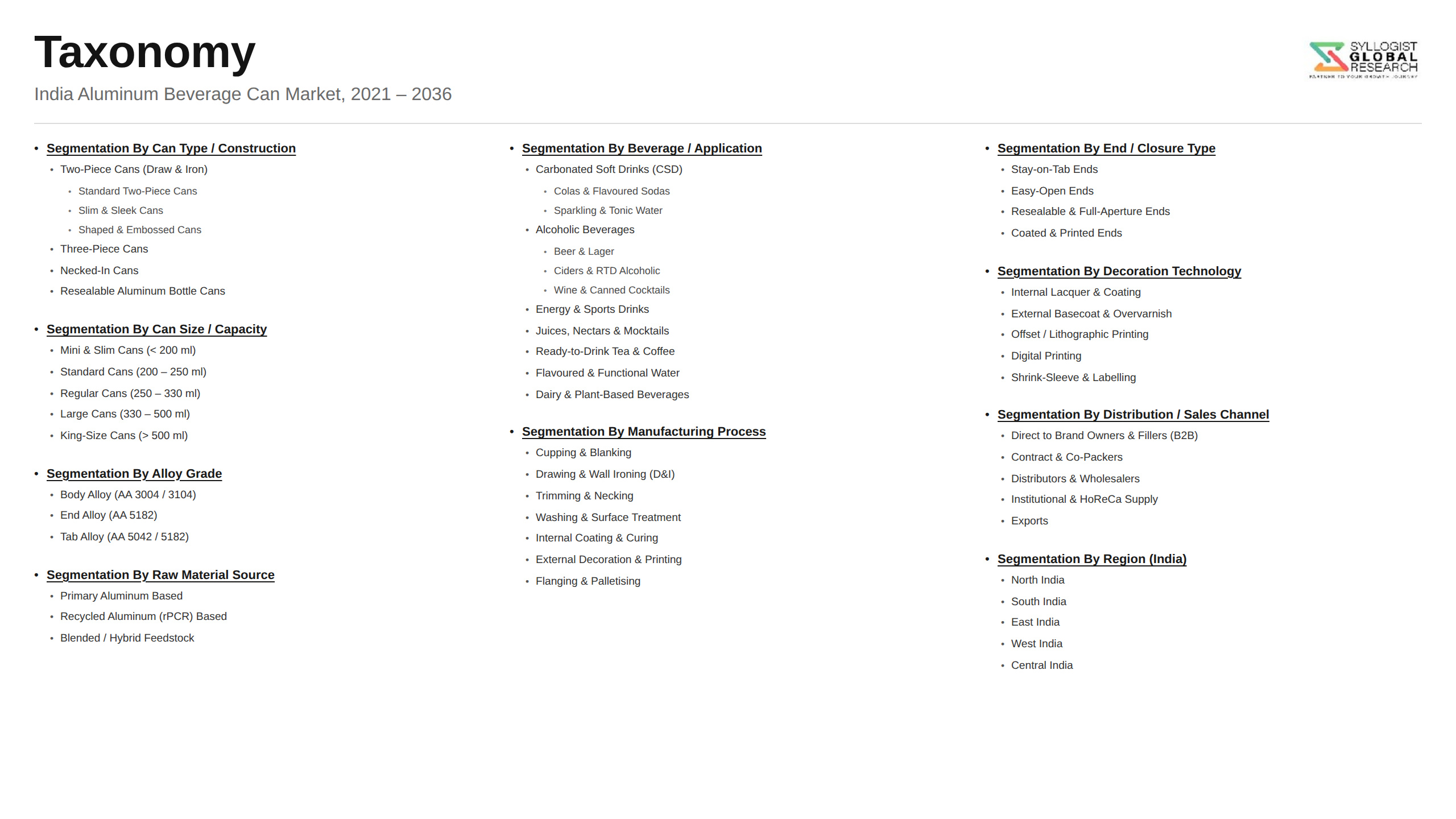
- Segmentation By Product Type
- Two-Piece Cans
- Three-Piece Cans
- Segmentation By Material Type
- Recycled Aluminum
- Virgin Aluminum
- Segmentation By Beverage Type
- Alcoholic Beverages (Beer, Craft Beer, Ready-to-Drink Alcohol)
- Carbonated Soft Drinks
- Energy and Sports Drinks
- Packaged Juices and Nectars
- Flavored and Functional Water
- Others
- Segmentation By Capacity
- Less than 200 ml
- 200 ml to 330 ml
- Above 330 ml
- Segmentation By Distribution Channel
- Supermarkets and Hypermarkets
- Convenience Stores
- Online Retail and Quick Commerce
- On-Premise (Bars, Restaurants, Hotels)
- Others
- Segmentation By End User
- Beverage Bottlers and Fillers
- Breweries and Craft Beer Producers
- Contract Packaging and Co-Packers
- Others
- Segmentation By Region
- West India
- North India
- South India
- East India
All market revenues are presented in USD
Historical Year: 2021-2024 | Base Year: 2025 | Estimated Year: 2026 | Forecast Period: 2027-2034
Key Questions this Study Will Answer
- What is the total market valuation of the India Aluminum Beverage Can Market in 2025, projected through 2034, segmented by product type, material type, beverage type, capacity, and distribution channel, enabling can manufacturers, aluminum sheet coil suppliers, beverage bottlers, and investors to identify highest-growth segments and most durable revenue opportunities across the India aluminum beverage can market?
- How are beverage bottlers, breweries, contract fillers, and can manufacturers structuring procurement and capacity investment decisions across two-piece and three-piece cans, and which sourcing models, including domestic manufacturing, greenfield capacity, and imported supply, are shaping commercial deployment economics within the India aluminum beverage can market through 2034?
- What alcoholic beverage growth, carbonated soft drink recovery, and energy drink expansion dynamics are shaping the pace and geographic distribution of aluminum beverage can demand across urban, semi-urban, and organized retail beverage consumption zones in the India aluminum beverage can market?
- Which can formats, including sleek, slim, and standard cans across capacities below 200 ml, 200 ml to 330 ml, and above 330 ml, are gaining the strongest procurement traction across alcoholic, carbonated, and functional beverage applications, and what lightweighting, decoration, and cost of ownership metrics are shaping format selection within the India aluminum beverage can market?
- How is the competitive landscape structured among aluminum sheet coil suppliers, two-piece and three-piece can manufacturers, coating and ink suppliers, and turnkey canning line integrators within the India aluminum beverage can market, and what partnership, joint venture, and greenfield capacity expansion strategies are enabling participants to compete against established can manufacturers?
- What sustainability mandates, plastic substitution trends, recycling infrastructure development, and circular economy dynamics are reshaping aluminum beverage can adoption, material sourcing, and recycled aluminum availability across the India aluminum beverage can market?
- Which regional markets, including West India, North India, South India, and East India, are projected to generate the largest incremental aluminum beverage can demand through 2034, and what beverage manufacturing capacity, organized retail penetration, greenfield investment, and consumption growth factors are shaping supplier selection and capacity investment priorities in each regional India aluminum beverage can market?
- Product Definition
- Research Methodology
- Research Design & Framework
- Overall Research Approach: Descriptive, Exploratory & Quantitative Mixed-Method Design
- Market Definition & Scope Boundaries: What is Included and Excluded
- Segmentation Framework
- Key Research Assumptions & Limitations
- Secondary Research
- Primary Research Design & Execution
- Data Triangulation & Validation
- Market Sizing & Forecasting Methodology
- Competitive Intelligence Methodology
- Quality Assurance & Peer Review
- Definitions, Abbreviations & Data Notes
- Executive Summary
- Market Snapshot & Headline Numbers
- Key Findings & Research Highlights
- Market Dynamics
- Regional Market Summary
- Competitive Landscape Snapshot
- Technology & Innovation Highlights
- Market Dynamics
- Drivers
- Restraints
- Opportunities
- Challenges
- Porter’s Five Forces Analysis
- PESTLE Analysis
- Market Trends & Developments
- Emerging Trends
- Technological Developments
- Regulatory & Policy Changes
- Supply Chain & Sourcing Trends
- Manufacturing & Process Trends
- Investment & Funding Activity
- Sustainability & ESG Trends
- Risk Assessment Framework
- Aluminum Sheet and Coil Price Volatility & Input Cost Escalation Risk
- Substitution by PET, Glass & Alternative Packaging Formats Risk
- Beverage Demand Seasonality, Consumption Shifts & Volume Volatility Risk
- Supply Concentration, Can Body Stock Import Dependence & Feedstock Risk
- Regulatory, Excise & Alcohol Policy Change Impact on Can Demand Risk
- Regulatory Framework & Standards
- Food-Contact, FSSAI & Internal Coating (BPA) Compliance Standards
- Extended Producer Responsibility (EPR), Plastic Waste & Packaging Recycling Rules
- Labelling, Metrology & Beverage Packaging Declaration Regulations
- Aluminum Can Recycling, Deposit Return & Circular Economy Policy
- BIS Standards, Quality Certification & Manufacturing Compliance Frameworks
- India Aluminum Beverage Can Market Outlook
- Market Size & Forecast by Value
- Market Size & Forecast by Volume (Aluminum Beverage Cans Produced in Billion Units per Year and Aluminum Consumed in Kilo Tonnes per Year)
- Market Size & Forecast by Can Type
- Two-Piece Can
- Three-Piece Can
- Bottle Can (Resealable)
- Others
- Market Size & Forecast by Can Size
- 150 ml
- 180 ml
- 250 ml
- 300 ml
- 330 ml
- 500 ml
- Others
- Market Size & Forecast by Shape
- Standard
- Sleek
- Slim
- Others
- Market Size & Forecast by Fill Type
- Cold Fill
- Hot Fill
- Aseptic Fill
- Others
- Market Size & Forecast by Decoration
- Litho-Printed
- Sleeve-Labelled
- Plain and Coated
- Others
- Market Size & Forecast by Beverage Type
- Carbonated Soft Drinks
- Beer
- Energy Drinks
- Fruit Juices and Nectars
- Ready-to-Drink (RTD) Tea and Coffee
- Alcoholic RTD and Hard Seltzer
- Packaged Water
- Others
- Market Size & Forecast by End-Use Industry
- Alcoholic Beverage Producers
- Soft Drink and CSD Bottlers
- Energy and Sports Drink Brands
- Juice and Dairy Beverage Producers
- Others
- Market Size & Forecast by Sales Channel
- Direct Supply to Beverage Fillers
- Contract Packer and Co-Packer Channel
- Distributor and Wholesaler Channel
- Retail and Modern Trade
- Others
- North India Aluminum Beverage Can Market Outlook
- Market Size & Forecast
- By Value
- By Volume (Aluminum Beverage Cans Produced in Billion Units per Year and Aluminum Consumed in Kilo Tonnes per Year)
- By Can Type
- By Can Size
- By Shape
- By Fill Type
- By Decoration
- By Beverage Type
- By End-Use Industry
- By State
- By Sales Channel
- South India Aluminum Beverage Can Market Outlook
- Market Size & Forecast
- By Value
- By Volume (Aluminum Beverage Cans Produced in Billion Units per Year and Aluminum Consumed in Kilo Tonnes per Year)
- By Can Type
- By Can Size
- By Shape
- By Fill Type
- By Decoration
- By Beverage Type
- By End-Use Industry
- By State
- By Sales Channel
- East India Aluminum Beverage Can Market Outlook
- Market Size & Forecast
- By Value
- By Volume (Aluminum Beverage Cans Produced in Billion Units per Year and Aluminum Consumed in Kilo Tonnes per Year)
- By Can Type
- By Can Size
- By Shape
- By Fill Type
- By Decoration
- By Beverage Type
- By End-Use Industry
- By State
- By Sales Channel
- West India Aluminum Beverage Can Market Outlook
- Market Size & Forecast
- By Value
- By Volume (Aluminum Beverage Cans Produced in Billion Units per Year and Aluminum Consumed in Kilo Tonnes per Year)
- By Can Type
- By Can Size
- By Shape
- By Fill Type
- By Decoration
- By Beverage Type
- By End-Use Industry
- By State
- By Sales Channel
- Central India Aluminum Beverage Can Market Outlook
- Market Size & Forecast
- By Value
- By Volume (Aluminum Beverage Cans Produced in Billion Units per Year and Aluminum Consumed in Kilo Tonnes per Year)
- By Can Type
- By Can Size
- By Shape
- By Fill Type
- By Decoration
- By Beverage Type
- By End-Use Industry
- By State
- By Sales Channel
- State-Wise* Aluminum Beverage Can Market Outlook
- Market Size & Forecast
- By Value
- By Volume (Aluminum Beverage Cans Produced in Billion Units per Year and Aluminum Consumed in Kilo Tonnes per Year)
- By Can Type
- By Can Size
- By Shape
- By Fill Type
- By Decoration
- By Beverage Type
- By End-Use Industry
- By State
- By Sales Channel
- Market Size & Forecast
- Market Size & Forecast
- Market Size & Forecast
- Market Size & Forecast
- Market Size & Forecast
- Market Size & Forecast
*States Analysed in the India Research Portfolio: Maharashtra, Gujarat, Karnataka, Tamil Nadu, Telangana, Andhra Pradesh, Uttar Pradesh, Delhi NCR, West Bengal, Rajasthan, Punjab, Haryana, Madhya Pradesh, Kerala, Bihar, Odisha, Assam, Jharkhand, Chhattisgarh, Uttarakhand, Himachal Pradesh, Goa, Chandigarh, Puducherry
- Technology Landscape & Innovation Analysis
- Two-Piece Draw and Iron (D&I) Can Manufacturing Technology Deep-Dive
- Can Lightweighting, Downgauging & Aluminum Reduction Technology
- Advanced Internal Coating, BPA-Free & Barrier Liner Technology
- High-Definition Litho Printing, Digital Decoration & Sleeve Technology
- Easy-Open End, Resealable & Bottle-Can Closure Technology
- Recycled-Content (Closed-Loop) Aluminum Can Body Stock Technology
- Automated Inspection, Vision Systems & Quality Control Technology
- Patent & IP Landscape in Aluminum Beverage Can Technologies
- Value Chain & Supply Chain Analysis
- Primary and Recycled Aluminum Can Body Stock Supply Chain
- Coil Coating, Lacquer & Internal Coating Material Supply Chain
- Can Body and End Manufacturing Supply Chain
- Filling, Seaming & Contract Packing Supply Chain
- Beverage Brand and Bottler Customer Channel (CSD, Beer, Energy, Juice)
- Distribution, Warehousing & Cold Chain Logistics Network
- Used Beverage Can Collection, Recycling & Closed-Loop Recovery Network
- Pricing Analysis
- Standard 330 ml Can Pricing Across Volume & Contract Tiers
- Sleek and Slim Can Pricing Differentials by Size & Shape
- Aluminum LME-Linked and Conversion-Cost Pricing Economics
- Printed vs Plain Can Decoration Pricing Analysis
- Recycled-Content Can Pricing & Sustainability Premium Analysis
- Regional Pricing Benchmarks Across Key India Zones
- Total Delivered Cost, Freight & Value-in-Use Pricing Models
- Sustainability & Environmental Analysis
- Lifecycle Assessment (LCA) of Aluminum Cans Across Manufacture, Use & Recycling
- Recycled Content, Closed-Loop Recycling & Circular Economy Performance
- Carbon Footprint of Aluminum Cans vs PET & Glass Packaging
- Lightweighting, Material Efficiency & Waste Reduction Performance
- Regulatory-Driven Sustainability, EPR Compliance, SDG 12 (Responsible Consumption) Alignment & Green Finance Eligibility
- Competitive Landscape
- Market Structure & Concentration
- Market Consolidation Level (Fragmented vs. Consolidated by Can Type & Geography)
- Top 10 Players Market Share
- HHI (Herfindahl-Hirschman Index) Concentration Analysis
- Competitive Intensity Map by Can Type, Application & Geography
- Player Classification
- Integrated Aluminum Can Manufacturers
- Beverage Can Making Specialists
- Aluminum Sheet and Coil Suppliers
- Contract Packers and Co-Packers
- End and Closure Manufacturers
- Regional and Independent Can Producers
- Coating and Decoration Service Providers
- Distributors and Recyclers
- Competitive Analysis Frameworks
- Market Share Analysis by Can Type, Application & Region
- Company Profile
- Company Overview & Headquarters
- Aluminum Can Product Portfolio
- Key Customer Relationships & Reference Beverage Brand Accounts
- Manufacturing Footprint & Production Capacity Coverage
- Revenue (Beverage Can Segment) & Order Backlog
- Technology Differentiators & IP
- Key Strategic Partnerships, JVs & M&A Activity
- Recent Developments (Capacity Expansion, Contract Wins, Product Launches)
- SWOT Analysis
- Strategic Focus Areas & Roadmap
- Competitive Positioning Map (Technology Capability vs. Market Penetration)
- Key Company Profiles
- Market Structure & Concentration
- Technology Landscape & Innovation Analysis
- Strategic Output
- Market Opportunity Matrix: By Can Type, Size, Beverage Type, End-Use Industry & Geography
- White Space Opportunity Analysis
- Strategic Recommendations
- Product Portfolio & Technology Investment Strategy
- Manufacturing Excellence & Capacity Expansion Strategy
- Geographic Expansion & Localisation Strategy
- Customer & Beverage Brand Engagement Strategy
- Partnership, M&A & Ecosystem Strategy
- Sustainability & Circular Economy Strategy
- Risk Mitigation & Future Roadmap
- Strategic Priority Matrix & Roadmap
- Near-term (2025-2028)
- Mid-term (2029-2032)
- Long-term (2033-2037)