Global Carbon Black Market By Type, By Grade, By Production Process, By Feedstock, By Application, By End-Use Industry, By Region, Competition, Forecast & Opportunities, 2021-2036F
Market Definition
The Global Carbon Black Market covers the manufacture, supply, distribution, and downstream consumption of engineered carbonaceous particulate materials produced through the controlled incomplete combustion or thermal decomposition of heavy petroleum feedstocks, coal tar derivatives, and emerging recycled tire pyrolysis oils. The market encompasses standard furnace black grades engineered for tire reinforcement, conductive carbon blacks for lithium-ion battery cathode and anode formulations, specialty pigment-grade carbon blacks for inks, coatings, and plastics, channel black, lamp black, thermal black, acetylene black, and emerging sustainable and circular grades produced from end-of-life tire pyrolysis, methane pyrolysis, and biomass pathways. Carbon black is procured by tire manufacturers, mechanical rubber goods producers, plastics compounders, masterbatch suppliers, ink and coatings formulators, lithium-ion battery cell makers, conductive plastics manufacturers, cable and wire producers, and emerging applications in printing inks, toners, and reinforcing fillers across construction polymers. The supplier landscape is concentrated among integrated producers including Cabot Corporation, Orion Engineered Carbons, Birla Carbon, Tokai Carbon, China Synthetic Rubber Corporation (CSRC), Continental Carbon, Phillips Carbon Black, OMSK Carbon Group, Mitsubishi Chemical, Black Cat Carbon Black, Longxing Chemical Industry, and Jiangxi Black Cat, with competition shaped by feedstock cost positioning, energy efficiency, ASTM grade portfolio breadth, application engineering depth, sustainability credentials, and proximity to major rubber and battery industry demand centers. Market dynamics are governed by global tire production volumes, replacement tire demand cycles, lithium-ion battery cell manufacturing capacity additions, plastics and coatings consumption, regulatory frameworks including emissions standards in the European Union, the United States, India, and China, and the structural transition toward sustainable carbon black production pathways.
Market Insights
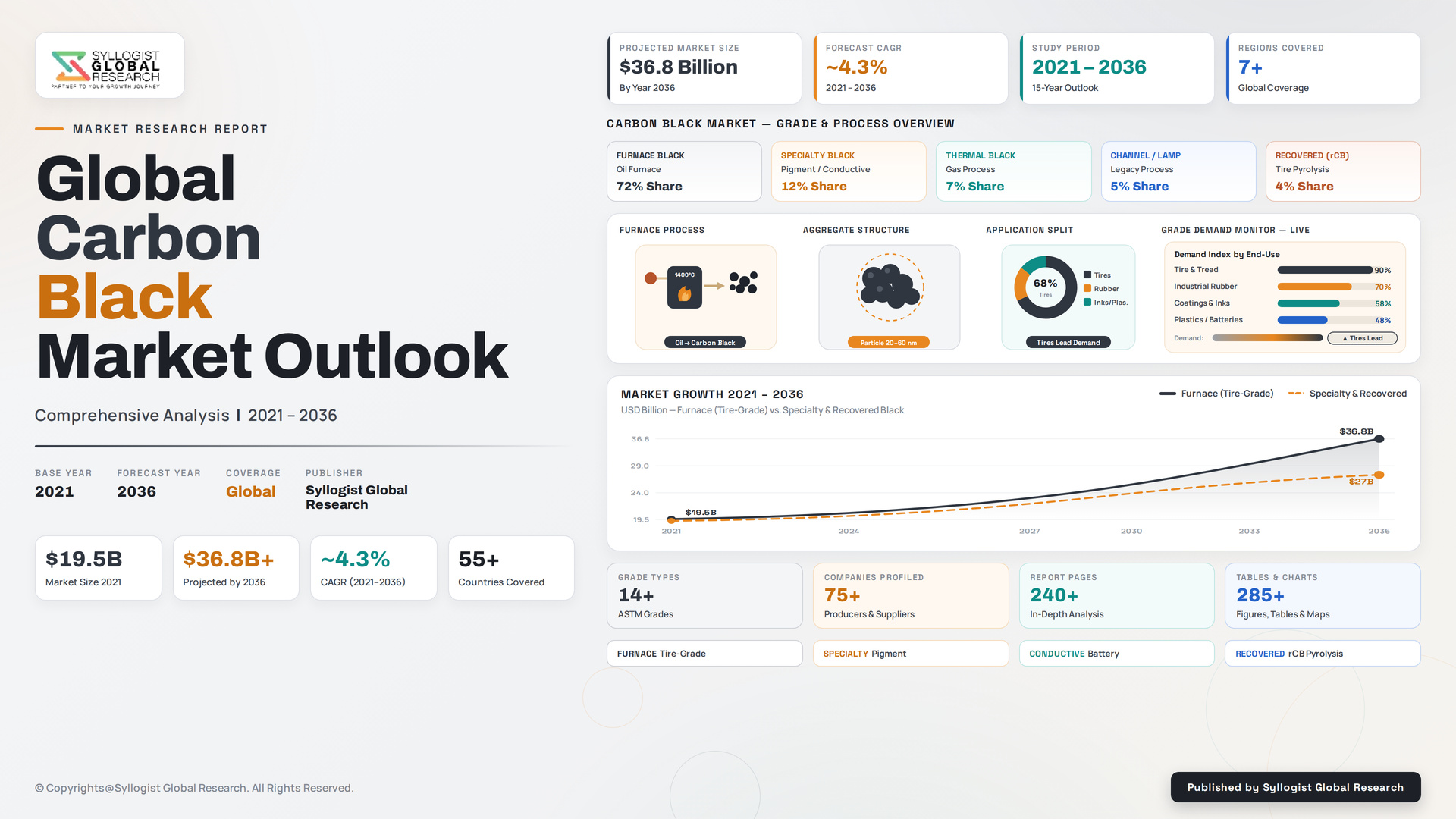
The global carbon black market is entering a structurally expansionary phase driven by the convergence of resilient tire industry demand, accelerating lithium-ion battery cathode and anode formulation requirements, plastics and coatings consumption growth across emerging markets, and the rising commercial importance of sustainable and circular carbon black grades produced from end-of-life tire pyrolysis. The market was valued at USD 21.6 billion in 2025 and is projected to reach USD 41.8 billion by 2034, advancing at a compound annual growth rate of 7.6% through the forecast period, supported by global tire production volumes exceeding 2.4 billion units annually, structural battery materials capacity additions across China, South Korea, Europe, and North America, and rising specialty carbon black demand across coatings, conductive plastics, and printing inks.
Tire applications remain the dominant demand segment accounting for nearly 72% of global carbon black consumption in 2025, with passenger car tires, truck and bus tires, off-the-road tires, and aviation tires each requiring tailored carbon black grades engineered for rolling resistance, abrasion performance, wet grip, and tread durability. The transition from internal combustion engine vehicles to battery electric vehicles is materially reshaping tire carbon black formulations, with EV tires requiring 18% to 25% higher load-bearing capacity, lower rolling resistance, and reduced noise generation, driving demand for premium reinforcing grades such as N134, N121, and N115. Bridgestone, Michelin, Goodyear, Continental, Pirelli, Sumitomo Rubber, Hankook, Yokohama, Kumho, Apollo Tyres, MRF, CEAT, and emerging Chinese tire manufacturers Linglong, ZC Rubber, and Sailun are collectively driving structural carbon black procurement across major manufacturing geographies.
Battery-grade carbon black has emerged as the fastest growing application segment, advancing at over 14.8% CAGR through 2034, supported by the explosive ramp of lithium-ion battery cell capacity additions at CATL, BYD, LG Energy Solution, Samsung SDI, SK On, Panasonic, Northvolt, AESC, Farasis Energy, EVE Energy, CALB, Sunwoda, and Gotion High-Tech serving electric vehicle, energy storage system, and consumer electronics demand. Conductive carbon black grades including Super P, Ketjenblack, and acetylene black are essential components of lithium-ion cathode and anode formulations, with battery-grade carbon black consumption projected to advance from approximately 78,000 tonnes in 2025 to over 240,000 tonnes by 2034 as global battery cell capacity scales beyond 4,500 GWh. Specialty carbon black demand across coatings, plastics, inks, and conductive applications is simultaneously expanding at 8.4% CAGR through 2034 across PPG Industries, AkzoNobel, Sherwin-Williams, Nippon Paint, BASF, and Sun Chemical formulation programs.
Asia-Pacific dominates the global carbon black market with approximately 64% revenue share in 2025, anchored by China, India, Thailand, Vietnam, Indonesia, South Korea, and Japan as the principal demand centers, supported by dense tire manufacturing capacity and the explosive growth of lithium-ion battery cell production. China alone accounts for nearly 38% of global carbon black consumption, while India is the fastest growing regional market advancing at over 9.4% CAGR through 2034, supported by domestic tire manufacturing capacity expansion at MRF, CEAT, Apollo Tyres, JK Tyre, Balkrishna Industries, and TVS Srichakra, alongside lithium-ion battery cell investments under the Production Linked Incentive scheme. Europe represents a critical premium specialty market, while North America continues to anchor tire replacement demand at Goodyear, Cooper Tire, Bridgestone, and Michelin manufacturing facilities across the United States, Canada, and Mexico. Russian carbon black exports remain constrained following the 2022 sanctions framework, materially reshaping European supply architecture.
Key Drivers
Global Tire Production Growth, EV Tire Premiumization, and Replacement Tire Demand Driving Sustained Reinforcing Grade Procurement
Global tire production exceeding 2.4 billion units annually, alongside the structural transition toward premium EV tires requiring 18% to 25% higher load-bearing capacity, lower rolling resistance, and reduced noise generation, is anchoring durable reinforcing grade carbon black demand growth. Bridgestone, Michelin, Goodyear, Continental, Pirelli, Sumitomo Rubber, Hankook, Yokohama, Kumho, Apollo Tyres, MRF, CEAT, Linglong, ZC Rubber, and Sailun are collectively committing capacity expansion programs that will sustain reinforcing carbon black procurement growth, while replacement tire demand cycles support consistent baseline volumes across mature and emerging tire markets through 2034.
Lithium-Ion Battery Cell Capacity Expansion and Conductive Carbon Black Demand Driving Premium Application Growth
Explosive lithium-ion battery cell capacity expansion at CATL, BYD, LG Energy Solution, Samsung SDI, SK On, Panasonic, Northvolt, AESC, Farasis Energy, EVE Energy, CALB, Sunwoda, and Gotion High-Tech is driving sustained battery-grade conductive carbon black procurement, with consumption projected to advance from approximately 78,000 tonnes in 2025 to over 240,000 tonnes by 2034. Global battery cell capacity scaling beyond 4,500 GWh by 2034 supports durable premium carbon black demand across Super P, Ketjenblack, and acetylene black grades, with battery-grade carbon black advancing at 14.8% CAGR through the forecast horizon.
Plastics, Coatings, Inks, and Conductive Polymer Applications Driving Specialty Carbon Black Diversification Beyond Tire Segment
Specialty carbon black demand across PPG Industries, AkzoNobel, Sherwin-Williams, Nippon Paint, BASF, Sun Chemical, Sakata INX, DIC Corporation, and Toyo Ink is advancing at 8.4% CAGR through 2034, supported by automotive coatings expansion, packaging ink demand, conductive plastics for electronics housings, and reinforcing fillers across construction polymers. Pigment-grade carbon blacks with enhanced jetness, dispersion, and tinting strength are anchoring durable specialty segment growth across global coatings and inks production geographies through 2034.
Key Challenges
Stringent Environmental Emissions Regulations and Sustainability Pressures Pressuring Furnace Black Production Economics
Tightening environmental emissions regulations covering sulfur oxides, nitrogen oxides, particulate matter, and carbon dioxide across the EU Industrial Emissions Directive, US EPA NSPS frameworks, India CPCB guidelines, and Chinese emissions standards are escalating capital expenditure and operating cost burdens for furnace black producers. Carbon intensity scrutiny, scope 3 emissions reporting under CSRD, and customer net-zero commitments at major tire and automotive OEMs are forcing producers to accelerate investment in flue gas treatment, waste heat recovery, and emerging sustainable carbon black production pathways.
Feedstock Cost Volatility, Carbon Black Oil Supply Constraints, and Heavy Aromatic Residue Pricing Compression Pressuring Margins
Carbon black oil feedstock pricing remains structurally volatile and increasingly constrained, with heavy aromatic residues, decant oil, and coal tar feedstock availability narrowing as refining configurations shift toward lighter products, naphtha cracking, and renewable diesel co-processing. Feedstock pricing volatility of 22% to 38% across multiple quarters in 2024 and 2025 is materially compressing producer margins, while supplier consolidation, logistics constraints, and Russian feedstock export disruptions following the 2022 sanctions framework are reshaping global feedstock procurement architecture across major producers.
Tire Pyrolysis Recycled Carbon Black Adoption, Sustainable Grade Qualification, and Competitive Pressure on Virgin Furnace Black Demand
Accelerating commercialization of recycled carbon black produced from end-of-life tire pyrolysis at Bolder Industries, Klean Industries, Pyrum Innovations, Wastefront, Continental, Michelin, Bridgestone, and emerging joint ventures is introducing competitive pressure on traditional virgin furnace black demand across selected tire and rubber applications. Recycled carbon black grades are qualifying for partial substitution at 8% to 22% load levels across new tire formulations, with major tire OEM commitments under EU Green Deal, US sustainability mandates, and corporate net-zero frameworks reshaping virgin carbon black procurement through 2034.
Market Segmentation
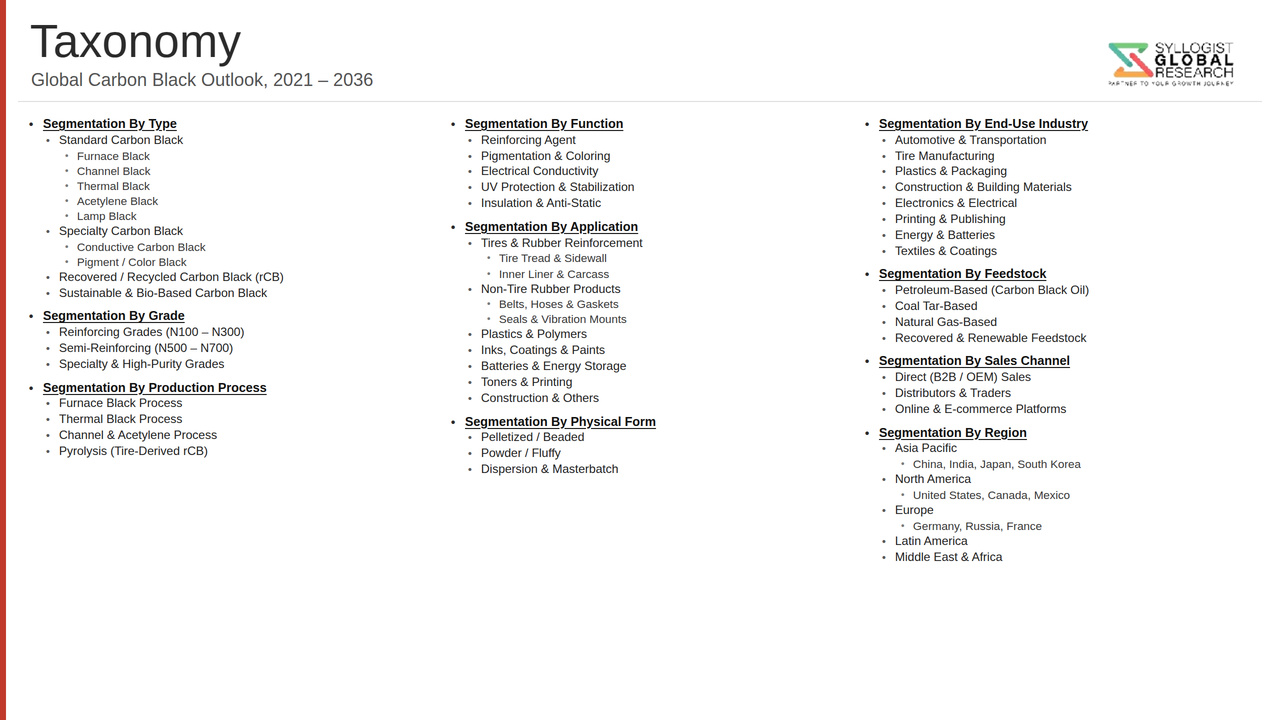
- Segmentation By Type
- Furnace Black
- Channel Black
- Thermal Black
- Acetylene Black
- Lamp Black
- Recycled Carbon Black (rCB)
- Others
- Segmentation By Grade
- Reinforcing Grades (N100, N200, N300 Series)
- Semi-Reinforcing Grades (N500, N600, N700 Series)
- Conductive and Battery-Grade Carbon Black
- Specialty Pigment Grades
- Food and Pharmaceutical Grade
- Others
- Segmentation By Production Process
- Oil Furnace Process
- Gas Furnace Process
- Channel Process
- Thermal Process
- Acetylene Process
- Plasma and Methane Pyrolysis
- Tire Pyrolysis (Recycled)
- Others
- Segmentation By Feedstock
- Carbon Black Oil (Decant Oil)
- Coal Tar Derivatives
- Heavy Aromatic Residues
- Natural Gas and Methane
- Acetylene
- End-of-Life Tire Pyrolysis Oils
- Bio-Based Feedstocks
- Others
- Segmentation By Application
- Tires and Tire Components
- Mechanical Rubber Goods (Belts, Hoses, Seals)
- Plastics and Masterbatches
- Inks and Coatings
- Lithium-Ion Battery Electrodes
- Conductive Plastics and Compounds
- Cables and Wires
- Printing Toners and Pigments
- Others
- Segmentation By End-Use Industry
- Automotive and Tire Manufacturing
- Industrial Rubber Goods
- Packaging and Plastics
- Paints and Coatings
- Printing and Inks
- Lithium-Ion Battery and Energy Storage
- Construction
- Electronics and Cables
- Others
- Segmentation By Region
- Asia-Pacific (China, India, Japan, South Korea, Southeast Asia)
- North America
- Europe
- Middle East and Africa
- Latin America
All market revenues are presented in USD
Historical Year: 2021-2024 | Base Year: 2025 | Estimated Year: 2026 | Forecast Period: 2027-2034
Key Questions this Study Will Answer
- What is the total market valuation of the Global Carbon Black Market in 2025, projected through 2034, disaggregated by type, grade, application, and end-use industry, enabling carbon black producers, tire manufacturers, battery cell makers, coatings formulators, and investors to identify the highest-growth opportunities and most durable revenue corridors across the carbon black value chain?
- How are global tire production growth, electric vehicle tire premiumization, and replacement tire demand cycles reshaping reinforcing grade carbon black procurement across Bridgestone, Michelin, Goodyear, Continental, Pirelli, Sumitomo Rubber, Hankook, Yokohama, Kumho, Apollo Tyres, MRF, CEAT, Linglong, ZC Rubber, and Sailun through 2034?
- How is lithium-ion battery cell capacity expansion at CATL, BYD, LG Energy Solution, Samsung SDI, SK On, Panasonic, Northvolt, AESC, Farasis Energy, EVE Energy, CALB, Sunwoda, and Gotion High-Tech driving battery-grade conductive carbon black procurement, and what application-level growth rates are projected through 2034?
- Which carbon black grades including reinforcing N100-N300 series, semi-reinforcing N500-N700 series, conductive Super P, Ketjenblack, acetylene black, specialty pigment, and recycled carbon black are generating the highest growth rates, and how is the supply landscape evolving across Cabot Corporation, Orion Engineered Carbons, Birla Carbon, Tokai Carbon, CSRC, Continental Carbon, Phillips Carbon Black, OMSK Carbon, and Black Cat Carbon Black?
- How are tightening environmental emissions regulations under the EU Industrial Emissions Directive, US EPA NSPS, India CPCB guidelines, and Chinese emissions standards reshaping furnace black production economics, sustainability investment priorities, and capacity rationalization across global carbon black producers through 2034?
- How is recycled carbon black commercialization at Bolder Industries, Klean Industries, Pyrum Innovations, Wastefront, Continental, Michelin, and Bridgestone driving competitive pressure on virgin furnace black demand, and what tire OEM substitution commitments and EU Green Deal mandates are reshaping virgin carbon black demand trajectories?
- Which regional markets including China, India, Southeast Asia, North America, Europe, and Latin America are generating the highest incremental carbon black demand, and how are regional tire manufacturing capacity additions, battery cell investments, and government industrial policy reshaping geographic demand and supply architectures through 2034?
- Product Definition
- Research Methodology
- Research Design & Framework
- Overall Research Approach: Descriptive, Exploratory & Quantitative Mixed-Method Design
- Market Definition & Scope Boundaries: What is Included and Excluded
- Segmentation Framework
- Key Research Assumptions & Limitations
- Secondary Research
- Primary Research Design & Execution
- Data Triangulation & Validation
- Market Sizing & Forecasting Methodology
- Competitive Intelligence Methodology
- Quality Assurance & Peer Review
- Definitions, Abbreviations & Data Notes
- Research Design & Framework
- Executive Summary
- Market Snapshot & Headline Numbers
- Key Findings & Research Highlights
- Market Dynamics
- Regional Market Summary
- Competitive Landscape Snapshot
- Technology & Innovation Highlights
- Market Dynamics
- Drivers
- Restraints
- Opportunities
- Challenges
- Porter’s Five Forces Analysis
- PESTLE Analysis
- Market Trends & Developments
- Emerging Trends
- Technological Developments
- Regulatory & Policy Changes
- Supply Chain & Sourcing Trends
- Manufacturing & Process Trends
- Investment & Funding Activity
- Sustainability & ESG Trends
- Risk Assessment Framework
- Feedstock (Carbon Black Oil & Heavy Aromatics) Availability & Price Volatility Risk
- Environmental, Emissions & Tightening Air-Quality Regulation Risk
- Demand Concentration & Tire-Industry Cyclicality Risk
- Technology Transition, Decarbonisation & Sustainable-Grade Substitution Risk
- Energy Cost, Carbon Pricing & Stranded Asset Risk
- Regulatory Framework & Standards
- Air Emissions, Particulate & Industrial Pollution Control Frameworks
- Product Classification, REACH, TSCA & Chemical Registration Standards
- Occupational Health, Worker Exposure & Dust Safety Standards
- Carbon Pricing, GHG Emissions & Decarbonisation Policy Frameworks
- Circular Economy, Recovered Carbon Black & Sustainable Procurement Standards
- Global Carbon Black Market Outlook
- Market Size & Forecast by Value
- Market Size & Forecast by Volume (Production & Consumption, Kilo Tonnes)
- Market Size & Forecast by Type
- Furnace Black (Standard Grades)
- Thermal Black
- Acetylene Black
- Channel Black
- Lamp Black
- Conductive Carbon Black
- Specialty & Pigment-Grade Carbon Black
- Recovered / Recycled Carbon Black (rCB)
- Other & Emerging Grades
- Market Size & Forecast by Production Process
- Oil Furnace Process Technology
- Thermal Decomposition Process Technology
- Acetylene Decomposition Process Technology
- Channel (Impingement) Process Technology
- Lamp Black Process Technology
- Gas Black Process Technology
- Plasma & Hydrogen Pyrolysis (Clean) Process Technology
- Tire Pyrolysis & Carbon Recovery (rCB) Process Technology
- Other Emerging & Sustainable Process Technologies
- Market Size & Forecast by Grade & Function
- Reinforcing Carbon Black
- Conductive Carbon Black
- Pigment & Color Carbon Black
- UV-Stabilising & Protective Carbon Black
- Specialty & High-Performance Carbon Black
- Market Size & Forecast by Production Scale
- Large-Scale Integrated Plants (Above 200 Kilo Tonnes per Annum)
- Medium-Scale Plants (50 to 200 Kilo Tonnes per Annum)
- Small-Scale & Specialty Plants (Below 50 Kilo Tonnes per Annum)
- Market Size & Forecast by Application
- Tire & Tire Components
- Non-Tire Rubber & Mechanical Rubber Goods
- Plastics & Polymer Compounding
- Inks, Coatings & Paints
- Toners & Printing
- Batteries, Electronics & Other Applications
- Market Size & Forecast by End-Use Industry
- Automotive & Transportation
- Building & Construction
- Packaging
- Electronics & Energy Storage
- Industrial & Other End-Use Industries
- Market Size & Forecast by Sales Channel
- Direct Sales & Long-Term Supply Contract
- Distributors & Traders
- Aftermarket & Specialty Channel
- Online & Procurement Platforms
- North America Carbon Black Market Outlook
- Market Size & Forecast
- By Value
- By Volume (Production & Consumption, Kilo Tonnes)
- By Type
- By Production Process
- By Grade & Function
- By Production Scale
- By Application
- By End-Use Industry
- By Country
- By Sales Channel
- Europe Carbon Black Market Outlook
- Market Size & Forecast
- By Value
- By Volume (Production & Consumption, Kilo Tonnes)
- By Type
- By Production Process
- By Grade & Function
- By Production Scale
- By Application
- By End-Use Industry
- By Country
- By Sales Channel
- Asia-Pacific Carbon Black Market Outlook
- Market Size & Forecast
- By Value
- By Volume (Production & Consumption, Kilo Tonnes)
- By Type
- By Production Process
- By Grade & Function
- By Production Scale
- By Application
- By End-Use Industry
- By Country
- By Sales Channel
- Latin America Carbon Black Market Outlook
- Market Size & Forecast
- By Value
- By Volume (Production & Consumption, Kilo Tonnes)
- By Type
- By Production Process
- By Grade & Function
- By Production Scale
- By Application
- By End-Use Industry
- By Country
- By Sales Channel
- Middle East & Africa Carbon Black Market Outlook
- Market Size & Forecast
- By Value
- By Volume (Production & Consumption, Kilo Tonnes)
- By Type
- By Production Process
- By Grade & Function
- By Production Scale
- By Application
- By End-Use Industry
- By Country
- By Sales Channel
- Country-Wise* Carbon Black Market Outlook
- Market Size & Forecast
- By Value
- By Volume (Production & Consumption, Kilo Tonnes)
- By Type
- By Production Process
- By Grade & Function
- By Production Scale
- By Application
- By End-Use Industry
- By Country
- By Sales Channel
- *Countries Analyzed in the Syllogist Global Research Portfolio: United States, Canada, Mexico, Germany, France, United Kingdom, Netherlands, Spain, Italy, Norway, Sweden, China, Japan, India, Australia, South Korea, Singapore, Brazil, Chile, Saudi Arabia, UAE, Egypt, South Africa, Israel
- Technology Landscape & Innovation Analysis
- Oil Furnace Process Technology Deep-Dive
- Thermal & Acetylene Black Process Technology
- Recovered Carbon Black (rCB) & Tire Pyrolysis Technology
- Plasma & Hydrogen-Based Clean Carbon Black Technology
- Conductive & Specialty Carbon Black Technology
- Post-Treatment, Surface Modification & Pelletisation Technology
- Emissions Control, CO2 Capture & Process Decarbonisation Technology
- Patent & IP Landscape in Carbon Black Technologies
- Value Chain & Supply Chain Analysis
- Feedstock (Carbon Black Feedstock Oil & Heavy Aromatics) Supply Chain
- Carbon Black Manufacturing & Reactor Equipment Supply Chain
- Post-Treatment, Pelletising & Packaging Supply Chain
- Logistics, Storage & Bulk Handling Infrastructure
- Tire, Rubber & Plastics Compounder Procurement Landscape
- Distributor, Trader & End-User Channel
- Recovered Carbon Black, Recycling & Circular Economy
- Pricing Analysis
- Furnace Black Production Cost and Pricing Analysis
- Thermal & Acetylene Black Cost and Pricing Analysis
- Specialty & Conductive Carbon Black Pricing Analysis
- Recovered Carbon Black (rCB) Cost and Price Parity Analysis
- Feedstock Cost, Energy Cost & Margin Structure Analysis
- Total Carbon Black Economics: Cost-per-Tonne and Grade-Premium Optimisation Analysis
- Sustainability & Environmental Analysis
- Lifecycle Assessment (LCA) of Carbon Black: Carbon Footprint, Energy Intensity & Emissions Across Production Processes
- Carbon Neutrality & Net Zero Contribution: Pathway to Low-Carbon and Clean Carbon Black
- Circular Economy & Recovered Carbon Black: Tire Recycling and Material Recovery Contribution
- Environmental Compliance, Particulate Emissions & Air-Quality Consideration in Manufacturing
- Regulatory-Driven Sustainability, SDG 12 (Responsible Consumption) & SDG 13 (Climate Action) Alignment & Green Finance Eligibility
- Competitive Landscape
- Market Structure & Concentration
- Market Consolidation Level (Fragmented vs. Consolidated by Type & Geography)
- Top 10 Players Market Share
- HHI (Herfindahl-Hirschman Index) Concentration Analysis
- Competitive Intensity Map by Type, Process & Geography
- Player Classification
- Integrated Global Carbon Black Producers
- Regional & Mid-Tier Carbon Black Manufacturers
- Specialty & Conductive Carbon Black Producers
- Tire & Rubber Industry-Captive Producers
- Recovered Carbon Black (rCB) & Recycling Companies
- Plasma & Clean Carbon Black Technology Players
- Feedstock & Raw Material Suppliers
- Emerging & Sustainable Carbon Black Entrants
- Competitive Analysis Frameworks
- Market Share Analysis by Type, Process & Region
- Company Profile
- Company Overview & Headquarters
- Carbon Black Products & Grade Portfolio
- Key Customer Relationships & Reference Supply Agreements
- Manufacturing Footprint & Production Capacity
- Revenue (Carbon Black Segment) & Backlog
- Technology Differentiators & IP
- Key Strategic Partnerships, JVs & M&A Activity
- Recent Developments (Capacity Expansion, Supply Deals, Product Launches)
- SWOT Analysis
- Strategic Focus Areas & Roadmap
- Competitive Positioning Map (Technology Capability vs. Market Penetration)
- Key Company Profiles
- Market Structure & Concentration
- Technology Landscape & Innovation Analysis
- Strategic Output
- Market Opportunity Matrix: By Type, Process, Application, End-Use Industry & Geography
- White Space Opportunity Analysis
- Strategic Recommendations
- Product Portfolio & Technology Investment Strategy
- Manufacturing & Operational Excellence Strategy
- Geographic Expansion & Localisation Strategy
- Customer & End-User Engagement Strategy
- Partnership, M&A & Ecosystem Strategy
- Sustainability & Circular Economy Strategy
- Risk Mitigation & Future Roadmap
- Strategic Priority Matrix & Roadmap
- Near-term (2025-2028)
- Mid-term (2029-2032)
- Long-term (2033-2037)
- Strategic Output
- Market Size & Forecast
- Market Size & Forecast
- Market Size & Forecast
- Market Size & Forecast
- Market Size & Forecast
- Market Size & Forecast