Global Construction Chemicals Market By Product Type, By Application, By End User, By Construction Type, By Function, By Distribution Channel, By Region, Competition, Forecast & Opportunities, 2021-2034F
Market Definition
The Global Construction Chemicals Market encompasses the production, distribution, formulation, and end use application of specialty chemical additives, polymer compounds, and performance enhancing materials engineered to modify, protect, and improve the physical, mechanical, and durability characteristics of concrete, cement, mortar, masonry, structural steel, and architectural finishes across residential, commercial, industrial, and infrastructure construction projects globally. The market includes concrete admixtures such as superplasticizers, water reducers, accelerators, retarders, and air entraining agents, alongside waterproofing membranes, protective coatings, surface treatments, adhesives, sealants, grouts, repair mortars, flooring chemicals, asphalt modifiers, and fiber reinforcements supplied to general contractors, civil engineering firms, ready mix concrete producers, precast manufacturers, and specialty applicators. These chemistries enhance compressive strength, workability, setting behaviour, permeability resistance, freeze thaw durability, chemical resistance, crack control, bonding performance, and aesthetic finish quality across the full life cycle of built assets. The market scope covers commodity grade and high performance specialty product portfolios distributed through original equipment manufacturer channels, dealer networks, e commerce platforms, and direct technical sales relationships with major engineering, procurement, and construction firms. End users span public sector infrastructure agencies, private real estate developers, repair and rehabilitation specialists, oil and gas project owners, transportation authorities, water utility operators, and the rapidly expanding renewable energy construction segment. The study also captures the structural transition toward sustainable formulations including low carbon admixtures, bio based polymers, and waterborne coatings supporting green building certifications such as LEED, BREEAM, GRIHA, and the European Green Deal, alongside digitalisation themes encompassing smart concrete sensors, BIM integrated specification platforms, and predictive durability modelling that are reshaping product positioning and competitive differentiation across regional construction value chains.
Market Insights
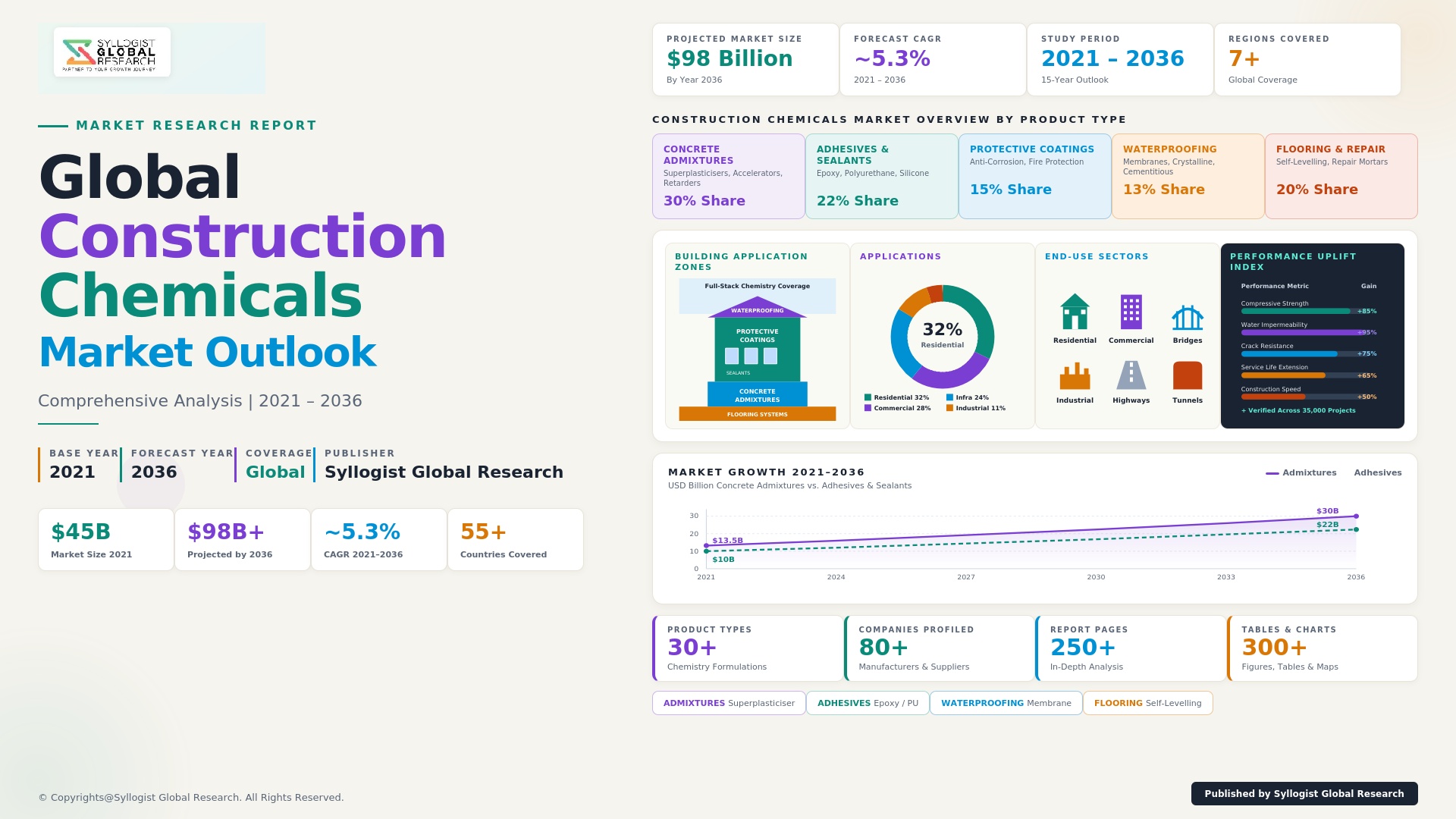
The global construction chemicals market is advancing through a structural growth phase shaped by intensifying urbanisation across emerging economies, expanding infrastructure pipelines in advanced economies, and a measurable shift toward higher specification material systems demanded by green building codes and asset durability targets. The market was valued at approximately USD 53.9 billion in 2025 and is projected to reach USD 88.5 billion by 2034, advancing at a compound annual growth rate of 6.4% through the forecast period, as project owners transition from commodity grade chemistry inputs toward performance engineered specialty solutions that deliver demonstrable returns through longer service life, lower repair frequency, and accelerated construction schedules. Concrete admixtures represent the single largest product category, accounting for nearly 38% of global revenue, supported by sustained growth in ready mix concrete consumption, precast production, and high performance concrete deployment across tall buildings, transportation infrastructure, and energy generation facilities.
Asia Pacific dominates the global construction chemicals market with a revenue share exceeding 52%, anchored by the unprecedented scale of construction activity across China, India, Indonesia, Vietnam, and the broader ASEAN economic corridor, where government led infrastructure mandates, smart city programmes, and affordable housing initiatives generate durable end use demand. China alone accounts for close to 28% of global construction chemicals consumption, while India is registering the highest country level growth at a CAGR of 8.1%, driven by the National Infrastructure Pipeline, expressway expansion, metro rail networks, and the PM Awas Yojana housing programme. North America maintains a high value position underpinned by the Infrastructure Investment and Jobs Act allocation of USD 1.2 trillion across roads, bridges, water systems, and broadband connectivity, while Europe continues to evolve toward circular construction chemistry as the Construction Products Regulation tightens embodied carbon disclosure obligations across both new build and renovation projects.
A pronounced sustainability transition is reshaping product portfolios across the value chain, with low carbon and bio based admixtures, geopolymer binders, plant derived superplasticizers, and waterborne protective coatings capturing accelerating market share. Green construction chemistries now reduce volatile organic compound emissions by more than 80% relative to legacy solvent borne systems, supporting LEED, BREEAM, GRIHA, and DGNB certification pathways increasingly mandated by institutional investors, sovereign wealth funds, and corporate real estate occupiers committed to net zero pledges. Digitalisation is also entering specification workflows through BIM integrated product libraries, AI assisted concrete mix design platforms, smart embedded sensors that monitor concrete maturity and durability in real time, and digital twins that allow project owners to model long term performance under variable climate and load scenarios.
The competitive landscape is moderately consolidated, with the top 10 producers controlling close to 45% of global revenue, while a long tail of regional formulators and private label distributors serve localised contractor demand. Leading suppliers are differentiating through proprietary chemistry, technical service depth, applicator training programmes, and integrated digital specification platforms that lock in long term project specifications. Non residential construction, encompassing commercial offices, industrial facilities, hospitality, healthcare, and education infrastructure, accounts for around 41% of global construction chemicals consumption, while residential construction contributes 33% and civil infrastructure approximately 26%. The repair and rehabilitation segment is generating outsized growth across mature economies, where ageing concrete structures spanning bridges, parking facilities, marine assets, and water treatment plants require structural restoration chemistries, cathodic protection systems, and high performance protective coatings that command premium price points and recurring service revenues.
Key Drivers
Accelerating Urbanisation and Infrastructure Build Out Across Emerging Economies Driving Sustained Demand for Concrete Admixtures and Specialty Construction Chemistries
Urbanisation rates across Asia Pacific, the Middle East, and Africa are translating into multi decade construction pipelines covering metro rail, expressways, ports, airports, affordable housing, and integrated industrial townships that all require substantial volumes of admixtures, waterproofing systems, and protective coating solutions. The United Nations projects that 68% of the global population will live in urban areas by 2050, generating an estimated USD 94 trillion in cumulative global infrastructure investment requirement. India, China, Indonesia, Saudi Arabia, and the United Arab Emirates are anchoring this growth through sovereign infrastructure programmes that lock in multi year specification volumes, supplier prequalification frameworks, and project bank guarantees that favour scaled construction chemicals manufacturers with regional production footprints and proven technical service capability.
Rising Adoption of Green Building Standards and Embodied Carbon Disclosure Regulations Accelerating the Shift Toward Low Carbon and Bio Based Construction Chemistries
Regulatory mandates on embodied carbon, volatile organic compound limits, and construction waste minimisation are reshaping product specification across both public and private sector projects. The European Green Deal, LEED v5, BREEAM, GRIHA, Estidama Pearl Rating, and DGNB are pushing developers toward low VOC coatings, supplementary cementitious material admixtures, geopolymer binders, and recycled content systems that command premium margins and create durable competitive moats for innovation led suppliers. Corporate real estate occupiers committed to Science Based Targets initiative goals are now embedding embodied carbon thresholds into procurement tenders, effectively excluding suppliers that cannot deliver verifiable Environmental Product Declarations and life cycle assessment data for their chemistry portfolios.
Expansion of the Repair, Rehabilitation, and Asset Renewal Market in Mature Economies Underpinning Durable Demand for High Performance Specialty Chemistries
Ageing concrete infrastructure across North America, Western Europe, and Japan, with bridges, parking structures, marine ports, dams, tunnels, and water systems requiring restoration, is generating durable demand for repair mortars, cathodic protection chemicals, structural strengthening systems, fiber reinforced polymer composites, and corrosion inhibiting protective coatings. The American Society of Civil Engineers grades United States infrastructure at C, signalling a USD 9.1 trillion investment gap through 2033. European Union infrastructure renewal programmes, Japan’s national resilience mandate, and Australia’s transport infrastructure pipeline are reinforcing this trend, creating a recurring revenue stream that is materially less cyclical than new construction activity and supports premium price points across specialty repair chemistry portfolios.
Key Challenges
Volatile Raw Material Pricing and Petrochemical Feedstock Dependency Compressing Margins Across the Construction Chemicals Value Chain
The dependency of construction chemistries on upstream petrochemical feedstocks such as ethylene oxide, propylene, naphthalene, melamine, and acrylic monomers exposes formulators to recurring price swings driven by crude oil volatility, refinery outages, freight cost spikes, and currency fluctuation. Cement, fly ash, ground granulated blast furnace slag, and silica fume prices have also exhibited material volatility, complicating long term contracting and squeezing margins on fixed price construction supply agreements that typically span 18 to 36 months. The cost pass through window in the construction chemicals industry is structurally narrower than in upstream chemicals, leaving formulators with limited pricing flexibility when input costs surge in volatile market environments.
Stringent Environmental and Worker Safety Regulations Restricting Conventional Chemistries and Extending Product Reformulation Timelines
Restrictions on crystalline silica exposure, isocyanate handling, formaldehyde emissions, biocide residues, and high VOC solvents under REACH, TSCA, OSHA, and regional ecotoxicity frameworks are eroding the addressable market for legacy formulations. Reformulating products to comply with these regulations requires significant capital outlay across pilot lines, application trials, and certification testing, and obtaining clearance for new active ingredients can extend product development cycles by 24 to 48 months, delaying time to market. Compliance complexity is further amplified for multinational formulators that must navigate divergent regulatory frameworks across the European Union, the United States, India, China, and the Gulf Cooperation Council simultaneously.
Skilled Applicator Shortages and Inconsistent On Site Quality Control Limiting Realised Performance of Premium Construction Chemistries
The realised performance of specialty construction chemicals depends heavily on correctly trained applicators, controlled surface preparation, accurate dosing, and adherence to ambient temperature and humidity application windows. Persistent skilled labour shortages across major construction markets including the United States, Germany, the United Kingdom, Australia, and parts of the Middle East, combined with fragmented contractor structures and inconsistent on site supervision, lead to application failures, warranty claims, and growing reluctance from project owners to commit to premium specifications. This dynamic ultimately constrains the addressable market for advanced product portfolios and pressures suppliers to invest heavily in applicator certification, digital training, and on site technical service to protect product credibility and warranty exposure.
Market Segmentation
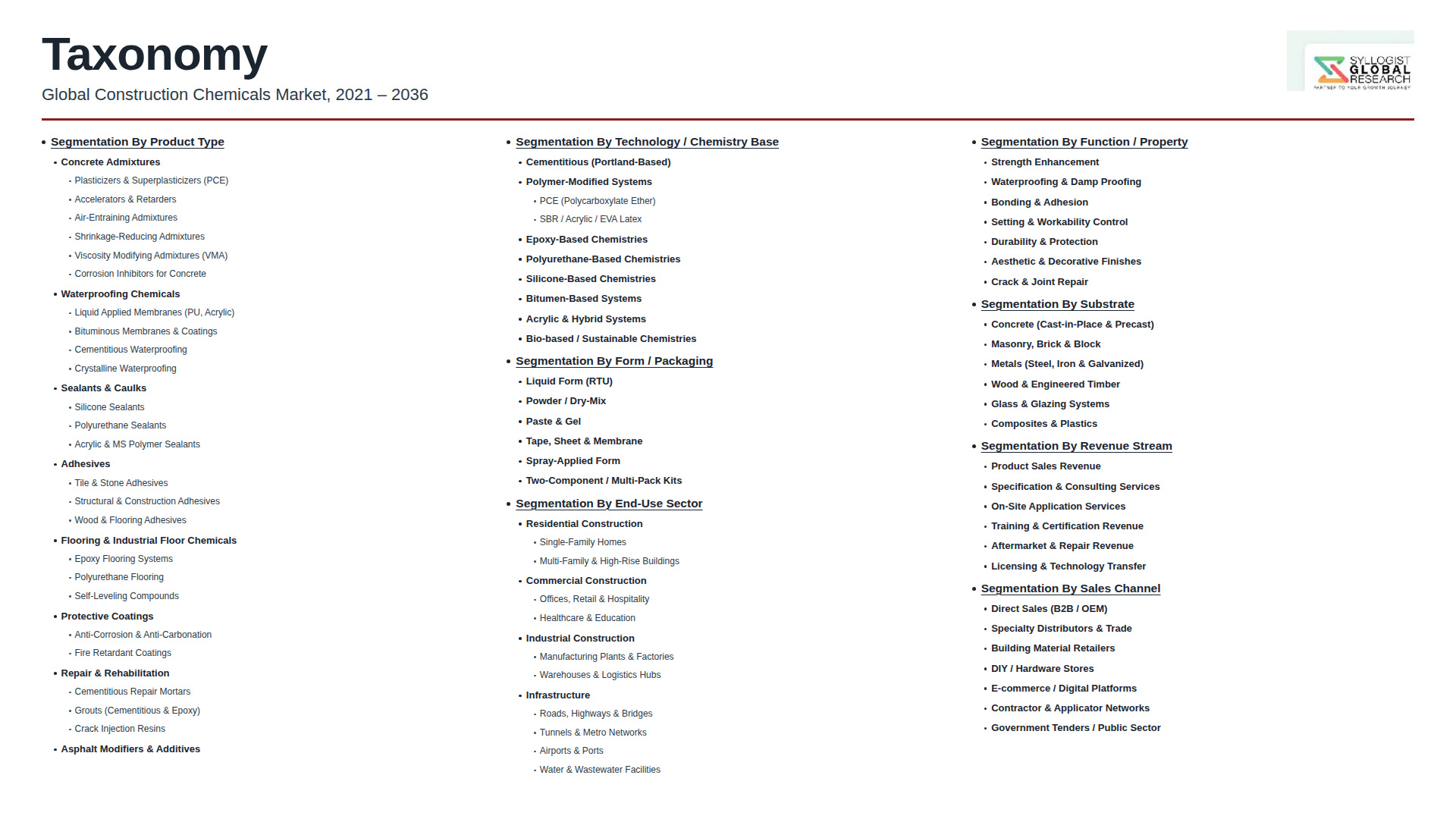
- Segmentation By Product Type
- Concrete Admixtures
- Waterproofing Chemicals
- Protective Coatings
- Adhesives and Sealants
- Repair Mortars and Grouts
- Flooring Chemicals
- Asphalt Modifiers
- Fiber Reinforcements
- Others
- Segmentation By Application
- Residential Buildings
- Commercial Buildings
- Industrial Facilities
- Infrastructure (Roads, Bridges, Tunnels, Metro Rail)
- Marine and Offshore Structures
- Water and Wastewater Treatment Plants
- Energy and Power Generation Facilities
- Others
- Segmentation By End User
- General Contractors and Engineering, Procurement, and Construction Firms
- Ready Mix Concrete Producers
- Precast and Prefabricated Concrete Manufacturers
- Specialty Applicators and Repair Contractors
- Government and Public Sector Infrastructure Agencies
- Private Real Estate Developers
- Others
- Segmentation By Construction Type
- New Construction
- Repair, Rehabilitation, and Renovation
- Segmentation By Function
- Workability and Setting Control
- Waterproofing and Damp Proofing
- Surface Protection and Aesthetics
- Structural Bonding and Anchoring
- Corrosion Protection
- Insulation and Thermal Performance
- Others
- Segmentation By Distribution Channel
- Direct Sales and Project Tenders
- Distributors and Dealer Networks
- E commerce and Online Platforms
- Original Equipment Manufacturer Partnerships
- Specialty Building Material Retailers
- Segmentation By Region
- North America
- Europe
- Asia Pacific
- Middle East and Africa
- Latin America
All market revenues are presented in USD
Historical Year: 2021-2024 | Base Year: 2025 | Estimated Year: 2026 | Forecast Period: 2027-2034
Key Questions this Study Will Answer
- What is the total global market valuation of the Construction Chemicals Market in 2025, projected through 2034, disaggregated by product type, application, and region, enabling chemical manufacturers, investors, and EPC firms to identify highest growth segments and most durable revenue opportunities across the construction value chain?
- How are Asia Pacific, North America, and European construction chemicals markets evolving in response to differing infrastructure programmes, urbanisation rates, and green building regulations, and which country level markets are setting the technical specification benchmarks for global chemistry adoption through 2034?
- Which product segments, including concrete admixtures, waterproofing membranes, protective coatings, adhesives, sealants, and repair mortars, are delivering the highest growth and margin profile, and which innovations in superplasticizer chemistry, geopolymer binders, and bio based formulations are reshaping competitive differentiation among multinational and regional suppliers?
- How are green building certifications such as LEED, BREEAM, GRIHA, DGNB, and Estidama, alongside embodied carbon disclosure mandates, reshaping product specification, premium pricing power, and addressable market share for low VOC, low carbon, and bio based construction chemistries across both new build and renovation projects?
- What is the structure of the competitive landscape across multinational chemical majors, regional formulators, and specialty applicator service providers, and what partnership, acquisition, and capacity expansion strategies are enabling leading suppliers to defend share against price competition and private label entrants?
- How is the repair, rehabilitation, and asset renewal segment evolving across mature economies, and which structural strengthening, corrosion protection, and high performance restoration chemistries are capturing the largest share of infrastructure renewal budgets through the forecast period?
- What raw material cost dynamics, petrochemical feedstock dependencies, freight and energy cost pressures, and currency fluctuations are reshaping margin structures across the construction chemicals value chain, and how are leading suppliers responding through vertical integration, pricing discipline, and product portfolio rebalancing?
- Which digitalisation themes, including BIM integrated product libraries, smart concrete sensors, AI assisted mix design platforms, and digital twins for asset durability modelling, are emerging as competitive differentiators, and how are early adopters monetising data driven service offerings alongside product sales?
- What regulatory developments under REACH, TSCA, OSHA, and regional ecotoxicity frameworks are constraining conventional chemistries, and how should formulators sequence reformulation investments, regulatory clearance applications, and customer education programmes to manage transition risk effectively?
- Which strategic partnerships, joint ventures, mergers and acquisitions, technology licensing arrangements, and capacity expansions are reshaping the global construction chemicals landscape, and what entry barriers, technical know how requirements, and customer relationship dynamics face new participants seeking to scale globally through 2034?
- Product Definition
- Research Methodology
- Research Design & Framework
- Overall Research Approach: Descriptive, Exploratory & Quantitative Mixed-Method Design
- Market Definition & Scope Boundaries: What is Included and Excluded
- Segmentation Framework
- Key Research Assumptions & Limitations
- Secondary Research
- Primary Research Design & Execution
- Data Triangulation & Validation
- Market Sizing & Forecasting Methodology
- Competitive Intelligence Methodology
- Quality Assurance & Peer Review
- Definitions, Abbreviations & Data Notes
- Research Design & Framework
- Executive Summary
- Market Snapshot & Headline Numbers
- Key Findings & Research Highlights
- Market Dynamics
- Regional Market Summary
- Competitive Landscape Snapshot
- Technology & Innovation Highlights
- Market Dynamics
- Drivers
- Restraints
- Opportunities
- Challenges
- Porter’s Five Forces Analysis
- PESTLE Analysis
- Market Trends & Developments
- Emerging Trends
- Technological Developments
- Regulatory & Policy Changes
- Supply Chain & Sourcing Trends
- Manufacturing & Process Trends
- Investment & Funding Activity
- Sustainability & ESG Trends
- Risk Assessment Framework
- Cement, Clinker, Aggregate & Petrochemical Feedstock Price Volatility Risk
- Construction Cycle Sensitivity, Real Estate Slowdown & Infrastructure Capex Timing Risk
- Embodied Carbon, Low-Carbon Cement Transition & Decarbonization Compliance Risk
- VOC Emissions, Hazardous Chemical Restriction & Worker Health and Safety Risk
- Counterfeit Product, Distributor Channel Quality & Brand Protection Risk
- Regulatory Framework & Standards
- EU Construction Products Regulation (CPR), CE Marking & National Building Code Compliance
- ASTM, EN, ISO & National Standards for Admixtures, Sealants, Waterproofing and Flooring Chemicals
- Green Building Rating Systems: LEED, BREEAM, EDGE, IGBC, GBI and Environmental Product Declarations (EPDs)
- REACH, TSCA, K-REACH, VOC Emission Limits & Indoor Air Quality Standards (CDPH 01350)
- Worker Safety, GHS Hazard Classification, Substances of Very High Concern (SVHC) & ESG Disclosure Standards
- Global Construction Chemicals Market Outlook
- Market Size & Forecast by Value
- Market Size & Forecast by Volume (Kilotons)
- Market Size & Forecast by Product Type
- Concrete Admixtures (Superplasticizers, Plasticizers, Accelerators, Retarders, Air-Entrainers, VMA, Shrinkage Reducers)
- Waterproofing Chemicals (Crystalline, Cementitious, Liquid-Applied Membranes, Bituminous, PU, Acrylic)
- Repair Mortars, Grouts, Micro-Concrete and Anchoring Compounds
- Adhesives and Sealants (Epoxy, Polyurethane, MS Polymer, Silicone, Acrylic)
- Industrial Flooring Chemicals (Epoxy, Polyurethane, Polyaspartic, MMA, Cementitious Self-Levelling)
- Protective and Decorative Coatings (Corrosion, Fire Retardant, Anti-Graffiti, Decorative)
- Tile Adhesives and Grouts
- Asphalt Modifiers and Pavement Chemicals (Polymer-Modified Bitumen, SBS, SBR, EVA)
- Cement Grinding Aids and Supplementary Cementitious Material Activators
- Surface Hardeners, Densifiers, Form Release Agents and Curing Compounds
- Market Size & Forecast by Chemistry
- Polycarboxylate Ether (PCE) Superplasticizers
- Sulfonated Naphthalene Formaldehyde (SNF) and Sulfonated Melamine Formaldehyde (SMF)
- Lignosulfonate and Modified Lignosulfonate Plasticizers
- Epoxy and Modified Epoxy Resin Systems
- Polyurethane and Hybrid Polyurethane Systems
- Acrylic, Styrene-Acrylic and Vinyl Acrylic Polymers
- Bitumen, Bituminous Emulsions and Polymer-Modified Bitumen
- Silicone, Silane and Siloxane-Based Systems
- Cementitious and Mineral-Based Systems
- Bio-Based and Renewable Feedstock Systems
- Market Size & Forecast by Function
- Water Reduction and Workability Enhancement
- Setting Time Acceleration and Retardation
- Strength and Durability Enhancement
- Waterproofing and Water Repellence
- Adhesion Promotion and Bonding
- Surface Protection, Sealing and Coating
- Crack Repair and Structural Strengthening
- Corrosion Protection of Reinforcement
- Market Size & Forecast by Physical Form
- Liquid Construction Chemicals
- Powder and Dry-Mix Construction Chemicals
- Paste and Gel Construction Chemicals
- Granular and Solid Construction Chemicals
- Spray and Aerosol Construction Chemicals
- Market Size & Forecast by Construction Type
- New Construction
- Repair, Renovation and Restoration
- Precast and Modular Construction
- 3D Printed and Robotic Construction
- Market Size & Forecast by Application
- Residential Construction
- Commercial Construction (Offices, Retail, Hospitality, Education)
- Industrial Construction (Factories, Warehouses, Logistics, Data Centers)
- Infrastructure (Roads, Highways, Bridges, Tunnels, Airports)
- Water and Wastewater Infrastructure
- Energy and Power Infrastructure (Wind, Solar, Hydro, Nuclear)
- Marine, Port and Offshore Construction
- Mining, Tunneling and Underground Construction
- Precast Concrete Element Manufacturing
- Market Size & Forecast by End-User
- Ready-Mix Concrete Producers
- Precast Concrete Element Manufacturers
- General Construction Contractors
- Specialty Construction Contractors (Waterproofing, Flooring, Repair)
- Architects, Specifiers and Consulting Engineers
- Building Owners and Facility Management Operators
- Government Infrastructure Authorities and Public Works Departments
- Tile Setters, Floor Installers and Finishing Contractors
- Cement and Concrete Product Manufacturers
- Mining, Tunneling and Heavy Civil Contractors
- Market Size & Forecast by Sales Channel
- Direct Sales to Concrete Producers, Contractors and Project Owners
- Distributor, Dealer and Specialty Building Materials Channel
- Retail and DIY Home Improvement Channel
- Digital, E-Commerce and B2B Construction Procurement Platforms
- North America Construction Chemicals Market Outlook
- Market Size & Forecast
- By Value
- By Volume (Kilotons)
- By Product Type
- By Chemistry
- By Function
- By Physical Form
- By Construction Type
- By Application
- By End-User
- By Country
- By Sales Channel
- Market Size & Forecast
- Europe Construction Chemicals Market Outlook
- Market Size & Forecast
- By Value
- By Volume (Kilotons)
- By Product Type
- By Chemistry
- By Function
- By Physical Form
- By Construction Type
- By Application
- By End-User
- By Country
- By Sales Channel
- Market Size & Forecast
- Asia-Pacific Construction Chemicals Market Outlook
- Market Size & Forecast
- By Value
- By Volume (Kilotons)
- By Product Type
- By Chemistry
- By Function
- By Physical Form
- By Construction Type
- By Application
- By End-User
- By Country
- By Sales Channel
- Market Size & Forecast
- Latin America Construction Chemicals Market Outlook
- Market Size & Forecast
- By Value
- By Volume (Kilotons)
- By Product Type
- By Chemistry
- By Function
- By Physical Form
- By Construction Type
- By Application
- By End-User
- By Country
- By Sales Channel
- Market Size & Forecast
- Middle East & Africa Construction Chemicals Market Outlook
- Market Size & Forecast
- By Value
- By Volume (Kilotons)
- By Product Type
- By Chemistry
- By Function
- By Physical Form
- By Construction Type
- By Application
- By End-User
- By Country
- By Sales Channel
- Market Size & Forecast
- Country-Wise* Construction Chemicals Market Outlook
- Market Size & Forecast
- By Value
- By Volume (Kilotons)
- By Product Type
- By Chemistry
- By Function
- By Physical Form
- By Construction Type
- By Application
- By End-User
- By Country
- By Sales Channel
- Market Size & Forecast
- *Countries Analyzed in the Global Research Portfolio: United States, Canada, Mexico, Germany, France, United Kingdom, Netherlands, Spain, Italy, Norway, Sweden, China, Japan, India, Australia, South Korea, Singapore, Brazil, Chile, Saudi Arabia, UAE, Egypt, South Africa, Israel
- Technology Landscape & Innovation Analysis
- Next-Generation Polycarboxylate Ether (PCE) Superplasticizer Chemistry for Low-Carbon Cement Systems
- Self-Healing Concrete Technology (Microencapsulated, Bacterial, Crystalline Admixtures)
- Nano-Additive Technology (Nano-Silica, Nano-Clay, Carbon Nanotubes) for Concrete Performance
- 3D Printing Concrete Admixture and Robotic Construction Chemistry Technology
- CO2-Cured Concrete, Carbon Sequestration Admixture and Low-Carbon Binder Compatibility Technology
- Bio-Based Polymers, Renewable Feedstock and Circular Construction Chemical Technology
- Waterborne, Low-VOC and Solvent-Free Coating, Sealant and Adhesive Technology
- Smart Coating, Anti-Microbial Surface and Photocatalytic (Self-Cleaning) Construction Chemical Technology
- Digital Construction, BIM Integration and IoT-Enabled Chemical Dosing Technology
- Patent & IP Landscape in Construction Chemical Formulation and Application Technology
- Value Chain & Supply Chain Analysis
- Petrochemical Feedstock (Ethylene, Propylene, Acrylic, Epoxy Precursors) Supply Chain
- Cement, Clinker, Aggregate and Mineral Admixture Raw Material Supply Chain
- Specialty Polymer, Surfactant and Functional Additive Manufacturing Footprint
- Construction Chemical Manufacturing, Blending and Toll Production Landscape
- Distributor, Dealer, Retail and Specialty Building Materials Channel Landscape
- Concrete Producer, Contractor and Project Procurement Channel
- Logistics, Hazmat Transportation and Cross-Border Construction Chemical Trade
- Packaging, Bulk Handling and On-Site Storage Considerations
- Pricing Analysis
- Concrete Admixture Pricing by Chemistry (PCE, SNF, SMF, Lignosulfonate)
- Waterproofing Chemical Pricing by Technology (Crystalline, Membrane, Liquid-Applied)
- Industrial Flooring Chemical Pricing by Resin Type (Epoxy, PU, Polyaspartic, MMA)
- Adhesive, Sealant and Tile Adhesive Pricing by Application
- Repair Mortar, Grout and Anchoring Compound Pricing Analysis
- Total Cost of Ownership: Construction Chemical Spend versus Lifecycle and Maintenance Savings
- Sustainability & Environmental Analysis
- Lifecycle Assessment (LCA) of Construction Chemicals: Carbon Footprint, Embodied Energy and EPD Disclosure
- Contribution to Low-Carbon Concrete, SCM-Activation and Net Zero Cement Pathway
- Bio-Based, Renewable Feedstock and Circular Construction Chemistry Commercial Readiness
- VOC Reduction, Indoor Air Quality and Worker Health Compliance Considerations
- Green Building Certification Alignment (LEED, BREEAM, EDGE, IGBC) and Sustainable Procurement Standards
- Competitive Landscape
- Market Structure & Concentration
- Market Consolidation Level (Fragmented vs. Consolidated by Product Type & Geography)
- Top 10 Players Market Share
- HHI (Herfindahl-Hirschman Index) Concentration Analysis
- Competitive Intensity Map by Product Type, Application & Geography
- Player Classification
- Integrated Construction Chemical Majors with Full-Range Portfolios
- Concrete Admixture Specialists and Superplasticizer Manufacturers
- Waterproofing and Sealant Specialists
- Industrial Flooring and Protective Coating Specialists
- Adhesive, Sealant and Tile-Setting Material Manufacturers
- Cement Producers with Captive Construction Chemical Divisions
- Repair Mortar, Grout and Structural Strengthening Specialists
- Regional and National Construction Chemical Manufacturers
- Bio-Based and Sustainable Construction Chemical Innovators
- Competitive Analysis Frameworks
- Market Share Analysis by Product Type, Application & Region
- Company Profile
- Company Overview & Headquarters
- Construction Chemical Products & Technology Portfolio
- Key Customer Relationships & Reference Project Installations
- Manufacturing Footprint & Production Capacity
- Revenue (Construction Chemicals Segment) & Backlog
- Technology Differentiators & IP
- Key Strategic Partnerships, JVs & M&A Activity
- Recent Developments (Contract Wins, Capacity Expansion, Product Launches)
- SWOT Analysis
- Strategic Focus Areas & Roadmap
- Competitive Positioning Map (Technology Capability vs. Market Penetration)
- Key Company Profiles
- Market Structure & Concentration
- Technology Landscape & Innovation Analysis
- Strategic Output
- Market Opportunity Matrix: By Product Type, Chemistry, Application, End-User & Geography
- White Space Opportunity Analysis
- Strategic Recommendations
- Product Portfolio & Technology Investment Strategy
- Manufacturing & Operational Excellence Strategy
- Geographic Expansion & Localisation Strategy
- Customer & End-User Engagement Strategy
- Partnership, M&A & Ecosystem Strategy
- Sustainability & Circular Economy Strategy
- Risk Mitigation & Future Roadmap
- Strategic Priority Matrix & Roadmap
- Near-term (2025-2028)
- Mid-term (2029-2032)
- Long-term (2033-2037)