Global Dietary Supplements Market By Ingredient, By Form, By Application, By Type, By End User, By Distribution Channel, By Region, Competition, Forecast & Opportunities, 2021-2034F
Market Definition
Dietary supplements are orally administered nutritional products formulated to supply vitamins, minerals, amino acids, botanical extracts, enzymes, probiotics, omega fatty acids, and other bioactive compounds that supplement daily dietary intake and address nutritional gaps across broad consumer populations. The Global Dietary Supplements Market encompasses the formulation, manufacturing, encapsulation, packaging, branding, distribution, and retail sale of tablets, capsules, softgels, gummies, powders, liquids, and effervescent formats consumed to support immunity, energy, bone health, gut health, cognitive function, sports performance, weight management, and preventive wellness.
The dietary supplements market covers products supplied across over-the-counter and prescribed channels, spanning single-nutrient and multi-nutrient formulations sold through pharmacies, drugstores, supermarkets, specialty nutrition retailers, direct selling networks, and e-commerce platforms. Market participants within the dietary supplements market include ingredient suppliers, contract manufacturers, branded supplement companies, private label producers, nutraceutical formulators, and multichannel distributors serving retail, clinical, and direct-to-consumer demand. End users of the dietary supplements market span adults, geriatric consumers, pregnant and lactating women, children, athletes, and fitness-focused populations pursuing targeted nutritional outcomes. The dietary supplements market explicitly excludes conventional pharmaceutical drugs, fortified staple foods, infant formula, and medical nutrition administered under clinical supervision, focusing exclusively on supplement formats consumed to complement dietary intake and support consumer health, wellness, and preventive nutrition objectives across global and regional demand centers.
Market Insights
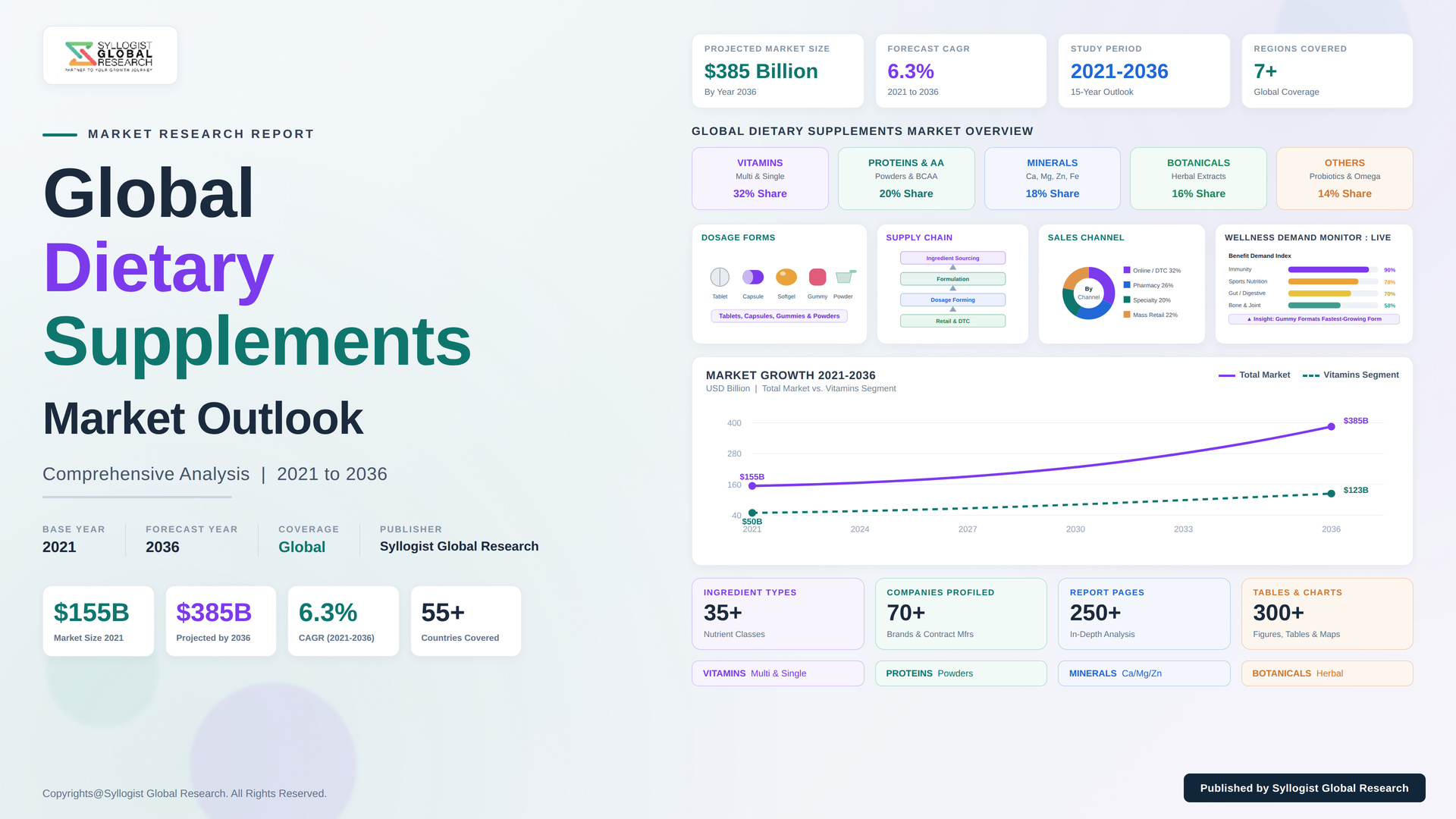
The global dietary supplements market is entering a sustained expansion phase, shaped by rising preventive healthcare awareness, accelerating demand for immunity and gut health formulations, expanding sports nutrition consumption, aging demographics, and the rapid migration of supplement purchasing toward digital and direct-to-consumer channels. The dietary supplements market was valued at USD 203.4 billion in 2025 and is projected to reach USD 441.8 billion by 2034, advancing at a compound annual growth rate of 9.0% through the forecast period, as consumers across North America, Europe, Asia-Pacific, the Middle East, and Latin America adopt daily supplementation for nutritional gaps, chronic disease prevention, and targeted wellness outcomes. Sustained double-digit growth in immunity, gut health, and sports nutrition formulations, combined with the structural shift of purchasing toward online and direct-to-consumer channels, continues to widen the addressable base of the dietary supplements market across both developed and high-growth emerging economies.
The dietary supplements market trajectory is being reshaped by the commercial maturation of personalized nutrition, clean-label and plant-based formulations, condition-specific botanical blends, and gummy and effervescent delivery formats that widen consumer adoption beyond traditional tablet and capsule users. Vitamins account for the largest ingredient share within the dietary supplements market, with vitamin D, vitamin C, and B-complex products sustaining high repeat purchase rates driven by immunity, bone health, and energy metabolism demand. Botanical and herbal ingredients including ashwagandha, turmeric, and mushroom extracts represent the fastest expanding ingredient category within the dietary supplements market, supported by consumer preference for natural, traditional, and clinically substantiated formulations.
Vitamins represent the largest ingredient segment within the dietary supplements market, while proteins and amino acids and botanicals record the fastest growth as sports nutrition and herbal wellness demand scales globally. Tablets remain the largest format within the dietary supplements market, supported by dosage accuracy, shelf stability, and cost efficiency, while liquid, gummy, and powder formats capture accelerating consumer preference for convenience and palatability. Over-the-counter products dominate the dietary supplements market with the majority of revenue, reflecting easy accessibility and preventive purchasing behavior, while prescribed and clinically recommended supplements gain traction as nutritional deficiency diagnosis expands. The adult consumer segment contributes the largest share of the dietary supplements market, while geriatric and sports-focused populations record intensifying demand. Online and e-commerce distribution is the fastest expanding channel within the dietary supplements market, supported by younger consumers, subscription models, and cross-border access, while pharmacies and drugstores retain a leading share through consumer trust and professional recommendation across the dietary supplements market.
North America represents a leading regional market within the dietary supplements market, supported by high per capita supplement consumption, an established preventive healthcare culture, and strong direct selling and e-commerce infrastructure across the United States and Canada. Asia-Pacific has emerged as the fastest expanding regional position within the dietary supplements market, driven by rising disposable incomes, traditional herbal supplement heritage, and rapid e-commerce penetration across China, India, Japan, and Southeast Asia. Europe holds a substantial position within the dietary supplements market, supported by aging demographics, regulated quality standards, and steady demand for bone health, cognitive, and immunity formulations across Germany, the United Kingdom, France, and Italy, while the Middle East, Africa, and Latin America record steady growth within the dietary supplements market driven by expanding retail access and rising health awareness.
Key Drivers
Rising Preventive Healthcare Awareness, Immunity Demand, and High Nutritional Deficiency Prevalence Driving Sustained Dietary Supplements Consumption
The structural shift of consumer behavior toward preventive healthcare, the durable elevation of immunity awareness following the pandemic period, and the widespread prevalence of nutritional deficiencies caused by processed diets and demanding lifestyles are generating sustained consumption demand across the dietary supplements market. Consumers are increasingly treating daily supplementation as a routine health practice rather than an occasional purchase, driving repeat consumption of vitamins, minerals, and immunity-focused formulations across all major demand centers. Deficiencies in vitamin D, vitamin B12, iron, and calcium remain prevalent across both developed and emerging markets, reinforcing consistent demand for corrective and maintenance supplementation within the dietary supplements market. The rising incidence of lifestyle-related chronic conditions including diabetes, cardiovascular disorders, and obesity is prompting healthcare practitioners and consumers to adopt nutritional supplementation as a complementary preventive measure. Growing health literacy, supported by digital wellness platforms and social media education, is expanding consumer understanding of micronutrient roles and accelerating adoption of condition-specific formulations. This preventive orientation is broadening the consumer base of the dietary supplements market beyond traditional health-conscious buyers into mainstream household purchasing, anchoring long-duration demand visibility for branded supplement companies, contract manufacturers, and ingredient suppliers operating across the dietary supplements market value chain.
Expanding Sports Nutrition, Fitness Culture, and Protein Supplement Consumption Driving High-Growth Product Category Demand
The rapid expansion of fitness culture, the mainstreaming of sports nutrition beyond professional athletes, and the accelerating consumption of protein and amino acid formulations are driving high-growth demand across the dietary supplements market. Rising participation in gym-based training, running, and active lifestyle pursuits is expanding the consumer base for performance, recovery, and endurance supplements across younger and working-age populations. Protein powders, creatine, branched-chain amino acids, and collagen formulations are recording strong consumption growth within the dietary supplements market, supported by demand for muscle maintenance, recovery, and body composition management. The entry of women into fitness and strength training is materially broadening the addressable base of the dietary supplements market, generating demand for formulations tailored to female physiology and wellness goals. Social media fitness influencers, celebrity supplement brand launches, and direct-to-consumer nutrition startups are amplifying category visibility and accelerating trial across new consumer cohorts. Convenient formats including ready-to-mix powders, functional gummies, and single-serve sachets are removing consumption friction and expanding daily usage occasions within the dietary supplements market. This structural fitness-driven demand is supporting premium pricing, portfolio diversification, and sustained volume growth for supplement companies competing across the sports nutrition and active wellness segments of the dietary supplements market.
Aging Demographics, Personalized Nutrition, and E-Commerce Channel Expansion Broadening Reach Across the Dietary Supplements Market
The irreversible aging of the global population, the commercial rise of personalized nutrition, and the rapid expansion of e-commerce distribution are collectively broadening consumer reach and deepening demand across the dietary supplements market. The population aged 65 and above represents a high-consumption demographic within the dietary supplements market, driving sustained demand for bone health, joint health, cognitive, and cardiac wellness formulations as consumers pursue healthy aging outcomes. Personalized nutrition, enabled by data-driven health assessments, subscription models, and condition-specific formulation, is shifting the dietary supplements market toward higher-value, targeted, and recurring-revenue product offerings. Digital health platforms and artificial intelligence tools are enabling supplement companies to match formulations to individual nutritional profiles, increasing consumer engagement and retention across the dietary supplements market. The rapid growth of online and direct-to-consumer channels is removing geographic and retail access barriers, enabling supplement brands to reach consumers in tier-two cities and underserved regions across the dietary supplements market. Cross-border e-commerce is further expanding access to premium and specialized formulations, particularly in high-growth Asia-Pacific markets. The convergence of aging demand, personalization, and digital distribution is expanding both the volume and value trajectory of the dietary supplements market, supporting durable revenue growth across branded, private label, and specialty supplement participants.
Key Challenges
Fragmented and Tightening Regulatory Frameworks, Labeling Compliance Requirements, and Quality Assurance Burden Constraining Market Participants
Fragmented regulatory frameworks across geographies, tightening labeling and health claim compliance requirements, and the escalating quality assurance burden are generating substantial operational and cost challenges across the dietary supplements market. Regulatory treatment of supplements varies widely between regions, with divergent rules governing permissible ingredients, dosage limits, health claims, and product registration creating complexity for companies pursuing multi-market distribution within the dietary supplements market. Tightening enforcement around unsubstantiated health claims, structure-function labeling, and ingredient safety is increasing compliance costs and legal exposure for supplement companies operating across the dietary supplements market. Good manufacturing practice requirements, third-party testing expectations, and traceability mandates are raising the quality assurance burden, particularly for smaller manufacturers with limited compliance infrastructure. The absence of harmonized global standards forces supplement companies to maintain region-specific formulations, labeling, and documentation, increasing complexity and slowing new product launches within the dietary supplements market. Regulatory scrutiny of novel ingredients, botanical extracts, and imported products can delay market entry and constrain innovation velocity. These evolving and inconsistent regulatory conditions collectively raise the cost of doing business, limit scalability for emerging players, and constrain the pace at which supplement companies can expand product portfolios and geographic reach across the dietary supplements market.
Product Efficacy Skepticism, Adulteration Risk, and Consumer Trust Erosion Limiting Category Confidence
Persistent skepticism regarding product efficacy, recurring incidents of adulteration and mislabeling, and the resulting erosion of consumer trust are constraining category confidence across the dietary supplements market. Because supplements are not required to demonstrate the clinical efficacy standards applied to pharmaceutical drugs, a portion of consumers and healthcare professionals remain skeptical of health benefit claims, limiting conversion and repeat purchase within segments of the dietary supplements market. Documented cases of adulteration, undeclared ingredients, contamination, and inaccurate potency labeling have generated negative publicity that undermines consumer confidence across the dietary supplements market. The proliferation of low-quality and counterfeit products through unregulated online channels further amplifies quality and safety concerns within the dietary supplements market, particularly in fast-growing emerging regions. Inconsistent scientific substantiation behind certain botanical and specialty ingredients complicates efficacy messaging and exposes brands to reputational and regulatory risk. Building and maintaining consumer trust therefore requires sustained investment in clinical validation, transparent labeling, third-party certification, and quality traceability, raising the cost base for reputable supplement companies within the dietary supplements market. This trust deficit constrains premium adoption, elongates purchase decision cycles, and pressures brands to differentiate on credibility and evidence across the dietary supplements market.
Price Sensitivity, Ingredient Cost Volatility, and Intense Market Fragmentation Pressuring Margins and Brand Differentiation
Consumer price sensitivity, volatility in raw ingredient costs, and intense fragmentation among competing brands are pressuring margins and complicating differentiation across the dietary supplements market. A large share of consumers treat supplements as discretionary spending, making demand sensitive to pricing, economic cycles, and household budget pressures within the dietary supplements market. Volatility in the cost of key inputs including botanical extracts, vitamins, proteins, and specialty actives, driven by agricultural supply variability, currency movements, and supply chain disruption, compresses manufacturer margins across the dietary supplements market. The low barriers to entry in branding and private label supply have produced a highly fragmented dietary supplements market populated by numerous regional and online brands competing aggressively on price and marketing. This fragmentation intensifies customer acquisition costs, dilutes brand loyalty, and pressures established players to sustain heavy marketing and promotional spending within the dietary supplements market. Private label expansion by pharmacies, retailers, and e-commerce platforms is further intensifying pricing competition and eroding differentiation for branded supplement companies. Sustaining margin, brand equity, and shelf presence in this environment requires continuous product innovation, formulation differentiation, and marketing investment, raising the operating cost base and challenging profitability for participants competing across the crowded and price-sensitive dietary supplements market.
Market Segmentation
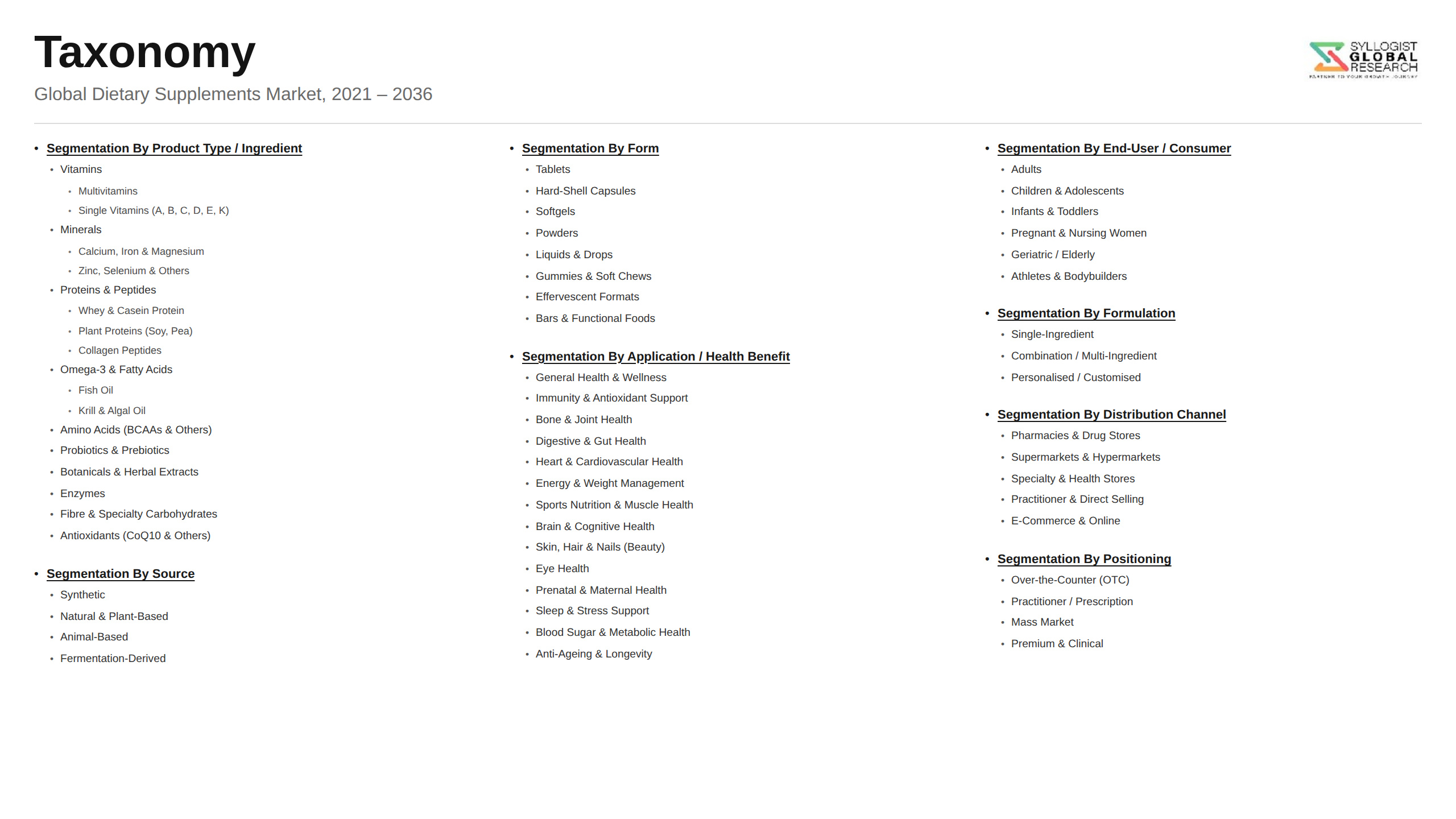
- Segmentation By Ingredient
- Vitamins
- Minerals
- Proteins and Amino Acids
- Botanicals and Herbal Extracts
- Probiotics
- Omega Fatty Acids
- Enzymes
- Others
- Segmentation By Form
- Tablets
- Capsules
- Softgels
- Gummies
- Powders
- Liquids
- Others
- Segmentation By Application
- Immunity
- Bone and Joint Health
- Gut and Digestive Health
- Energy and Weight Management
- Cognitive Health
- General Wellness
- Sports Nutrition
- Others
- Segmentation By Type
- Over-the-Counter (OTC)
- Prescribed
- Segmentation By End User
- Adults
- Geriatric
- Pregnant and Lactating Women
- Children
- Athletes and Fitness Consumers
- Others
- Segmentation By Distribution Channel
- Pharmacies and Drugstores
- Supermarkets and Hypermarkets
- Specialty Nutrition Stores
- Direct Selling
- Online and E-Commerce
- Others
- Segmentation By Region
- North America
- Europe
- Asia-Pacific
- Middle East and Africa
- Latin America
All market revenues are presented in USD
Historical Year: 2021-2024 | Base Year: 2025 | Estimated Year: 2026 | Forecast Period: 2027-2034
Key Questions this Study Will Answer
- What is the total global market valuation of the Dietary Supplements Market in 2025, projected through 2034, segmented by ingredient, form, application, type, and distribution channel, enabling supplement manufacturers, ingredient suppliers, branded companies, and healthcare investors to identify highest-growth segments and the most durable revenue opportunities across the dietary supplements market?
- How are preventive healthcare awareness, immunity demand, sports nutrition consumption, and aging demographics shaping the pace and geographic distribution of demand across mature and emerging regions of the dietary supplements market through 2034?
- Which ingredient categories, including vitamins, minerals, proteins and amino acids, botanicals, and probiotics, are gaining the strongest consumer traction across immunity, gut health, sports nutrition, and cognitive applications, and what formulation, efficacy, and clean-label factors are shaping product selection within the dietary supplements market?
- How are consumer preferences for personalized nutrition, plant-based formulations, and convenient delivery formats such as gummies, powders, and liquids reshaping product innovation, portfolio strategy, and premium positioning across the dietary supplements market?
- How is the competitive structure organized among ingredient suppliers, contract manufacturers, branded supplement companies, private label producers, and direct-to-consumer brands within the dietary supplements market, and what partnership, acquisition, and channel expansion strategies are enabling new entrants to compete against established players?
- What regulatory compliance, quality assurance, product efficacy, adulteration, and consumer trust factors are shaping brand differentiation, pricing power, and market access across the dietary supplements market, and how are leading companies mitigating these challenges?
- Which regional markets, including North America, Asia-Pacific, Europe, the Middle East and Africa, and Latin America, are projected to generate the largest incremental revenue opportunities through 2034, and what health awareness, disposable income, e-commerce penetration, and demographic factors are shaping investment priorities and competitive positioning in each regional dietary supplements market?
- Product Definition
- Research Methodology
- Research Design & Framework
- Overall Research Approach: Descriptive, Exploratory & Quantitative Mixed-Method Design
- Market Definition & Scope Boundaries: What is Included and Excluded
- Segmentation Framework
- Key Research Assumptions & Limitations
- Secondary Research
- Primary Research Design & Execution
- Data Triangulation & Validation
- Market Sizing & Forecasting Methodology
- Competitive Intelligence Methodology
- Quality Assurance & Peer Review
- Definitions, Abbreviations & Data Notes
- Executive Summary
- Market Snapshot & Headline Numbers
- Key Findings & Research Highlights
- Market Dynamics
- Regional Market Summary
- Competitive Landscape Snapshot
- Technology & Innovation Highlights
- Market Dynamics
- Drivers
- Restraints
- Opportunities
- Challenges
- Porter’s Five Forces Analysis
- PESTLE Analysis
- Market Trends & Developments
- Emerging Trends
- Technological Developments
- Regulatory & Policy Changes
- Supply Chain & Sourcing Trends
- Manufacturing & Process Trends
- Investment & Funding Activity
- Sustainability & ESG Trends
- Risk Assessment Framework
- Raw Material (Botanical, Vitamin) Price Volatility & Ingredient Cost Escalation Risk
- Regulatory Scrutiny, Health Claim Restriction & Product Approval Risk
- Product Safety, Adulteration, Contamination & Recall Liability Risk
- Ingredient Supply Concentration & Botanical Sourcing Dependence Risk
- Consumer Trust, Efficacy Perception & Demand Volatility Risk
- Regulatory Framework & Standards
- Dietary Supplement Registration, FDA DSHEA & EFSA Novel Food Standards
- Health Claim, Structure-Function Claim & Labelling Regulations
- Good Manufacturing Practice (GMP), Quality & Ingredient Purity Standards
- Botanical, Herbal & Traditional Medicine Ingredient Approval Frameworks
- Import-Export, Cross-Border & Novel Ingredient Compliance Regulations
- Global Dietary Supplements Market Outlook
- Market Size & Forecast by Value
- Market Size & Forecast by Volume (Dietary Supplements Consumed in Kilo Tonnes per Year and Product Units Sold in Billion Units per Year)
- Market Size & Forecast by Product Type
- Vitamins
- Minerals
- Botanicals and Herbal
- Amino Acids
- Proteins and Peptides
- Probiotics
- Omega-3 and Fatty Acids
- Enzymes
- Fibre and Specialty Carbohydrates
- Others
- Market Size & Forecast by Form
- Tablets
- Capsules
- Softgels
- Powders
- Gummies
- Liquids
- Soft Chews
- Others
- Market Size & Forecast by Application
- General Health and Wellness
- Immune Support
- Bone and Joint Health
- Heart Health
- Digestive Health
- Brain and Cognitive Health
- Energy and Weight Management
- Sports Nutrition
- Beauty (Skin, Hair, Nails)
- Others
- Market Size & Forecast by Consumer Group
- Adults
- Children
- Elderly (Geriatric)
- Pregnant Women
- Athletes and Bodybuilders
- Infants
- Others
- Market Size & Forecast by Source
- Animal-Based
- Plant-Based
- Synthetic
- Microbial and Fermentation-Derived
- Others
- Market Size & Forecast by Formulation
- Single-Ingredient
- Multi-Ingredient (Combination)
- Others
- Market Size & Forecast by Nature
- Conventional
- Organic
- Non-GMO
- Vegan
- Others
- Market Size & Forecast by Sales Channel
- Pharmacies and Drug Stores
- Health and Wellness Stores
- Supermarkets and Hypermarkets
- Online and E-commerce
- Direct Selling
- Practitioner and Clinic Channel
- Others
- North America Dietary Supplements Market Outlook
- Market Size & Forecast
- By Value
- By Volume (Dietary Supplements Consumed in Kilo Tonnes per Year and Product Units Sold in Billion Units per Year)
- By Product Type
- By Form
- By Application
- By Consumer Group
- By Source
- By Formulation
- By Nature
- By Country
- By Sales Channel
- Europe Dietary Supplements Market Outlook
- Market Size & Forecast
- By Value
- By Volume (Dietary Supplements Consumed in Kilo Tonnes per Year and Product Units Sold in Billion Units per Year)
- By Product Type
- By Form
- By Application
- By Consumer Group
- By Source
- By Formulation
- By Nature
- By Country
- By Sales Channel
- Asia-Pacific Dietary Supplements Market Outlook
- Market Size & Forecast
- By Value
- By Volume (Dietary Supplements Consumed in Kilo Tonnes per Year and Product Units Sold in Billion Units per Year)
- By Product Type
- By Form
- By Application
- By Consumer Group
- By Source
- By Formulation
- By Nature
- By Country
- By Sales Channel
- Latin America Dietary Supplements Market Outlook
- Market Size & Forecast
- By Value
- By Volume (Dietary Supplements Consumed in Kilo Tonnes per Year and Product Units Sold in Billion Units per Year)
- By Product Type
- By Form
- By Application
- By Consumer Group
- By Source
- By Formulation
- By Nature
- By Country
- By Sales Channel
- Middle East & Africa Dietary Supplements Market Outlook
- Market Size & Forecast
- By Value
- By Volume (Dietary Supplements Consumed in Kilo Tonnes per Year and Product Units Sold in Billion Units per Year)
- By Product Type
- By Form
- By Application
- By Consumer Group
- By Source
- By Formulation
- By Nature
- By Country
- By Sales Channel
- Country-Wise* Dietary Supplements Market Outlook
- Market Size & Forecast
- By Value
- By Volume (Dietary Supplements Consumed in Kilo Tonnes per Year and Product Units Sold in Billion Units per Year)
- By Product Type
- By Form
- By Application
- By Consumer Group
- By Source
- By Formulation
- By Nature
- By Country
- By Sales Channel
- Market Size & Forecast
- Market Size & Forecast
- Market Size & Forecast
- Market Size & Forecast
- Market Size & Forecast
- Market Size & Forecast
*Countries Analysed in the Global Research Portfolio: United States, Canada, Mexico, Germany, France, United Kingdom, Netherlands, Spain, Italy, Norway, Sweden, China, Japan, India, Australia, South Korea, Singapore, Brazil, Chile, Saudi Arabia, UAE, Egypt, South Africa, Israel
- Technology Landscape & Innovation Analysis
- Bioavailability Enhancement, Liposomal & Nano-Delivery Technology Deep-Dive
- Encapsulation, Controlled-Release & Taste-Masking Technology
- Gummy, Soft Chew & Novel Delivery Format Technology
- Personalised Nutrition, DNA-Based & AI Recommendation Technology
- Probiotic, Postbiotic & Microbiome-Targeted Formulation Technology
- Plant-Based, Fermentation & Precision-Fermented Ingredient Technology
- Clean-Label, Natural Preservation & Sustainable Formulation Technology
- Patent & IP Landscape in Dietary Supplements Technologies
- Value Chain & Supply Chain Analysis
- Botanical, Vitamin & Active Ingredient Raw Material Supply Chain
- Ingredient Extraction, Fermentation & Active Manufacturing Supply Chain
- Formulation, Blending & Contract Manufacturing Supply Chain
- Packaging, Filling & Private Label Manufacturing Supply Chain
- Brand, Distributor & Wholesaler Channel Network
- Retail, Pharmacy & E-commerce Consumer Channel
- Practitioner, Clinic & Direct Selling Channel Network
- Pricing Analysis
- Vitamin and Mineral Supplement Pricing Across Mass & Premium Tiers
- Botanical and Herbal Supplement Pricing Economics
- Protein and Sports Nutrition Pricing Analysis
- Gummy and Novel Format Pricing Premium Analysis
- Private Label vs Branded Supplement Pricing Differentials
- Raw Material Cost Pass-Through & Formulation Cost Economics
- Regional Pricing Benchmarks & Value-in-Use Pricing Models
- Sustainability & Environmental Analysis
- Lifecycle Assessment (LCA) of Dietary Supplements Across Sourcing & Production
- Sustainable Botanical Sourcing, Traceability & Ethical Supply Performance
- Clean-Label, Vegan & Plant-Based Formulation Performance
- Sustainable Packaging, Recyclability & Circular Economy Performance
- Regulatory-Driven Sustainability, SDG 3 (Good Health) & SDG 12 (Responsible Consumption) Alignment & Green Finance Eligibility
- Competitive Landscape
- Market Structure & Concentration
- Market Consolidation Level (Fragmented vs. Consolidated by Product Type & Geography)
- Top 10 Players Market Share
- HHI (Herfindahl-Hirschman Index) Concentration Analysis
- Competitive Intensity Map by Product Type, Application & Geography
- Player Classification
- Integrated Nutrition and Supplement Manufacturers
- Vitamin and Mineral Producers
- Botanical and Herbal Supplement Specialists
- Sports Nutrition and Protein Brands
- Probiotic and Microbiome Specialists
- Private Label and Contract Manufacturers
- Ingredient and Active Suppliers
- Distributors and Direct Selling Companies
- Competitive Analysis Frameworks
- Market Share Analysis by Product Type, Application & Region
- Company Profile
- Company Overview & Headquarters
- Dietary Supplements Product Portfolio
- Key Customer Relationships & Reference Retail Accounts
- Manufacturing Footprint & Production Capacity Coverage
- Revenue (Dietary Supplements Segment) & Order Backlog
- Technology Differentiators & IP
- Key Strategic Partnerships, JVs & M&A Activity
- Recent Developments (Product Launches, Capacity Expansion, Contract Wins)
- SWOT Analysis
- Strategic Focus Areas & Roadmap
- Competitive Positioning Map (Technology Capability vs. Market Penetration)
- Key Company Profiles
- Market Structure & Concentration
- Technology Landscape & Innovation Analysis
- Strategic Output
- Market Opportunity Matrix: By Product Type, Form, Application, Consumer Group & Geography
- White Space Opportunity Analysis
- Strategic Recommendations
- Product Portfolio & Formulation Innovation Strategy
- Manufacturing Excellence & Capacity Expansion Strategy
- Geographic Expansion & Localisation Strategy
- Customer & Channel Engagement Strategy
- Partnership, M&A & Ecosystem Strategy
- Sustainability & Clean-Label Strategy
- Risk Mitigation & Future Roadmap
- Strategic Priority Matrix & Roadmap
- Near-term (2025-2028)
- Mid-term (2029-2032)
- Long-term (2033-2037)