Saudi Arabia Downstream Chemicals Market By Product Type, By Feedstock, By Process Technology, By Application, By End User, By Region, Competition, Forecast & Opportunities, 2021-2034F
Market Definition
Downstream chemicals are value-added intermediate and derivative products manufactured by converting basic petrochemical building blocks, refinery streams, and natural gas liquids into higher-value materials used across packaging, construction, automotive, agriculture, and consumer goods industries within Saudi Arabia. The Saudi Arabia Downstream Chemicals Market covers the production, integration, and supply of polymers and plastics, aromatics derivatives, olefins derivatives, glycols, oxygenates, elastomers, and specialty and performance chemicals produced from ethylene, propylene, methanol, benzene, toluene, and xylene feedstock streams generated across integrated refining and petrochemical complexes. The Saudi Arabia downstream chemicals market includes polyethylene, polypropylene, monoethylene glycol, polyols, styrene, purified terephthalic acid, methyl tertiary butyl ether, and a broad set of derivative and conversion chemicals produced through steam cracking, catalytic conversion, and liquids-to-chemicals routes aligned with the Kingdom’s value-addition strategy.
Market participants in the Saudi Arabia downstream chemicals market include integrated petrochemical producers, refining-to-chemicals operators, specialty chemical manufacturers, converters, and derivative plant operators supplying domestic manufacturing and export markets. End users span packaging converters, construction material producers, automotive component manufacturers, agricultural input suppliers, textile producers, and consumer goods manufacturers consuming downstream chemical derivatives across the Kingdom. The Saudi Arabia downstream chemicals market excludes crude oil extraction, natural gas processing, standalone refining fuel output, and mineral mining, focusing exclusively on value-added downstream chemical derivatives, intermediates, and specialty chemicals produced from hydrocarbon and gas feedstock across integrated industrial complexes in Jubail, Yanbu, and emerging conversion clusters nationwide.
Market Insights
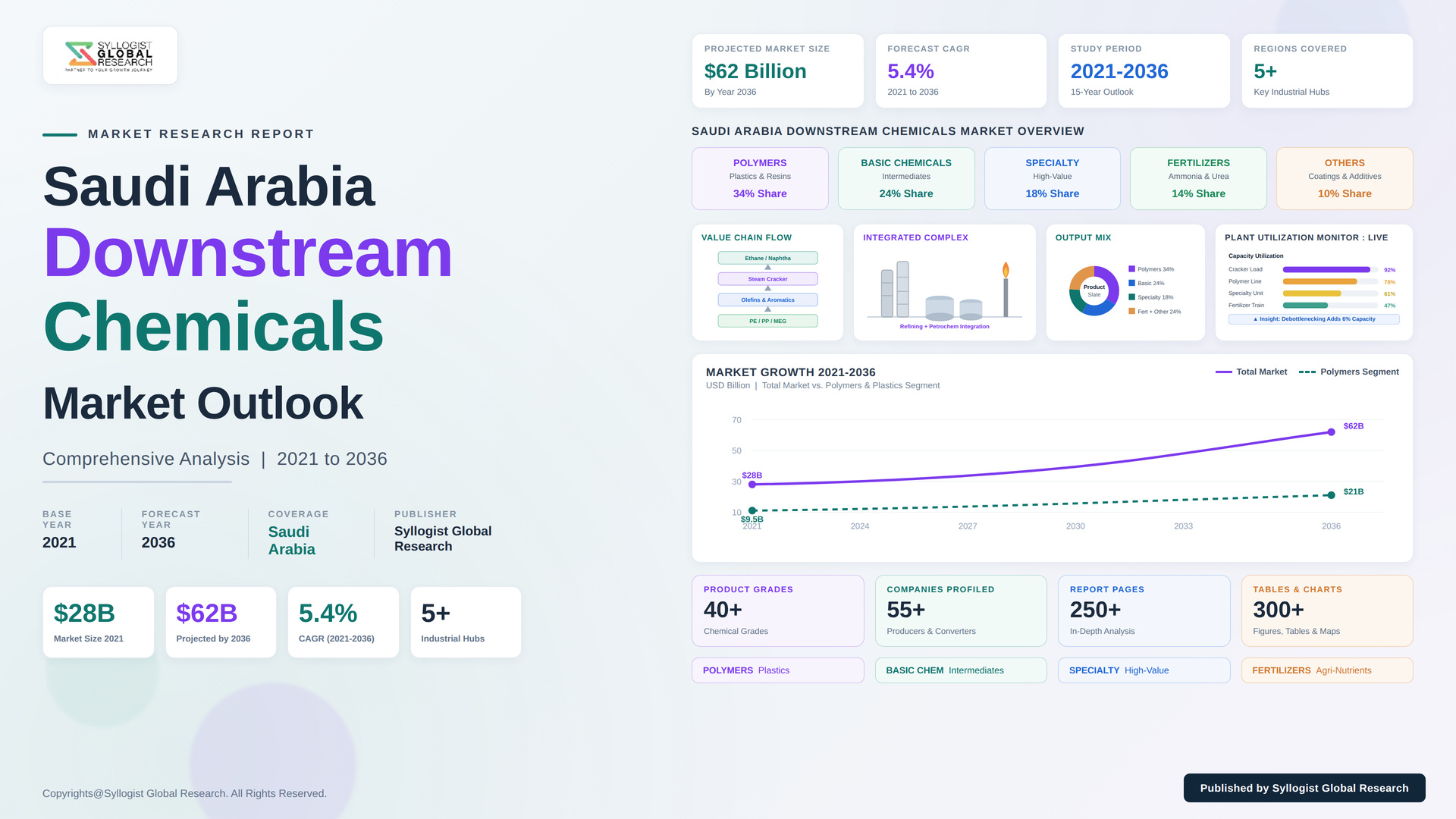
The Saudi Arabia downstream chemicals market is entering a structural expansion phase, shaped by the Kingdom’s liquids-to-chemicals strategy, accelerating value-addition beyond basic petrochemicals, large-scale integrated complex commissioning, and Vision 2030 industrial diversification targets driving downstream derivative and specialty chemical capacity buildout across Jubail and Yanbu. The Saudi Arabia downstream chemicals market was valued at USD 28.6 billion in 2025 and is projected to reach USD 52.4 billion by 2034, advancing at a compound annual growth rate of 6.9% through the forecast period, as integrated producers, refining-to-chemicals operators, and specialty chemical manufacturers scale derivative output. The Kingdom targets a fourfold increase in downstream chemical output by 2035, reinforcing sustained investment momentum across the Saudi Arabia downstream chemicals market.
The Saudi Arabia downstream chemicals market structure is being reshaped by the crude-to-chemicals technology shift, mixed-feed steam cracker commissioning, and the transition from commodity chemicals toward higher-value performance materials. The USD 11 billion Amiral petrochemical complex in Jubail, integrated with the SATORP refinery, will add 1.65 million tonnes of ethylene capacity annually plus polyethylene and derivatives with commercial operations targeted for 2027, anchoring downstream derivative supply within the Saudi Arabia downstream chemicals market. The Sipchem and LyondellBasell joint complex targeting 1.5 million tonnes of ethylene and 1.8 million tonnes of polymers, and the Tasnee complex targeting 3.3 million tonnes of polyethylene, methyl tertiary butyl ether, and specialty chemicals, further expand downstream conversion capacity across the Saudi Arabia downstream chemicals market.
Polymers and plastics represent the largest product segment within the Saudi Arabia downstream chemicals market, supported by world-scale polyethylene and polypropylene capacity, abundant advantaged feedstock, and sustained export demand across packaging, construction, and automotive applications. Specialty and performance chemicals represent the fastest-growing product segment within the Saudi Arabia downstream chemicals market, propelled by Vision 2030 targets to reduce chemical imports by 40%, rising demand for engineering plastics, electronic chemicals, and pharmaceutical intermediates, and government incentive programs supporting localization. Packaging, construction, and automotive collectively constitute the largest end-user applications within the Saudi Arabia downstream chemicals market, while agriculture, textiles, and electronics are gaining procurement traction supported by industrial diversification and expanding domestic manufacturing across the Saudi Arabia downstream chemicals market.
The Eastern Province anchors the largest regional position within the Saudi Arabia downstream chemicals market, centered on Jubail Industrial City, which hosts world-scale integrated petrochemical and derivative complexes operated by leading producers and international joint ventures. The Western Region occupies the second regional position within the Saudi Arabia downstream chemicals market, anchored by Yanbu Industrial City and Rabigh, supported by refinery integration and mixed-feed cracker expansion across the Yasref and Petro Rabigh complexes. The Central Region, centered on Riyadh, is emerging as a downstream conversion and specialty chemical zone within the Saudi Arabia downstream chemicals market, supported by transport links, industrial zone development, and proximity to domestic manufacturing demand, while sustained feedstock cost advantage of 30% to 50% versus international competitors continues to underpin the export competitiveness of the Saudi Arabia downstream chemicals market globally. The Kingdom currently accounts for around 4.7% of global chemical production and targets raising its global petrochemical capacity share toward 12% by 2030, reinforcing the scale trajectory of the Saudi Arabia downstream chemicals market.
Key Drivers
Liquids-to-Chemicals Strategy, Crude-to-Chemicals Integration, and Vision 2030 Value-Addition Targets Driving Downstream Derivative Capacity Expansion
The Kingdom’s liquids-to-chemicals strategy, accelerating crude-to-chemicals integration, and Vision 2030 value-addition targets are collectively driving sustained downstream derivative capacity expansion across the Saudi Arabia downstream chemicals market. Saudi Aramco targets processing up to 4 million barrels per day of crude into petrochemicals by 2030, a significant increase from current levels, redirecting refinery feedstock toward integrated downstream conversion within the Saudi Arabia downstream chemicals market. The USD 11 billion Amiral complex, the Sipchem and LyondellBasell joint venture, the Tasnee complex, and Yasref refinery expansion collectively add multi-million tonne derivative capacity, converting refinery off-gases, naphtha, and gas liquids into higher-value polymers and specialty chemicals. The Kingdom aims to increase downstream chemical output fourfold by 2035, contributing an estimated 58.2 billion Saudi Riyals to the economy and generating approximately 108,000 jobs through localization within the Saudi Arabia downstream chemicals market. Crude-to-chemicals pathways enable conversion of up to 50% of a crude barrel directly into chemical feedstock, fundamentally improving production economics and enabling competitive downstream exports at scale. Aramco and SABIC integration has created a vertically integrated hydrocarbons-to-chemicals value chain with unmatched feedstock cost advantage, anchoring long-duration capital commitments and reinforcing structural downstream derivative expansion across the Saudi Arabia downstream chemicals market nationwide. Aramco has also signed joint development agreements to advance crude-to-chemicals technology, underscoring sustained policy and capital commitment to downstream value capture.
Feedstock Cost Advantage, Integrated Complex Economics, and Export Competitiveness Driving Downstream Chemical Production Scale
Sustained feedstock cost advantage, integrated complex economics, and strong export competitiveness are collectively driving downstream chemical production scale across the Saudi Arabia downstream chemicals market. Saudi producers access ethane and gas liquids at administered prices materially below global market rates, creating a production cost advantage of 30% to 50% versus European and Asian competitors for commodity and derivative chemicals within the Saudi Arabia downstream chemicals market. This feedstock advantage persists even as the Kingdom gradually adjusts domestic energy prices, sustaining structural margin resilience for integrated downstream producers. Integrated complexes across Jubail and Yanbu combine refining, cracking, and derivative production within single value chains, lowering logistics cost, improving conversion economics, and enabling world-scale downstream chemical output across the Saudi Arabia downstream chemicals market. Saudi petrochemical and downstream exports reached approximately USD 45 billion to USD 50 billion in 2025, representing the largest non-crude export category and reinforcing the export orientation of the Saudi Arabia downstream chemicals market. The Kingdom accounts for nearly 80% of total Gulf Cooperation Council petrochemical revenue, anchored by advantaged feedstock, established infrastructure, and efficient export networks reaching Asian and European markets. Large industrial zones with ready-to-expand capacity, competitive energy pricing, and strategic port access continue to strengthen the production scale and export competitiveness of the Saudi Arabia downstream chemicals market nationwide.
Government Incentive Programs, Import Substitution Targets, and Specialty Chemical Localization Driving Downstream Diversification
Government incentive programs, ambitious import substitution targets, and specialty chemical localization initiatives are collectively driving downstream diversification across the Saudi Arabia downstream chemicals market. Vision 2030 targets reducing chemical imports by 40%, incentivizing domestic and foreign companies to establish local downstream production and specialty chemical capacity within the Saudi Arabia downstream chemicals market. The Standard Incentives Program launched in 2025 provides funding of up to 35% of capital investment for qualifying chemical and manufacturing projects, allocated across construction and production stages, reducing project risk and encouraging new entrants to the Saudi Arabia downstream chemicals market. Producers are shifting from commodity chemicals toward higher-value performance polymers, engineering plastics, electronic chemicals, and pharmaceutical intermediates, reducing commodity cycle exposure and building domestic manufacturing capability across the Saudi Arabia downstream chemicals market. Specialty chemical capacity additions, including new surfactant, chlor-alkali, and performance chemical facilities across Jubail and Dammam, are creating shorter supply chains and faster response to domestic customer demand. Downstream fields anchored into coatings, adhesives, sealants, elastomers, lubricants, and surfactant value chains are being deliberately developed toward 2030 targets. Rising construction, automotive, packaging, and renewable energy demand continues to reinforce downstream specialty chemical localization and derivative diversification across the Saudi Arabia downstream chemicals market nationwide.
Key Challenges
Feedstock Price Adjustments, Ethane Cost Increases, and Margin Compression Constraining Downstream Producer Profitability
Feedstock price adjustments, ethane cost increases, and resulting margin compression collectively constrain downstream producer profitability across the Saudi Arabia downstream chemicals market. In 2025, state-owned Saudi Aramco officially increased feedstock prices, including ethane and methane, directly impacting downstream chemical producers within the Saudi Arabia downstream chemicals market. Ethane prices were raised toward levels closer to global benchmarks in early 2025, marking the second increase since 2016 and reflecting broader energy cost dynamics that elevate downstream production budgets. Leading petrochemical producers have publicly disclosed that these feedstock hikes can raise cost of sales by roughly 1% to 3%, directly compressing margins across the Saudi Arabia downstream chemicals market. Feedstock price volatility disrupts production planning, complicates procurement cost management, and pressures downstream derivative margins, particularly for producers exposed to fixed long-term supply contracts. Gradual adjustment of administered feedstock prices toward global benchmarks narrows the historical cost advantage that underpins downstream export competitiveness within the Saudi Arabia downstream chemicals market. Producers must offset rising feedstock cost through efficiency gains, value-addition, and higher-margin specialty output to preserve profitability. The combined effect of feedstock price adjustments, ethane cost increases, and margin compression generates persistent cost management complexity that constrains profitability stability for downstream chemical producers across the Saudi Arabia downstream chemicals market nationwide.
Global Commodity Overcapacity, Polyolefin Price Weakness, and Cyclical Demand Volatility Constraining Downstream Revenue Stability
Global commodity overcapacity, polyolefin price weakness, and cyclical demand volatility collectively constrain downstream revenue stability across the Saudi Arabia downstream chemicals market. Sustained global overcapacity in commodity polyolefins, driven by large capacity additions across Asia and North America, generates persistent pricing pressure that weighs on downstream commodity chemical margins within the Saudi Arabia downstream chemicals market. Polyolefin and basic derivative prices remain exposed to global demand cycles, feedstock swings, and trade dynamics that resist accurate forward forecasting and complicate capital deployment for downstream capacity investment. Leading producers have reported challenging global chemicals pricing environments, with profitability recovering only gradually despite the Kingdom’s feedstock cost advantage within the Saudi Arabia downstream chemicals market. Heavy exposure to commodity polyolefin exports leaves downstream revenue sensitive to cyclical troughs, particularly where derivative portfolios remain concentrated in basic grades rather than differentiated specialties. Demand cyclicality across packaging, construction, and automotive end markets propagates through downstream derivative volumes, generating revenue variability that challenges planning within the Saudi Arabia downstream chemicals market. The transition toward higher-value specialty chemicals partially offsets commodity cycle exposure, yet the scale of existing commodity capacity means global overcapacity, polyolefin price weakness, and cyclical demand volatility continue to constrain downstream revenue stability across the Saudi Arabia downstream chemicals market nationwide.
Decarbonization Pressure, Sustainability Compliance, and Circular Economy Transition Costs Constraining Downstream Capital Allocation
Decarbonization pressure, tightening sustainability compliance, and circular economy transition costs collectively constrain downstream capital allocation across the Saudi Arabia downstream chemicals market. Rising global environmental regulation and customer demand for lower-carbon supply chains require substantial investment in carbon capture, low-carbon hydrogen, and bio-based feedstock integration across the Saudi Arabia downstream chemicals market. Leading producers are deploying large-scale carbon capture and utilization capacity, including facilities capturing hundreds of thousands of tonnes of carbon dioxide annually, yet decarbonization capital requirements compete with capacity expansion for constrained investment budgets within the Saudi Arabia downstream chemicals market. Circular economy adoption, chemical recycling infrastructure, and emissions reduction mandates add compliance cost and engineering complexity to downstream production, particularly for legacy commodity assets requiring retrofit within the Saudi Arabia downstream chemicals market. International buyers increasingly favor environmentally compliant supply chains, pressuring downstream producers to accelerate sustainability investment to preserve export access. Balancing decarbonization capital, circular economy transition, and specialty diversification against commodity margin pressure generates capital allocation complexity for downstream producers within the Saudi Arabia downstream chemicals market. The combined effect of decarbonization pressure, sustainability compliance, and circular economy transition costs continues to constrain the pace and structure of downstream capital allocation across the Saudi Arabia downstream chemicals market nationwide.
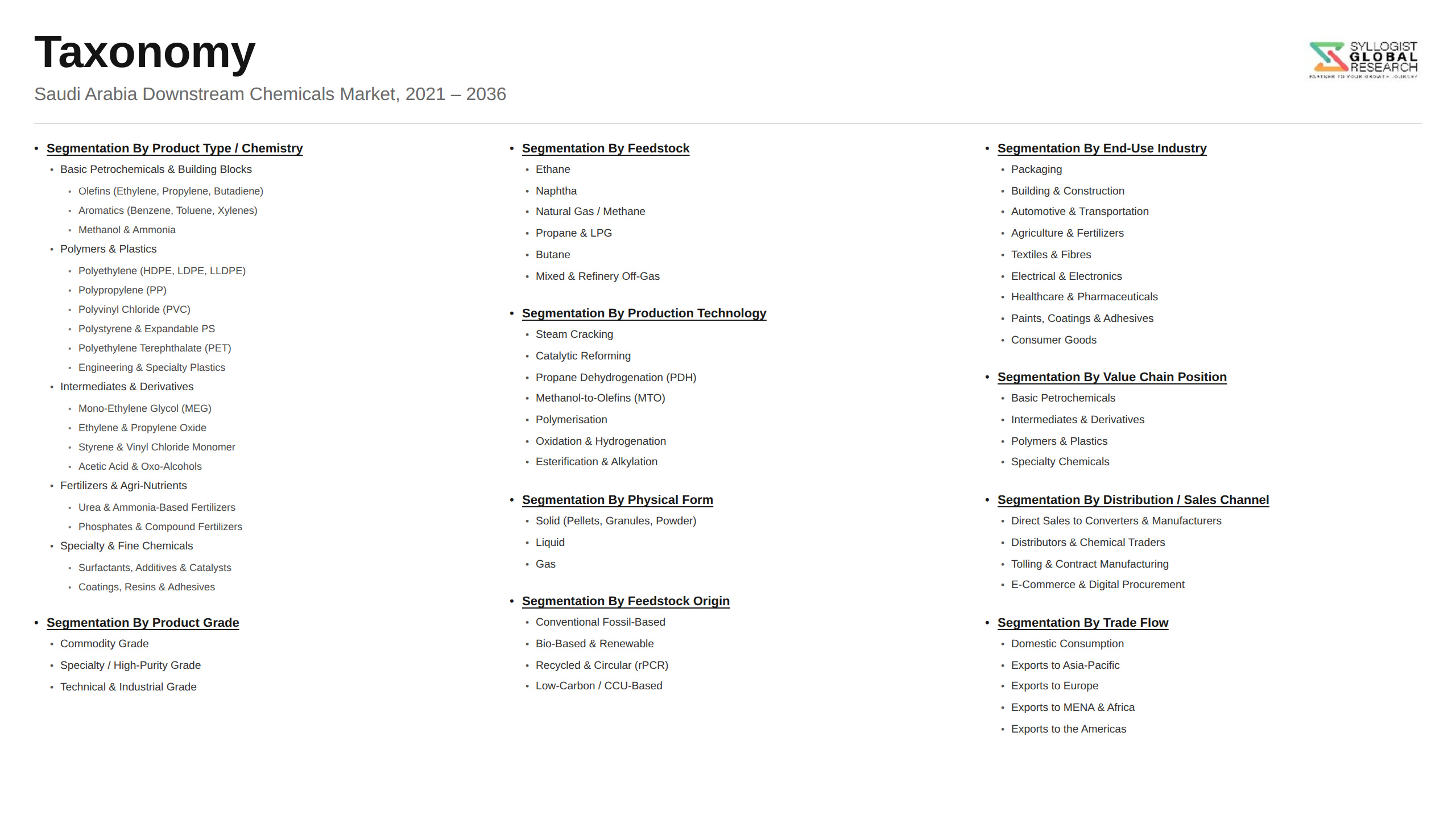
Market Segmentation
- Segmentation By Product Type
- Polymers and Plastics (Polyethylene, Polypropylene, Polystyrene)
- Aromatics Derivatives (Benzene, Toluene, Xylene Derivatives)
- Olefins Derivatives (Ethylene and Propylene Derivatives)
- Glycols and Oxygenates (MEG, MTBE, Methanol Derivatives)
- Elastomers and Synthetic Rubber
- Specialty and Performance Chemicals
- Others
- Segmentation By Feedstock
- Ethane
- Propane and Liquefied Petroleum Gas
- Naphtha
- Methanol
- Refinery Off-Gases and Mixed Feed
- Segmentation By Process Technology
- Steam Cracking
- Catalytic Conversion
- Crude-to-Chemicals and Liquids-to-Chemicals
- Others
- Segmentation By Application
- Packaging
- Construction
- Automotive and Transportation
- Agriculture
- Textiles
- Electronics and Electrical
- Consumer Goods
- Others
- Segmentation By End User
- Packaging Converters
- Construction Material Producers
- Automotive Component Manufacturers
- Agricultural Input Suppliers
- Textile and Consumer Goods Manufacturers
- Others
- Segmentation By Region
- Eastern Province (Jubail)
- Western Region (Yanbu, Rabigh)
- Central Region (Riyadh)
- Rest of Saudi Arabia
All market revenues are presented in USD
Historical Year: 2021-2024 | Base Year: 2025 | Estimated Year: 2026 | Forecast Period: 2027-2034
Key Questions this Study Will Answer
- What is the total market valuation of the Saudi Arabia Downstream Chemicals Market in 2025, projected through 2034, segmented by product type, feedstock, process technology, and application, enabling integrated producers, specialty chemical manufacturers, converters, and investors to identify highest-growth segments and most durable revenue opportunities across the Saudi Arabia downstream chemicals market?
- How are integrated petrochemical producers, refining-to-chemicals operators, and specialty chemical manufacturers structuring capacity investment across steam cracking, catalytic conversion, and liquids-to-chemicals routes, and which operating and integration models are shaping downstream derivative deployment economics within the Saudi Arabia downstream chemicals market through 2034?
- What liquids-to-chemicals strategy execution, crude-to-chemicals integration, and Vision 2030 value-addition dynamics are shaping the pace and structure of downstream derivative and specialty chemical capacity buildout across Jubail, Yanbu, and emerging conversion clusters in the Saudi Arabia downstream chemicals market?
- Which product categories, including polymers and plastics, aromatics derivatives, olefins derivatives, glycols and oxygenates, and specialty and performance chemicals, are gaining the strongest investment traction across packaging, construction, automotive, and electronics applications, and what feedstock, margin, and localization metrics are shaping product selection within the Saudi Arabia downstream chemicals market?
- How is the competitive landscape structured among integrated petrochemical producers, refining-to-chemicals operators, specialty chemical manufacturers, and international joint ventures within the Saudi Arabia downstream chemicals market, and what partnership, joint venture, and capacity expansion strategies are enabling participants to compete across commodity and specialty downstream segments?
- What feedstock price adjustment, global commodity overcapacity, decarbonization, and circular economy dynamics are reshaping downstream chemical production economics, capital allocation, and specialty diversification across the Saudi Arabia downstream chemicals market?
- Which regional markets, including the Eastern Province, the Western Region, and the Central Region, are projected to generate the largest incremental downstream chemical capacity and demand through 2034, and what integrated complex activity, feedstock access, industrial zone development, and export network factors are shaping investment priorities and supplier selection in each regional Saudi Arabia downstream chemicals market?
- Product Definition
- Research Methodology
- Research Design & Framework
- Overall Research Approach: Descriptive, Exploratory & Quantitative Mixed-Method Design
- Market Definition & Scope Boundaries: What is Included and Excluded
- Segmentation Framework
- Key Research Assumptions & Limitations
- Secondary Research
- Primary Research Design & Execution
- Data Triangulation & Validation
- Market Sizing & Forecasting Methodology
- Competitive Intelligence Methodology
- Quality Assurance & Peer Review
- Definitions, Abbreviations & Data Notes
- Executive Summary
- Market Snapshot & Headline Numbers
- Key Findings & Research Highlights
- Market Dynamics
- Regional Market Summary
- Competitive Landscape Snapshot
- Technology & Innovation Highlights
- Market Dynamics
- Drivers
- Restraints
- Opportunities
- Challenges
- Porter’s Five Forces Analysis
- PESTLE Analysis
- Market Trends & Developments
- Emerging Trends
- Technological Developments
- Regulatory & Policy Changes
- Supply Chain & Sourcing Trends
- Manufacturing & Process Trends
- Investment & Funding Activity
- Sustainability & ESG Trends
- Risk Assessment Framework
- Crude Oil and Feedstock Price Volatility & Petrochemical Margin Compression Risk
- Global Overcapacity, Asian Competition & Export Market Access Risk
- Feedstock Allocation, Ethane Availability & Gas Supply Constraint Risk
- Carbon Cost, Decarbonisation Pressure & Energy Transition Demand Risk
- Diversification Execution, Vision 2030 Delivery & Downstream Investment Risk
- Regulatory Framework & Standards
- Saudi Chemical Registration, GHS Classification & Hazardous Substance Standards
- Emission Control, Flaring Reduction & Greenhouse Gas Reporting Regulations
- Local Content, IKTVA & In-Kingdom Value Addition Requirements
- Product Quality, SASO & Petrochemical Specification Standards
- Export Compliance, Trade Policy & Petrochemical Import-Export Regulations
- Saudi Arabia Downstream Chemicals Market Outlook
- Market Size & Forecast by Value
- Market Size & Forecast by Volume (Downstream Chemical Output in Million Tonnes per Year and Nameplate Production Capacity in Million Tonnes per Year)
- Market Size & Forecast by Product Category
- Basic and Commodity Chemicals
- Petrochemical Intermediates
- Polymers and Plastics
- Fertilizers and Agrochemicals
- Specialty and Fine Chemicals
- Industrial Gases
- Others
- Market Size & Forecast by Chemical Type
- Ethylene
- Propylene
- Polyethylene (HDPE, LDPE, LLDPE)
- Polypropylene
- Methanol
- Monoethylene Glycol (MEG)
- Aromatics (Benzene, Toluene, Xylene)
- Ammonia and Urea
- PVC and PET
- Others
- Market Size & Forecast by Feedstock
- Ethane
- Naphtha
- Propane and LPG
- Natural Gas
- Methanol
- Others
- Market Size & Forecast by Production Technology
- Steam Cracking
- Catalytic Reforming
- Methanol Synthesis
- Polymerisation
- Ammonia Synthesis
- Methanol-to-Olefins (MTO/MTP)
- Others
- Market Size & Forecast by Application
- Packaging
- Building and Construction
- Automotive and Transportation
- Agriculture
- Textiles and Fibres
- Consumer Goods
- Electrical and Electronics
- Others
- Market Size & Forecast by End-Use Industry
- Packaging
- Construction
- Automotive
- Agriculture
- Textiles
- Healthcare and Pharmaceuticals
- Electronics
- Others
- Market Size & Forecast by Grade
- Commodity Grade
- Specialty Grade
- High-Purity Grade
- Others
- Market Size & Forecast by Sales Channel
- Direct Long-Term Supply Contract
- Merchant Spot Market
- Distributor and Trader Channel
- Export Trade Channel
- Others
- Central Region (Riyadh) Downstream Chemicals Market Outlook
- Market Size & Forecast
- By Value
- By Volume (Downstream Chemical Output in Million Tonnes per Year and Nameplate Production Capacity in Million Tonnes per Year)
- By Product Category
- By Chemical Type
- By Feedstock
- By Production Technology
- By Application
- By End-Use Industry
- By Grade
- By Province
- By Sales Channel
- Eastern Province (Jubail and Dammam) Downstream Chemicals Market Outlook
- Market Size & Forecast
- By Value
- By Volume (Downstream Chemical Output in Million Tonnes per Year and Nameplate Production Capacity in Million Tonnes per Year)
- By Product Category
- By Chemical Type
- By Feedstock
- By Production Technology
- By Application
- By End-Use Industry
- By Grade
- By Province
- By Sales Channel
- Western Region (Jeddah and Yanbu) Downstream Chemicals Market Outlook
- Market Size & Forecast
- By Value
- By Volume (Downstream Chemical Output in Million Tonnes per Year and Nameplate Production Capacity in Million Tonnes per Year)
- By Product Category
- By Chemical Type
- By Feedstock
- By Production Technology
- By Application
- By End-Use Industry
- By Grade
- By Province
- By Sales Channel
- Northern Region Downstream Chemicals Market Outlook
- Market Size & Forecast
- By Value
- By Volume (Downstream Chemical Output in Million Tonnes per Year and Nameplate Production Capacity in Million Tonnes per Year)
- By Product Category
- By Chemical Type
- By Feedstock
- By Production Technology
- By Application
- By End-Use Industry
- By Grade
- By Province
- By Sales Channel
- Southern Region Downstream Chemicals Market Outlook
- Market Size & Forecast
- By Value
- By Volume (Downstream Chemical Output in Million Tonnes per Year and Nameplate Production Capacity in Million Tonnes per Year)
- By Product Category
- By Chemical Type
- By Feedstock
- By Production Technology
- By Application
- By End-Use Industry
- By Grade
- By Province
- By Sales Channel
- Province-Wise* Downstream Chemicals Market Outlook
- Market Size & Forecast
- By Value
- By Volume (Downstream Chemical Output in Million Tonnes per Year and Nameplate Production Capacity in Million Tonnes per Year)
- By Product Category
- By Chemical Type
- By Feedstock
- By Production Technology
- By Application
- By End-Use Industry
- By Grade
- By Province
- By Sales Channel
- Market Size & Forecast
- Market Size & Forecast
- Market Size & Forecast
- Market Size & Forecast
- Market Size & Forecast
- Market Size & Forecast
*Provinces and Industrial Hubs Analysed in the Saudi Arabia Research Portfolio: Riyadh, Eastern Province, Makkah, Madinah, Asir, Tabuk, Qassim, Hail, Jazan, Najran, Al-Bahah, Al-Jawf, Northern Borders, Jubail, Yanbu, Dammam, Jeddah, Ras Al-Khair, Jazan Economic City, NEOM, Khobar, Dhahran, Hofuf, Buraidah
- Technology Landscape & Innovation Analysis
- Crude-Oil-to-Chemicals (COTC) & Direct Crude Conversion Technology Deep-Dive
- Steam Cracker Feedstock Flexibility & Olefins Production Technology
- Advanced Polymerisation, Metallocene & High-Performance Polymer Technology
- Methanol-to-Olefins (MTO/MTP) & On-Purpose Propylene Technology
- Carbon Capture, Utilisation & Blue Ammonia Production Technology
- Green Hydrogen, Renewable-Powered & Low-Carbon Chemicals Technology
- Specialty and Performance Chemicals Innovation & Downstream Diversification Technology
- Patent & IP Landscape in Downstream Chemicals Technologies
- Value Chain & Supply Chain Analysis
- Crude Oil, Ethane, Naphtha & Natural Gas Feedstock Supply Chain
- Steam Cracking, Reforming & Basic Chemicals Production Supply Chain
- Intermediate, Polymer & Derivative Manufacturing Supply Chain
- Jubail, Yanbu & Ras Al-Khair Industrial Cluster Integration
- Port, Pipeline & Bulk Chemical Logistics Network
- Domestic Converter and End-Use Industry Customer Channel
- Merchant Trader, Distributor & Seaborne Export Network
- Pricing Analysis
- Commodity Polymer (PE, PP) Pricing Across Contract & Spot Market Tiers
- Basic Chemical (Ethylene, Methanol, MEG) Pricing Economics
- Feedstock-Advantaged Ethane vs Naphtha Cost Position Analysis
- Fertilizer (Ammonia, Urea) Pricing Across Regional Benchmarks
- Specialty Chemical Value-Added Pricing & Margin Analysis
- CIF vs FOB Pricing, Freight & Delivered Cost Analysis
- Total Delivered Cost, Netback & Value-in-Use Pricing Models
- Sustainability & Environmental Analysis
- Lifecycle Assessment (LCA) of Downstream Chemicals Across Feedstock & Production Routes
- Carbon Intensity, Blue Ammonia & Carbon Capture Decarbonisation Pathways
- Circular Economy, Chemical Recycling & Plastic Waste Reduction Performance
- Water Use, Energy Efficiency & Renewable Integration Performance
- Regulatory-Driven Sustainability, Vision 2030, SDG 9 (Industry, Innovation) & SDG 12 (Responsible Consumption) Alignment & Green Finance Eligibility
- Competitive Landscape
- Market Structure & Concentration
- Market Consolidation Level (Fragmented vs. Consolidated by Product Category & Geography)
- Top 10 Players Market Share
- HHI (Herfindahl-Hirschman Index) Concentration Analysis
- Competitive Intensity Map by Product Category, Application & Geography
- Player Classification
- Integrated National Petrochemical Producers
- Joint-Venture Petrochemical Complexes
- Polymer and Plastics Producers
- Fertilizer and Agrochemical Producers
- Specialty and Performance Chemicals Producers
- Industrial Gas Suppliers
- Independent and Downstream Converters
- Merchant Traders and Distributors
- Competitive Analysis Frameworks
- Market Share Analysis by Product Category, Application & Region
- Company Profile
- Company Overview & Headquarters
- Downstream Chemicals Product Portfolio
- Key Customer Relationships & Reference Downstream Accounts
- Production Footprint & Nameplate Capacity Coverage
- Revenue (Downstream Chemicals Segment) & Offtake Contract Backlog
- Technology Differentiators & IP
- Key Strategic Partnerships, JVs & M&A Activity
- Recent Developments (Capacity Additions, Contract Wins, Project Launches)
- SWOT Analysis
- Strategic Focus Areas & Roadmap
- Competitive Positioning Map (Technology Capability vs. Market Penetration)
- Key Company Profiles
- Market Structure & Concentration
- Technology Landscape & Innovation Analysis
- Strategic Output
- Market Opportunity Matrix: By Product Category, Chemical Type, Application, End-Use Industry & Geography
- White Space Opportunity Analysis
- Strategic Recommendations
- Product Portfolio & Downstream Diversification Strategy
- Operational Excellence & Capacity Expansion Strategy
- Geographic Expansion & Export Market Strategy
- Customer & Downstream Converter Engagement Strategy
- Partnership, M&A & Ecosystem Strategy
- Sustainability & Circular Economy Strategy
- Risk Mitigation & Future Roadmap
- Strategic Priority Matrix & Roadmap
- Near-term (2025-2028)
- Mid-term (2029-2032)
- Long-term (2033-2037)