Global Ethylene Market By Feedstock, By Production Process, By Derivative, By Application, By End User, By Region, Competition, Forecast & Opportunities, 2021-2034F
Market Definition
Ethylene is a colorless, highly reactive two-carbon olefin and the single largest-volume organic chemical produced worldwide, serving as the foundational building block of the modern petrochemical industry. The Global Ethylene Market encompasses the production, trade, and consumption of ethylene manufactured primarily through steam cracking of hydrocarbon feedstocks, including ethane, naphtha, propane, and butane, alongside emerging bio-based and catalytic conversion routes. The global ethylene market covers ethylene supplied as captive and merchant volumes to integrated petrochemical complexes and downstream derivative units producing polyethylene, ethylene oxide, ethylene dichloride, ethylbenzene, vinyl acetate, and monoethylene glycol, which in turn feed packaging, construction, automotive, textiles, agrochemicals, and consumer goods value chains globally.
Market participants in the global ethylene market include integrated petrochemical producers, steam cracker operators, refining-to-chemicals companies, merchant ethylene suppliers, and derivative manufacturers operating across ethane-advantaged and naphtha-based production regions. End users span polyethylene and plastics converters, ethylene oxide and glycol producers, vinyl and construction material manufacturers, and specialty derivative operators consuming ethylene across industrial and consumer applications. The global ethylene market excludes standalone crude oil refining fuel output, natural gas processing, and non-olefin petrochemical streams, focusing exclusively on ethylene production, its principal derivatives, and the feedstock, process technology, and application value chains that determine ethylene supply, demand, and cost competitiveness across all major producing and consuming regions worldwide.
Market Insights
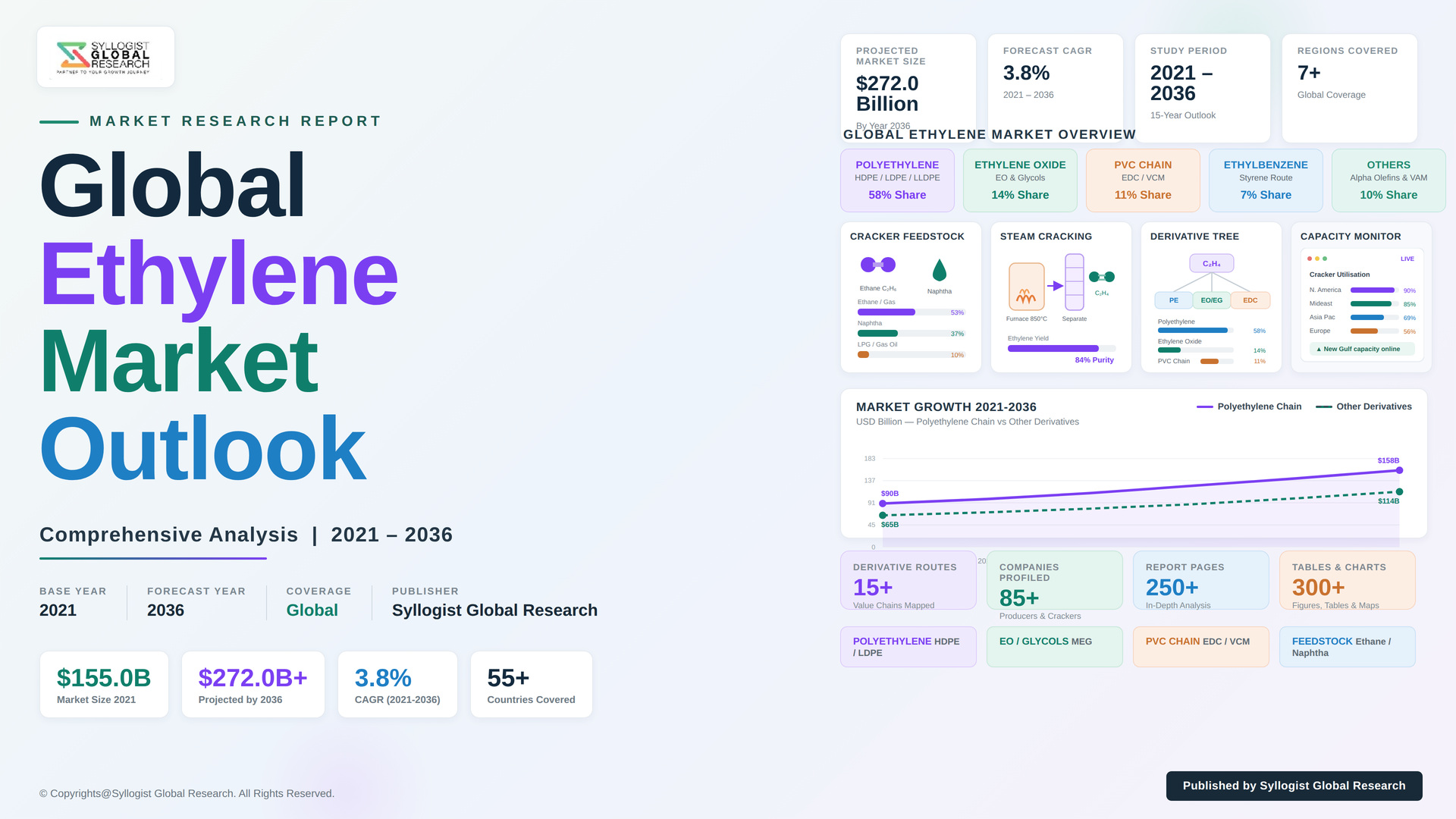
The global ethylene market is entering a period defined by capacity rationalization and demand recovery, shaped by sustained polyethylene consumption, feedstock cost divergence between ethane and naphtha routes, aggressive capacity additions in China and the Middle East, and a global supply glut driving margin pressure and cracker consolidation across mature regions. The global ethylene market was valued at USD 208.5 billion in 2025 and is projected to reach USD 349.7 billion by 2034, advancing at a compound annual growth rate of 5.9% through the forecast period, as producers scale integrated cracker capacity and downstream derivative output across Asia-Pacific, North America, and the Middle East. Rising packaging, construction, and automotive demand continues to anchor structural consumption within the global ethylene market.
The global ethylene market structure is being reshaped by feedstock economics, with ethane-based steam cracking yielding 80% to 84% ethylene compared with 29% to 34% for naphtha cracking, giving ethane-advantaged producers in North America and the Middle East a durable variable cost advantage. Naphtha remains the largest feedstock by volume within the global ethylene market, yet its energy-intensive, higher-emission profile is eroding its share as producers shift toward ethane and lighter feeds. Major capacity additions are anchoring supply within the global ethylene market, including the Amiral and SATORP-linked ethylene plant in Jubail at 1.6 million tonnes annually, the Ras Laffan Petrochemicals ethane cracker at 2.08 million tonnes, the Shaheen project in South Korea at 1.8 million tonnes, and the Sinopec Tianjin complex at 1.2 million tonnes, each expanding integrated cracker capacity.
Polyethylene represents the largest derivative segment within the global ethylene market, capturing approximately 57% of ethylene consumption in 2025, driven by extensive use across flexible and rigid packaging, consumer goods, and construction pipe applications. Ethylene oxide represents the fastest-growing derivative segment within the global ethylene market, advancing at a compound annual growth rate of 5.8%, propelled by monoethylene glycol demand for polyester and polyethylene terephthalate resin, surfactant production, and medical sterilization applications. Packaging constitutes the largest end-use application within the global ethylene market, accounting for 51.8% of consumption in 2025, while construction, automotive, and textiles represent sustained demand pillars supported by lightweighting, infrastructure expansion, and polyester fiber growth across emerging economies within the global ethylene market.
Asia-Pacific anchors the largest regional position within the global ethylene market, accounting for 43% of consumption in 2025, driven by China’s expansive downstream polymer demand and India’s rapid industrialization and packaging growth. China led global ethylene consumption at 27 million tonnes in 2024, followed by the United States at 15 million tonnes and India at 11 million tonnes, with the top three markets holding a combined 38% of demand within the global ethylene market. North America holds a 27% share of the global ethylene market, underpinned by abundant shale-derived ethane feedstock supporting low-cost production and strong export volumes, while the Middle East continues to expand ethane-based cracker capacity across integrated complexes. Europe and parts of Asia, reliant on naphtha cracking, face elevated cost exposure and rationalization pressure, with South Korea agreeing to reduce ethylene capacity by up to 3.7 million tonnes annually to address regional oversupply within the global ethylene market.
Key Drivers
Sustained Polyethylene and Packaging Demand, Consumer Goods Growth, and Lightweight Plastics Adoption Driving Ethylene Derivative Consumption
Sustained polyethylene and packaging demand, expanding consumer goods production, and accelerating lightweight plastics adoption are collectively driving derivative consumption across the global ethylene market. Polyethylene captures approximately 57% of ethylene consumption within the global ethylene market, supported by extensive use across flexible and rigid packaging, milk jugs, detergent bottles, pharmaceutical containers, and construction pipe. The packaging industry accounts for 51.8% of ethylene end-use demand within the global ethylene market, propelled by booming e-commerce, rising packaged food and beverage consumption, and expanding flexible packaging formats across emerging economies. Ethylene-based polymers offer unmatched lightweighting, impact resistance, moisture barrier performance, and chemical stability, making them increasingly critical for automotive lightweighting and modern consumer durables within the global ethylene market. Rapid expansion of water and gas pipeline networks across emerging economies is driving high-density polyethylene pipe demand, where corrosion resistance and longevity favor ethylene-derived materials over traditional alternatives. Rising demand for polyester and polyethylene terephthalate resin, supported by textile industry resurgence across South and Southeast Asia, is reinforcing ethylene oxide and monoethylene glycol consumption within the global ethylene market. Rapid industrialization, urbanization, and a growing middle class across India, China, Brazil, and Mexico continue to drive higher ethylene derivative consumption, anchoring structural demand growth across the global ethylene market worldwide.
Ethane Feedstock Advantage, Shale Gas Availability, and Integrated Crude-to-Chemicals Investment Driving Low-Cost Ethylene Production Capacity
Ethane feedstock advantage, abundant shale gas availability, and integrated crude-to-chemicals investment are collectively driving low-cost ethylene production capacity across the global ethylene market. Ethane cracking yields 80% to 84% ethylene compared with 29% to 34% for naphtha cracking, giving ethane-advantaged producers in North America and the Middle East a durable variable cost advantage within the global ethylene market. Abundant, inexpensive shale-derived ethane underpins North America’s 27% share of the global ethylene market, supporting low-cost production and strong export volumes to global markets. Major capacity investment continues to anchor supply within the global ethylene market, including the Ras Laffan Petrochemicals ethane cracker at 2.08 million tonnes annually, the Shaheen project at 1.8 million tonnes, the CNPC Inner Mongolia ethane cracker at 1.5 million tonnes, and the Sinopec Tianjin complex at 1.2 million tonnes. Integrated crude-to-chemicals and refining-to-chemicals complexes across the Middle East and Asia combine refining, cracking, and derivative production within single value chains, lowering logistics cost and improving conversion economics across the global ethylene market. Ethane’s high yield ratio, competitive pricing, and integration with downstream polymer capacity continue to drive world-scale cracker commissioning, reinforcing structural low-cost ethylene production capacity expansion across the global ethylene market worldwide. Oxidative dehydrogenation and other advanced production routes are further enhancing yield efficiency and lowering the cost base for ethane-advantaged producers within the global ethylene market.
Emerging Economy Industrialization, Downstream Capacity Expansion, and Bio-Ethylene Investment Driving Long-Term Ethylene Demand Growth
Emerging economy industrialization, rapid downstream capacity expansion, and accelerating bio-ethylene investment are collectively driving long-term demand growth across the global ethylene market. Rapid industrialization and infrastructure growth across India, China, Brazil, and Mexico are driving higher ethylene consumption, with India representing a high-growth market fueled by urbanization, packaging demand, and a growing middle class within the global ethylene market. Downstream petrochemical capacity expansion across Asia-Pacific and the Middle East continues to pull ethylene demand, as producers integrate cracker output into polyethylene, ethylene oxide, and glycol derivative chains within the global ethylene market. Bio-based ethylene investment is accelerating, with producers launching bio-ethylene facilities from renewable ethanol and sugarcane feedstock to support decarbonization and net-zero commitments across the global ethylene market. Green ethylene technology licensing, sustainable ethylene glycol production, and bio-polyethylene capacity additions are creating new demand pathways aligned with sustainability targets within the global ethylene market. Government initiatives, including ethanol blending programs and biofuel research funding, are supporting bio-based ethylene pathways across emerging economies. Rising demand for sustainable packaging, expanding downstream integration, and sustained emerging economy consumption continue to reinforce long-term ethylene demand growth across the global ethylene market worldwide. Rising per-capita plastics consumption, expanding medical device manufacturing, and growing electronics production across developing regions provide additional structural demand pathways for ethylene derivatives within the global ethylene market.
Key Challenges
Persistent Global Oversupply, Capacity Rationalization, and Polyethylene Price Weakness Constraining Ethylene Producer Margins
Persistent global oversupply, forced capacity rationalization, and polyethylene price weakness collectively constrain producer margins across the global ethylene market. Aggressive capacity expansions in China and the United States have outpaced demand growth, generating a projected market glut through at least 2026 within the global ethylene market, with capacity exceeding demand forecast to reach 20.3 million tonnes in 2025. This structural oversupply is driving sustained pricing pressure across ethylene and polyethylene, compressing producer margins and forcing capacity rationalization within the global ethylene market. South Korea agreed to reduce ethylene capacity by up to 3.7 million tonnes annually through consolidations and operating rate reductions to address regional oversupply, while Japanese producers are consolidating cracker operations to improve utilization within the global ethylene market. Older, higher-cost naphtha crackers in Europe and parts of Asia face closure risk, exemplified by ethylene unit shutdowns driven by high energy prices and carbon levies. Producers concentrated in commodity polyethylene grades remain particularly exposed to cyclical troughs, while ethane-advantaged competitors sustain margins through lower feedstock cost within the global ethylene market. The combined effect of persistent oversupply, capacity rationalization, and polyethylene price weakness continues to constrain producer margins and profitability stability across the global ethylene market worldwide. Delayed recovery in construction and automotive demand across key regions further prolongs the oversupply cycle, deepening margin pressure within the global ethylene market.
Naphtha Feedstock Cost Volatility, Energy Price Exposure, and Regional Competitiveness Divergence Constraining Naphtha-Based Producers
Naphtha feedstock cost volatility, elevated energy price exposure, and widening regional competitiveness divergence collectively constrain naphtha-based producers across the global ethylene market. Naphtha cracking links production economics closely to crude oil prices, exposing European and Asian producers to greater cost volatility than ethane-advantaged competitors within the global ethylene market. Naphtha cracking yields only 29% to 34% ethylene compared with 80% to 84% for ethane, structurally disadvantaging naphtha-based producers on both cost and yield within the global ethylene market. High energy prices and carbon levies in Europe have driven ethylene unit closures, with producers citing deindustrialization pressure that shifts manufacturing and emissions abroad without environmental benefit within the global ethylene market. The cost gap between ethane-advantaged and naphtha-based regions continues to widen, eroding the competitiveness of naphtha crackers concentrated in Europe and parts of Asia within the global ethylene market. Rising feedstock and energy cost volatility complicates capital deployment, margin planning, and long-term capacity investment decisions for naphtha-exposed producers. Regional price divergence tied to feedstock availability, energy cost, and demand-supply conditions generates persistent competitiveness uncertainty within the global ethylene market. The combined effect of naphtha cost volatility, energy price exposure, and regional divergence continues to constrain naphtha-based producer competitiveness across the global ethylene market worldwide.
Carbon Emissions, Decarbonization Mandates, and Sustainability Transition Costs Constraining Conventional Ethylene Production
Carbon emissions intensity, tightening decarbonization mandates, and sustainability transition costs collectively constrain conventional ethylene production across the global ethylene market. Steam cracking is highly energy and emissions intensive, with naphtha-based ethylene production emitting approximately 1.8 to 2 kilograms of carbon dioxide per kilogram of ethylene, generating substantial decarbonization pressure within the global ethylene market. The European Union Fit for 55 framework mandates a 55% reduction in emissions by 2030, forcing steam crackers to adopt electrification and renewable energy to maintain competitiveness within the global ethylene market. Meeting decarbonization targets requires substantial investment in carbon capture, cracker electrification, low-carbon hydrogen, and bio-based feedstock integration, competing with capacity investment for constrained capital across the global ethylene market. Carbon levies, emissions trading costs, and regulatory compliance elevate production cost for conventional crackers, particularly legacy assets requiring retrofit within the global ethylene market. International buyers and corporate net-zero commitments increasingly favor low-carbon and bio-based ethylene, pressuring producers to accelerate sustainability investment to preserve market access. Balancing decarbonization capital, bio-ethylene transition, and margin preservation against commodity oversupply generates capital allocation complexity within the global ethylene market. The combined effect of carbon emissions, decarbonization mandates, and sustainability transition costs continues to constrain conventional ethylene production across the global ethylene market worldwide.
Market Segmentation
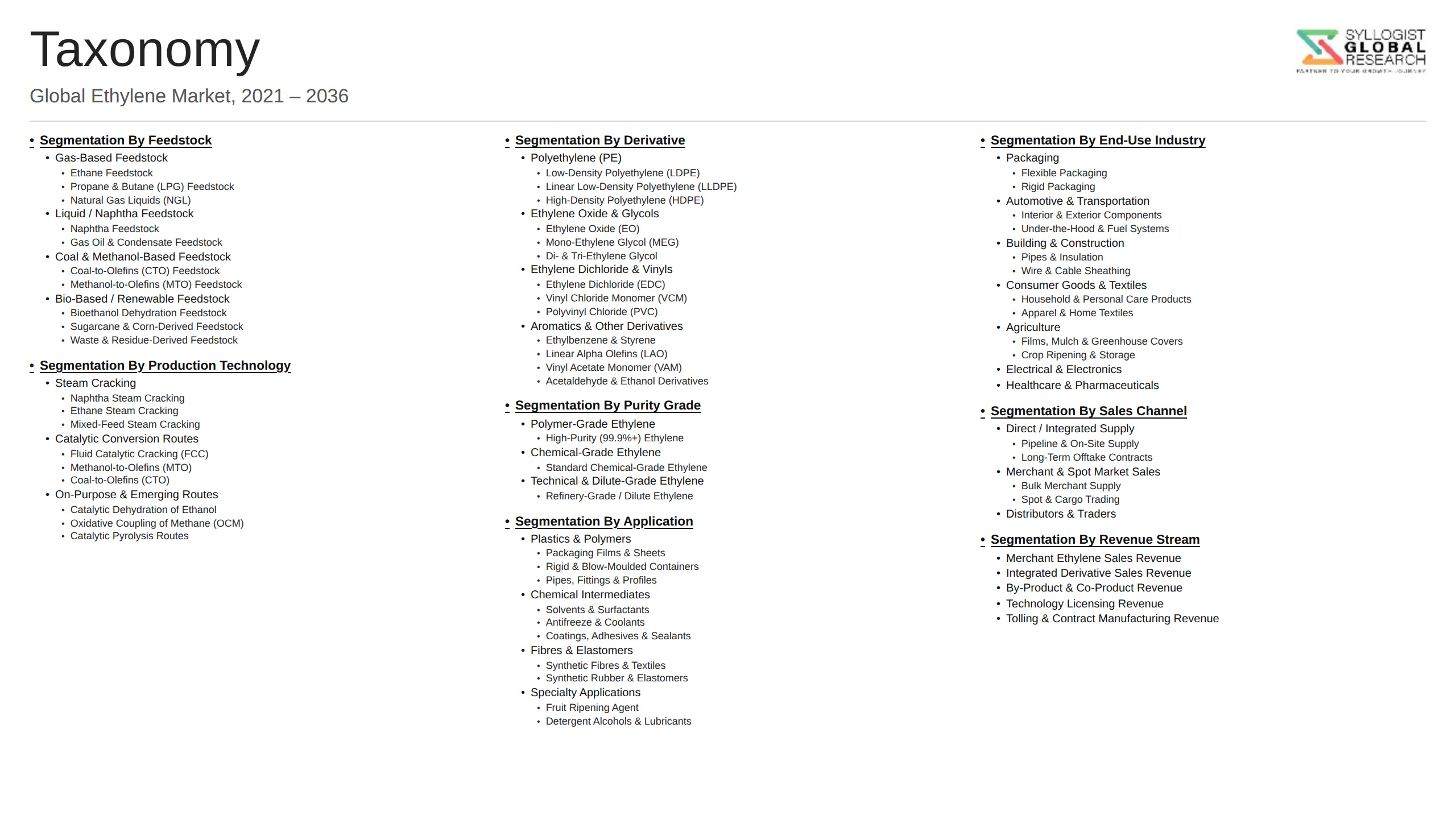
- Segmentation By Feedstock
- Ethane
- Naphtha
- Propane
- Butane
- Others
- Segmentation By Production Process
- Steam Cracking
- Catalytic Conversion
- Bio-Based and Renewable Ethylene
- Others
- Segmentation By Derivative
- Polyethylene (HDPE, LDPE, LLDPE)
- Ethylene Oxide and Ethylene Glycol
- Ethylene Dichloride and Vinyl Chloride Monomer
- Ethylbenzene and Styrene
- Vinyl Acetate
- Others
- Segmentation By Application
- Packaging
- Construction
- Automotive and Transportation
- Textiles
- Agrochemicals
- Consumer Goods
- Others
- Segmentation By End User
- Polyethylene and Plastics Converters
- Ethylene Oxide and Glycol Producers
- Vinyl and Construction Material Manufacturers
- Specialty Derivative Operators
- Others
- Segmentation By Region
- Asia-Pacific
- North America
- Europe
- Middle East and Africa
- Latin America
All market revenues are presented in USD
Historical Year: 2021-2024 | Base Year: 2025 | Estimated Year: 2026 | Forecast Period: 2027-2034
Key Questions this Study Will Answer
- What is the total global market valuation of the Global Ethylene Market in 2025, projected through 2034, segmented by feedstock, production process, derivative, and application, enabling integrated producers, cracker operators, derivative manufacturers, and investors to identify highest-growth segments and most durable revenue opportunities across the global ethylene market?
- How are integrated petrochemical producers, ethane-advantaged operators, and naphtha-based crackers structuring feedstock sourcing and capacity investment across steam cracking, catalytic conversion, and bio-based routes, and which operating and integration models are shaping ethylene production economics within the global ethylene market through 2034?
- What polyethylene demand growth, packaging expansion, and downstream derivative dynamics are shaping the pace and geographic distribution of ethylene consumption across mature and emerging economies in the global ethylene market?
- Which feedstock and process routes, including ethane, naphtha, and bio-based ethylene, are gaining the strongest competitive traction across polyethylene, ethylene oxide, and vinyl derivative applications, and what yield, cost, and carbon intensity metrics are shaping feedstock and technology selection within the global ethylene market?
- How is the competitive landscape structured among integrated petrochemical producers, refining-to-chemicals operators, merchant ethylene suppliers, and derivative manufacturers within the global ethylene market, and what capacity expansion, consolidation, and rationalization strategies are enabling participants to compete amid persistent oversupply?
- What global oversupply, capacity rationalization, feedstock cost volatility, decarbonization, and bio-ethylene dynamics are reshaping ethylene production economics, margin structure, and capital allocation across the global ethylene market?
- Which regional markets, including Asia-Pacific, North America, the Middle East, and Europe, are projected to generate the largest incremental ethylene capacity and demand through 2034, and what feedstock access, downstream integration, export network, and industrialization factors are shaping investment priorities and supplier selection in each regional global ethylene market?
- Product Definition
- Research Methodology
- Research Design & Framework
- Overall Research Approach: Descriptive, Exploratory & Quantitative Mixed-Method Design
- Market Definition & Scope Boundaries: What is Included and Excluded
- Segmentation Framework
- Key Research Assumptions & Limitations
- Secondary Research
- Primary Research Design & Execution
- Data Triangulation & Validation
- Market Sizing & Forecasting Methodology
- Competitive Intelligence Methodology
- Quality Assurance & Peer Review
- Definitions, Abbreviations & Data Notes
- Executive Summary
- Market Snapshot & Headline Numbers
- Key Findings & Research Highlights
- Market Dynamics
- Regional Market Summary
- Competitive Landscape Snapshot
- Technology & Innovation Highlights
- Market Dynamics
- Drivers
- Restraints
- Opportunities
- Challenges
- Porter’s Five Forces Analysis
- PESTLE Analysis
- Market Trends & Developments
- Emerging Trends
- Technological Developments
- Regulatory & Policy Changes
- Supply Chain & Sourcing Trends
- Manufacturing & Process Trends
- Investment & Funding Activity
- Sustainability & ESG Trends
- Risk Assessment Framework
- Feedstock Price Volatility, Ethane-Naphtha Spread & Crude Oil Linkage Cost Escalation Risk
- Global Overcapacity, Capacity Wave & Merchant Margin Compression Risk
- Feedstock Availability, Shale Gas Dependence & Ethane Supply Constraint Risk
- Cracker Turnaround, Unplanned Outage & Supply Chain Disruption Risk
- Decarbonisation Pressure, Carbon Cost & Fossil-Feedstock Transition Risk
- Regulatory Framework & Standards
- REACH, TSCA Chemical Registration & Hazardous Substance Compliance Standards
- Process Safety Management, Flammable Gas Handling & Pressure Storage Standards
- Emission Control, VOC, Greenhouse Gas Reporting & Carbon Pricing Regulations
- Product Purity, Polymer-Grade Specification & ISO Quality Standards
- Cross-Border Trade, Anti-Dumping Duty & Petrochemical Import-Export Regulations
- Global Ethylene Market Outlook
- Market Size & Forecast by Value
- Market Size & Forecast by Volume (Ethylene Consumed in Million Tonnes per Year and Nameplate Production Capacity in Million Tonnes per Year)
- Market Size & Forecast by Production Process
- Steam Cracking
- Methanol-to-Olefins (MTO)
- Coal-to-Olefins (CTO)
- Catalytic Dehydration of Ethanol (Bio-Ethylene)
- Oxidative Coupling of Methane
- Others
- Market Size & Forecast by Feedstock
- Ethane
- Naphtha
- Propane and LPG
- Gas Oil
- Methanol
- Others
- Market Size & Forecast by Derivative
- Polyethylene (HDPE, LDPE, LLDPE)
- Ethylene Oxide
- Monoethylene Glycol (MEG)
- Ethylene Dichloride (EDC)
- Styrene
- Vinyl Acetate Monomer (VAM)
- Alpha-Olefins
- Ethanol and Acetaldehyde
- Ethylene-Propylene Rubber
- Others
- Market Size & Forecast by Application
- Packaging
- Building and Construction
- Automotive and Transportation
- Textiles and Fibres
- Agriculture
- Consumer Goods
- Electrical and Electronics
- Others
- Market Size & Forecast by End-Use Industry
- Packaging
- Construction
- Automotive
- Agriculture
- Textiles
- Consumer Goods
- Chemicals
- Others
- Market Size & Forecast by Grade
- Polymer Grade
- Chemical Grade
- High-Purity Grade
- Others
- Market Size & Forecast by Source
- Conventional (Fossil-Based)
- Bio-Based (Renewable)
- Recycled and Circular
- Others
- Market Size & Forecast by Sales Channel
- Direct Long-Term Supply Contract
- Merchant Spot Market
- Distributor and Trader Channel
- Integrated Captive Consumption
- Others
- North America Ethylene Market Outlook
- Market Size & Forecast
- By Value
- By Volume (Ethylene Consumed in Million Tonnes per Year and Nameplate Production Capacity in Million Tonnes per Year)
- By Production Process
- By Feedstock
- By Derivative
- By Application
- By End-Use Industry
- By Grade
- By Source
- By Country
- By Sales Channel
- Europe Ethylene Market Outlook
- Market Size & Forecast
- By Value
- By Volume (Ethylene Consumed in Million Tonnes per Year and Nameplate Production Capacity in Million Tonnes per Year)
- By Production Process
- By Feedstock
- By Derivative
- By Application
- By End-Use Industry
- By Grade
- By Source
- By Country
- By Sales Channel
- Asia-Pacific Ethylene Market Outlook
- Market Size & Forecast
- By Value
- By Volume (Ethylene Consumed in Million Tonnes per Year and Nameplate Production Capacity in Million Tonnes per Year)
- By Production Process
- By Feedstock
- By Derivative
- By Application
- By End-Use Industry
- By Grade
- By Source
- By Country
- By Sales Channel
- Latin America Ethylene Market Outlook
- Market Size & Forecast
- By Value
- By Volume (Ethylene Consumed in Million Tonnes per Year and Nameplate Production Capacity in Million Tonnes per Year)
- By Production Process
- By Feedstock
- By Derivative
- By Application
- By End-Use Industry
- By Grade
- By Source
- By Country
- By Sales Channel
- Middle East & Africa Ethylene Market Outlook
- Market Size & Forecast
- By Value
- By Volume (Ethylene Consumed in Million Tonnes per Year and Nameplate Production Capacity in Million Tonnes per Year)
- By Production Process
- By Feedstock
- By Derivative
- By Application
- By End-Use Industry
- By Grade
- By Source
- By Country
- By Sales Channel
- Country-Wise* Ethylene Market Outlook
- Market Size & Forecast
- By Value
- By Volume (Ethylene Consumed in Million Tonnes per Year and Nameplate Production Capacity in Million Tonnes per Year)
- By Production Process
- By Feedstock
- By Derivative
- By Application
- By End-Use Industry
- By Grade
- By Source
- By Country
- By Sales Channel
- Market Size & Forecast
- Market Size & Forecast
- Market Size & Forecast
- Market Size & Forecast
- Market Size & Forecast
- Market Size & Forecast
*Countries Analysed in the Global Research Portfolio: United States, Canada, Mexico, Germany, France, United Kingdom, Netherlands, Spain, Italy, Norway, Sweden, China, Japan, India, Australia, South Korea, Singapore, Brazil, Chile, Saudi Arabia, UAE, Egypt, South Africa, Israel
- Technology Landscape & Innovation Analysis
- Steam Cracker Feedstock Flexibility & High-Yield Ethylene Production Technology Deep-Dive
- Electric (E-Cracker) & Low-Carbon Steam Cracking Technology
- Methanol-to-Olefins (MTO) & Coal-to-Olefins (CTO) Process Technology
- Catalytic Dehydration & Bio-Ethylene Production Technology
- Oxidative Coupling of Methane & Alternative Route Technology
- Carbon Capture, Utilisation & Cracker Decarbonisation Technology
- Ethylene Recovery, Separation & Energy Efficiency Technology
- Patent & IP Landscape in Ethylene Production Technologies
- Value Chain & Supply Chain Analysis
- Crude Oil, Ethane, Naphtha & Natural Gas Feedstock Supply Chain
- Steam Cracker & Ethylene Production Supply Chain
- Ethylene Purification, Fractionation & Grade Separation Supply Chain
- Pipeline, Storage & Bulk Ethylene Logistics Network
- Derivative Producer Channel (Polyethylene, Ethylene Oxide, PVC, Styrene)
- End-Use Industry Customer Channel (Packaging, Construction, Automotive, Textiles)
- Merchant Trader, Distributor & Seaborne Export Network
- Pricing Analysis
- Polymer-Grade Ethylene Pricing Across Contract & Spot Market Tiers
- Chemical-Grade Ethylene Pricing Differentials
- Regional Ethylene Pricing Across North America, Europe & Asia Benchmarks
- Feedstock-Linked Pricing: Ethane vs Naphtha Cracker Margin Economics
- Ethylene-Propylene and Ethylene-Naphtha Spread Analysis
- Bio-Based vs Fossil Ethylene Cost of Production Analysis
- Total Delivered Cost, Netback & Value-in-Use Pricing Models
- Sustainability & Environmental Analysis
- Lifecycle Assessment (LCA) of Ethylene Across Feedstock & Production Routes
- Carbon Intensity, Electric Cracker & Decarbonisation Pathways
- Bio-Based, Renewable & Circular Ethylene Performance
- Green Hydrogen, Electrification & Low-Carbon Production Integration
- Regulatory-Driven Sustainability, SDG 9 (Industry, Innovation) & SDG 12 (Responsible Consumption) Alignment & Green Finance Eligibility
- Competitive Landscape
- Market Structure & Concentration
- Market Consolidation Level (Fragmented vs. Consolidated by Production Process & Geography)
- Top 10 Players Market Share
- HHI (Herfindahl-Hirschman Index) Concentration Analysis
- Competitive Intensity Map by Production Process, Derivative & Geography
- Player Classification
- Integrated Oil, Refining & Petrochemical Majors
- Merchant Steam Cracker Operators
- Methanol-to-Olefins (MTO/CTO) Producers
- National Oil Company Petrochemical Arms
- Bio-Based and Renewable Ethylene Producers
- Regional and Independent Petrochemical Producers
- Ethylene Technology Licensors and Process Developers
- Merchant Traders and Distributors
- Competitive Analysis Frameworks
- Market Share Analysis by Production Process, Derivative & Region
- Company Profile
- Company Overview & Headquarters
- Ethylene Production Portfolio & Capacity
- Key Customer Relationships & Reference Derivative Accounts
- Production Footprint & Nameplate Capacity Coverage
- Revenue (Ethylene Segment) & Offtake Contract Backlog
- Technology Differentiators & IP
- Key Strategic Partnerships, JVs & M&A Activity
- Recent Developments (Capacity Additions, Contract Wins, Project Launches)
- SWOT Analysis
- Strategic Focus Areas & Roadmap
- Competitive Positioning Map (Technology Capability vs. Market Penetration)
- Key Company Profiles
- Market Structure & Concentration
- Technology Landscape & Innovation Analysis
- Strategic Output
- Market Opportunity Matrix: By Production Process, Feedstock, Derivative, End-Use Industry & Geography
- White Space Opportunity Analysis
- Strategic Recommendations
- Production Portfolio & Technology Investment Strategy
- Operational Excellence & Capacity Expansion Strategy
- Geographic Expansion & Feedstock Localisation Strategy
- Customer & Derivative Account Engagement Strategy
- Partnership, M&A & Ecosystem Strategy
- Sustainability & Circular Economy Strategy
- Risk Mitigation & Future Roadmap
- Strategic Priority Matrix & Roadmap
- Near-term (2025-2028)
- Mid-term (2029-2032)
- Long-term (2033-2037)