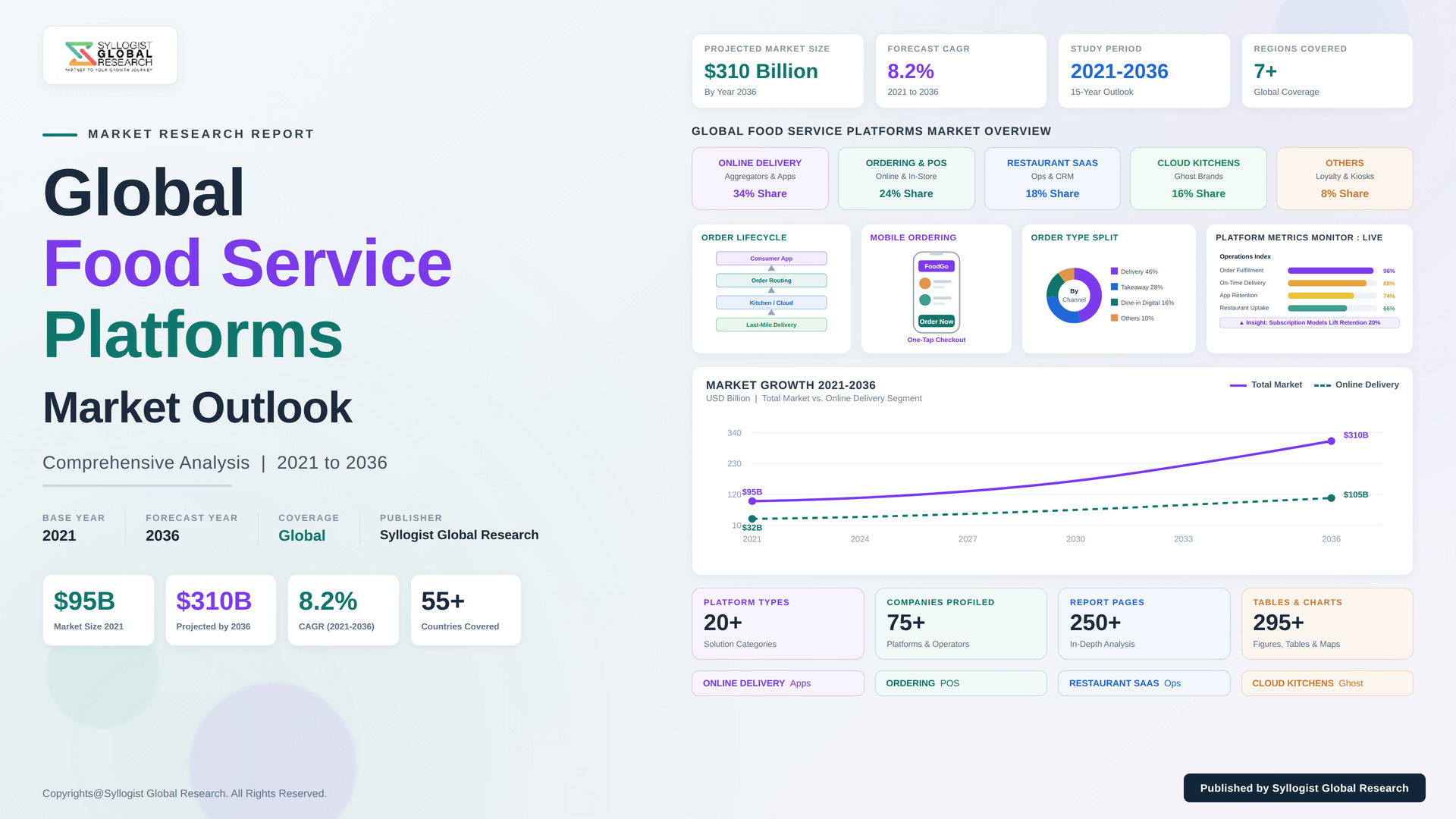
Global Food Service Platforms Market By Platform Type, By Business Model, By Deployment, By Revenue Model, By End User, By Region, Competition, Forecast & Opportunities, 2021-2034F
Market Definition
Food service platforms are digital marketplaces, software systems, and operational infrastructure that connect restaurants, cloud kitchens, and food service operators with consumers through online ordering, delivery, payment, and restaurant management technology. The Global Food Service Platforms Market encompasses platform-to-consumer and restaurant-to-consumer delivery marketplaces, cloud and ghost kitchen networks, online ordering and reservation systems, restaurant management and point-of-sale software, and last-mile delivery logistics technology serving the global food service ecosystem. The global food service platforms market covers mobile application and web-based ordering, aggregator marketplaces, virtual restaurant brands, subscription and loyalty programs, kitchen display and order management systems, and AI-driven dispatch, demand forecasting, and personalization tools that power digital food ordering, fulfillment, and food service operations worldwide.
Market participants in the global food service platforms market include food delivery aggregators, quick-commerce operators, cloud kitchen networks, restaurant management software providers, point-of-sale and payment technology vendors, and last-mile logistics platforms. End users span quick-service restaurants, full-service restaurants, cafes, cloud and ghost kitchens, convenience and grocery operators, and multi-brand virtual kitchen operators consuming platform, software, and delivery services. The global food service platforms market excludes traditional offline dine-in operations without digital integration, packaged food retail manufacturing, and standalone hardware unconnected to food service software, focusing exclusively on digital food service platforms, ordering and delivery marketplaces, cloud kitchen infrastructure, and restaurant technology that enable digital food ordering, fulfillment, and management across all major regions worldwide.
Market Insights
The global food service platforms market is entering a sustained expansion phase, shaped by accelerating online food ordering, rapid cloud kitchen proliferation, quick-commerce integration promising sub-15-minute fulfillment, subscription and loyalty program maturation, and AI-driven logistics adoption reshaping digital food ordering and delivery economics worldwide. The global food service platforms market was valued at USD 458.3 billion in 2025 and is projected to reach USD 912.6 billion by 2034, advancing at a compound annual growth rate of 7.9% through the forecast period, as delivery aggregators, cloud kitchen networks, and restaurant technology providers scale digital ordering, fulfillment, and management capacity across Asia-Pacific, North America, and Europe. Over 2.9 billion users worldwide used food delivery platforms in 2024, up from 1.8 billion in 2019, anchoring structural demand within the global food service platforms market.
The global food service platforms market structure is being reshaped by app-based ordering, which accounts for over 84% of total orders, alongside smartphone penetration above 72% and AI-driven dispatch adoption reaching 67% across restaurant partners. Cloud kitchens represent approximately 23% of restaurants listed on digital platforms within the global food service platforms market, while multi-brand virtual kitchens contribute 18% of total platform menus, reflecting a structural shift toward delivery-only fulfillment models. Subscription models influence 44% of repeat orders within the global food service platforms market, with bundled loyalty programs raising purchase frequency by 40% to 60% among members and lifting average basket size by 26%. Quick-commerce integration now enables delivery within 15 to 20 minutes for 32% of orders in urban zones, reinforcing hyperlocal fulfillment across the global food service platforms market.
Platform-to-consumer delivery represents the largest business model segment within the global food service platforms market, driven by aggregator marketplaces that list nearby restaurants and cloud kitchens for app-based ordering and last-mile delivery. Cloud kitchen and virtual restaurant infrastructure represents the fastest-growing segment within the global food service platforms market, propelled by low overhead economics, rapid brand launch capability, and private equity investment, with independent cloud kitchens holding the largest share of delivery-only operations. Restaurant management and online ordering software represents a strategic growth pillar within the global food service platforms market, with cloud-based point-of-sale adoption exceeding 54% and mobile application ordering dominating platform engagement. Meal delivery accounts for the majority of platform order volume within the global food service platforms market, while online grocery and convenience delivery represents the fastest-expanding category, supported by dark stores and micro-fulfillment centers enabling rapid delivery across the global food service platforms market.
Asia-Pacific anchors the largest regional position within the global food service platforms market, holding approximately 43% of demand in 2025, driven by dense urban populations, rising disposable income, and rapid digitalization across China, India, and Southeast Asia. North America occupies a strong regional position within the global food service platforms market, supported by high smartphone penetration, mature subscription ecosystems, and consolidation activity including a USD 3.86 billion acquisition of Deliveroo creating a 40-country delivery network and a USD 650 million acquisition of Grubhub fusing owned-kitchen and marketplace models. Europe represents a substantial regional market within the global food service platforms market, supported by private-equity-backed cloud kitchen expansion and high online delivery penetration, while Latin America and the Middle East and Africa are emerging growth regions, with Brazil generating USD 32 billion in gross merchandise value and rising smartphone and digital payment adoption expanding the global food service platforms market.
Key Drivers
Rising Smartphone Penetration, Digital Ordering Adoption, and Consumer Convenience Demand Driving Food Service Platform Usage
Rising smartphone penetration, accelerating digital ordering adoption, and sustained consumer convenience demand are collectively driving usage across the global food service platforms market. Smartphone penetration above 72% globally and app-based ordering accounting for over 84% of total orders are directly supporting expansion within the global food service platforms market. Over 2.9 billion users worldwide used food delivery platforms in 2024, up from 1.8 billion in 2019, with more than 65% of urban consumers across major economies placing at least 1 online food order per week and 38% placing 3 or more orders monthly within the global food service platforms market. Busy work schedules, rapid urbanization, rising dual-income households, and evolving lifestyle patterns are driving sustained demand for convenient, time-saving digital food ordering across the global food service platforms market. Expanding mobile internet access, improved network connectivity across developing economies, and the rollout of 5G are enhancing the digital ordering experience and opening new growth avenues within the global food service platforms market. Contactless ordering, digital wallet adoption, and secure payment gateways continue to build consumer trust and lower friction across the global food service platforms market. Rising per-capita digital dining, expanding metro-city demand concentration, and growing platform user bases across emerging economies continue to anchor structural growth across the global food service platforms market worldwide.
Cloud Kitchen Proliferation, Virtual Brand Expansion, and Low-Overhead Fulfillment Economics Driving Digital Food Service Capacity
Cloud kitchen proliferation, rapid virtual brand expansion, and low-overhead fulfillment economics are collectively driving digital food service capacity across the global food service platforms market. Cloud kitchens represent approximately 23% of restaurants listed on digital platforms, while multi-brand virtual kitchens contribute 18% of total platform menus within the global food service platforms market. Cloud kitchens carry materially lower overhead than traditional dine-in restaurants, enabling operators to launch delivery-only brands without dine-in infrastructure and offer more competitive pricing across the global food service platforms market. Independent cloud kitchens hold the largest share of delivery-only operations, supported by menu flexibility, rapid market entry, and technology-driven order processing within the global food service platforms market. Private equity and strategic investment continue to fund cloud kitchen expansion, with delivery platforms increasingly partnering with or establishing owned kitchen networks to expand offerings and improve delivery logistics across the global food service platforms market. Cloud kitchen partnership growth reached 31% among platform operators, reinforcing delivery-only fulfillment capacity. Rising Generation Z and millennial demand for convenient online delivery, combined with hub-and-spoke commissary models and micro-fulfillment expansion, continues to drive cloud kitchen and virtual brand capacity across the global food service platforms market worldwide. Established restaurant chains and quick-service operators are also launching delivery-only virtual brands to expand menu reach without added dine-in cost, further scaling capacity within the global food service platforms market.
Subscription and Loyalty Program Growth, Quick-Commerce Integration, and AI-Driven Logistics Driving Platform Engagement and Efficiency
Subscription and loyalty program growth, quick-commerce integration, and AI-driven logistics are collectively driving engagement and efficiency across the global food service platforms market. Subscription models influence 44% of repeat orders within the global food service platforms market, with bundled loyalty programs raising purchase frequency by 40% to 60% among members and lifting average basket size by 26%. Subscription programs provide predictable recurring revenue that offsets rising customer acquisition costs, with premium membership tiers generating materially higher spending than single-product users across the global food service platforms market. Quick-commerce integration enables delivery within 15 to 20 minutes for 32% of orders in urban zones, with 63% of orders delivered within a 5 kilometer radius, reinforcing hyperlocal fulfillment within the global food service platforms market. AI-driven dispatch adoption reached 67% across restaurant partners, reducing delivery time by 22% and food waste by 19%, while analytics-led efficiency improved by 29% across the global food service platforms market. Real-time inventory synchronization, demand forecasting engines, EV fleet expansion at 27%, and route optimization continue to compress cycle times and improve unit economics. Rising personalized upselling, dark store integration, and micro-fulfillment density continue to drive platform engagement and operational efficiency across the global food service platforms market worldwide.
Key Challenges
Thin Margins, High Customer Acquisition Costs, and Intense Competitive Pressure Constraining Food Service Platform Profitability
Thin operating margins, escalating customer acquisition costs, and intense competitive pressure collectively constrain profitability across the global food service platforms market. Food delivery platforms operate on structurally thin margins, with fluctuating food costs, delivery expenses, and consumer price sensitivity compressing profitability across the global food service platforms market. Promotional-led customer acquisition drives 54% of platform growth, yet escalating acquisition costs pressure unit economics and force platforms to balance discounting against margin preservation within the global food service platforms market. Intense competition concentrates market share among leading players, with the top five platforms holding 59% of the market, driving aggressive pricing, promotional spending, and exclusive partnership competition across the global food service platforms market. Multi-platform restaurant listings at 46% reduce platform exclusivity and increase price competition, while loyalty-driven retention at 61% requires sustained investment to preserve customer lifetime value within the global food service platforms market. Achieving profitability at scale requires advanced demand forecasting, real-time inventory synchronization, and operational efficiency to offset thin per-order economics. The combined effect of thin margins, high customer acquisition costs, and intense competitive pressure continues to constrain profitability stability and sustainable unit economics across the global food service platforms market worldwide. Delivery cost inflation and rising fulfillment expenses further pressure per-order economics, deepening the profitability challenge within the global food service platforms market.
Regulatory Pressure, Gig-Worker Directives, and Commission Cap Constraints Compressing Platform Margins and Reshaping Economics
Regulatory pressure, gig-worker directives, and commission cap constraints collectively compress margins and reshape economics across the global food service platforms market. Commission caps imposed in major cities limit the fees platforms can charge restaurant partners, directly compressing platform revenue and margins within the global food service platforms market. European gig-worker directives and insurance mandates are reclassifying delivery workers and raising labor and compliance costs, reshaping competitive economics across the global food service platforms market. Regulatory frameworks such as open digital commerce networks are altering platform competitive dynamics by lowering barriers for restaurants to reach consumers directly, prompting strategic recalibration within the global food service platforms market. Platforms are responding by introducing consumer-facing fees, accelerating automation, and restructuring delivery economics to offset regulatory cost pressure across the global food service platforms market. Divergent regulation across regions generates compliance complexity, with rules on worker classification, data privacy, and fee structures varying by jurisdiction within the global food service platforms market. Balancing regulatory compliance, worker cost increases, and margin preservation generates persistent economic uncertainty for platform operators. The combined effect of regulatory pressure, gig-worker directives, and commission caps continues to compress margins and reshape competitive economics across the global food service platforms market worldwide.
Operational Complexity, Food Quality Consistency, and Sustainability Compliance Constraining Scalable Platform Fulfillment
Operational complexity, food quality consistency, and sustainability compliance collectively constrain scalable fulfillment across the global food service platforms market. Maintaining food quality, delivery efficiency, and order accuracy across high order volumes generates persistent operational complexity within the global food service platforms market, with 28% of restaurants citing challenges managing omnichannel traffic during peak order periods. Food quality degradation during last-mile delivery, particularly across longer distances and peak surges, remains a structural challenge that pressures customer satisfaction and retention within the global food service platforms market. Scaling fulfillment sustainably amid rising environmental concerns requires substantial investment, with eco-friendly packaging adoption reaching 48% under sustainability mandates affecting multiple countries across the global food service platforms market. Connectivity issues, system downtime, and technology integration challenges affect operational capacity for platforms and restaurant partners, with cyber-risk and data security concerns rising as digital adoption grows within the global food service platforms market. Balancing delivery speed, food quality, packaging sustainability, and cost efficiency generates persistent operational trade-offs for platform operators. Last-mile logistics remain challenging outside major urban centers, constraining fulfillment reliability in lower-density areas. The combined effect of operational complexity, food quality consistency, and sustainability compliance continues to constrain scalable platform fulfillment across the global food service platforms market worldwide.
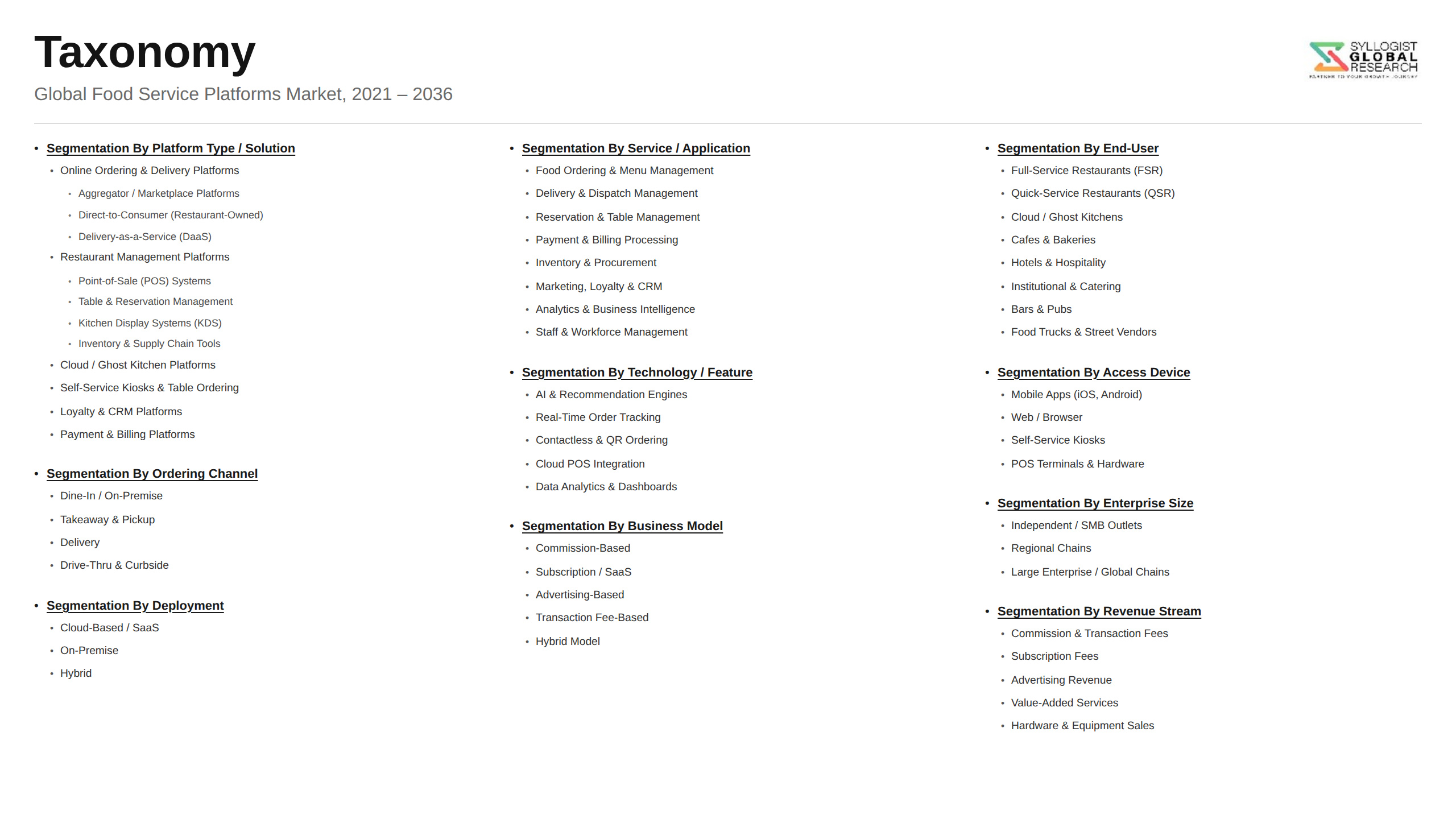
Market Segmentation
- Segmentation By Platform Type
- Food Delivery Aggregator Marketplaces
- Cloud Kitchen and Virtual Restaurant Platforms
- Online Ordering and Reservation Systems
- Restaurant Management and Point-of-Sale Software
- Last-Mile Delivery and Logistics Platforms
- Others
- Segmentation By Business Model
- Platform-to-Consumer
- Restaurant-to-Consumer
- Cloud Kitchen and Owned-Kitchen Model
- Quick-Commerce and Convenience Delivery
- Segmentation By Deployment
- Cloud-Based
- On-Premise
- Segmentation By Revenue Model
- Commission-Based
- Subscription and Membership
- Advertising and Promotion
- Software Licensing and SaaS
- Others
- Segmentation By End User
- Quick-Service Restaurants
- Full-Service Restaurants
- Cafes and Coffee Shops
- Cloud and Ghost Kitchens
- Grocery and Convenience Operators
- Others
- Segmentation By Region
- Asia-Pacific
- North America
- Europe
- Latin America
- Middle East and Africa
All market revenues are presented in USD
Historical Year: 2021-2024 | Base Year: 2025 | Estimated Year: 2026 | Forecast Period: 2027-2034
Key Questions this Study Will Answer
- What is the total global market valuation of the Global Food Service Platforms Market in 2025, projected through 2034, segmented by platform type, business model, deployment, and revenue model, enabling delivery aggregators, cloud kitchen operators, restaurant technology providers, and investors to identify highest-growth segments and most durable revenue opportunities across the global food service platforms market?
- How are food delivery aggregators, cloud kitchen networks, and restaurant technology providers structuring platform, fulfillment, and monetization models across commission, subscription, advertising, and software licensing revenue streams, and which operating models are shaping platform economics within the global food service platforms market through 2034?
- What smartphone penetration, digital ordering adoption, cloud kitchen proliferation, and quick-commerce integration dynamics are shaping the pace and geographic distribution of digital food ordering and delivery across mature and emerging economies in the global food service platforms market?
- Which platform categories, including delivery marketplaces, cloud kitchen infrastructure, online ordering software, and last-mile logistics, are gaining the strongest engagement traction across quick-service, full-service, and delivery-only applications, and what subscription, AI dispatch, and unit economics metrics are shaping platform selection within the global food service platforms market?
- How is the competitive landscape structured among food delivery aggregators, cloud kitchen operators, restaurant management software providers, and quick-commerce platforms within the global food service platforms market, and what acquisition, partnership, and vertical integration strategies are enabling participants to secure density, scale, and technology assets?
- What margin pressure, customer acquisition cost, regulatory, gig-worker directive, and sustainability dynamics are reshaping platform profitability, unit economics, and operational strategy across the global food service platforms market?
- Which regional markets, including Asia-Pacific, North America, Europe, and Latin America, are projected to generate the largest incremental digital food ordering and delivery demand through 2034, and what smartphone penetration, cloud kitchen activity, subscription adoption, and regulatory factors are shaping investment priorities and platform selection in each regional global food service platforms market?
- Product Definition
- Research Methodology
- Research Design & Framework
- Overall Research Approach: Descriptive, Exploratory & Quantitative Mixed-Method Design
- Market Definition & Scope Boundaries: What is Included and Excluded
- Segmentation Framework
- Key Research Assumptions & Limitations
- Secondary Research
- Primary Research Design & Execution
- Data Triangulation & Validation
- Market Sizing & Forecasting Methodology
- Competitive Intelligence Methodology
- Quality Assurance & Peer Review
- Definitions, Abbreviations & Data Notes
- Executive Summary
- Market Snapshot & Headline Numbers
- Key Findings & Research Highlights
- Market Dynamics
- Regional Market Summary
- Competitive Landscape Snapshot
- Technology & Innovation Highlights
- Market Dynamics
- Drivers
- Restraints
- Opportunities
- Challenges
- Porter’s Five Forces Analysis
- PESTLE Analysis
- Market Trends & Developments
- Emerging Trends
- Technological Developments
- Regulatory & Policy Changes
- Supply Chain & Sourcing Trends
- Manufacturing & Process Trends
- Investment & Funding Activity
- Sustainability & ESG Trends
- Risk Assessment Framework
- Platform Commission Pressure, Take-Rate Regulation & Margin Compression Risk
- Restaurant Churn, Multi-Homing & Customer Retention Risk
- Gig Worker Classification, Labour Regulation & Delivery Cost Risk
- Data Privacy, Cybersecurity & Payment Fraud Risk
- Market Saturation, Consolidation & Competitive Intensity Risk
- Regulatory Framework & Standards
- Data Privacy, GDPR & Consumer Protection Compliance Standards
- Gig Economy, Delivery Worker Classification & Labour Regulations
- Payment Processing, PCI-DSS & Financial Transaction Standards
- Food Safety, Hygiene Rating & Delivery Compliance Regulations
- Platform Commission Cap, Antitrust & Fair Trading Frameworks
- Global Food Service Platforms Market Outlook
- Market Size & Forecast by Value
- Market Size & Forecast by Volume (Food Service Orders Processed in Billion Transactions per Year and Active Platform Users in Million per Year)
- Market Size & Forecast by Platform Type
- Online Food Delivery and Ordering
- Restaurant Management Software
- Point-of-Sale (POS) Systems
- Table Reservation and Booking
- Kitchen and Order Management
- Food Procurement and Supply
- Cloud Kitchen and Virtual Brand
- Loyalty and Customer Engagement
- Payment and Billing
- Others
- Market Size & Forecast by Deployment
- Cloud-Based (SaaS)
- On-Premise
- Hybrid
- Others
- Market Size & Forecast by Business Model
- Commission-Based
- Subscription (SaaS)
- Transaction Fee
- Advertising-Supported
- Freemium
- Others
- Market Size & Forecast by Delivery Model
- Platform-to-Consumer (Aggregator)
- Restaurant-to-Consumer (Direct)
- Full-Stack (Cloud Kitchen)
- White-Label
- Others
- Market Size & Forecast by Application
- Online Ordering
- Delivery and Dispatch Management
- Payment Processing
- Inventory and Procurement
- Reservation and Table Management
- Analytics and Reporting
- Marketing and Loyalty
- Others
- Market Size & Forecast by End User
- Full-Service Restaurants
- Quick-Service Restaurants (QSR)
- Cafes and Bakeries
- Cloud and Ghost Kitchens
- Hotels and Hospitality
- Institutional and Contract Catering
- Independent Vendors and Food Trucks
- Others
- Market Size & Forecast by Enterprise Size
- Small and Independent Outlets
- Mid-Sized Chains
- Large Enterprise Chains
- Others
- Market Size & Forecast by Sales Channel
- Direct (Vendor Sales)
- Reseller and Partner Channel
- App Store and Marketplace
- Online Self-Service
- Others
- North America Food Service Platforms Market Outlook
- Market Size & Forecast
- By Value
- By Volume (Food Service Orders Processed in Billion Transactions per Year and Active Platform Users in Million per Year)
- By Platform Type
- By Deployment
- By Business Model
- By Delivery Model
- By Application
- By End User
- By Enterprise Size
- By Country
- By Sales Channel
- Europe Food Service Platforms Market Outlook
- Market Size & Forecast
- By Value
- By Volume (Food Service Orders Processed in Billion Transactions per Year and Active Platform Users in Million per Year)
- By Platform Type
- By Deployment
- By Business Model
- By Delivery Model
- By Application
- By End User
- By Enterprise Size
- By Country
- By Sales Channel
- Asia-Pacific Food Service Platforms Market Outlook
- Market Size & Forecast
- By Value
- By Volume (Food Service Orders Processed in Billion Transactions per Year and Active Platform Users in Million per Year)
- By Platform Type
- By Deployment
- By Business Model
- By Delivery Model
- By Application
- By End User
- By Enterprise Size
- By Country
- By Sales Channel
- Latin America Food Service Platforms Market Outlook
- Market Size & Forecast
- By Value
- By Volume (Food Service Orders Processed in Billion Transactions per Year and Active Platform Users in Million per Year)
- By Platform Type
- By Deployment
- By Business Model
- By Delivery Model
- By Application
- By End User
- By Enterprise Size
- By Country
- By Sales Channel
- Middle East & Africa Food Service Platforms Market Outlook
- Market Size & Forecast
- By Value
- By Volume (Food Service Orders Processed in Billion Transactions per Year and Active Platform Users in Million per Year)
- By Platform Type
- By Deployment
- By Business Model
- By Delivery Model
- By Application
- By End User
- By Enterprise Size
- By Country
- By Sales Channel
- Country-Wise* Food Service Platforms Market Outlook
- Market Size & Forecast
- By Value
- By Volume (Food Service Orders Processed in Billion Transactions per Year and Active Platform Users in Million per Year)
- By Platform Type
- By Deployment
- By Business Model
- By Delivery Model
- By Application
- By End User
- By Enterprise Size
- By Country
- By Sales Channel
- Market Size & Forecast
- Market Size & Forecast
- Market Size & Forecast
- Market Size & Forecast
- Market Size & Forecast
- Market Size & Forecast
*Countries Analysed in the Global Research Portfolio: United States, Canada, Mexico, Germany, France, United Kingdom, Netherlands, Spain, Italy, Norway, Sweden, China, Japan, India, Australia, South Korea, Singapore, Brazil, Chile, Saudi Arabia, UAE, Egypt, South Africa, Israel
- Technology Landscape & Innovation Analysis
- Cloud-Native, SaaS & Multi-Tenant Platform Architecture Technology Deep-Dive
- AI-Driven Demand Forecasting, Dynamic Pricing & Recommendation Technology
- Real-Time Order Routing, Dispatch & Delivery Optimisation Technology
- Integrated POS, Payment & Contactless Ordering Technology
- Kitchen Automation, Order Management & Cloud Kitchen Technology
- Data Analytics, Customer Insights & Loyalty Personalisation Technology
- API Integration, Third-Party Ecosystem & Open Platform Technology
- Patent & IP Landscape in Food Service Platform Technologies
- Value Chain & Supply Chain Analysis
- Platform Development, Software & Technology Infrastructure Supply Chain
- Restaurant and Merchant Onboarding & Partner Network
- Delivery Fleet, Logistics & Last-Mile Network
- Payment, Fintech & Transaction Processing Integration
- Consumer Acquisition, Marketing & Engagement Channel
- Cloud Hosting, Data & Infrastructure Service Providers
- Third-Party Integration, API & Ecosystem Partner Network
- Pricing Analysis
- Commission and Take-Rate Pricing Across Platform Models
- SaaS Subscription and Tiered Pricing Analysis
- Transaction Fee and Payment Processing Pricing Economics
- Delivery Fee, Surge and Dynamic Pricing Analysis
- Enterprise vs SME Pricing Differentials
- Advertising and Value-Added Service Pricing
- Regional Pricing Benchmarks & Total Cost of Ownership Models
- Sustainability & Environmental Analysis
- Sustainable Packaging, Delivery Emissions & Carbon Footprint Assessment
- Electric and Low-Carbon Delivery Fleet Performance
- Food Waste Reduction, Surplus Redistribution & Circular Economy Performance
- Gig Worker Welfare, Fair Labour & Social Sustainability Performance
- Regulatory-Driven Sustainability, SDG 8 (Decent Work) & SDG 12 (Responsible Consumption) Alignment & Green Finance Eligibility
- Competitive Landscape
- Market Structure & Concentration
- Market Consolidation Level (Fragmented vs. Consolidated by Platform Type & Geography)
- Top 10 Players Market Share
- HHI (Herfindahl-Hirschman Index) Concentration Analysis
- Competitive Intensity Map by Platform Type, Application & Geography
- Player Classification
- Integrated Food Delivery Aggregators
- Restaurant Management and POS Software Providers
- Cloud Kitchen and Virtual Brand Platforms
- Reservation and Table Management Providers
- Payment and Fintech Platform Providers
- Procurement and Supply Chain Platforms
- Regional and Independent Platform Providers
- Niche and Vertical-Specific Platforms
- Competitive Analysis Frameworks
- Market Share Analysis by Platform Type, Application & Region
- Company Profile
- Company Overview & Headquarters
- Platform Product Portfolio
- Key Customer Relationships & Reference Merchant Accounts
- Geographic Footprint & Market Coverage
- Revenue (Platform Segment) & GMV
- Technology Differentiators & IP
- Key Strategic Partnerships, JVs & M&A Activity
- Recent Developments (Product Launches, Market Expansion, Funding Rounds)
- SWOT Analysis
- Strategic Focus Areas & Roadmap
- Competitive Positioning Map (Technology Capability vs. Market Penetration)
- Key Company Profiles
- Market Structure & Concentration
- Technology Landscape & Innovation Analysis
- Strategic Output
- Market Opportunity Matrix: By Platform Type, Business Model, Application, End User & Geography
- White Space Opportunity Analysis
- Strategic Recommendations
- Platform Portfolio & Product Innovation Strategy
- Operational Excellence & Scalability Strategy
- Geographic Expansion & Localisation Strategy
- Merchant & Consumer Engagement Strategy
- Partnership, M&A & Ecosystem Strategy
- Sustainability & Responsible Platform Strategy
- Risk Mitigation & Future Roadmap
- Strategic Priority Matrix & Roadmap
- Near-term (2025-2028)
- Mid-term (2029-2032)
- Long-term (2033-2037)