Global Fragrances Market By Product Type, By Ingredient, By Concentration, By Price Range, By End User, By Distribution Channel, By Region, Competition, Forecast & Opportunities, 2021-2034F
Market Definition
Fragrances are aromatic products and scented compositions engineered to deliver pleasant, long-lasting scent for personal grooming, self-expression, and ambient use across consumer and institutional settings. The Global Fragrances Market encompasses the formulation, manufacturing, branding, distribution, and end use of fine fragrances including perfume, eau de parfum, eau de toilette, and eau de cologne, along with deodorants and body sprays, home fragrances such as candles, diffusers, and air care products, and the natural and synthetic aroma ingredients used to compose them. The fragrances market covers products positioned across mass, premium, and luxury price tiers and formulated for women, men, and unisex use, supplied through specialty stores, department stores, hypermarkets and supermarkets, and online channels. Market participants include fragrance houses and scent creators, natural aroma ingredient and synthetic aroma chemical producers, branded fragrance owners, licensed fashion and celebrity fragrance brands, contract manufacturers, and retailers serving global consumer demand. End users span individual consumers purchasing fine fragrances, deodorants, and home fragrance products, along with cosmetics, personal care, and home care brand owners that incorporate fragrance compositions into finished goods. The global fragrances market covers mass-market scented products and higher-specification premium, niche, and artisanal fragrances, including natural, clean-label, and sustainable formulations developed to meet evolving consumer and regulatory expectations. The fragrances market explicitly excludes flavor compositions used in food and beverages, standalone cosmetic and skincare products without a primary scent function, and cleaning products where fragrance is a secondary attribute, focusing exclusively on fragrance products and scent compositions across global consumer end-use sectors.
Market Insights
The global fragrances market is entering a sustained expansion phase, shaped by accelerating premiumization, rising disposable incomes, growing consumer focus on personal grooming and self-expression, the rapid rise of niche and artisanal perfumery, and increasing demand for natural and clean-label scent formulations. The fragrances market was valued at USD 59.2 billion in 2025 and is projected to reach USD 98.4 billion by 2034, advancing at a compound annual growth rate of 5.8% through the forecast period, as consumers, fragrance houses, branded fragrance owners, and retailers scale fine fragrance, deodorant, and home fragrance sales across North America, Europe, Asia-Pacific, the Middle East and Africa, and Latin America. Sustained migration from mass products toward premium and luxury offerings continues to widen the value base of the global fragrances market.
The fragrances market trajectory is being reshaped by accelerating premiumization, with consumers trading up to higher-concentration parfum and eau de parfum formats that deliver greater longevity and stronger personal identity within the global fragrances market. Niche and artisanal fragrances are gaining share across the fragrances market as consumers seek distinctive, authentic, and story-driven scents beyond mainstream designer offerings. Personalization is emerging as a structural growth vector within the fragrances market, supported by bespoke scent services, layering, and digital scent-discovery tools that deepen consumer engagement. Heightened consumer scrutiny of ingredient transparency, safety, and environmental impact is accelerating the shift toward natural, clean-label, and sustainably-sourced fragrance formulations across the global fragrances market, prompting brands to reformulate around green chemistry principles, biotechnology-derived aroma ingredients, and responsibly-sourced naturals while maintaining scent performance and regulatory compliance.
Fine fragrances represent the largest product segment within the fragrances market, supported by sustained demand for perfume, eau de parfum, and eau de toilette across mass, premium, and luxury tiers of the global fragrances market. Eau de parfum leads the concentration mix within the fragrances market on the basis of its balance of longevity and wearability, while parfum is the fastest-growing concentration segment, propelled by premiumization and demand for intense, long-lasting scent experiences. The premium price segment represents the fastest-growing tier within the global fragrances market, propelled by rising luxury consumption and gifting culture, while the mass segment retains the largest volume base and serves as an entry point for new consumers. Among end users, women’s fragrances hold the largest revenue share within the fragrances market, supported by higher per-capita consumption and multiple-fragrance ownership, while men’s and unisex fragrances represent the fastest-growing end-user categories within the global fragrances market. Online distribution is the fastest-growing channel within the fragrances market, propelled by digital scent discovery, sampling programs, and subscription models.
Europe represents a leading regional market within the fragrances market, supported by centuries of perfumery heritage anchored in France, a concentration of luxury fragrance houses, and elevated premium and niche consumption across the global fragrances market. North America occupies a leading revenue position within the fragrances market, propelled by high consumer spending on premium and prestige fragrances and a well-developed retail and e-commerce infrastructure. Asia-Pacific represents the fastest-growing region within the global fragrances market, supported by rapid urbanization, rising disposable incomes, a large and youthful consumer base, and expanding fragrance penetration across China, India, and Southeast Asian economies. The Middle East and Africa hold a strategically important position within the fragrances market, supported by deeply rooted oud and bakhoor traditions and exceptionally high per-capita fragrance expenditure, while Latin America represents a fast-growing region within the global fragrances market driven by rising aspirational spending and strong brand consciousness across Brazil and Mexico.
Key Drivers
Accelerating Premiumization, Rising Disposable Incomes, and Growing Personal Grooming and Self-Expression Culture Driving Value Growth Across the Fragrances Market
Accelerating premiumization, rising disposable incomes, and the strengthening culture of personal grooming and self-expression are generating durable value growth within the global fragrances market. Consumers increasingly view fragrance as an extension of personal identity, status, and mood rather than a simple grooming product, driving trade-up from mass products toward premium and luxury offerings across the fragrances market. Rising disposable incomes and expanding affluent and middle-class populations across emerging economies are widening the consumer base and lifting per-capita fragrance consumption within the global fragrances market. Growing frequency of fragrance use across office wear, social gatherings, fitness, and travel is increasing repeat purchase and multiple-fragrance ownership, supporting sustained volume and value growth across the fragrances market. Gifting culture and the emotional connection consumers form with scent are reinforcing demand for premium and prestige fragrances, particularly around seasonal and celebratory occasions within the global fragrances market. Higher fragrance oil concentrations, sophisticated scent structures, and premium packaging are commanding stronger pricing and consumer loyalty, moving the category up the value chain across the fragrances market. Rising male grooming adoption and the growth of unisex fragrances are broadening the addressable base, sustaining momentum across designer, prestige, and luxury tiers of the global fragrances market worldwide.
Rise of Niche and Artisanal Perfumery, Personalization, and Clean-Label Natural Formulations Driving Differentiation Across the Fragrances Market
The rise of niche and artisanal perfumery, growing demand for personalization, and the shift toward clean-label and natural formulations are driving differentiation and value creation across the global fragrances market. Consumers increasingly seek distinctive, authentic, and story-driven scents beyond mainstream designer offerings, propelling rapid growth of niche and artisanal brands within the fragrances market. Personalization, including bespoke scent creation, fragrance layering, and digital scent-discovery tools, is deepening consumer engagement and supporting premium positioning across the global fragrances market. Heightened scrutiny of ingredient transparency, safety, and sustainability is accelerating demand for natural, clean-label, and responsibly-sourced fragrance formulations within the fragrances market. Brands are responding by reformulating around green chemistry principles, biotechnology-derived aroma ingredients, and sustainably-sourced naturals that align with consumer values while maintaining scent performance across the global fragrances market. Concentrated formats, solid perfumes, and alcohol-free oils are creating incremental entry points into the fragrances market, appealing to travelers and consumers seeking low-emission, skin-friendly, and religiously compliant options. Social media, influencer-led discovery, and content-driven scent storytelling are amplifying niche brand visibility and accelerating product turnover across the global fragrances market. This combined shift toward niche, personalized, and clean formulations commands higher realized pricing, supporting value growth across the fragrances market even where volume growth is moderate.
Expansion of E-Commerce, Digital Scent Discovery, and Emerging Market Penetration Driving Reach and Volume Growth Across the Fragrances Market
The rapid expansion of e-commerce, the maturation of digital scent-discovery models, and deepening penetration across emerging markets are driving reach and volume growth within the global fragrances market. Online retail is outpacing physical formats across the fragrances market, supported by sampling programs, subscription-based scent discovery, artificial intelligence scent quizzes, and livestream selling that help overcome the inability to smell products through a screen. Digital channels are extending brand access into smaller and tier-two cities, broadening the consumer base and lifting fragrance penetration across the global fragrances market. Rising urbanization, expanding organized retail, and growing disposable incomes across Asia-Pacific, Latin America, the Middle East, and Africa are scaling demand for both mass and premium fragrances within the fragrances market. Social media and influencer marketing are accelerating product discovery, trend cycles, and impulse purchasing, shortening the path from awareness to purchase across the global fragrances market. Sampling, miniatures, and travel-size formats are lowering trial barriers and converting new consumers into repeat buyers within the fragrances market. Expanding international brand presence and localized product launches are shaping consumer preferences and lifting fragrance adoption across high-growth emerging economies, supporting sustained multi-year volume growth across mass, premium, and luxury tiers of the global fragrances market worldwide.
Key Challenges
Tightening Allergen, Safety, and Ingredient Disclosure Regulation Increasing Reformulation Burden and Compliance Cost Across the Fragrances Market
Tightening regulation of allergens, ingredient safety, and disclosure requirements is increasing reformulation burden, extending time-to-market, and raising compliance cost across the global fragrances market. Expanding allergen labeling requirements, particularly across Europe, are forcing brands to reformulate products, redesign packaging, and revisit ingredient portfolios within the fragrances market. Industry fragrance standards and evolving restrictions on specific aroma ingredients require continual reformulation, generating substantial research, testing, and safety-assessment expenditure across the global fragrances market. Reformulating established scents to comply with new restrictions while preserving the original olfactory character is technically demanding and risks altering signature fragrances that underpin brand equity within the fragrances market. Divergent regulatory requirements across regions force multinational brands to maintain multiple formulation variants and disclosure regimes, complicating portfolio management across the global fragrances market. Rising consumer demand for full ingredient transparency adds further pressure to disclose compositions historically protected as proprietary within the fragrances market. Small and independent niche brands face disproportionate compliance burden relative to large diversified players, constraining competitive positioning across the global fragrances market. This sustained tightening of allergen, safety, and disclosure regulation continues to raise the ongoing cost of participation and slow the pace of new product introduction across the fragrances market.
Volatile Natural Aroma Ingredient Supply, Raw Material Price Fluctuation, and Sourcing Sustainability Constraints Across the Fragrances Market
Volatile natural aroma ingredient supply, fluctuating raw material prices, and sourcing sustainability constraints generate persistent cost and continuity challenges across the global fragrances market. Natural aroma materials including essential oils, absolutes, and botanical extracts are exposed to agricultural cycles, weather variability, and crop yield fluctuation that create price volatility and supply uncertainty within the fragrances market. Growing consumer preference for natural and sustainably-sourced ingredients intensifies demand for constrained botanical raw materials, tightening availability and raising input cost across the global fragrances market. Concentration of key natural ingredient production in specific geographies heightens exposure to regional disruption, geopolitical risk, and trade constraints within the fragrances market. Ensuring ethical, traceable, and sustainable sourcing of naturals requires investment in supply chain transparency and grower partnerships that raise cost and complexity across the global fragrances market. Price volatility in both natural and petrochemical-derived synthetic aroma ingredients complicates cost planning and margin management for fragrance houses and brand owners within the fragrances market. Balancing sustainability commitments, scent performance, and cost efficiency remains a persistent challenge, particularly for premium and natural-positioned products across the global fragrances market. These combined supply, price, and sustainability pressures continue to constrain margin stability and complicate long-range sourcing across the fragrances market.
Counterfeiting, Gray-Market Diversion, and Intense Competitive Intensity Constraining Brand Value Across the Fragrances Market
Widespread counterfeiting, gray-market diversion, and intense competitive intensity are eroding brand value, pricing integrity, and consumer trust across the global fragrances market. Counterfeit fragrances closely imitating premium and luxury brands are widely available through unauthorized physical and online channels, diverting sales and damaging brand reputation within the fragrances market. Gray-market diversion of authentic products across regions undermines pricing structures, authorized distribution agreements, and brand positioning across the global fragrances market. The proliferation of low-priced imitation and dupe products, amplified by social media, is pressuring premium brands and complicating consumer perception of value within the fragrances market. Intense competition among global designer brands, licensed fragrance houses, and fast-growing niche players sustains high marketing and innovation cost across the global fragrances market. Rapid trend cycles driven by social media shorten product life spans and require continual new launches to maintain relevance within the fragrances market. Discretionary spending sensitivity means fragrance demand, particularly in premium and luxury tiers, can soften during economic downturns, adding demand variability across the global fragrances market. Protecting brand equity against counterfeits and diversion requires sustained investment in authentication, enforcement, and distribution control, raising operating cost and challenging profitability across the fragrances market.
Market Segmentation
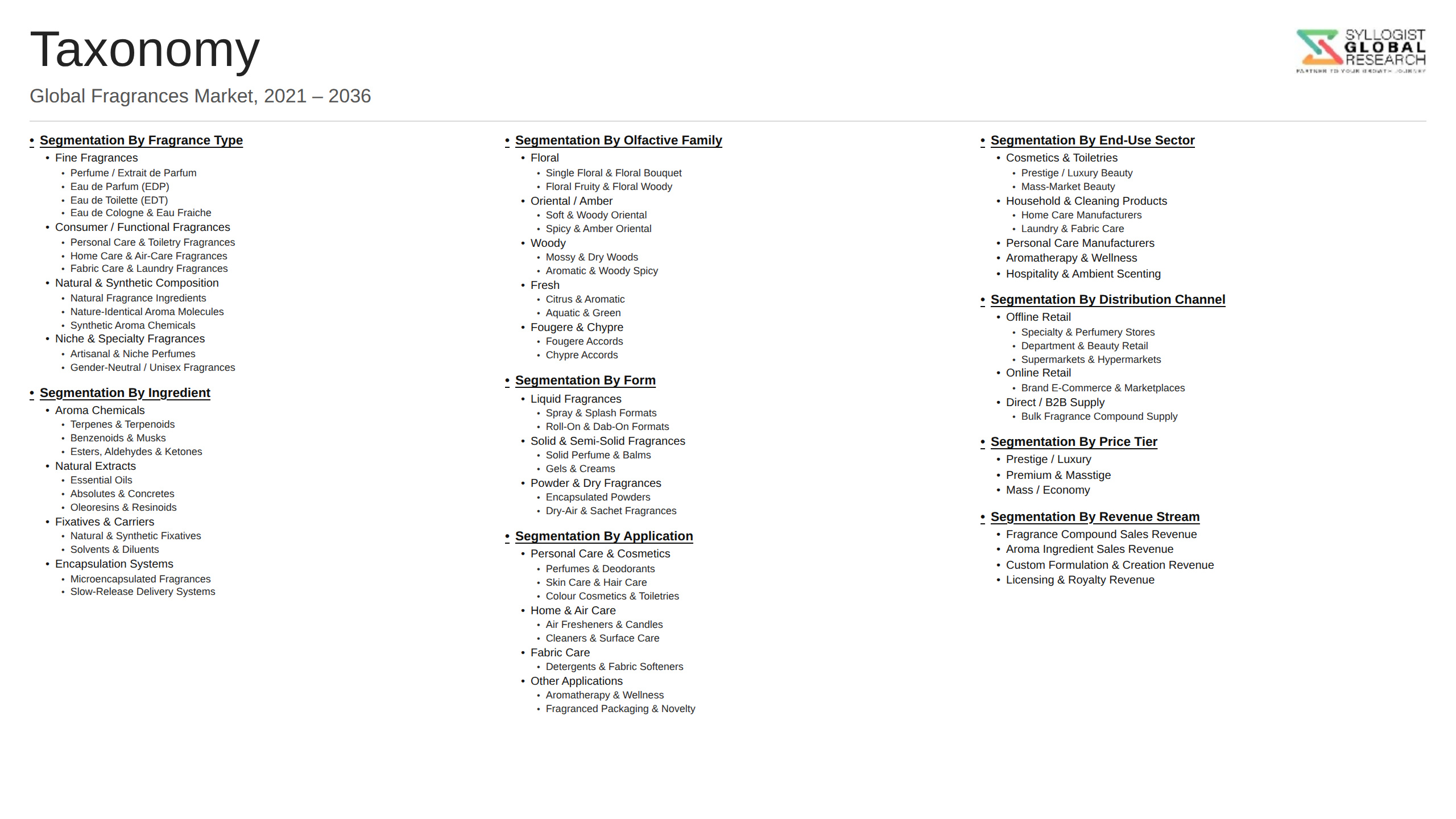
- Segmentation By Product Type
- Fine Fragrances (Perfume, Eau de Parfum, Eau de Toilette, Eau de Cologne)
- Deodorants and Body Sprays
- Home Fragrances (Candles, Diffusers, Air Care)
- Others
- Segmentation By Ingredient
- Natural
- Synthetic
- Segmentation By Concentration
- Parfum
- Eau de Parfum
- Eau de Toilette
- Eau de Cologne
- Others
- Segmentation By Price Range
- Mass
- Premium
- Luxury
- Segmentation By End User
- Women
- Men
- Unisex
- Segmentation By Distribution Channel
- Specialty Stores
- Department Stores
- Hypermarkets and Supermarkets
- Online
- Others
- Segmentation By Region
- North America
- Europe
- Asia-Pacific
- Middle East and Africa
- Latin America
All market revenues are presented in USD
Historical Year: 2021-2024 | Base Year: 2025 | Estimated Year: 2026 | Forecast Period: 2027-2034
Key Questions this Study Will Answer
- What is the total global market valuation of the Fragrances Market in 2025, projected through 2034, segmented by product type, ingredient, concentration, price range, end user, and distribution channel, enabling fragrance houses, branded fragrance owners, retailers, and investors to identify the highest-growth segments and most durable revenue opportunities across the global fragrances market?
- How are consumers, branded fragrance owners, licensed fashion and celebrity brands, and retailers structuring fragrance purchasing and distribution, and which commercial models, including specialty retail, department store, and digital-first direct-to-consumer channels, are shaping the economics of the fragrances market through 2034?
- What premiumization, niche and artisanal perfumery, personalization, and clean-label natural formulation dynamics are shaping the pace and geographic distribution of fragrance demand across mass, premium, and luxury tiers in mature and emerging fragrances markets?
- Which product types and concentrations, including perfume, eau de parfum, eau de toilette, deodorants, and home fragrances, are gaining the strongest consumer traction, and what longevity, ingredient, sustainability, and value metrics are shaping product selection across the global fragrances market?
- How is the competitive landscape structured among global designer brands, luxury fragrance houses, aroma ingredient producers, licensed fragrance brands, and fast-growing niche players within the fragrances market, and what partnership, acquisition, and brand expansion strategies are enabling participants to compete on scent, authenticity, and premium positioning?
- What e-commerce growth, digital scent-discovery adoption, social-media-led discovery, and sustainability trends are reshaping product development, marketing, distribution, and premiumization across the global fragrances market?
- Which regional markets, including Europe, North America, Asia-Pacific, the Middle East and Africa, and Latin America, are projected to generate the largest incremental fragrance demand through 2034, and what disposable income growth, grooming culture, premiumization, and retail penetration factors are shaping demand growth and brand selection in each regional fragrances market?
- Product Definition
- Research Methodology
- Research Design & Framework
- Overall Research Approach: Descriptive, Exploratory & Quantitative Mixed-Method Design
- Market Definition & Scope Boundaries: What is Included and Excluded
- Segmentation Framework
- Key Research Assumptions & Limitations
- Secondary Research
- Primary Research Design & Execution
- Data Triangulation & Validation
- Market Sizing & Forecasting Methodology
- Competitive Intelligence Methodology
- Quality Assurance & Peer Review
- Definitions, Abbreviations & Data Notes
- Executive Summary
- Market Snapshot & Headline Numbers
- Key Findings & Research Highlights
- Market Dynamics
- Regional Market Summary
- Competitive Landscape Snapshot
- Technology & Innovation Highlights
- Market Dynamics
- Drivers
- Restraints
- Opportunities
- Challenges
- Porter’s Five Forces Analysis
- PESTLE Analysis
- Market Trends & Developments
- Emerging Trends
- Technological Developments
- Regulatory & Policy Changes
- Supply Chain & Sourcing Trends
- Manufacturing & Process Trends
- Investment & Funding Activity
- Sustainability & ESG Trends
- Risk Assessment Framework
- Natural Ingredient (Essential Oil, Absolute) Price Volatility & Supply Risk
- IFRA, Allergen Restriction & Ingredient Regulation Compliance Risk
- Counterfeiting, Grey Market & Brand Dilution Risk
- Shifting Consumer Preference, Clean Fragrance & Reformulation Risk
- Discretionary Spending Sensitivity & Demand Volatility Risk
- Regulatory Framework & Standards
- IFRA Standards, Allergen Labelling & Fragrance Safety Compliance
- REACH, Cosmetic Regulation & Ingredient Restriction Standards
- Natural, Organic & Clean Fragrance Certification Standards
- Sustainable Sourcing, CITES & Endangered Botanical Regulations
- Cross-Border Trade, Labelling & Import-Export Compliance Frameworks
- Global Fragrances Market Outlook
- Market Size & Forecast by Value
- Market Size & Forecast by Volume (Fragrances Consumed in Kilo Tonnes per Year and Product Units Sold in Million Units per Year)
- Market Size & Forecast by Product Type
- Eau de Parfum (EDP)
- Eau de Toilette (EDT)
- Eau de Cologne (EDC)
- Perfume (Parfum / Extrait)
- Body Mist and Splash
- Solid and Oil Perfume
- Others
- Market Size & Forecast by Ingredient Type
- Natural (Essential Oils and Absolutes)
- Synthetic (Aroma Chemicals)
- Nature-Identical
- Naturals-Derived (Biotech)
- Others
- Market Size & Forecast by Fragrance Family
- Floral
- Woody
- Oriental (Amber)
- Fresh and Citrus
- Fougere
- Chypre
- Gourmand
- Others
- Market Size & Forecast by Application
- Fine Fragrance
- Personal Care and Cosmetics
- Home Care
- Soaps and Detergents
- Air Care and Fresheners
- Fabric Care
- Toiletries
- Others
- Market Size & Forecast by End-Use Industry
- Cosmetics and Personal Care
- Household and Home Care
- Fine Fragrance and Perfumery
- Cleaning and Detergents
- Aromatherapy and Wellness
- Textiles
- Others
- Market Size & Forecast by Consumer Group
- Men
- Women
- Unisex
- Children
- Others
- Market Size & Forecast by Price Tier
- Mass
- Premium
- Prestige
- Luxury and Niche
- Others
- Market Size & Forecast by Sales Channel
- Specialty and Perfumery Stores
- Department Stores
- Supermarkets and Hypermarkets
- Online and E-commerce
- Pharmacies and Drug Stores
- Duty-Free and Travel Retail
- Others
- North America Fragrances Market Outlook
- Market Size & Forecast
- By Value
- By Volume (Fragrances Consumed in Kilo Tonnes per Year and Product Units Sold in Million Units per Year)
- By Product Type
- By Ingredient Type
- By Fragrance Family
- By Application
- By End-Use Industry
- By Consumer Group
- By Price Tier
- By Country
- By Sales Channel
- Europe Fragrances Market Outlook
- Market Size & Forecast
- By Value
- By Volume (Fragrances Consumed in Kilo Tonnes per Year and Product Units Sold in Million Units per Year)
- By Product Type
- By Ingredient Type
- By Fragrance Family
- By Application
- By End-Use Industry
- By Consumer Group
- By Price Tier
- By Country
- By Sales Channel
- Asia-Pacific Fragrances Market Outlook
- Market Size & Forecast
- By Value
- By Volume (Fragrances Consumed in Kilo Tonnes per Year and Product Units Sold in Million Units per Year)
- By Product Type
- By Ingredient Type
- By Fragrance Family
- By Application
- By End-Use Industry
- By Consumer Group
- By Price Tier
- By Country
- By Sales Channel
- Latin America Fragrances Market Outlook
- Market Size & Forecast
- By Value
- By Volume (Fragrances Consumed in Kilo Tonnes per Year and Product Units Sold in Million Units per Year)
- By Product Type
- By Ingredient Type
- By Fragrance Family
- By Application
- By End-Use Industry
- By Consumer Group
- By Price Tier
- By Country
- By Sales Channel
- Middle East & Africa Fragrances Market Outlook
- Market Size & Forecast
- By Value
- By Volume (Fragrances Consumed in Kilo Tonnes per Year and Product Units Sold in Million Units per Year)
- By Product Type
- By Ingredient Type
- By Fragrance Family
- By Application
- By End-Use Industry
- By Consumer Group
- By Price Tier
- By Country
- By Sales Channel
- Country-Wise* Fragrances Market Outlook
- Market Size & Forecast
- By Value
- By Volume (Fragrances Consumed in Kilo Tonnes per Year and Product Units Sold in Million Units per Year)
- By Product Type
- By Ingredient Type
- By Fragrance Family
- By Application
- By End-Use Industry
- By Consumer Group
- By Price Tier
- By Country
- By Sales Channel
- Market Size & Forecast
- Market Size & Forecast
- Market Size & Forecast
- Market Size & Forecast
- Market Size & Forecast
- Market Size & Forecast
*Countries Analysed in the Global Research Portfolio: United States, Canada, Mexico, Germany, France, United Kingdom, Netherlands, Spain, Italy, Norway, Sweden, China, Japan, India, Australia, South Korea, Singapore, Brazil, Chile, Saudi Arabia, UAE, Egypt, South Africa, Israel
- Technology Landscape & Innovation Analysis
- Aroma Chemical Synthesis & Molecular Fragrance Design Technology Deep-Dive
- Biotechnology, Fermentation & Sustainable Natural Ingredient Technology
- Encapsulation, Controlled-Release & Long-Lasting Fragrance Technology
- Clean, Hypoallergenic & Allergen-Free Formulation Technology
- AI-Driven Fragrance Creation & Scent Personalisation Technology
- Headspace Capture, Natural Extraction & Green Chemistry Technology
- Sustainable Sourcing, Upcycled Ingredient & Circular Fragrance Technology
- Patent & IP Landscape in Fragrance Technologies
- Value Chain & Supply Chain Analysis
- Natural Botanical, Essential Oil & Raw Material Supply Chain
- Aroma Chemical & Synthetic Ingredient Manufacturing Supply Chain
- Fragrance Compounding, Creation & Formulation Supply Chain
- Brand, Bottling & Packaging Supply Chain
- Fragrance House and Brand Customer Channel
- Retail, Travel Retail & E-commerce Distribution Network
- Sustainable Sourcing & Ethical Ingredient Partner Network
- Pricing Analysis
- Fine Fragrance Pricing Across Mass, Prestige & Luxury Tiers
- Natural vs Synthetic Ingredient Pricing Differentials
- Fragrance Compound and Formulation Value-Added Pricing
- Niche and Artisanal Fragrance Premium Pricing Analysis
- Raw Material Cost Pass-Through & Formulation Cost Economics
- Travel Retail and Channel-Specific Pricing Analysis
- Regional Pricing Benchmarks & Value-in-Use Pricing Models
- Sustainability & Environmental Analysis
- Lifecycle Assessment (LCA) of Fragrances Across Sourcing & Production
- Sustainable Botanical Sourcing, Biodiversity & Ethical Supply Performance
- Green Chemistry, Biotech Ingredients & Reduced Environmental Impact
- Sustainable Packaging, Refill Systems & Circular Economy Performance
- Regulatory-Driven Sustainability, SDG 12 (Responsible Consumption) & SDG 15 (Life on Land) Alignment & Green Finance Eligibility
- Competitive Landscape
- Market Structure & Concentration
- Market Consolidation Level (Fragmented vs. Consolidated by Product Type & Geography)
- Top 10 Players Market Share
- HHI (Herfindahl-Hirschman Index) Concentration Analysis
- Competitive Intensity Map by Product Type, Application & Geography
- Player Classification
- Integrated Fragrance and Flavour Houses
- Fine Fragrance and Luxury Perfume Brands
- Mass and Personal Care Fragrance Producers
- Natural and Organic Fragrance Specialists
- Aroma Chemical and Ingredient Suppliers
- Niche and Artisanal Perfume Houses
- Private Label and Contract Manufacturers
- Distributors and Travel Retailers
- Competitive Analysis Frameworks
- Market Share Analysis by Product Type, Application & Region
- Company Profile
- Company Overview & Headquarters
- Fragrance Product Portfolio
- Key Customer Relationships & Reference Brand Accounts
- Manufacturing Footprint & Production Capacity Coverage
- Revenue (Fragrance Segment) & Order Backlog
- Technology Differentiators & IP
- Key Strategic Partnerships, JVs & M&A Activity
- Recent Developments (Product Launches, Capacity Expansion, Contract Wins)
- SWOT Analysis
- Strategic Focus Areas & Roadmap
- Competitive Positioning Map (Technology Capability vs. Market Penetration)
- Key Company Profiles
- Market Structure & Concentration
- Technology Landscape & Innovation Analysis
- Strategic Output
- Market Opportunity Matrix: By Product Type, Ingredient Type, Application, End-Use Industry & Geography
- White Space Opportunity Analysis
- Strategic Recommendations
- Product Portfolio & Fragrance Innovation Strategy
- Manufacturing Excellence & Capacity Expansion Strategy
- Geographic Expansion & Localisation Strategy
- Brand & Customer Engagement Strategy
- Partnership, M&A & Ecosystem Strategy
- Sustainability & Ethical Sourcing Strategy
- Risk Mitigation & Future Roadmap
- Strategic Priority Matrix & Roadmap
- Near-term (2025-2028)
- Mid-term (2029-2032)
- Long-term (2033-2037)