Global Glass Market By Product Type, By Manufacturing Process, By Application, By End User, By Region, Competition, Forecast & Opportunities, 2021-2034F
Market Definition
Glass is a hard, transparent, inorganic material produced by melting silica sand together with soda ash, limestone, and other additives at high temperature and cooling the melt without crystallization, delivering transparency, chemical inertness, thermal resistance, and formability across construction, automotive, packaging, electronics, and specialty applications. The Global Glass Market covers the manufacturing, processing, and supply of flat glass, container glass, fiberglass, and specialty and technical glass produced through float, rolled, blown, pressed, drawn, and fiber-forming processes, and encompasses annealed, tempered, laminated, insulated, coated, and chemically strengthened glass products. The glass market spans architectural and building glass for windows, facades, and insulated glazing units, automotive glazing for windshields, sidelites, backlites, and sunroofs, container glass for beverages, food, pharmaceuticals, and cosmetics, glass fiber for insulation and composite reinforcement, and technical glass for displays, solar panels, optics, laboratory ware, and electronic substrates. Market participants include float glass manufacturers, container glass producers, fiberglass makers, specialty and technical glass suppliers, glass processors and fabricators, and distributors that convert primary glass into finished products for downstream industries. End users span the building and construction sector, automotive and transportation manufacturers, food and beverage and pharmaceutical packaging, electronics and solar producers, and industrial and consumer goods manufacturers. The glass market excludes glass-ceramics sold outside conventional glass supply routes, raw silica and mineral inputs, and non-glass transparent polymers such as acrylic and polycarbonate, concentrating on flat, container, fiber, and specialty glass volumes that serve structural, packaging, insulation, and technical roles across regulated and industrial applications worldwide.
Market Insights
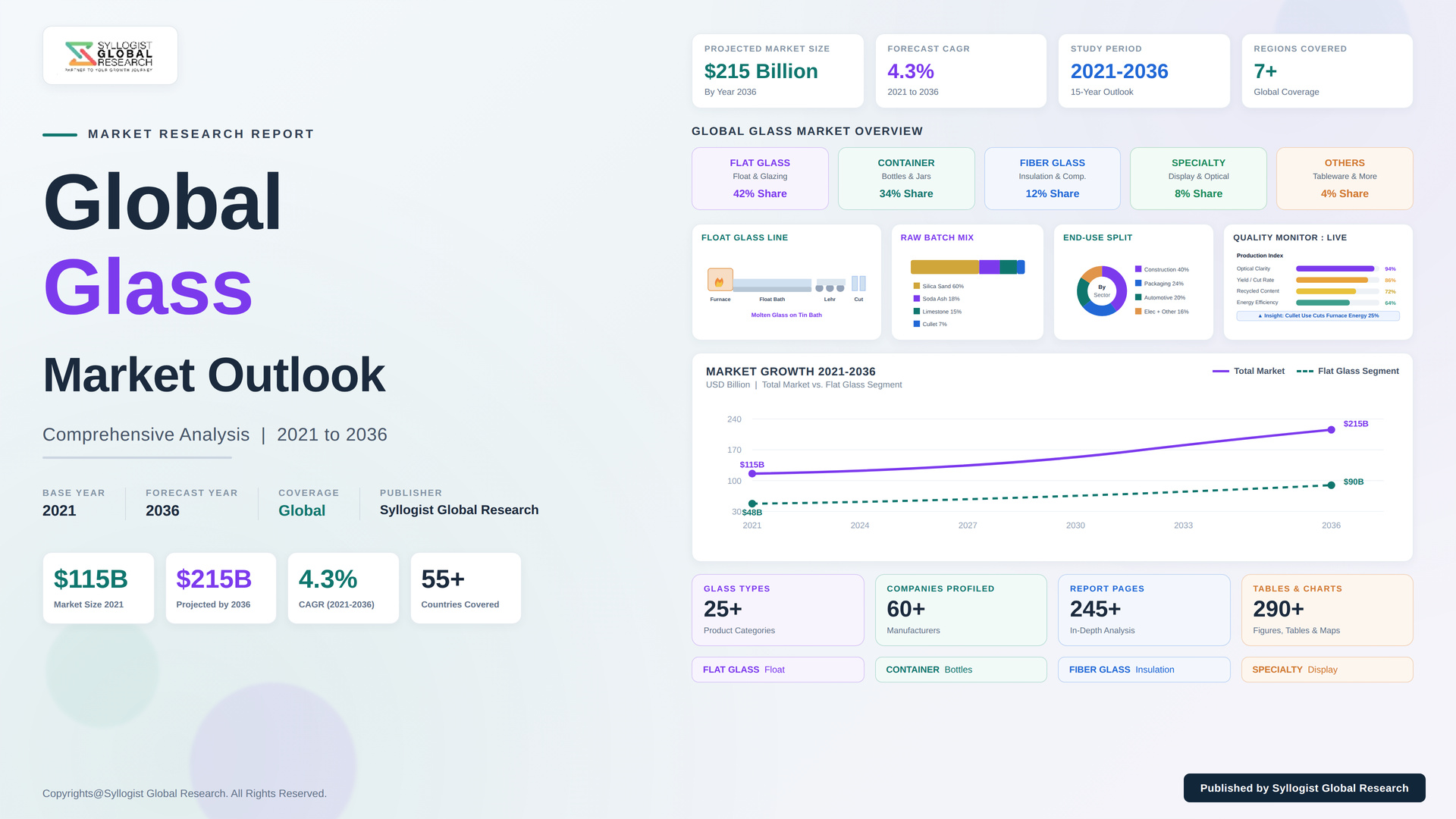
The global glass market is moving through a steady expansion phase, shaped by rising construction and infrastructure activity, growing demand for energy-efficient glazing, expanding automotive and electric vehicle production, accelerating solar panel installations, and a structural shift toward glass packaging driven by sustainability and premiumization. The global glass market was valued at USD 138.6 billion in 2025 and is projected to reach USD 214.3 billion by 2034, advancing at a compound annual growth rate of 5.0% through the forecast period, as construction firms, automotive manufacturers, packaging producers, solar developers, and electronics makers scale glass procurement across North America, Europe, Asia-Pacific, the Middle East and Africa, and Latin America.
The glass market trajectory is being reshaped by the scaling of low-emissivity coated glazing, the growth of solar photovoltaic glass, and the adoption of lightweight, thin, and chemically strengthened glass in vehicles and electronics. Flat glass accounts for close to 48% of total global glass demand, driven by architectural glazing, automotive glass, and solar panel cover glass, with low-emissivity and insulated glazing units becoming standard specification in new commercial and residential buildings across mature markets. Solar photovoltaic glass is scaling rapidly within the glass market, supported by global solar capacity additions exceeding 400 gigawatts in 2024, while container glass demand is strengthening as beverage, food, and pharmaceutical brands shift toward recyclable and infinitely reusable glass packaging in response to plastic reduction commitments and consumer preference for premium presentation.
Flat glass remains the single largest product category within the global glass market, sustained by architectural glazing, automotive glass, and solar cover glass demand across construction and transportation value chains. Container glass represents the second largest product category within the glass market, anchored by beverage, food, pharmaceutical, and cosmetic packaging where recyclability and product integrity drive sustained demand. Fiberglass is gaining strategic procurement traction within the glass market, propelled by building insulation demand tied to energy-efficiency regulation and by composite reinforcement in wind energy, automotive, and construction applications. Specialty and technical glass represents the fastest-growing product category within the glass market, propelled by display glass, ultra-thin and chemically strengthened cover glass for smartphones and devices, and solar glass, while the float process continues to dominate flat glass production and remains the largest manufacturing process within the glass market supported by high-volume architectural and automotive glazing output.
Asia-Pacific represents the largest regional market within the global glass market, supported by large-scale construction activity, dominant flat and container glass capacity, and rapid growth of solar and display glass manufacturing across China, India, and Southeast Asia. China alone accounts for more than 50% of global flat glass production and continues to add float and solar glass capacity. Europe occupies a leading regional position within the glass market, anchored by energy-efficient glazing mandates, strong container glass demand, and specialty glass production. North America represents an established regional market within the glass market, propelled by construction glazing, automotive glass, and premium beverage packaging demand, while the Middle East and Africa form a growing regional position within the glass market driven by construction investment and float glass capacity additions. Latin America represents an emerging position within the glass market, supported by container glass demand and expanding construction activity across the region.
Key Drivers
Rising Construction Activity, Infrastructure Investment, and Energy-Efficient Glazing Mandates Driving Architectural Flat Glass Demand
Rising construction activity, sustained infrastructure investment, and tightening energy-efficiency building codes are generating durable procurement demand for architectural flat glass within the global glass market. Urbanization, commercial development, and residential construction across emerging and mature economies are lifting demand for windows, facades, curtain walls, and insulated glazing units that consume large volumes of float and processed glass. Energy-efficiency mandates are a powerful demand driver, with building codes across major markets requiring low-emissivity coated and insulated glazing to reduce heating and cooling loads, shifting demand toward higher-value coated and multi-pane glass products. Green building certification programs further reinforce specification of high-performance glazing in new commercial construction, raising the glass content and value per building. Retrofit and renovation of existing building stock to improve energy performance adds a substantial secondary demand layer within the glass market, as older single-pane windows are replaced with insulated and coated glazing. Because building energy codes tighten progressively and construction activity remains structurally linked to population and economic growth, architectural glass demand provides the glass market with a large, recurring baseline that is closely tied to construction cycles and energy regulation, anchoring long-term volume growth for float glass manufacturers and supporting sustained capacity utilization across major producing regions worldwide.
Accelerating Solar Photovoltaic Installations and Renewable Energy Investment Driving Solar Glass and Specialty Glass Demand
Accelerating solar photovoltaic installations and sustained renewable energy investment are driving strong demand growth for solar glass and specialty glass within the global glass market. Solar panels require high-transmission, low-iron cover glass and increasingly dual-glass module configurations, making glass a critical and growing component of every photovoltaic module manufactured. Global solar capacity additions surpassed 400 gigawatts in 2024, and continued policy support, falling module costs, and energy transition commitments are expected to sustain rapid solar deployment, directly expanding solar glass consumption within the glass market. The shift toward bifacial and dual-glass modules, which use glass on both sides in place of polymer backsheets, is further increasing glass content per panel and lifting solar glass demand faster than module volume alone. Solar glass manufacturers are investing in dedicated rolled and patterned glass capacity, anti-reflective coatings, and thinner high-strength substrates to meet efficiency and cost targets. Because solar deployment is central to global decarbonization and is backed by long-term policy commitments across major economies, solar glass provides the glass market with a high-growth, policy-supported demand avenue that diversifies consumption beyond traditional construction and packaging applications and creates a durable growth runway for specialty and technical glass producers across major regions worldwide, reinforcing glass as an essential enabler of the global energy transition.
Sustainability-Driven Shift Toward Recyclable Glass Packaging and Premiumization Across Beverage, Food, and Pharmaceutical Applications
The sustainability-driven shift toward recyclable glass packaging and premiumization across beverage, food, and pharmaceutical applications is driving sustained demand growth for container glass within the global glass market. Glass is infinitely recyclable without loss of quality, inert, and impermeable, making it a preferred packaging material as brands and regulators push to reduce single-use plastic and improve packaging circularity. Beverage producers across wine, spirits, beer, and premium non-alcoholic categories continue to favor glass for its premium presentation, taste protection, and recyclability, sustaining strong container glass demand within the glass market. Pharmaceutical demand for glass vials, ampoules, and cartridges is expanding with rising injectable drug and vaccine production, where borosilicate and specialty glass provide the chemical stability and barrier properties required for sensitive formulations. Food and cosmetic brands are also increasing glass packaging adoption to signal quality and support sustainability positioning. Extended producer responsibility rules and deposit return schemes in several markets further reinforce glass packaging demand by improving collection and recycling economics. This convergence of circularity, premiumization, and regulatory support secures a resilient and expanding container glass demand base within the glass market, supporting capacity investment in furnaces, recycling infrastructure, and lightweight glass container technology across major producing regions worldwide, sustaining long-term demand tied to circularity and premium packaging trends.
Key Challenges
High Energy Intensity, Natural Gas Price Volatility, and Rising Carbon Cost Constraining Glass Manufacturing Economics
High energy intensity, exposure to volatile natural gas and electricity prices, and rising carbon costs generate persistent margin pressure that constrains the global glass market. Glass melting is among the most energy-intensive industrial processes, with furnaces operating continuously above 1500 degrees Celsius and energy accounting for more than 20% of total glass production cost, leaving producers highly exposed to fuel and power price swings. Natural gas price volatility, particularly the sharp spikes seen across Europe, has repeatedly compressed glass manufacturer margins and forced temporary furnace idling and production curtailment. Carbon pricing and emission regulations add further cost pressure, as glass melting generates significant carbon dioxide from both fuel combustion and raw material decomposition, exposing producers to rising compliance costs under tightening emission frameworks. Furnaces represent large fixed assets with multi-year campaigns and limited flexibility to reduce output quickly, meaning energy and carbon cost shocks directly erode profitability. Producers are investing in oxy-fuel firing, electric and hybrid melting, cullet use, and waste heat recovery to reduce energy and carbon intensity, but these transitions require substantial capital. The combined effect of energy intensity, fuel volatility, and carbon cost complicates margin management and capacity planning, leaving the glass market vulnerable to energy market cycles and decarbonization cost pressure across major producing regions worldwide.
Cyclical Construction and Automotive Demand, Overcapacity Risk, and Freight-Sensitive Trade Exposure Limiting Pricing Stability
Cyclical construction and automotive demand, periodic regional overcapacity, and freight-sensitive trade exposure generate demand and pricing instability that constrains the global glass market. Flat glass demand is closely tied to construction and automotive cycles, both of which are sensitive to interest rates, economic activity, and consumer confidence, exposing glass producers to sharp demand swings during downturns. Float glass furnaces require continuous operation and cannot be easily throttled, so demand contractions can leave producers with excess capacity, triggering price competition and margin erosion, particularly in regions where capacity additions outpace demand growth. Overcapacity in major producing regions has periodically depressed flat glass pricing, and new capacity commissioning can quickly shift regional supply and demand balances. Glass is also heavy and fragile, making it costly and risky to transport over long distances, which limits the ability of producers to redirect output to stronger markets and exposes them to localized demand and pricing conditions. Anti-dumping measures and trade barriers further complicate cross-border flows within the glass market. These dynamics constrain pricing power, complicate capacity investment timing, and leave producers exposed to demand cyclicality and regional supply imbalances, limiting the pace at which the glass market can maintain stable margins across construction and automotive-linked segments worldwide.
Competition From Alternative Materials, Recycling Infrastructure Gaps, and Weight-Related Cost Pressure in Packaging and Glazing Applications
Competition from alternative materials, gaps in glass recycling infrastructure, and weight-related cost pressure add structural challenges that constrain the global glass market. In packaging, glass competes with lightweight plastics, aluminum cans, and cartons that offer lower weight, lower transport cost, and reduced breakage, capping glass penetration in cost and convenience-driven segments despite glass sustainability advantages. In glazing and construction, polymers such as polycarbonate and acrylic compete in applications where impact resistance and light weight are prioritized. The weight of glass raises transportation and handling costs across container and flat glass value chains, pressuring producers to lightweight products without compromising strength. Recycling infrastructure gaps further constrain the sustainability case for glass, as inconsistent collection, sorting, and cullet quality in many regions limit the recycled content producers can use, raising both cost and carbon intensity relative to markets with mature recycling systems. Contamination and color mixing in collected glass reduce cullet usability and recycling efficiency. These competitive and infrastructure pressures require glass producers to invest in lightweighting, recycling partnerships, and cullet supply chains to defend share, raising cost and complexity and limiting the pace at which the glass market can convert its sustainability advantages into volume growth across packaging and glazing applications worldwide.
Market Segmentation
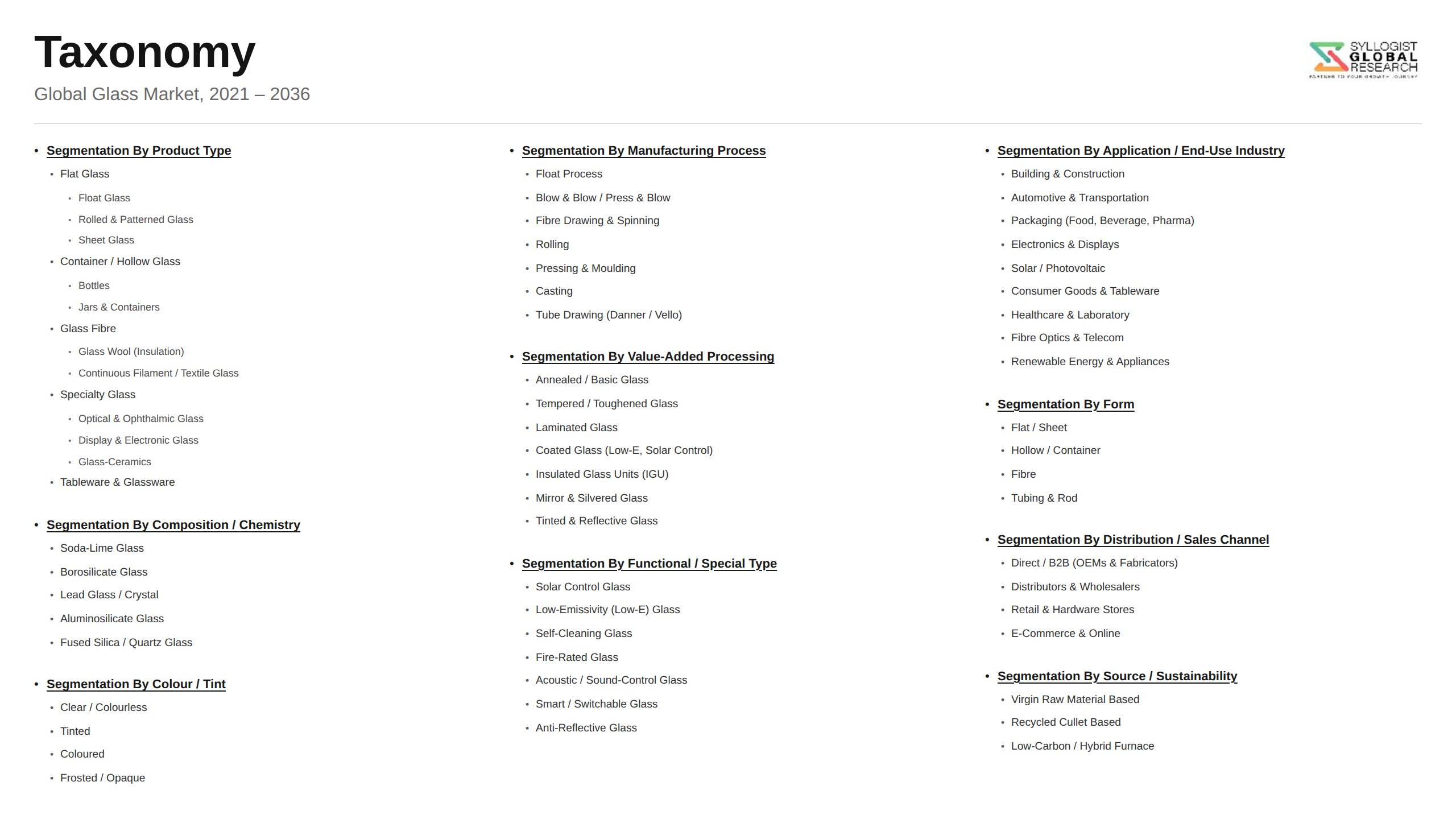
- Segmentation By Product Type
- Flat Glass
- Container Glass
- Fiberglass
- Specialty and Technical Glass
- Segmentation By Manufacturing Process
- Float Process
- Rolled and Sheet Process
- Blown Process
- Pressed and Drawn Process
- Fiber-Forming Process
- Segmentation By Glass Treatment
- Annealed
- Tempered
- Laminated
- Insulated
- Coated
- Chemically Strengthened
- Segmentation By Application
- Architectural and Building Glazing
- Automotive and Transportation Glazing
- Packaging (Beverage, Food, Pharmaceutical, Cosmetic)
- Solar Photovoltaic Glass
- Insulation and Composite Reinforcement
- Displays and Electronics
- Optics and Laboratory Ware
- Others
- Segmentation By End User
- Building and Construction
- Automotive and Transportation
- Food and Beverage
- Pharmaceutical and Healthcare
- Electronics and Solar
- Industrial and Consumer Goods
- Others
- Segmentation By Region
- North America
- Europe
- Asia-Pacific
- Middle East and Africa
- Latin America
All market revenues are presented in USD
Historical Year: 2021-2024 | Base Year: 2025 | Estimated Year: 2026 | Forecast Period: 2027-2034
Key Questions this Study Will Answer
- What is the total global market valuation of the Glass Market in 2025, projected through 2034, segmented by product type, manufacturing process, application, and end user, enabling glass manufacturers, processors, construction firms, packaging producers, and industry investors to identify highest-growth segments and the most durable revenue opportunities across the global glass market?
- How are construction firms, automotive manufacturers, packaging producers, and solar developers structuring glass procurement, product specification, and supplier qualification, and which commercial models, including integrated float supply, merchant purchase, and long-term contracts, are shaping deployment economics within the glass market through 2034?
- What construction activity, energy-efficiency glazing mandates, solar installation growth, and automotive production trends are shaping the pace and geographic distribution of flat, solar, and specialty glass demand across mature and emerging markets within the glass market?
- How is the sustainability-driven shift toward recyclable glass packaging, premiumization, and extended producer responsibility reshaping container glass demand, recycling investment, and lightweighting strategy within the glass market?
- How is the competitive structure organized among float glass manufacturers, container glass producers, fiberglass makers, and specialty and technical glass suppliers within the glass market, and what capacity expansion, decarbonization, acquisition, and lightweighting strategies are enabling suppliers to defend and grow share across construction, packaging, and technical segments?
- How are energy intensity, natural gas and carbon cost, alternative material competition, and recycling infrastructure gaps reshaping production, sourcing, and sustainability strategies across the glass market?
- Which regional markets, including Asia-Pacific, Europe, North America, the Middle East and Africa, and Latin America, are projected to generate the largest incremental glass demand through 2034, and what construction investment, solar deployment, packaging trends, and energy-efficiency regulation factors are shaping investment priorities and supplier selection decisions in each regional glass market?
- Product Definition
- Research Methodology
- Research Design & Framework
- Overall Research Approach: Descriptive, Exploratory & Quantitative Mixed-Method Design
- Market Definition & Scope Boundaries: What is Included and Excluded
- Segmentation Framework
- Key Research Assumptions & Limitations
- Secondary Research
- Primary Research Design & Execution
- Data Triangulation & Validation
- Market Sizing & Forecasting Methodology
- Competitive Intelligence Methodology
- Quality Assurance & Peer Review
- Definitions, Abbreviations & Data Notes
- Executive Summary
- Market Snapshot & Headline Numbers
- Key Findings & Research Highlights
- Market Dynamics
- Regional Market Summary
- Competitive Landscape Snapshot
- Technology & Innovation Highlights
- Market Dynamics
- Drivers
- Restraints
- Opportunities
- Challenges
- Porter’s Five Forces Analysis
- PESTLE Analysis
- Market Trends & Developments
- Emerging Trends
- Technological Developments
- Regulatory & Policy Changes
- Supply Chain & Sourcing Trends
- Manufacturing & Process Trends
- Investment & Funding Activity
- Sustainability & ESG Trends
- Risk Assessment Framework
- Raw Material (Soda Ash, Silica Sand) Price Volatility & Input Cost Escalation Risk
- Energy Cost Volatility, Natural Gas Dependence & Furnace Operating Cost Risk
- Construction and Automotive Demand Cyclicality & Volume Volatility Risk
- Overcapacity, Import Competition & Margin Compression Risk
- Carbon Cost, Decarbonisation Pressure & Furnace Transition Risk
- Regulatory Framework & Standards
- Building Glazing, Safety Glass & Construction Product Standards
- Food-Contact, Pharmaceutical Glass & Packaging Compliance Standards
- Energy Efficiency, Low-E Glazing & Building Code Regulations
- Emission Control, Furnace NOx & Greenhouse Gas Reporting Regulations
- Recycled Content, Cullet Utilisation & Circular Economy Standards
- Global Glass Market Outlook
- Market Size & Forecast by Value
- Market Size & Forecast by Volume (Glass Produced in Million Tonnes per Year and Flat Glass Output in Million Square Metres per Year)
- Market Size & Forecast by Product Type
- Flat (Float) Glass
- Container Glass
- Fibreglass
- Specialty and Technical Glass
- Tableware and Domestic Glass
- Coated and Processed Glass
- Others
- Market Size & Forecast by Composition
- Soda-Lime Glass
- Borosilicate Glass
- Lead Glass
- Aluminosilicate Glass
- Others
- Market Size & Forecast by Manufacturing Process
- Float Process
- Blown and Pressed (Container)
- Rolled and Sheet
- Fibre Drawing and Spinning
- Tube Drawing
- Others
- Market Size & Forecast by Treatment
- Annealed
- Toughened (Tempered)
- Laminated
- Coated (Low-E, Reflective)
- Insulated (Double and Triple Glazed)
- Others
- Market Size & Forecast by Application
- Architectural and Building
- Automotive and Transportation
- Food and Beverage Packaging
- Pharmaceutical Packaging
- Electronics and Displays
- Solar and Photovoltaic
- Insulation
- Tableware and Consumer
- Optical and Lighting
- Others
- Market Size & Forecast by End-Use Industry
- Building and Construction
- Automotive and Transportation
- Packaging (Food, Beverage, Pharma)
- Electronics and Semiconductors
- Solar and Renewable Energy
- Consumer Goods
- Healthcare
- Others
- Market Size & Forecast by Source
- Virgin Batch
- Recycled (Cullet-Based)
- Mixed
- Others
- Market Size & Forecast by Sales Channel
- Direct Sales to OEMs and Fabricators
- Distributor and Dealer Channel
- Retail and Modern Trade
- Project and Contract Channel
- Others
- North America Glass Market Outlook
- Market Size & Forecast
- By Value
- By Volume (Glass Produced in Million Tonnes per Year and Flat Glass Output in Million Square Metres per Year)
- By Product Type
- By Composition
- By Manufacturing Process
- By Treatment
- By Application
- By End-Use Industry
- By Source
- By Country
- By Sales Channel
- Europe Glass Market Outlook
- Market Size & Forecast
- By Value
- By Volume (Glass Produced in Million Tonnes per Year and Flat Glass Output in Million Square Metres per Year)
- By Product Type
- By Composition
- By Manufacturing Process
- By Treatment
- By Application
- By End-Use Industry
- By Source
- By Country
- By Sales Channel
- Asia-Pacific Glass Market Outlook
- Market Size & Forecast
- By Value
- By Volume (Glass Produced in Million Tonnes per Year and Flat Glass Output in Million Square Metres per Year)
- By Product Type
- By Composition
- By Manufacturing Process
- By Treatment
- By Application
- By End-Use Industry
- By Source
- By Country
- By Sales Channel
- Latin America Glass Market Outlook
- Market Size & Forecast
- By Value
- By Volume (Glass Produced in Million Tonnes per Year and Flat Glass Output in Million Square Metres per Year)
- By Product Type
- By Composition
- By Manufacturing Process
- By Treatment
- By Application
- By End-Use Industry
- By Source
- By Country
- By Sales Channel
- Middle East & Africa Glass Market Outlook
- Market Size & Forecast
- By Value
- By Volume (Glass Produced in Million Tonnes per Year and Flat Glass Output in Million Square Metres per Year)
- By Product Type
- By Composition
- By Manufacturing Process
- By Treatment
- By Application
- By End-Use Industry
- By Source
- By Country
- By Sales Channel
- Country-Wise* Glass Market Outlook
- Market Size & Forecast
- By Value
- By Volume (Glass Produced in Million Tonnes per Year and Flat Glass Output in Million Square Metres per Year)
- By Product Type
- By Composition
- By Manufacturing Process
- By Treatment
- By Application
- By End-Use Industry
- By Source
- By Country
- By Sales Channel
- Market Size & Forecast
- Market Size & Forecast
- Market Size & Forecast
- Market Size & Forecast
- Market Size & Forecast
- Market Size & Forecast
*Countries Analysed in the Global Research Portfolio: United States, Canada, Mexico, Germany, France, United Kingdom, Netherlands, Spain, Italy, Norway, Sweden, China, Japan, India, Australia, South Korea, Singapore, Brazil, Chile, Saudi Arabia, UAE, Egypt, South Africa, Israel
- Technology Landscape & Innovation Analysis
- Float Glass Manufacturing & Advanced Flat Glass Production Technology Deep-Dive
- Low-E, Coated & Energy-Efficient Glazing Technology
- Lightweight Container & Narrow-Neck Press-and-Blow Technology
- Fibreglass, Reinforcement & Composite Glass Technology
- Electric Melting, Hybrid Furnace & Low-Carbon Glass Technology
- Ultra-Thin, Chemically Strengthened & Display Glass Technology
- Recycled Cullet, Batch Optimisation & Circular Glass Technology
- Patent & IP Landscape in Glass Manufacturing Technologies
- Value Chain & Supply Chain Analysis
- Silica Sand, Soda Ash, Limestone & Cullet Raw Material Supply Chain
- Batch Preparation, Melting & Forming Supply Chain
- Coating, Toughening, Laminating & Processing Supply Chain
- Fabricator, Converter & Downstream Processing Channel
- Construction, Automotive & Packaging Customer Channel
- Distributor, Dealer & Project Contract Network
- Cullet Collection, Recycling & Closed-Loop Recovery Network
- Pricing Analysis
- Float (Flat) Glass Pricing Across Grade & Thickness Tiers
- Container Glass Pricing Across Volume & Contract Tiers
- Coated and Processed Glass Value-Added Pricing Analysis
- Specialty and Technical Glass Pricing Economics
- Energy and Raw Material Cost Pass-Through Analysis
- Recycled vs Virgin Batch Cost Economics
- Regional Pricing Benchmarks & Value-in-Use Pricing Models
- Sustainability & Environmental Analysis
- Lifecycle Assessment (LCA) of Glass Across Manufacture, Use & Recycling
- Recycled Cullet, Closed-Loop Recycling & Circular Economy Performance
- Electric Melting, Hydrogen Furnace & Decarbonisation Pathways
- Energy-Efficient Glazing, Building Performance & Emission Reduction
- Regulatory-Driven Sustainability, SDG 9 (Industry, Innovation) & SDG 12 (Responsible Consumption) Alignment & Green Finance Eligibility
- Competitive Landscape
- Market Structure & Concentration
- Market Consolidation Level (Fragmented vs. Consolidated by Product Type & Geography)
- Top 10 Players Market Share
- HHI (Herfindahl-Hirschman Index) Concentration Analysis
- Competitive Intensity Map by Product Type, Application & Geography
- Player Classification
- Integrated Flat Glass Manufacturers
- Container and Packaging Glass Producers
- Fibreglass and Reinforcement Producers
- Specialty and Technical Glass Manufacturers
- Glass Processing and Fabrication Specialists
- Tableware and Domestic Glass Producers
- Regional and Independent Glass Producers
- Distributors and Cullet Recyclers
- Competitive Analysis Frameworks
- Market Share Analysis by Product Type, Application & Region
- Company Profile
- Company Overview & Headquarters
- Glass Product Portfolio
- Key Customer Relationships & Reference OEM Accounts
- Manufacturing Footprint & Furnace Capacity Coverage
- Revenue (Glass Segment) & Order Backlog
- Technology Differentiators & IP
- Key Strategic Partnerships, JVs & M&A Activity
- Recent Developments (Capacity Additions, Furnace Rebuilds, Product Launches)
- SWOT Analysis
- Strategic Focus Areas & Roadmap
- Competitive Positioning Map (Technology Capability vs. Market Penetration)
- Key Company Profiles
- Market Structure & Concentration
- Technology Landscape & Innovation Analysis
- Strategic Output
- Market Opportunity Matrix: By Product Type, Application, End-Use Industry, Treatment & Geography
- White Space Opportunity Analysis
- Strategic Recommendations
- Product Portfolio & Technology Investment Strategy
- Manufacturing Excellence & Furnace Capacity Strategy
- Geographic Expansion & Localisation Strategy
- Customer & OEM Account Engagement Strategy
- Partnership, M&A & Ecosystem Strategy
- Sustainability & Circular Economy Strategy
- Risk Mitigation & Future Roadmap
- Strategic Priority Matrix & Roadmap
- Near-term (2025-2028)
- Mid-term (2029-2032)
- Long-term (2033-2037)