Global Helium Market By Phase, By Application, By End Use Industry, By Grade, By Distribution Mode, By Region, Competition, Forecast & Opportunities, 2021-2034F
Market Definition
Helium is a colourless, odourless, non-toxic, inert noble gas with the symbol He, distinguished by the lowest boiling point of any element, extremely low density, high thermal conductivity, and chemical inertness that make it irreplaceable across cryogenic, cooling, pressurizing, and controlled-atmosphere applications. The global helium market covers the extraction, purification, liquefaction, storage, distribution, and sale of gaseous and liquid helium recovered almost entirely as a byproduct of natural gas processing. Market participants include upstream natural gas producers with helium-rich fields, helium purification and liquefaction operators, integrated industrial gas companies, cryogenic logistics and transport specialists, and distributors supplying refined helium to healthcare, electronics, aerospace, and research end users.
The global helium market spans crude helium enrichment, Grade-A purification, liquefaction, bulk and cylinder distribution, and helium recovery and recycling systems that mitigate boil-off losses. End users span medical and healthcare providers operating MRI and superconducting systems, semiconductor and electronics manufacturers, aerospace and space launch operators, nuclear and scientific research facilities, welding and metal fabrication, and specialty analytical laboratories. The global helium market explicitly excludes other industrial gases such as nitrogen, argon, oxygen, and hydrogen, natural gas sold as fuel, and helium isotope research outside commercial supply, concentrating on the commercial extraction, purification, and distribution of helium as a finite, non-renewable resource sourced from a small number of helium-bearing natural gas reservoirs across every producing and consuming geography worldwide.
Market Insights
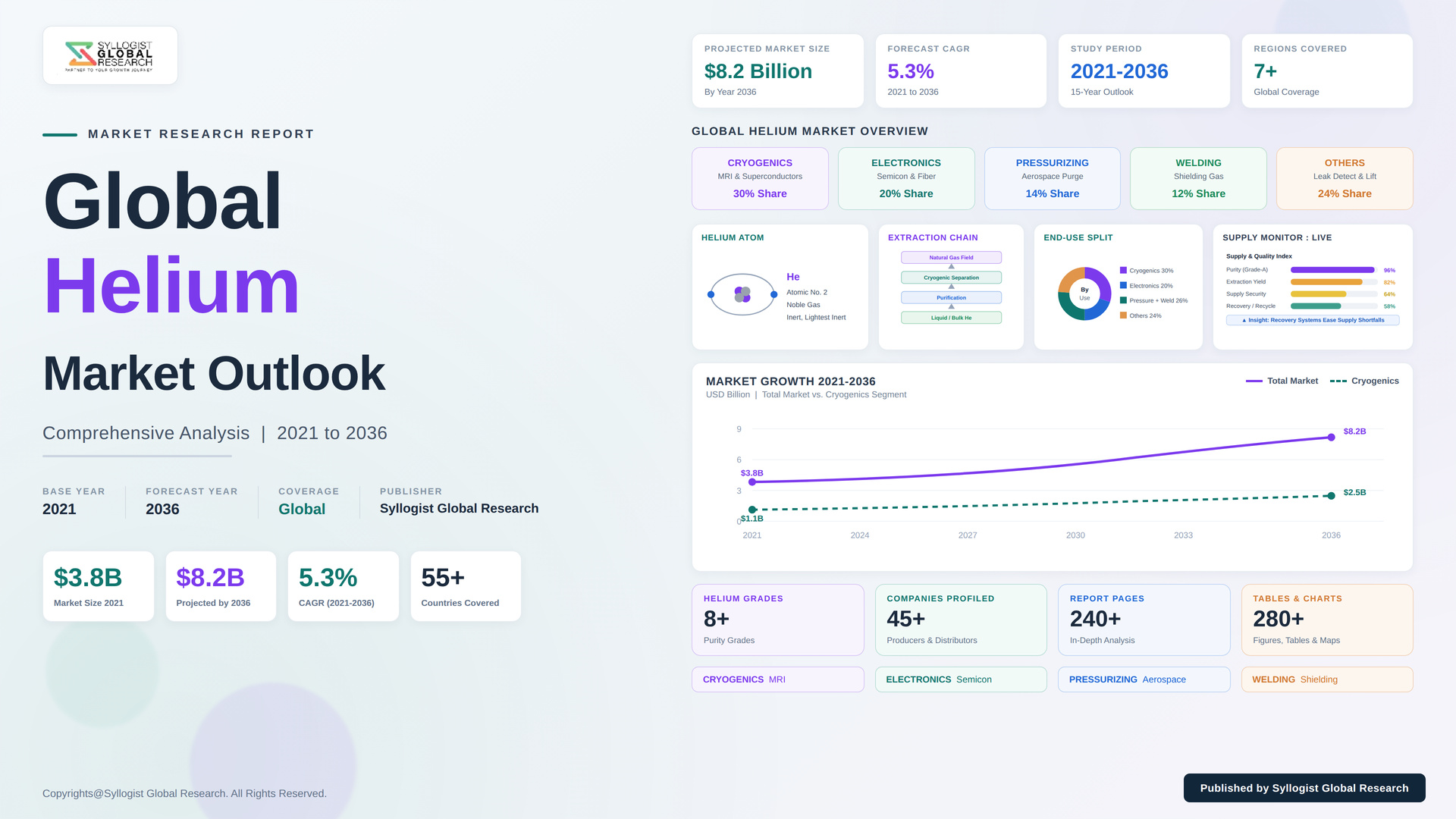
The global helium market is moving through a growth phase shaped by expanding semiconductor manufacturing, growing MRI and superconducting healthcare demand, accelerating quantum computing and space launch activity, and a supply base concentrated in a small number of helium-bearing natural gas fields. The global helium market was valued at USD 4.4 billion in 2025 and is projected to reach USD 7.6 billion by 2034, advancing at a compound annual growth rate of 6.3% through the forecast period, as industrial gas companies, upstream producers, and cryogenic logistics operators scale extraction, purification, and distribution across North America, the Middle East, Asia-Pacific, Europe, and Africa. Because helium is recovered almost exclusively as a byproduct of natural gas processing and cannot be synthesized, the global helium market is defined by tight supply, irreplaceable end-use demand, and pronounced price sensitivity to production disruptions.
Supply concentration is the defining structural feature of the global helium market, with fewer than 15 producers accounting for global output and the United States, Qatar, Algeria, and Russia supplying the majority of primary helium. The 2024 privatization of the United States Federal Helium Reserve removed a long-standing subsidized supply buffer from the global helium market, sharpening exposure to production outages, cryogenic logistics bottlenecks, and geopolitical risk. New capacity from Qatar, Russia, and emerging producers in South Africa and Tanzania is gradually easing scarcity, yet structural concentration keeps buyers focused on long-term contracts, security-of-supply agreements, and recovery investment across the global helium market. China imports the overwhelming majority of its helium, leaving major consuming economies acutely sensitive to supply conditions within the global helium market.
Demand across the global helium market is anchored by applications where helium has no practical substitute. Semiconductor manufacturing is the fastest-growing end use, consuming ultrapure helium for cryogenic cooling, wafer processing, lithography atmosphere control, and leak detection as chipmakers expand advanced-node capacity worldwide. Healthcare remains the largest end use within the global helium market, driven by liquid helium demand for superconducting MRI magnets and a growing global installed base of imaging systems. Cryogenics is the leading application, while quantum computing, high-energy physics, and commercial space launch are adding fast-rising demand for ultracold helium environments. Leak detection is expanding rapidly across the global helium market, supported by helium use in automotive, battery, semiconductor, and aerospace component testing where its small molecular size enables precise detection.
North America represents the largest regional helium market by production, supported by extensive helium-rich natural gas reserves, established extraction and purification infrastructure, and strong healthcare, aerospace, and research demand across the United States and Canada. The Middle East holds a decisive position in the global helium market, anchored by Qatar, one of the largest single sources of liquid helium supplied to Asia-Pacific and European buyers. Asia-Pacific is the largest and fastest-growing consuming region within the global helium market, led by semiconductor and electronics manufacturing in China, Taiwan, South Korea, and Japan, alongside expanding healthcare demand, despite heavy import dependence. Europe occupies a significant position in the global helium market, supported by healthcare, research, and manufacturing demand, while Africa is emerging as a growth source with new helium projects advancing across the global helium market.
Key Drivers
Accelerating Semiconductor Manufacturing, Advanced Node Expansion, and Electronics Production Driving Ultrapure Helium Demand
Rapid expansion of semiconductor manufacturing is a central force driving the global helium market, as chipmakers scale advanced-node capacity to meet demand from artificial intelligence, data centers, 5G, and consumer electronics. Semiconductor fabrication depends on ultrapure helium for cryogenic cooling of lithography equipment, wafer cooling, plasma etching atmosphere control, purging, and leak detection, tying helium demand directly to global chip production growth within the global helium market. Advanced lithography at leading-edge nodes tightens contamination tolerances and raises helium consumption per wafer, while major fabrication investments across the United States, Taiwan, South Korea, Japan, and China add sustained new demand to the global helium market. Large multi-year capital programmes announced by leading foundries commit substantial capacity that will require reliable ultrapure helium supply for years, reinforcing long-duration demand. As semiconductors become more central to transportation, healthcare, defense, and communication, chip production is expanding structurally, and helium’s irreplaceable role in fabrication positions the electronics segment as the fastest-growing source of demand across the global helium market. This deepening dependence on ultrapure helium in wafer fabrication continues to shape procurement strategy and long-term supply contracting throughout the global helium market. Chipmakers increasingly secure dedicated helium volumes years in advance and invest in on-site recovery to protect fabrication continuity across the global helium market.
Growing Healthcare MRI Installed Base, Superconducting Systems, and Quantum Computing Expanding Cryogenic Liquid Helium Demand
Growth in healthcare imaging and superconducting technology is a powerful driver expanding demand across the global helium market, as liquid helium is essential for cooling the superconducting magnets at the core of MRI systems. The global installed base of MRI scanners continues to grow, particularly across emerging markets in Asia-Pacific and Latin America, sustaining baseline liquid helium demand within the global helium market even as recovery and low-helium magnet technologies advance. Each superconducting MRI magnet requires helium to maintain temperatures approaching absolute zero, and the expanding number of installations, combined with servicing and top-up requirements, secures healthcare as the largest end use across the global helium market. Beyond imaging, superconducting systems in research, high-energy physics, and fusion experiments consume large volumes of liquid helium for magnet cooling. Quantum computing adds a fast-rising demand vector, as quantum processors require cryogenic cooling to maintain qubit temperatures below one kelvin, and the proliferation of quantum research facilities operated by technology companies and universities is establishing a new structural source of liquid helium demand. Together, MRI fleet growth, superconducting research, and quantum computing sustain durable cryogenic helium demand across the global helium market. Because these applications tolerate almost no substitution for liquid helium at the temperatures involved, they form one of the most resilient and price-inelastic pillars of demand across the global helium market.
Space Launch Growth, Leak Detection Applications, and Aerospace and Defense Demand Broadening Helium Consumption
Expanding space launch activity, growing leak detection applications, and sustained aerospace and defense demand are broadening consumption across the global helium market. Helium is critical to space launch operations, used to pressurize and purge rocket fuel systems, and the sharp rise in commercial and government launch cadence is lifting helium demand within the global helium market. Aerospace and defense manufacturing rely on helium for welding, additive manufacturing, and pressurization, where its inertness and high thermal conductivity support precision fabrication across the global helium market. Leak detection is one of the fastest-growing applications, as helium’s status as the second smallest molecule allows it to penetrate the finest leaks, making it indispensable for testing automotive components, lithium battery packs, semiconductor devices, air conditioning systems, and aerospace assemblies. The electrification of transport and the growth of battery manufacturing are multiplying leak-testing requirements that depend on helium across the global helium market. Controlled-atmosphere, breathing-mix, fiber-optic, and analytical chromatography applications add further diversified demand. This breadth of space, aerospace, leak detection, and specialty use cushions the global helium market and broadens its structural demand base beyond healthcare and electronics. As commercial spaceflight, electric mobility, and precision manufacturing all scale in parallel, these applications add resilient incremental volume that supports demand across the global helium market.
Key Challenges
Supply Concentration, Geopolitical Risk, and Dependence on Natural Gas Byproduct Recovery Generating Chronic Supply Insecurity
Supply concentration and geopolitical exposure represent the most significant challenge across the global helium market, since helium is produced by fewer than 15 major suppliers and recovered almost entirely as a byproduct of natural gas processing. Because helium extraction depends on natural gas production economics, output is tied to gas field activity rather than helium demand, so a decision to slow gas processing or a plant outage can remove significant helium volume from the global helium market regardless of end-use need. Supply is geographically concentrated in the United States, Qatar, Algeria, and Russia, exposing the global helium market to political tension, export restrictions, sanctions, and regional conflict that can disrupt flow with little warning. The 2024 privatization of the United States Federal Helium Reserve removed a long-standing supply buffer, increasing the market’s sensitivity to disruption. Major consumers such as China import the overwhelming majority of their helium, amplifying vulnerability to supply shocks within the global helium market. Repeated helium shortages over the past decade have demonstrated how quickly availability and pricing can deteriorate, forcing buyers into long-term contracts and stockpiling. This structural supply insecurity remains a persistent constraint on stable growth across the global helium market. Buyers increasingly treat security of supply as a strategic priority rather than a purchasing detail, reshaping contracting and inventory behaviour across the global helium market.
Non-Renewable Scarcity, Cryogenic Logistics Complexity, and Boil-Off Losses Constraining Availability and Raising Cost
Non-renewable scarcity, cryogenic logistics complexity, and boil-off losses create persistent availability and cost challenges across the global helium market. Helium is a finite, non-renewable resource that, once released to the atmosphere, escapes Earth’s gravity and is effectively lost, meaning every molecule consumed depletes a limited reserve and cannot be replaced within the global helium market. Transporting and storing liquid helium demands specialized cryogenic infrastructure that maintains temperatures near absolute zero, and this complex logistics chain is expensive, capital-intensive, and vulnerable to bottlenecks that constrain delivery across the global helium market. Boil-off losses during storage, transport, and transfer waste a meaningful share of produced helium, reducing effective supply and raising delivered cost within the global helium market. The scarcity of qualified cryogenic transport assets and specialized containers further tightens the logistics chain, and disruptions ripple quickly through delivery schedules. Extreme price volatility, with helium prices reaching record highs before correcting, complicates budgeting for end users and discourages investment in helium-dependent equipment. Managing scarcity, logistics fragility, and boil-off waste while controlling cost remains a continuous challenge that shapes procurement, recovery investment, and long-term supply strategy across the global helium market. These structural cost and logistics pressures also raise the barrier to entry for new distribution capacity, slowing the pace at which supply flexibility can improve across the global helium market.
Helium-Free and Low-Helium MRI Technology, Recycling Advances, and Demand Substitution Pressuring Traditional Consumption
Advances in helium-free and low-helium technology, expanding recovery and recycling, and demand substitution present a longer-term challenge to consumption across the global helium market. Leading medical imaging manufacturers have developed sealed-magnet MRI systems that use a small fixed quantity of helium and require no top-ups, reducing the recurring liquid helium demand that has historically anchored the global helium market. As these low-helium and helium-free systems replace conventional MRI installations over time, the healthcare segment’s helium intensity per scanner declines, tempering long-run demand growth within the global helium market. Helium recovery and recycling technology is advancing in parallel, with on-site liquefiers and high-efficiency recovery skids capturing boil-off that would previously have been lost, allowing large users in research, healthcare, and electronics to reduce net helium purchases across the global helium market. While recovery improves supply efficiency and sustainability, it also reduces incremental demand for newly produced helium. Substitution pressure extends to other applications where alternative gases or processes can replace helium in less critical uses. Although helium remains irreplaceable in many core applications, the combination of low-helium technology, recycling, and selective substitution introduces demand uncertainty across the global helium market. Over the long term, this efficiency and substitution trend could soften demand growth in mature end uses even as new applications emerge across the global helium market.
Market Segmentation
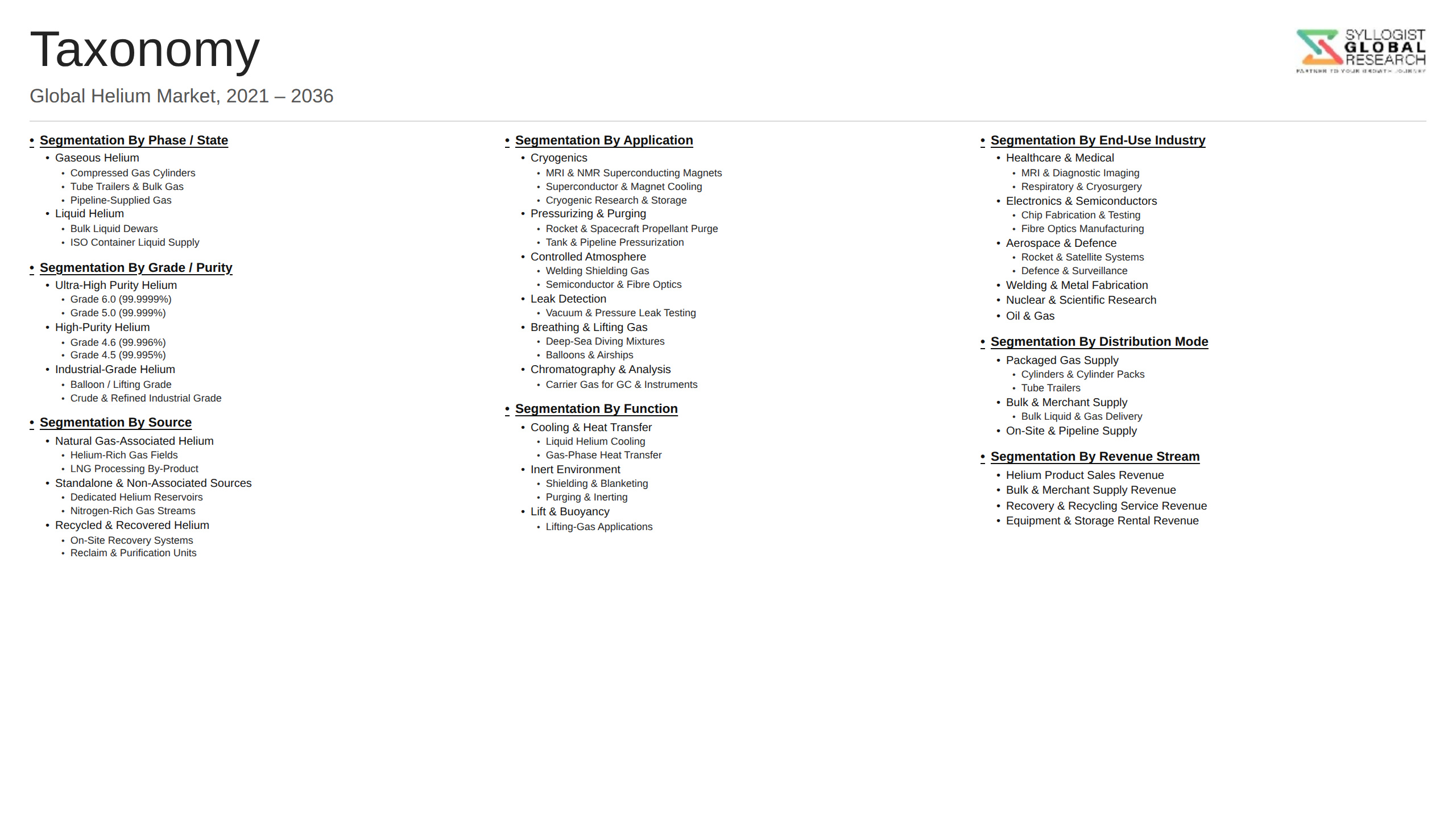
- Segmentation By Phase
- Gaseous Helium
- Liquid Helium
- Segmentation By Application
- Cryogenics
- Leak Detection
- Pressurizing and Purging
- Controlled Atmosphere
- Welding and Metal Fabrication
- Breathing Mixtures
- Lifting (Balloons and Airships)
- Analytical and Chromatography
- Others
- Segmentation By End Use Industry
- Medical and Healthcare
- Electronics and Semiconductors
- Aerospace and Defense
- Nuclear Power and Energy
- Metal Fabrication
- Research and Scientific
- Others
- Segmentation By Grade
- Grade-A (High Purity)
- Ultra-High Purity
- Others
- Segmentation By Distribution Mode
- Bulk Liquid
- Cylinder and Gas
- Others
- Segmentation By Region
- North America
- Europe
- Asia-Pacific
- Middle East and Africa
- Latin America
All market revenues are presented in USD
Historical Year: 2021-2024 | Base Year: 2025 | Estimated Year: 2026 | Forecast Period: 2027-2034
Key Questions this Study Will Answer
- What is the total global market valuation of the global helium market in 2025, projected through 2034, segmented by phase, application, end use industry, grade, and distribution mode, enabling industrial gas companies, upstream producers, helium distributors, and investors to identify the highest-growth segments and most durable revenue opportunities across the global helium market?
- How are industrial gas companies, upstream natural gas producers, and cryogenic logistics operators structuring extraction, purification, liquefaction, and long-term supply agreements to secure helium, and which sourcing, contracting, and recovery models are shaping delivered cost economics within the global helium market through 2034?
- What semiconductor capacity expansion, MRI installed-base growth, quantum computing, and space launch dynamics are shaping the pace and geographic distribution of helium demand across mature and emerging consuming markets?
- Which applications and phases, including gaseous and liquid helium across cryogenics, leak detection, pressurizing and purging, and controlled atmosphere, are gaining the strongest demand traction across healthcare, electronics, aerospace, and research end uses, and what purity, availability, and total cost of supply metrics are shaping buyer selection?
- How is the competitive structure of the global helium market organized among integrated industrial gas companies, upstream helium producers, purification and liquefaction operators, and cryogenic logistics specialists, and what acquisition, capacity investment, and security-of-supply strategies are enabling new entrants to compete against established suppliers?
- What supply concentration, geopolitical risk, Federal Helium Reserve privatization, and helium-free technology trends are reshaping supply security, price volatility, and demand substitution across major producing and consuming geographies within the global helium market?
- Which regional markets, including North America, the Middle East, Asia-Pacific, Europe, and Africa, are projected to generate the largest incremental helium supply and demand opportunities through 2034, and what reserve availability, production capacity, import dependence, and end-use growth factors are shaping supplier selection and capacity investment priorities in each regional helium market?
- Product Definition
- Research Methodology
- Research Design & Framework
- Overall Research Approach: Descriptive, Exploratory & Quantitative Mixed-Method Design
- Market Definition & Scope Boundaries: What is Included and Excluded
- Segmentation Framework
- Key Research Assumptions & Limitations
- Secondary Research
- Primary Research Design & Execution
- Data Triangulation & Validation
- Market Sizing & Forecasting Methodology
- Competitive Intelligence Methodology
- Quality Assurance & Peer Review
- Definitions, Abbreviations & Data Notes
- Executive Summary
- Market Snapshot & Headline Numbers
- Key Findings & Research Highlights
- Market Dynamics
- Regional Market Summary
- Competitive Landscape Snapshot
- Technology & Innovation Highlights
- Market Dynamics
- Drivers
- Restraints
- Opportunities
- Challenges
- Porter’s Five Forces Analysis
- PESTLE Analysis
- Market Trends & Developments
- Emerging Trends
- Technological Developments
- Regulatory & Policy Changes
- Supply Chain & Sourcing Trends
- Manufacturing & Process Trends
- Investment & Funding Activity
- Sustainability & ESG Trends
- Risk Assessment Framework
- Supply Concentration, Geopolitical Source Dependence & Availability Risk
- Helium Shortage, Allocation & Demand-Supply Imbalance Risk
- Natural Gas Field Decline, LNG Linkage & Feedstock Supply Risk
- Price Volatility, Long-Term Contract & Spot Market Risk
- Non-Renewable Resource Depletion & Conservation Pressure Risk
- Regulatory Framework & Standards
- Compressed and Cryogenic Gas Handling, Storage & Transport Standards
- Helium Purity, Grade Specification & Medical Gas Quality Standards
- Strategic Reserve, Federal Helium Program & Allocation Policy
- Export Control, Cross-Border Trade & Import-Export Regulations
- Safety, Pressure Vessel & Cryogenic Equipment Compliance Frameworks
- Global Helium Market Outlook
- Market Size & Forecast by Value
- Market Size & Forecast by Volume (Helium Consumed in Million Cubic Metres per Year and Nameplate Refining Capacity in Million Cubic Metres per Year)
- Market Size & Forecast by Phase
- Gaseous Helium
- Liquid Helium
- Others
- Market Size & Forecast by Grade
- Crude Helium
- Grade A (99.995%)
- Grade 5.0 (99.999%)
- Ultra-High Purity (99.9999%+)
- Others
- Market Size & Forecast by Application
- Cryogenics and MRI
- Semiconductors and Electronics
- Welding and Metal Fabrication
- Leak Detection
- Lifting Gas and Balloons
- Breathing Mixtures (Diving)
- Aerospace and Space Purging
- Analytical (Chromatography)
- Fibre Optics Fabrication
- Others
- Market Size & Forecast by End-Use Industry
- Healthcare and Medical
- Electronics and Semiconductors
- Aerospace and Defense
- Welding and Metal Fabrication
- Nuclear and Energy
- Research and Academia
- Manufacturing
- Others
- Market Size & Forecast by Source
- Natural Gas Extraction
- LNG-Associated Recovery
- Standalone Helium Fields
- Others
- Market Size & Forecast by Recovery Technology
- Cryogenic Distillation
- Pressure Swing Adsorption (PSA)
- Membrane Separation
- Others
- Market Size & Forecast by Packaging
- Bulk Liquid (ISO Containers)
- Bulk Gas (Tube Trailers)
- Cylinders
- Dewars
- Others
- Market Size & Forecast by Sales Channel
- Direct Long-Term Supply Contract
- Merchant Spot Market
- Distributor and Gas Reseller Channel
- Integrated Captive Supply
- Others
- North America Helium Market Outlook
- Market Size & Forecast
- By Value
- By Volume (Helium Consumed in Million Cubic Metres per Year and Nameplate Refining Capacity in Million Cubic Metres per Year)
- By Phase
- By Grade
- By Application
- By End-Use Industry
- By Source
- By Recovery Technology
- By Packaging
- By Country
- By Sales Channel
- Europe Helium Market Outlook
- Market Size & Forecast
- By Value
- By Volume (Helium Consumed in Million Cubic Metres per Year and Nameplate Refining Capacity in Million Cubic Metres per Year)
- By Phase
- By Grade
- By Application
- By End-Use Industry
- By Source
- By Recovery Technology
- By Packaging
- By Country
- By Sales Channel
- Asia-Pacific Helium Market Outlook
- Market Size & Forecast
- By Value
- By Volume (Helium Consumed in Million Cubic Metres per Year and Nameplate Refining Capacity in Million Cubic Metres per Year)
- By Phase
- By Grade
- By Application
- By End-Use Industry
- By Source
- By Recovery Technology
- By Packaging
- By Country
- By Sales Channel
- Latin America Helium Market Outlook
- Market Size & Forecast
- By Value
- By Volume (Helium Consumed in Million Cubic Metres per Year and Nameplate Refining Capacity in Million Cubic Metres per Year)
- By Phase
- By Grade
- By Application
- By End-Use Industry
- By Source
- By Recovery Technology
- By Packaging
- By Country
- By Sales Channel
- Middle East & Africa Helium Market Outlook
- Market Size & Forecast
- By Value
- By Volume (Helium Consumed in Million Cubic Metres per Year and Nameplate Refining Capacity in Million Cubic Metres per Year)
- By Phase
- By Grade
- By Application
- By End-Use Industry
- By Source
- By Recovery Technology
- By Packaging
- By Country
- By Sales Channel
- Country-Wise* Helium Market Outlook
- Market Size & Forecast
- By Value
- By Volume (Helium Consumed in Million Cubic Metres per Year and Nameplate Refining Capacity in Million Cubic Metres per Year)
- By Phase
- By Grade
- By Application
- By End-Use Industry
- By Source
- By Recovery Technology
- By Packaging
- By Country
- By Sales Channel
- Market Size & Forecast
- Market Size & Forecast
- Market Size & Forecast
- Market Size & Forecast
- Market Size & Forecast
- Market Size & Forecast
*Countries Analysed in the Global Research Portfolio: United States, Canada, Mexico, Germany, France, United Kingdom, Netherlands, Spain, Italy, Norway, Sweden, China, Japan, India, Australia, South Korea, Singapore, Brazil, Chile, Saudi Arabia, UAE, Egypt, South Africa, Israel
- Technology Landscape & Innovation Analysis
- Cryogenic Distillation & Helium Extraction from Natural Gas Technology Deep-Dive
- Pressure Swing Adsorption (PSA) & Membrane Purification Technology
- Helium Liquefaction, Storage & Cryogenic Handling Technology
- Helium Recovery, Recycling & Recapture Technology
- Standalone Helium Field & Non-Hydrocarbon Source Technology
- Leak Detection, Conservation & Efficiency Technology
- Advanced Refining, Purification & Ultra-High Purity Technology
- Patent & IP Landscape in Helium Production Technologies
- Value Chain & Supply Chain Analysis
- Natural Gas Field, LNG & Helium-Rich Feedstock Supply Chain
- Crude Helium Extraction & Recovery Supply Chain
- Refining, Purification & Liquefaction Supply Chain
- Bulk Storage, ISO Container & Cryogenic Logistics Network
- Healthcare, Electronics & Industrial Customer Channel
- Distributor, Gas Reseller & Regional Supply Network
- Helium Recovery, Recycling & Circular Supply Network
- Pricing Analysis
- Refined Helium Pricing Across Contract & Spot Market Tiers
- Crude vs Refined Helium Pricing Differentials
- Liquid vs Gaseous Helium Pricing Analysis
- Grade and Purity-Based Pricing Economics
- Supply Shortage, Allocation & Premium Pricing Analysis
- Regional Pricing Benchmarks Across US, Qatar & Algeria Sources
- Total Delivered Cost, Logistics & Value-in-Use Pricing Models
- Sustainability & Environmental Analysis
- Lifecycle Assessment (LCA) of Helium Across Extraction & Refining
- Helium Conservation, Recovery & Recycling Performance
- Resource Depletion, Non-Renewable Scarcity & Stewardship Assessment
- Energy Efficiency, Liquefaction & Emission Reduction Performance
- Regulatory-Driven Sustainability, SDG 9 (Industry, Innovation) & SDG 12 (Responsible Consumption) Alignment & Green Finance Eligibility
- Competitive Landscape
- Market Structure & Concentration
- Market Consolidation Level (Fragmented vs. Consolidated by Source & Geography)
- Top 10 Players Market Share
- HHI (Herfindahl-Hirschman Index) Concentration Analysis
- Competitive Intensity Map by Source, Application & Geography
- Player Classification
- Integrated Industrial Gas Majors
- Natural Gas and LNG-Linked Helium Producers
- Standalone Helium Exploration and Production Companies
- Helium Refining and Purification Specialists
- National and State-Owned Gas Enterprises
- Regional and Independent Helium Producers
- Gas Distributors and Resellers
- Merchant Traders and Suppliers
- Competitive Analysis Frameworks
- Market Share Analysis by Source, Application & Region
- Company Profile
- Company Overview & Headquarters
- Helium Production Portfolio & Capacity
- Key Customer Relationships & Reference End-Use Accounts
- Production Footprint & Nameplate Capacity Coverage
- Revenue (Helium Segment) & Offtake Contract Backlog
- Technology Differentiators & IP
- Key Strategic Partnerships, JVs & M&A Activity
- Recent Developments (Capacity Additions, Contract Wins, Project Launches)
- SWOT Analysis
- Strategic Focus Areas & Roadmap
- Competitive Positioning Map (Technology Capability vs. Market Penetration)
- Key Company Profiles
- Market Structure & Concentration
- Technology Landscape & Innovation Analysis
- Strategic Output
- Market Opportunity Matrix: By Phase, Grade, Application, End-Use Industry & Geography
- White Space Opportunity Analysis
- Strategic Recommendations
- Supply Portfolio & Source Diversification Strategy
- Operational Excellence & Capacity Expansion Strategy
- Geographic Expansion & Supply Security Strategy
- Customer & End-Use Account Engagement Strategy
- Partnership, M&A & Ecosystem Strategy
- Sustainability & Conservation Strategy
- Risk Mitigation & Future Roadmap
- Strategic Priority Matrix & Roadmap
- Near-term (2025-2028)
- Mid-term (2029-2032)
- Long-term (2033-2037)