Global Lubricants Market By Product Type, By Base Oil, By Viscosity Grade, By Application, By End-Use Industry, By Distribution Channel, By Region, Competition, Forecast & Opportunities, 2021-2036F
Market Definition
The Global Lubricants Market covers the manufacture, blending, packaging, distribution, and downstream consumption of finished lubricant products formulated to reduce friction, wear, heat, and corrosion in mechanical systems across automotive, industrial, marine, aviation, mining, construction, and consumer end-use applications worldwide. The market encompasses engine oils for passenger car motor oils (PCMO), heavy-duty diesel engine oils (HDDO), motorcycle oils, two-stroke and four-stroke lubricants, transmission and gear fluids, hydraulic fluids, metalworking fluids, process oils, greases, turbine oils, compressor oils, refrigeration lubricants, marine cylinder and system oils, aviation turbine oils and piston engine oils, electric vehicle thermal management fluids and EV greases, and emerging bio-based, re-refined, and synthetic-blend lubricants. The supplier landscape spans integrated oil majors and dedicated lubricant marketers including Shell, ExxonMobil (Mobil), BP Castrol, TotalEnergies, Chevron, Phillips 66, Valvoline (Restore), Pennzoil, Quaker Houghton, Fuchs Lubricants, Petronas Lubricants International, Sinopec, PetroChina, JXTG Eneos, Idemitsu Kosan, Indian Oil, HPCL, BPCL, Gulf Oil, Repsol, Cepsa, Lukoil, Rosneft, alongside dedicated additive suppliers Lubrizol, Infineum, Afton Chemical, Chevron Oronite, and base oil producers SK Lubricants, S-Oil, GS Caltex, and Neste. Market dynamics are governed by global vehicle parc growth, vehicle electrification, OEM specification tightening (API SP, ILSAC GF-7, ACEA C-classes, JASO MA/DH), drain interval extension, industrial automation, manufacturing migration, low-viscosity formulation trends, base oil group migration from Group I to Group II, III, and IV, EU Circular Economy frameworks, and the structural emergence of EV-specific lubrication products.
Market Insights
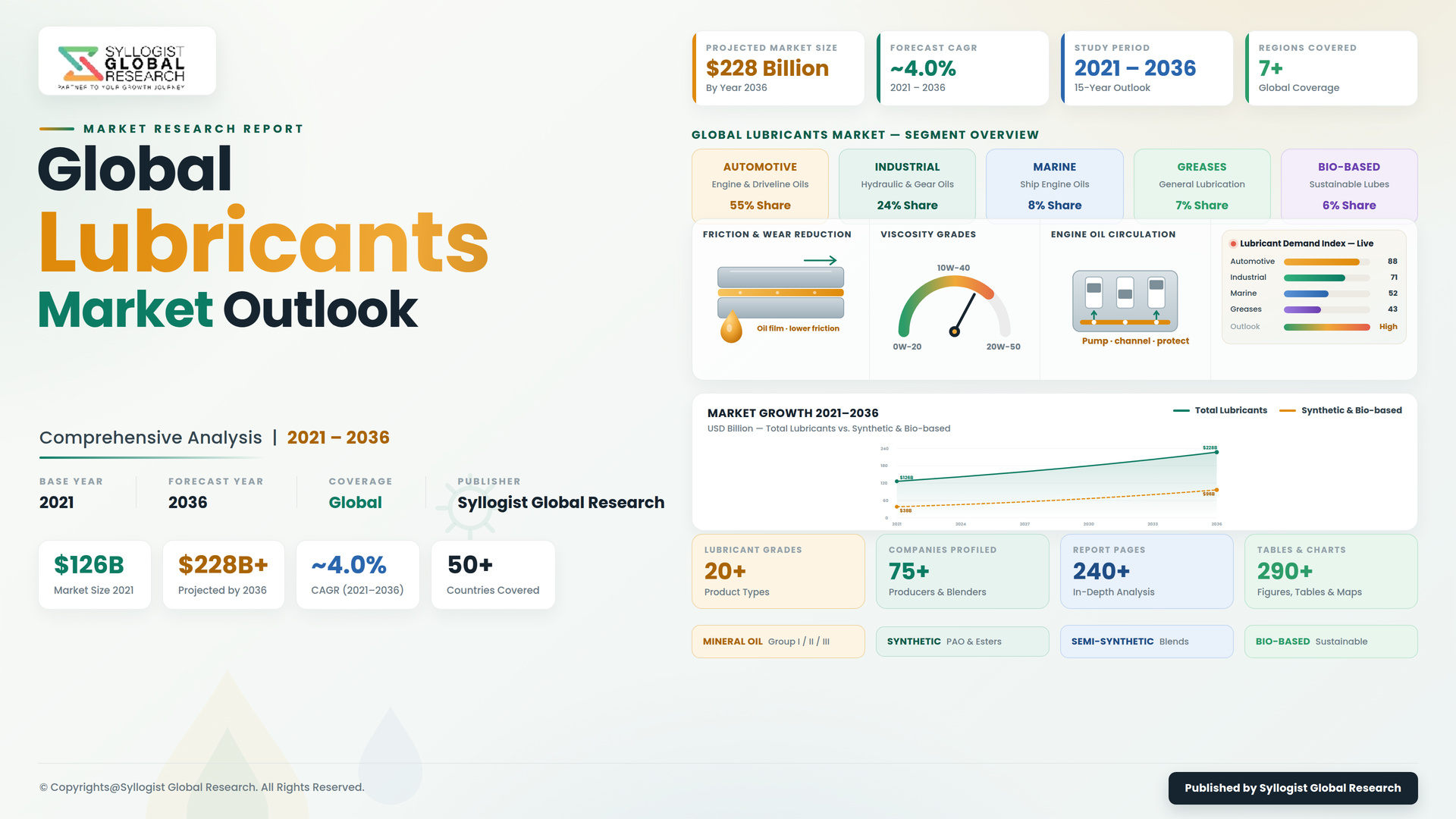
The global lubricants market is undergoing a structural transformation driven by accelerating vehicle electrification, OEM specification tightening, drain interval extension, industrial automation, the China Plus One manufacturing migration to Southeast Asia and India, base oil group migration from Group I to Group II, III, and IV, EU Circular Economy frameworks, and the structural emergence of EV-specific lubrication products including dielectric thermal management fluids and EV greases. The market was valued at USD 156.4 billion in 2025 and is projected to reach USD 218.6 billion by 2034, advancing at a compound annual growth rate of 3.8% through the forecast period, supported by volume growth in industrial, marine, and emerging market automotive applications offsetting structural volume contraction in mature ICE passenger car engine oil markets driven by electrification and longer drain intervals.
Automotive lubricants remain the dominant application segment accounting for approximately 56% of global lubricants volume in 2025, anchored by passenger car motor oils, heavy-duty diesel engine oils, transmission fluids, brake fluids, and emerging EV thermal management fluids. Global lubricant consumption exceeded 40.4 million tonnes in 2025, with PCMO volumes contracting at approximately 1.8% CAGR in mature markets driven by BEV penetration and extended drain intervals advancing toward 16,000 km service intervals at OEMs including BMW, Mercedes-Benz, Audi, Volvo, and emerging Chinese premium brands. Heavy-duty diesel engine oils continue to grow at 2.4% CAGR through 2034, supported by global commercial vehicle parc expansion, mining and construction equipment demand, and emerging API CK-4 and FA-4 specification adoption alongside ACEA E-class compliance across the global commercial vehicle fleet.
EV-specific lubrication products have emerged as the highest-growth product category, advancing at over 32.4% CAGR through 2034, supported by accelerating BEV production at Tesla, BYD, Volkswagen, Stellantis, GM, Ford, Hyundai, Kia, NIO, XPeng, Li Auto, Rivian, Lucid, and emerging Chinese brands. EV thermal management fluids for direct cooling of battery packs and electric motors, dielectric coolants, e-axle gear oils, and EV greases for motor bearings and reduction gears are reshaping the lubricant product portfolio, with Shell E-Fluids, ExxonMobil Mobil EV, BP Castrol ON, TotalEnergies Quartz EV Fluid, Valvoline Restore and Protect EV, Fuchs Renolin EV, and Petronas Iona programs anchoring early commercial development. Industrial lubricants including hydraulic fluids, gear oils, metalworking fluids, and greases continue to scale at 3.4% CAGR through 2034 supported by manufacturing migration, automation, and infrastructure expansion.
Asia-Pacific dominates the global lubricants market with approximately 48% revenue share in 2025, anchored by China, India, Japan, South Korea, and Southeast Asia as the principal demand centers, supported by dense automotive manufacturing, accelerating commercial vehicle production, mining and construction equipment demand, and emerging EV scaling. China alone accounts for nearly 22% of global lubricants consumption, while India is the fastest growing major market advancing at over 6.4% CAGR through 2034, supported by passenger car parc expansion, commercial vehicle growth, manufacturing PLI scheme investment, and infrastructure programs. North America at 21% share and Europe at 18% represent mature regional markets with volume contraction in PCMO offset by industrial growth, while Middle East and Africa and Latin America together contribute the balance with emerging market automotive parc expansion and oilfield activity supporting durable regional volume growth across the forecast horizon through 2034.
Key Drivers
Heavy-Duty Commercial Vehicle Growth, Mining and Construction Equipment Demand, and Emerging Market Vehicle Parc Expansion Driving Volume Growth
Global heavy-duty commercial vehicle parc exceeding 78 million units in 2025, mining and construction equipment demand at Caterpillar, Komatsu, Hitachi Construction, Volvo CE, Liebherr, and Sany, alongside emerging market passenger vehicle parc expansion across India, Indonesia, Vietnam, Brazil, Mexico, and Nigeria are anchoring durable lubricant volume growth. Indian passenger vehicle sales exceeding 4.1 million units in 2024 are driving lubricant demand at 6.4% CAGR through 2034, while heavy-duty diesel engine oil volumes advance at 2.4% CAGR globally supported by API CK-4 and FA-4 specification migration.
EV Thermal Management Fluids, EV Greases, and Dielectric Coolants Driving Premium Product Category Emergence
EV-specific lubrication products advancing at over 32.4% CAGR through 2034, supported by BEV production at Tesla, BYD, Volkswagen, Stellantis, GM, Ford, Hyundai, Kia, NIO, XPeng, Li Auto, Rivian, and Lucid, are anchoring the emergence of a high-value premium product category. Shell E-Fluids, ExxonMobil Mobil EV, BP Castrol ON, TotalEnergies Quartz EV Fluid, Valvoline Restore and Protect EV, Fuchs Renolin EV, and Petronas Iona programs are positioning major lubricant marketers for transition as EV penetration accelerates and demand for direct-cooling fluids, e-axle gear oils, and EV greases scales through 2034.
Industrial Automation, Manufacturing Migration, and Infrastructure Expansion Driving Durable Industrial Lubricant Demand
Industrial lubricants including hydraulic fluids, gear oils, metalworking fluids, and greases continue to scale at 3.4% CAGR through 2034 supported by manufacturing migration under the China Plus One strategy to Vietnam, Thailand, Malaysia, Indonesia, and Mexico, industrial automation, semiconductor fab additions, EV battery manufacturing, and infrastructure expansion. Vietnam alone receiving over USD 38 billion of FDI between 2023 and 2025, alongside Indian PLI scheme investment and US CHIPS Act manufacturing growth, are anchoring industrial lubricant procurement.
Key Challenges
Vehicle Electrification, BEV Penetration, and Drain Interval Extension Eroding Passenger Car Engine Oil Volumes
Accelerating vehicle electrification with BEV penetration advancing from approximately 18% of global new car sales in 2025 toward 42% by 2030, alongside drain interval extension advancing toward 16,000 km service intervals at BMW, Mercedes-Benz, Audi, Volvo, and Chinese premium brands, is eroding PCMO volumes at approximately 1.8% CAGR in mature markets. Lubricant marketers including Shell, ExxonMobil, BP Castrol, TotalEnergies, Chevron, Valvoline, and Fuchs are reshaping product portfolios toward EV-specific products and emerging market growth, while ICE volume contraction is compressing capacity utilization through 2034.
Base Oil Group Migration, Synthetic Adoption, and Feedstock Cost Volatility Pressuring Lubricant Margins
Structural base oil group migration from Group I to Group II, III, and IV, alongside accelerating synthetic and semi-synthetic lubricant adoption driven by OEM specifications including API SP, ILSAC GF-7, and ACEA C-classes, is reshaping base oil demand patterns and pressuring Group I producer economics. Base oil and additive feedstock cost volatility of 18% to 42% across 2022 to 2024 cycles, alongside crude oil price volatility, naphtha and gas oil supply dynamics, and emerging renewable feedstock pathways, are introducing margin compression through 2034.
Sustainability Mandates, Re-Refined Lubricant Adoption, and EU Circular Economy Frameworks Reshaping Product Strategy
Tightening sustainability mandates under the EU Circular Economy Action Plan, US EPA used oil recycling frameworks, Indian Used Oil Management Rules, alongside fleet operator and OEM commitments to incorporate re-refined and bio-based lubricants are reshaping product strategy and procurement decisions. Re-refined Group II and Group III base oil capacity at Safety-Kleen (Clean Harbors), Veolia, Avista Oil, and Hydrodec is scaling toward 4.8 million tonnes globally by 2030, while bio-based lubricants and emerging carbon-neutral lubricant programs are reshaping competitive positioning through 2034.
Market Segmentation
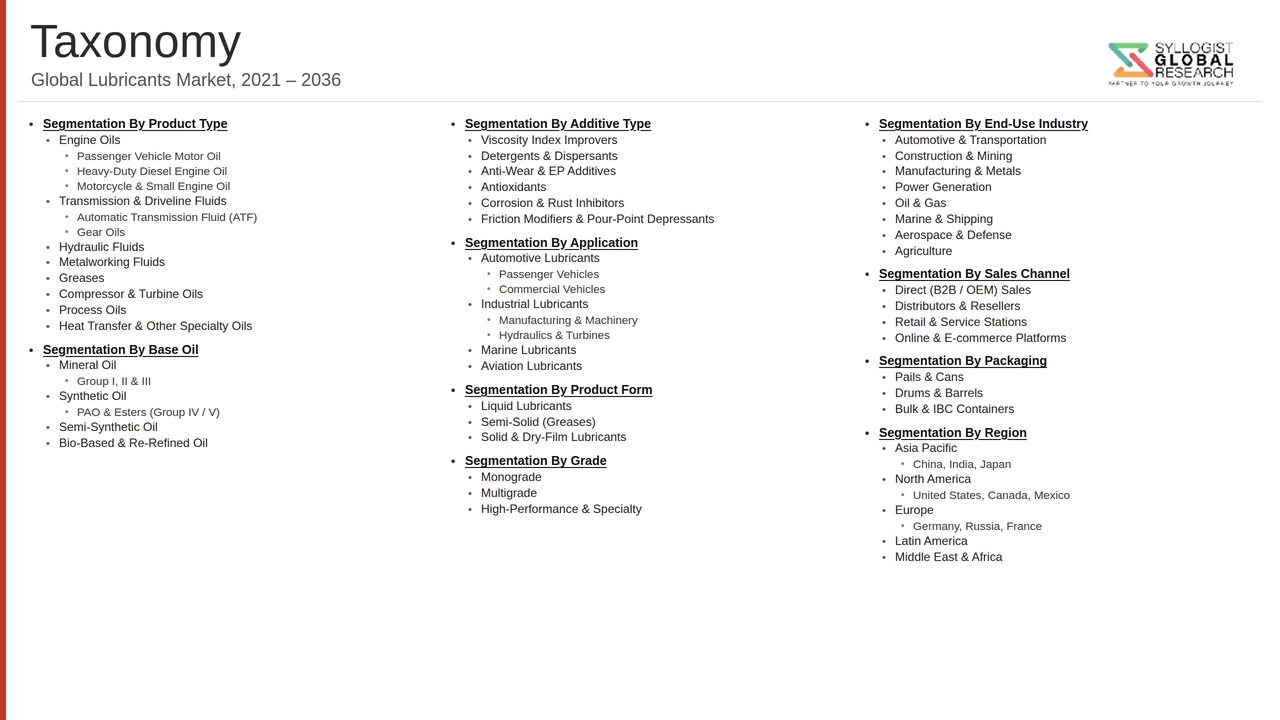
- Segmentation By Product Type
- Engine Oils (PCMO, HDDO, Motorcycle, Two-Stroke)
- Transmission and Gear Oils
- Hydraulic Fluids
- Metalworking Fluids
- Greases
- Process Oils
- Turbine and Compressor Oils
- Marine Cylinder and System Oils
- Aviation Lubricants
- EV Thermal Management Fluids and EV Greases
- Others
- Segmentation By Base Oil
- Group I (Solvent Refined)
- Group II (Hydrocracked)
- Group III (Severely Hydrocracked)
- Group IV (PAO Synthetics)
- Group V (Esters and Other Synthetics)
- Re-Refined Base Oils
- Bio-Based and Renewable Base Oils
- Others
- Segmentation By Viscosity Grade
- 0W-16, 0W-20, 0W-30
- 5W-20, 5W-30, 5W-40
- 10W-30, 10W-40
- 15W-40, 20W-50
- Monograde and Industrial Grades
- Others
- Segmentation By Application
- Passenger Vehicles
- Commercial Vehicles (Trucks, Buses, LCVs)
- Motorcycles and Two-Wheelers
- Off-Highway (Mining, Construction, Agriculture)
- Industrial Machinery and Manufacturing
- Marine and Shipping
- Aviation
- Power Generation
- Electric Vehicles (BEV, PHEV, HEV)
- Others
- Segmentation By End-Use Industry
- Automotive and Transportation
- Manufacturing and Industrial
- Construction and Mining
- Power Generation
- Marine and Shipping
- Aviation and Aerospace
- Metalworking
- Food Processing (Food-Grade Lubricants)
- Agriculture
- Others
- Segmentation By Distribution Channel
- OEM Factory Fill
- OEM Service and Authorized Workshops
- Independent Aftermarket
- Industrial Direct Sales
- E-Commerce and Quick Commerce
- Retail and Hypermarkets
- Others
- Segmentation By Region
- Asia-Pacific (China, India, Japan, South Korea, Southeast Asia, Australia)
- North America
- Europe
- Middle East and Africa
- Latin America
All market revenues are presented in USD
Historical Year: 2021-2024 | Base Year: 2025 | Estimated Year: 2026 | Forecast Period: 2027-2034
Key Questions this Study Will Answer
- What is the total market valuation of the Global Lubricants Market in 2025, projected through 2034, disaggregated by product type, base oil, viscosity grade, application, end-use industry, distribution channel, and region, enabling lubricant producers, additive suppliers, base oil producers, distributors, and investors to identify the highest-growth opportunities and most durable revenue corridors across the lubricants value chain?
- How are vehicle electrification with BEV penetration advancing from approximately 18% of global new car sales in 2025 toward 42% by 2030, drain interval extension toward 16,000 km service intervals, and OEM specification tightening under API SP, ILSAC GF-7, ACEA C-classes, and JASO MA/DH reshaping passenger car motor oil demand across mature and emerging markets through 2034?
- Which lubricant product categories including PCMO, HDDO, transmission fluids, hydraulic fluids, metalworking fluids, greases, marine cylinder oils, aviation lubricants, EV thermal management fluids, and EV greases are generating the highest growth rates, and how is the supply landscape evolving across Shell, ExxonMobil Mobil, BP Castrol, TotalEnergies, Chevron, Phillips 66, Valvoline, Pennzoil, Quaker Houghton, Fuchs Lubricants, Petronas Lubricants International, Sinopec, PetroChina, JXTG Eneos, Idemitsu Kosan, Indian Oil, HPCL, BPCL, Gulf Oil, Repsol, Cepsa, Lukoil, and Rosneft?
- How are EV-specific lubrication products advancing at over 32.4% CAGR through 2034 across Shell E-Fluids, ExxonMobil Mobil EV, BP Castrol ON, TotalEnergies Quartz EV Fluid, Valvoline Restore and Protect EV, Fuchs Renolin EV, and Petronas Iona programs reshaping competitive positioning across major lubricant marketers and OEM partnerships with Tesla, BYD, Volkswagen, Stellantis, GM, Ford, Hyundai, Kia, NIO, XPeng, Li Auto, Rivian, and Lucid?
- How is industrial lubricant demand scaling at 3.4% CAGR through 2034 supported by China Plus One manufacturing migration to Vietnam, Thailand, Malaysia, Indonesia, and Mexico, industrial automation, semiconductor fab additions, EV battery manufacturing, and infrastructure expansion, and what end-user procurement dynamics are reshaping regional demand patterns?
- How is base oil group migration from Group I to Group II, III, and IV, alongside re-refined Group II and Group III base oil capacity scaling toward 4.8 million tonnes globally by 2030 at Safety-Kleen, Veolia, Avista Oil, and Hydrodec, reshaping lubricant formulation economics and competitive positioning across additive suppliers Lubrizol, Infineum, Afton Chemical, and Chevron Oronite?
- How are tightening sustainability mandates under the EU Circular Economy Action Plan, US EPA used oil recycling frameworks, Indian Used Oil Management Rules, fleet operator and OEM commitments to incorporate re-refined and bio-based lubricants reshaping lubricant product strategy, procurement decisions, and competitive positioning across the global lubricant value chain through 2034?
- Product Definition
- Research Methodology
- Research Design & Framework
- Overall Research Approach: Descriptive, Exploratory & Quantitative Mixed-Method Design
- Market Definition & Scope Boundaries: What is Included and Excluded
- Segmentation Framework
- Key Research Assumptions & Limitations
- Secondary Research
- Primary Research Design & Execution
- Data Triangulation & Validation
- Market Sizing & Forecasting Methodology
- Competitive Intelligence Methodology
- Quality Assurance & Peer Review
- Definitions, Abbreviations & Data Notes
- Research Design & Framework
- Executive Summary
- Market Snapshot & Headline Numbers
- Key Findings & Research Highlights
- Market Dynamics
- Regional Market Summary
- Competitive Landscape Snapshot
- Technology & Innovation Highlights
- Market Dynamics
- Drivers
- Restraints
- Opportunities
- Challenges
- Porter’s Five Forces Analysis
- PESTLE Analysis
- Market Trends & Developments
- Emerging Trends
- Technological Developments
- Regulatory & Policy Changes
- Supply Chain & Sourcing Trends
- Manufacturing & Process Trends
- Investment & Funding Activity
- Sustainability & ESG Trends
- Risk Assessment Framework
- Base Oil & Additive Feedstock Availability & Price Volatility Risk
- Electric Vehicle Transition & Demand Erosion Risk
- Environmental, Emissions & Tightening Specification Regulation Risk
- Demand Cyclicality, Industrial Slowdown & End-Market Volatility Risk
- Counterfeit Products, Brand & Distribution Channel Risk
- Regulatory Framework & Standards
- Lubricant Performance, Viscosity & Quality Standards (API, ACEA, ILSAC & SAE)
- Environmental, Emissions & Biodegradability Regulatory Frameworks
- Product Registration, Labelling & Chemical Compliance (REACH & TSCA) Standards
- OEM Approval, Certification & Specification Frameworks
- Circular Economy, Re-Refining, Used Oil & Sustainable Procurement Standards
- Global Lubricants Market Outlook
- Market Size & Forecast by Value
- Market Size & Forecast by Volume (Consumption, Kilo Tonnes)
- Market Size & Forecast by Product Type
- Engine Oils
- Transmission & Gear Oils
- Hydraulic Fluids
- Metalworking Fluids
- Compressor & Turbine Oils
- Greases
- Process Oils
- Heat Transfer Fluids
- Other Specialty & Industrial Lubricants
- Market Size & Forecast by Base Oil Type
- Mineral Oil (Group I, II & III)
- Synthetic Oil (PAO & Esters)
- Semi-Synthetic Oil
- Bio-Based & Bio-Lubricants
- Re-Refined Base Oil
- Group III+ & Gas-to-Liquid (GTL) Base Oil
- Naphthenic Base Oil
- Greases & Solid Lubricant Bases
- Other & Emerging Base Stocks
- Market Size & Forecast by Formulation
- Mineral-Based Formulations
- Synthetic Formulations
- Semi-Synthetic Formulations
- Bio-Based & Biodegradable Formulations
- Other & Specialty Formulations
- Market Size & Forecast by Grade
- Mono-Grade Lubricants
- Multi-Grade Lubricants
- High-Performance & Specialty Grades
- Market Size & Forecast by Application
- Automotive & Transportation
- Industrial Machinery & Equipment
- Marine & Shipping
- Aviation & Aerospace
- Power Generation & Energy
- Construction, Mining & Other Applications
- Market Size & Forecast by End-Use Industry
- Automotive OEMs & Aftermarket
- Manufacturing & Heavy Industry
- Marine & Transportation Operators
- Energy, Power & Utilities
- Construction, Mining & Other End-Users
- Market Size & Forecast by Sales Channel
- Direct Sales & OEM Supply
- Distributors & Wholesalers
- Retail & Aftermarket Channel
- Online & E-Commerce Channel
- North America Lubricants Market Outlook
- Market Size & Forecast
- By Value
- By Volume (Consumption, Kilo Tonnes)
- By Product Type
- By Base Oil Type
- By Formulation
- By Grade
- By Application
- By End-Use Industry
- By Country
- By Sales Channel
- Europe Lubricants Market Outlook
- Market Size & Forecast
- By Value
- By Volume (Consumption, Kilo Tonnes)
- By Product Type
- By Base Oil Type
- By Formulation
- By Grade
- By Application
- By End-Use Industry
- By Country
- By Sales Channel
- Asia-Pacific Lubricants Market Outlook
- Market Size & Forecast
- By Value
- By Volume (Consumption, Kilo Tonnes)
- By Product Type
- By Base Oil Type
- By Formulation
- By Grade
- By Application
- By End-Use Industry
- By Country
- By Sales Channel
- Latin America Lubricants Market Outlook
- Market Size & Forecast
- By Value
- By Volume (Consumption, Kilo Tonnes)
- By Product Type
- By Base Oil Type
- By Formulation
- By Grade
- By Application
- By End-Use Industry
- By Country
- By Sales Channel
- Middle East & Africa Lubricants Market Outlook
- Market Size & Forecast
- By Value
- By Volume (Consumption, Kilo Tonnes)
- By Product Type
- By Base Oil Type
- By Formulation
- By Grade
- By Application
- By End-Use Industry
- By Country
- By Sales Channel
- Country-Wise* Lubricants Market Outlook
- Market Size & Forecast
- By Value
- By Volume (Consumption, Kilo Tonnes)
- By Product Type
- By Base Oil Type
- By Formulation
- By Grade
- By Application
- By End-Use Industry
- By Country
- By Sales Channel
- *Countries Analyzed in the Syllogist Global Research Portfolio: United States, Canada, Mexico, Germany, France, United Kingdom, Netherlands, Spain, Italy, Norway, Sweden, China, Japan, India, Australia, South Korea, Singapore, Brazil, Chile, Saudi Arabia, UAE, Egypt, South Africa, Israel
- Technology Landscape & Innovation Analysis
- Base Oil Refining & Hydroprocessing (Group II, III & GTL) Technology Deep-Dive
- Synthetic Base Stock (PAO & Ester) Production Technology
- Additive Chemistry & Performance Package Technology
- Bio-Based & Biodegradable Lubricant Technology
- Re-Refining & Used Oil Recovery Technology
- Grease & Solid Lubricant Formulation Technology
- EV Fluids, E-Mobility & Thermal Management Lubricant Technology
- Patent & IP Landscape in Lubricants Technologies
- Value Chain & Supply Chain Analysis
- Base Oil & Feedstock Supply Chain
- Additive & Chemical Input Supply Chain
- Blending, Manufacturing & Packaging Supply Chain
- Logistics, Storage & Bulk Distribution Infrastructure
- OEM, Industrial & Fleet Procurement Landscape
- Distributor, Retail & Aftermarket Channel
- Used Oil Collection, Re-Refining & Circular Economy
- Pricing Analysis
- Mineral-Based Lubricant Cost and Pricing Analysis
- Synthetic & Semi-Synthetic Lubricant Cost and Pricing Analysis
- Bio-Based & Biodegradable Lubricant Price Premium Analysis
- Re-Refined Lubricant Cost and Price Parity Analysis
- Base Oil, Additive & Margin Structure Analysis
- Total Lubricant Economics: Cost-per-Litre and Brand-Premium Optimisation Analysis
- Sustainability & Environmental Analysis
- Lifecycle Assessment (LCA) of Lubricants: Carbon Footprint, Energy Intensity & Emissions Across Product Types
- Carbon Neutrality & Net Zero Contribution: Pathway to Low-Carbon and Bio-Based Lubricants
- Circular Economy & Re-Refining: Used Oil Recovery and Material Reuse Contribution
- Environmental Compliance, Biodegradability & Spill Impact Consideration in Use
- Regulatory-Driven Sustainability, SDG 12 (Responsible Consumption) & SDG 13 (Climate Action) Alignment & Green Finance Eligibility
- Competitive Landscape
- Market Structure & Concentration
- Market Consolidation Level (Fragmented vs. Consolidated by Product Type & Geography)
- Top 10 Players Market Share
- HHI (Herfindahl-Hirschman Index) Concentration Analysis
- Competitive Intensity Map by Product Type, Base Oil & Geography
- Player Classification
- Integrated Oil Majors & Global Lubricant Producers
- Specialist & Independent Lubricant Blenders
- Additive & Performance Package Producers
- Base Oil & Re-Refining Companies
- Bio-Based & Specialty Lubricant Producers
- Grease & Industrial Lubricant Manufacturers
- Regional & Private-Label Lubricant Producers
- Emerging & EV-Fluid Lubricant Entrants
- Competitive Analysis Frameworks
- Market Share Analysis by Product Type, Base Oil & Region
- Company Profile
- Company Overview & Headquarters
- Lubricant Products & Technology Portfolio
- Key Customer Relationships & Reference Supply Agreements
- Manufacturing Footprint & Production Capacity
- Revenue (Lubricants Segment) & Backlog
- Technology Differentiators & IP
- Key Strategic Partnerships, JVs & M&A Activity
- Recent Developments (Capacity Expansion, Supply Deals, Product Launches)
- SWOT Analysis
- Strategic Focus Areas & Roadmap
- Competitive Positioning Map (Technology Capability vs. Market Penetration)
- Key Company Profiles
- Market Structure & Concentration
- Technology Landscape & Innovation Analysis
- Strategic Output
- Market Opportunity Matrix: By Product Type, Base Oil, Application, End-Use Industry & Geography
- White Space Opportunity Analysis
- Strategic Recommendations
- Product Portfolio & Technology Investment Strategy
- Manufacturing & Operational Excellence Strategy
- Geographic Expansion & Localisation Strategy
- Customer & End-User Engagement Strategy
- Partnership, M&A & Ecosystem Strategy
- Sustainability & Circular Economy Strategy
- Risk Mitigation & Future Roadmap
- Strategic Priority Matrix & Roadmap
- Near-term (2025-2028)
- Mid-term (2029-2032)
- Long-term (2033-2037)
- Strategic Output
- Market Size & Forecast
- Market Size & Forecast
- Market Size & Forecast
- Market Size & Forecast
- Market Size & Forecast
- Market Size & Forecast