Global Methane Market By Source, By Production Method, By Application, By End Use, By Region, Competition, Forecast & Opportunities, 2021-2034F
Market Definition
Methane is a colorless, odorless hydrocarbon gas that forms the primary component of natural gas and functions as a major energy fuel, chemical feedstock, and industrial raw material across power generation, heating, transportation, and manufacturing applications. The Global Methane Market encompasses the production, extraction, upgrading, purification, liquefaction, distribution, and supply of methane derived from natural sources including conventional natural gas, biogas, and landfill gas, and from synthetic and renewable pathways including power-to-gas, gasification, and methanation, consumed as fuel, chemical feedstock, and liquefied natural gas across residential, commercial, industrial, and mobility end uses.
The methane market covers methane supplied as pipeline natural gas, compressed and liquefied natural gas, renewable natural gas, high-purity industrial grades, and chemical feedstock for methanol, ammonia, and hydrogen production. Market participants within the methane market include oil and gas producers, natural gas processors, biogas and renewable natural gas developers, gas utilities, industrial gas suppliers, and distributors serving energy, chemical, and mobility demand across global and regional markets. End users of the methane market span power generation, residential and commercial heating, chemical manufacturing, automotive and transportation, aerospace, and industrial sectors procuring methane as fuel, feedstock, and industrial gas. The methane market explicitly excludes standalone methane detection and monitoring equipment, methane emissions abatement services, and downstream petrochemical products beyond primary feedstock supply, focusing exclusively on methane produced, processed, and supplied as an energy fuel, chemical feedstock, and industrial gas across global and regional demand centers spanning energy, chemical, and mobility applications.
Market Insights
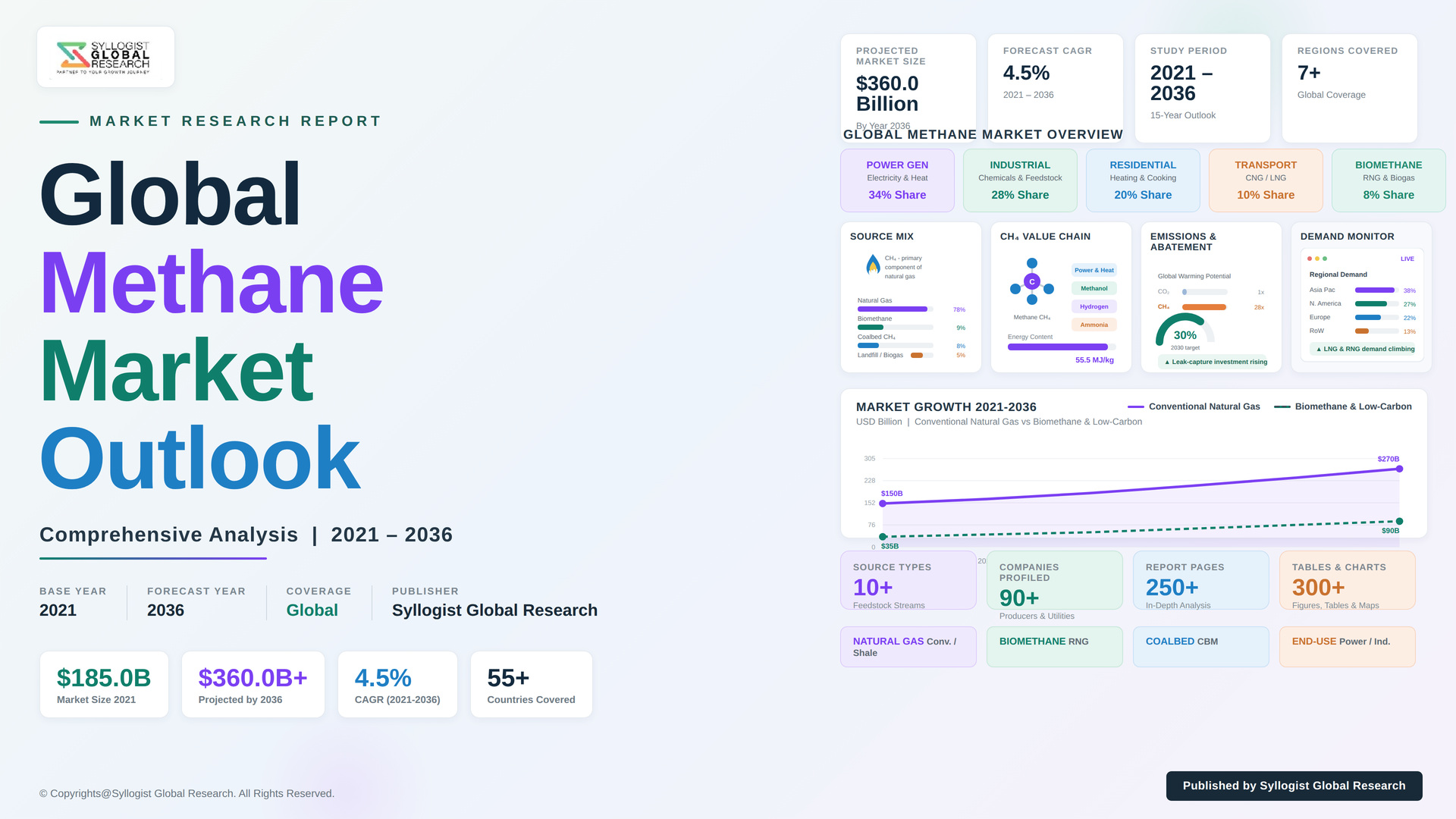
The global methane market is entering a sustained expansion phase, shaped by rising global energy demand, expanding liquefied natural gas trade, growing renewable natural gas and biomethane production, tightening methane emissions regulation, and increasing use of methane as a transition fuel and chemical feedstock. The methane market was valued at USD 106.6 billion in 2025 and is projected to reach USD 169.7 billion by 2034, advancing at a compound annual growth rate of 5.3% through the forecast period, as energy utilities, industrial manufacturers, and mobility operators across North America, Asia-Pacific, Europe, the Middle East, and Latin America scale methane production, processing, and consumption. Rising demand for cleaner-burning fuels, energy security priorities, and decarbonization commitments continue to widen the addressable base of the methane market across both mature and rapidly industrializing economies.
The methane market trajectory is being reshaped by the accelerating shift toward renewable and synthetic methane, including biomethane, renewable natural gas, and power-to-gas e-methane produced from organic waste and captured carbon. Natural methane, sourced from conventional natural gas, biogas, and landfill gas, continues to account for the dominant share of the methane market, supported by established extraction and pipeline infrastructure. Synthetic and renewable methane represents the fastest expanding category within the methane market, propelled by decarbonization policy, waste-to-energy investment, and corporate net-zero commitments. Satellite-based monitoring, methane capture-and-use initiatives, and the Global Methane Pledge are reshaping how methane is produced, tracked, and monetized across the methane market, converting emissions reduction into commercial renewable natural gas supply.
Natural methane represents the largest source segment within the methane market, while synthetic and renewable methane records the fastest growth as decarbonization and waste-to-energy investment scales globally. Fuel and liquefied natural gas constitute the largest application areas within the methane market, propelled by power generation, heating, and expanding global LNG trade, while chemical feedstock demand for methanol, ammonia, and hydrogen provides durable industrial consumption within the methane market. Power generation and residential and commercial heating represent leading end-use applications within the methane market, while automotive and transportation demand, including compressed and liquefied natural gas mobility, records steady growth across the methane market. Liquid-methane rocket fuel and aerospace applications provide an emerging, high-value niche within the methane market, supported by next-generation launch vehicle development.
North America represents the largest regional market within the methane market, supported by abundant shale gas production, extensive pipeline infrastructure, large-scale LNG export capacity, and the highest concentration of operational renewable natural gas plants across the United States and Canada. Asia-Pacific represents the fastest expanding regional position within the methane market, driven by rising energy demand, expanding LNG imports, and industrial growth across China, India, Japan, and Southeast Asia. Europe holds a significant position within the methane market, supported by aggressive biomethane and renewable natural gas policy, gas upgrading investment, and energy security diversification across Germany, France, the United Kingdom, and the Netherlands, while the Middle East, Africa, and Latin America record steady growth within the methane market driven by large natural gas reserves, expanding LNG export projects, and rising domestic energy consumption.
Key Drivers
Rising Global Energy Demand, Expanding Liquefied Natural Gas Trade, and Methane as a Cleaner-Burning Transition Fuel Driving Sustained Methane Demand
Rising global energy demand, the rapid expansion of liquefied natural gas trade, and the positioning of methane as a cleaner-burning transition fuel are generating durable demand growth across the methane market. Growing electricity consumption, industrialization, and population growth across emerging economies are driving sustained demand for methane as a primary power generation and heating fuel within the methane market. Natural gas, composed primarily of methane, emits significantly less carbon dioxide than coal and oil when combusted, positioning the methane market as a preferred bridge fuel in the transition away from higher-emission fossil fuels. Global liquefied natural gas trade is expanding rapidly, with new export terminals, import capacity, and long-term supply contracts connecting gas-rich producing regions to energy-hungry consuming markets within the methane market. Energy security concerns, supply diversification, and the displacement of coal in power generation are reinforcing demand for methane across major consuming regions. Rising demand for compressed and liquefied natural gas in heavy transport and marine fuel applications further broadens methane consumption. The combination of energy demand growth, LNG trade expansion, and the transition fuel role anchors long-duration demand visibility for producers, processors, and suppliers operating across the methane market value chain globally. Continued coal-to-gas switching in power generation and the buildout of new LNG export capacity are expected to sustain this demand momentum throughout the forecast period across the methane market.
Renewable Natural Gas, Biomethane, and Power-to-Gas Expansion Driven by Decarbonization Policy and Waste-to-Energy Investment
The rapid expansion of renewable natural gas, biomethane, and power-to-gas production, driven by decarbonization policy and waste-to-energy investment, is reshaping and broadening the methane market. Government mandates, blending targets, and incentive programs for renewable natural gas are accelerating investment in biomethane upgrading and injection capacity across the methane market. Anaerobic digestion of agricultural waste, municipal solid waste, sewage sludge, and food processing residues is generating a rapidly growing supply of renewable methane that displaces fossil natural gas within the methane market. Power-to-gas and e-methane technologies, which convert renewable electricity and captured carbon dioxide into synthetic methane, are emerging as a durable decarbonization pathway that expands the long-term supply base of the methane market. Corporate net-zero commitments, carbon pricing, and sustainability mandates are elevating demand for carbon-neutral and renewable methane across energy, industrial, and mobility applications within the methane market. Waste-to-energy investment additionally converts methane emissions from landfills and farms into commercial renewable natural gas, aligning environmental and commercial objectives. This structural shift toward renewable and synthetic methane supports resilient, policy-backed revenue growth for participants competing across the evolving methane market. Rising landfill gas capture and expanding agricultural digester deployment are expected to add further renewable supply within the methane market.
Growing Methane Demand as Chemical Feedstock for Methanol, Ammonia, and Hydrogen Production Across Industrial Applications
Growing demand for methane as a chemical feedstock for methanol, ammonia, and hydrogen production is driving sustained industrial consumption across the methane market. Methane serves as the primary feedstock for steam methane reforming, the dominant global route for hydrogen production, generating large-scale industrial demand within the methane market. Rising hydrogen demand, spanning refining, ammonia, and emerging clean hydrogen applications, is reinforcing methane consumption as a feedstock across the methane market. Methanol production, a key building block for chemicals, fuels, and plastics, relies heavily on methane feedstock, adding durable petrochemical demand within the methane market. Ammonia production for fertilizers and, increasingly, for energy carrier and marine fuel applications, sustains substantial methane feedstock consumption across the methane market. Expanding chemical manufacturing capacity across Asia-Pacific, the Middle East, and North America is generating incremental feedstock demand within the methane market. Investment in blue hydrogen, which pairs steam methane reforming with carbon capture, further reinforces the role of methane as a transitional feedstock in low-carbon chemical and energy production. This diversified feedstock demand across chemicals, fertilizers, and hydrogen supports resilient, multi-sector revenue growth for participants competing across the methane market. Growing investment in low-carbon ammonia and clean hydrogen projects is expected to reinforce methane feedstock demand across the methane market.
Key Challenges
Methane Emissions, Tightening Climate Regulation, and Environmental Scrutiny Constraining the Methane Market
Methane emissions, tightening climate regulation, and rising environmental scrutiny are generating substantial challenges across the methane market. Methane is a potent greenhouse gas with a global warming potential many times higher than carbon dioxide over the near term, placing the methane market under intense environmental and regulatory scrutiny. Governments across major economies are enacting stricter methane emissions regulation, leak detection and repair mandates, and super-emitter penalty provisions that raise compliance costs across the methane market. The Global Methane Pledge and international commitments to reduce methane emissions are compelling producers to invest in monitoring, capture, and abatement infrastructure within the methane market. Reputational pressure, investor sustainability expectations, and climate disclosure requirements are increasing the operational and financial burden on participants across the methane market. Fugitive emissions across extraction, processing, and distribution create both regulatory liability and lost product, complicating operations within the methane market. Balancing continued methane production and consumption with tightening climate obligations requires substantial investment in emissions control and transparency, raising costs and complexity for producers navigating environmental and regulatory transition across the methane market. Divergent national emissions rules, expanding satellite surveillance of super-emitters, and rising carbon penalties add further compliance uncertainty and reporting overhead for globally active participants across the methane market.
Price Volatility, Geopolitical Supply Risk, and High Infrastructure Capital Intensity Pressuring the Methane Market
Price volatility, geopolitical supply risk, and the high capital intensity of methane infrastructure are pressuring margins and investment stability across the methane market. Natural gas and methane prices are historically volatile, driven by supply and demand imbalances, weather, storage levels, and geopolitical events that complicate pricing and investment planning across the methane market. Geopolitical tensions, supply disruptions, and trade restrictions affecting major gas-producing regions introduce supply security risk and price shocks within the methane market. The capital intensity of methane infrastructure, including pipelines, compressors, liquefaction trains, storage, and regasification terminals, requires substantial upfront investment and long payback periods that constrain smaller participants within the methane market. Renewable natural gas and power-to-gas projects also require significant capital for upgrading and injection infrastructure, raising the cost of expanding low-carbon supply across the methane market. Financing uncertainty, permitting delays, and long project timelines add further risk to methane infrastructure development. Managing price volatility, supply security, and infrastructure capital requirements demands hedging, diversification, and disciplined capital allocation for participants competing across the methane market. Currency fluctuations, rising financing costs, and lengthy permitting processes further complicate long-horizon methane infrastructure investment across the methane market. Volatile spot and contract pricing can also distort investment signals and delay final investment decisions across the methane market.
Competition from Renewables and Electrification and Long-Term Energy Transition Risk Challenging the Methane Market
Growing competition from renewable electricity and electrification, alongside long-term energy transition risk, is challenging demand visibility across the methane market. The rapid cost decline and scaling of solar, wind, and battery storage are enabling electrification of power generation, heating, and transportation that can displace methane demand within the methane market. Building electrification, heat pump adoption, and electric vehicle penetration threaten to erode traditional methane consumption in residential, commercial, and mobility applications across the methane market. Long-term decarbonization targets and fossil fuel phase-down commitments introduce structural uncertainty over the future demand trajectory of the methane market. Policy shifts, carbon pricing, and stranded asset concerns can deter long-horizon investment in methane production and infrastructure within the methane market. While methane retains a role as a transition fuel and feedstock, the pace and direction of the energy transition create planning uncertainty for producers and investors across the methane market. Navigating this transition requires strategic pivoting toward renewable methane, carbon capture, and low-carbon applications to sustain relevance and revenue for participants competing across the evolving methane market. Accelerating renewable capacity additions and supportive electrification policy in key markets could compress conventional methane demand faster than currently anticipated across the methane market, intensifying the strategic pressure on producers to diversify.
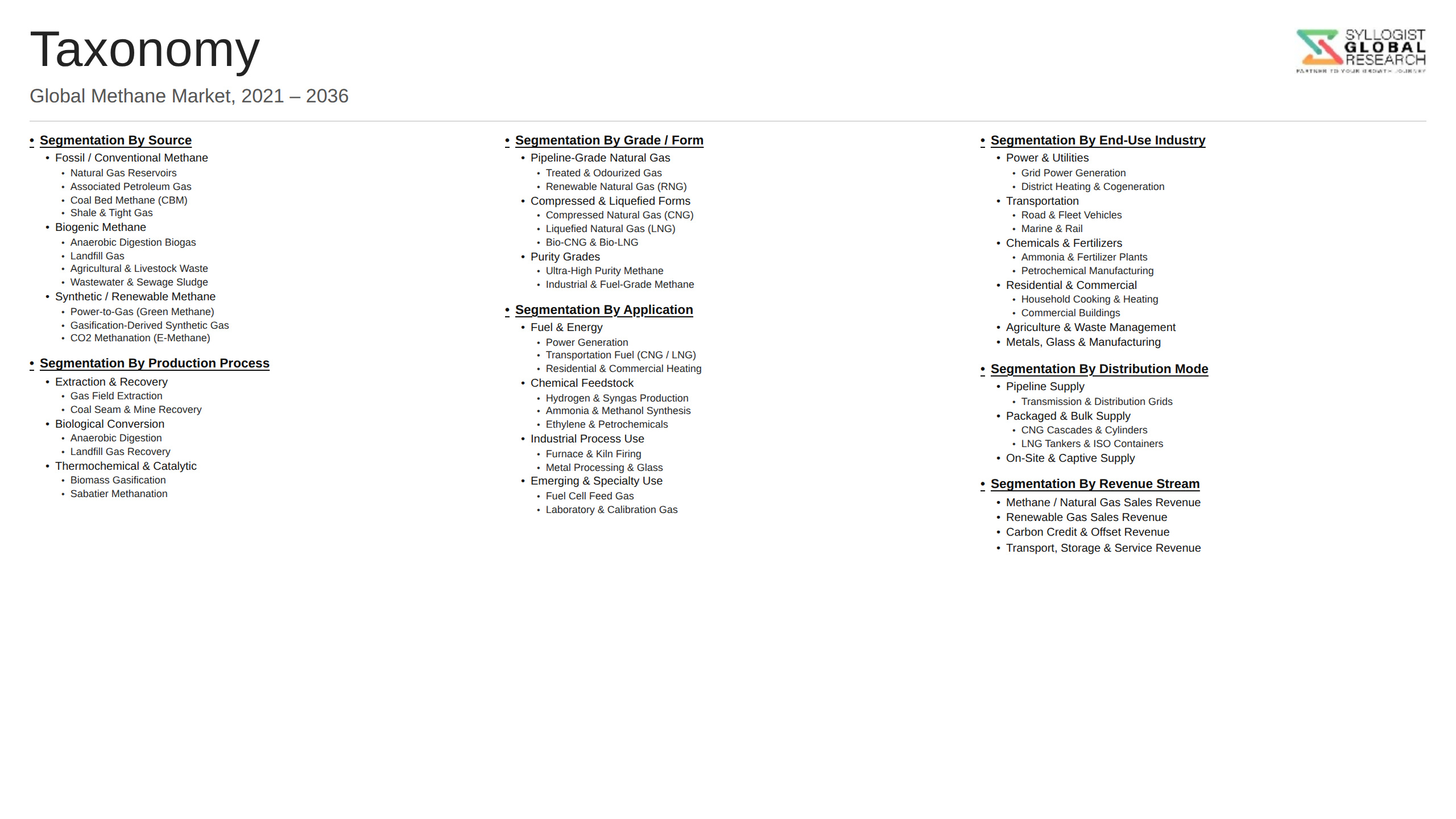
Market Segmentation
- Segmentation By Source
- Natural Methane
- Synthetic and Renewable Methane
- Segmentation By Production Method
- Conventional Natural Gas Extraction
- Anaerobic Digestion
- Landfill Gas Recovery
- Gasification
- Power-to-Gas and Methanation
- Others
- Segmentation By Application
- Fuel
- Liquefied Natural Gas (LNG)
- Chemical Feedstock
- Power Generation
- Residential and Commercial Heating
- Liquid-Methane Rocket Fuel
- Others
- Segmentation By End Use
- Energy and Power
- Chemical
- Automotive and Transportation
- Aerospace and Defense
- Residential
- Industrial
- Others
- Segmentation By Region
- North America
- Europe
- Asia-Pacific
- Middle East and Africa
- Latin America
All market revenues are presented in USD
Historical Year: 2021-2024 | Base Year: 2025 | Estimated Year: 2026 | Forecast Period: 2027-2034
Key Questions this Study Will Answer
- What is the total global market valuation of the Methane Market in 2025, projected through 2034, segmented by source, production method, application, and end use, enabling gas producers, renewable natural gas developers, utilities, and energy investors to identify highest-growth segments and the most durable revenue opportunities across the methane market?
- How are rising global energy demand, liquefied natural gas trade expansion, and the transition fuel role of methane shaping the pace and geographic distribution of demand across mature and rapidly industrializing regions of the methane market through 2034?
- Which sources and production methods, including conventional natural gas, biomethane, landfill gas, gasification, and power-to-gas, are gaining the strongest investment traction across energy, industrial, and mobility applications, and what decarbonization, feedstock, and cost factors are shaping supply development within the methane market?
- How are renewable natural gas, biomethane, and power-to-gas expansion, driven by decarbonization policy and waste-to-energy investment, reshaping supply, product innovation, and long-term demand across the methane market?
- How is the competitive structure organized among oil and gas producers, natural gas processors, renewable natural gas developers, gas utilities, and industrial gas suppliers within the methane market, and what partnership, acquisition, capacity expansion, and decarbonization strategies are enabling participants to strengthen competitive position?
- What methane emissions regulation, climate scrutiny, price volatility, geopolitical supply risk, and electrification competition factors are shaping investment, pricing power, and demand resilience across the methane market, and how are leading producers mitigating these challenges?
- Which regional markets, including North America, Asia-Pacific, Europe, the Middle East and Africa, and Latin America, are projected to generate the largest incremental revenue opportunities through 2034, and what energy demand, gas reserves, LNG trade, renewable methane policy, and infrastructure factors are shaping investment priorities and competitive positioning in each regional methane market?
- Product Definition
- Research Methodology
- Research Design & Framework
- Overall Research Approach: Descriptive, Exploratory & Quantitative Mixed-Method Design
- Market Definition & Scope Boundaries: What is Included and Excluded
- Segmentation Framework
- Key Research Assumptions & Limitations
- Secondary Research
- Primary Research Design & Execution
- Data Triangulation & Validation
- Market Sizing & Forecasting Methodology
- Competitive Intelligence Methodology
- Quality Assurance & Peer Review
- Definitions, Abbreviations & Data Notes
- Executive Summary
- Market Snapshot & Headline Numbers
- Key Findings & Research Highlights
- Market Dynamics
- Regional Market Summary
- Competitive Landscape Snapshot
- Technology & Innovation Highlights
- Market Dynamics
- Drivers
- Restraints
- Opportunities
- Challenges
- Porter’s Five Forces Analysis
- PESTLE Analysis
- Market Trends & Developments
- Emerging Trends
- Technological Developments
- Regulatory & Policy Changes
- Supply Chain & Sourcing Trends
- Manufacturing & Process Trends
- Investment & Funding Activity
- Sustainability & ESG Trends
- Risk Assessment Framework
- Natural Gas Price Volatility, Hub Benchmark & Supply Cost Escalation Risk
- Methane Emission Regulation, Leakage Scrutiny & Compliance Cost Risk
- Energy Transition, Decarbonisation Pressure & Demand Displacement Risk
- Geopolitical Supply, Pipeline & LNG Trade Disruption Risk
- Infrastructure Constraint, Storage & Distribution Bottleneck Risk
- Regulatory Framework & Standards
- Methane Emission, Leak Detection & Repair (LDAR) Compliance Standards
- Natural Gas Pipeline Safety, Transport & Quality Standards
- Biomethane, RNG Certification & Renewable Fuel Standards
- Carbon Pricing, Greenhouse Gas Reporting & Climate Regulations
- Cross-Border Trade, LNG Export & Import-Export Compliance Frameworks
- Global Methane Market Outlook
- Market Size & Forecast by Value
- Market Size & Forecast by Volume (Methane Consumed in Billion Cubic Metres per Year and Production Capacity in Billion Cubic Metres per Year)
- Market Size & Forecast by Source
- Conventional Natural Gas
- Shale Gas
- Tight Gas
- Coal Bed Methane (CBM)
- Biogas and Biomethane (RNG)
- Landfill Gas
- Synthetic (e-Methane)
- Others
- Market Size & Forecast by Form
- Pipeline Natural Gas
- Liquefied Natural Gas (LNG)
- Compressed Natural Gas (CNG)
- Renewable Natural Gas (RNG)
- Others
- Market Size & Forecast by Application
- Power Generation
- Residential and Commercial Heating
- Industrial Fuel
- Transportation Fuel
- Chemical Feedstock
- Petrochemicals
- Fertilizer (Ammonia)
- Others
- Market Size & Forecast by End-Use Industry
- Power and Utilities
- Residential and Commercial
- Industrial Manufacturing
- Transportation
- Chemicals and Petrochemicals
- Fertilizers
- Oil and Gas
- Others
- Market Size & Forecast by Grade
- Pipeline Grade
- Industrial Grade
- High-Purity (Chemical) Grade
- Others
- Market Size & Forecast by Recovery Technology
- Conventional Drilling
- Hydraulic Fracturing
- Anaerobic Digestion
- Gasification
- Others
- Market Size & Forecast by Distribution Mode
- Pipeline
- LNG Shipping
- Road and Trucking
- Virtual Pipeline
- Others
- Market Size & Forecast by Sales Channel
- Direct Long-Term Supply Contract
- Merchant Spot Market
- Utility and Distribution Channel
- Trader and Aggregator Channel
- Others
- North America Methane Market Outlook
- Market Size & Forecast
- By Value
- By Volume (Methane Consumed in Billion Cubic Metres per Year and Production Capacity in Billion Cubic Metres per Year)
- By Source
- By Form
- By Application
- By End-Use Industry
- By Grade
- By Recovery Technology
- By Distribution Mode
- By Country
- By Sales Channel
- Europe Methane Market Outlook
- Market Size & Forecast
- By Value
- By Volume (Methane Consumed in Billion Cubic Metres per Year and Production Capacity in Billion Cubic Metres per Year)
- By Source
- By Form
- By Application
- By End-Use Industry
- By Grade
- By Recovery Technology
- By Distribution Mode
- By Country
- By Sales Channel
- Asia-Pacific Methane Market Outlook
- Market Size & Forecast
- By Value
- By Volume (Methane Consumed in Billion Cubic Metres per Year and Production Capacity in Billion Cubic Metres per Year)
- By Source
- By Form
- By Application
- By End-Use Industry
- By Grade
- By Recovery Technology
- By Distribution Mode
- By Country
- By Sales Channel
- Latin America Methane Market Outlook
- Market Size & Forecast
- By Value
- By Volume (Methane Consumed in Billion Cubic Metres per Year and Production Capacity in Billion Cubic Metres per Year)
- By Source
- By Form
- By Application
- By End-Use Industry
- By Grade
- By Recovery Technology
- By Distribution Mode
- By Country
- By Sales Channel
- Middle East & Africa Methane Market Outlook
- Market Size & Forecast
- By Value
- By Volume (Methane Consumed in Billion Cubic Metres per Year and Production Capacity in Billion Cubic Metres per Year)
- By Source
- By Form
- By Application
- By End-Use Industry
- By Grade
- By Recovery Technology
- By Distribution Mode
- By Country
- By Sales Channel
- Country-Wise* Methane Market Outlook
- Market Size & Forecast
- By Value
- By Volume (Methane Consumed in Billion Cubic Metres per Year and Production Capacity in Billion Cubic Metres per Year)
- By Source
- By Form
- By Application
- By End-Use Industry
- By Grade
- By Recovery Technology
- By Distribution Mode
- By Country
- By Sales Channel
- Market Size & Forecast
- Market Size & Forecast
- Market Size & Forecast
- Market Size & Forecast
- Market Size & Forecast
- Market Size & Forecast
*Countries Analysed in the Global Research Portfolio: United States, Canada, Mexico, Germany, France, United Kingdom, Netherlands, Spain, Italy, Norway, Sweden, China, Japan, India, Australia, South Korea, Singapore, Brazil, Chile, Saudi Arabia, UAE, Egypt, South Africa, Israel
- Technology Landscape & Innovation Analysis
- Natural Gas Extraction, Processing & Purification Technology Deep-Dive
- LNG Liquefaction, Regasification & Cryogenic Technology
- Biomethane, Anaerobic Digestion & Biogas Upgrading Technology
- Power-to-Gas, e-Methane & Synthetic Methane Technology
- Methane Leak Detection, Monitoring & Abatement Technology
- Methane Pyrolysis, Turquoise Hydrogen & Conversion Technology
- Carbon Capture, Utilisation & Low-Carbon Methane Technology
- Patent & IP Landscape in Methane Production Technologies
- Value Chain & Supply Chain Analysis
- Upstream Exploration, Extraction & Well Supply Chain
- Gas Processing, Treatment & Purification Supply Chain
- Biomethane, Anaerobic Digestion & Upgrading Supply Chain
- Pipeline, LNG Terminal & Storage Infrastructure Network
- Power, Industrial & Chemical Customer Channel
- Utility, Distribution & Retail Supply Network
- Trader, Aggregator & LNG Export Network
- Pricing Analysis
- Pipeline Natural Gas Pricing Across Hub & Contract Benchmarks
- LNG Pricing Across Spot & Long-Term Contract Tiers
- Biomethane and RNG Premium Pricing Analysis
- Regional Pricing Across Henry Hub, TTF & JKM Benchmarks
- Carbon-Adjusted and Low-Carbon Methane Pricing Analysis
- Transport, Liquefaction & Delivered Cost Economics
- Total Delivered Cost, Netback & Value-in-Use Pricing Models
- Sustainability & Environmental Analysis
- Lifecycle Assessment (LCA) of Methane Across Source & Delivery Routes
- Methane Leakage, Fugitive Emissions & Abatement Performance
- Biomethane, RNG & Renewable Methane Carbon Reduction Performance
- Carbon Capture, e-Methane & Low-Carbon Pathway Performance
- Regulatory-Driven Sustainability, SDG 7 (Clean Energy) & SDG 13 (Climate Action) Alignment & Green Finance Eligibility
- Competitive Landscape
- Market Structure & Concentration
- Market Consolidation Level (Fragmented vs. Consolidated by Source & Geography)
- Top 10 Players Market Share
- HHI (Herfindahl-Hirschman Index) Concentration Analysis
- Competitive Intensity Map by Source, Application & Geography
- Player Classification
- Integrated Oil and Gas Majors
- Natural Gas Exploration and Production Companies
- LNG Producers and Exporters
- Biomethane and RNG Producers
- Gas Utilities and Distributors
- National and State-Owned Gas Enterprises
- Regional and Independent Producers
- Traders and Aggregators
- Competitive Analysis Frameworks
- Market Share Analysis by Source, Application & Region
- Company Profile
- Company Overview & Headquarters
- Methane Production Portfolio & Capacity
- Key Customer Relationships & Reference Offtake Accounts
- Production Footprint & Reserve Coverage
- Revenue (Methane Segment) & Offtake Contract Backlog
- Technology Differentiators & IP
- Key Strategic Partnerships, JVs & M&A Activity
- Recent Developments (Capacity Additions, Contract Wins, Project Launches)
- SWOT Analysis
- Strategic Focus Areas & Roadmap
- Competitive Positioning Map (Technology Capability vs. Market Penetration)
- Key Company Profiles
- Market Structure & Concentration
- Technology Landscape & Innovation Analysis
- Strategic Output
- Market Opportunity Matrix: By Source, Form, Application, End-Use Industry & Geography
- White Space Opportunity Analysis
- Strategic Recommendations
- Supply Portfolio & Source Diversification Strategy
- Operational Excellence & Capacity Expansion Strategy
- Geographic Expansion & Infrastructure Strategy
- Customer & Offtake Account Engagement Strategy
- Partnership, M&A & Ecosystem Strategy
- Sustainability & Emission Reduction Strategy
- Risk Mitigation & Future Roadmap
- Strategic Priority Matrix & Roadmap
- Near-term (2025-2028)
- Mid-term (2029-2032)
- Long-term (2033-2037)