Global Nitric Acid Market By Concentration, By Production Process, By Application, By End User, By Region, Competition, Forecast & Opportunities, 2021-2034F
Market Definition
Nitric acid is a strong, highly corrosive mineral acid with the chemical formula HNO3, produced predominantly through the catalytic oxidation of ammonia in the Ostwald process, and valued as a core industrial chemical for nitrogen fertilizer production, explosives manufacturing, and a wide range of nitration, oxidation, and metal treatment reactions. The Global Nitric Acid Market covers the production, distribution, and consumption of dilute or weak nitric acid, concentrated nitric acid, and fuming nitric acid manufactured through single-pressure, dual-pressure, and high-pressure Ostwald process configurations. The nitric acid market spans weak acid grades supplied to ammonium nitrate and calcium ammonium nitrate fertilizer production, concentrated and fuming grades used in explosives, nitroaromatic and nitrobenzene synthesis, adipic acid and toluene diisocyanate intermediates, metal pickling and passivation, and specialty applications including electronics etching, catalyst regeneration, and rocket propellant oxidizers. Market participants include integrated ammonia and nitric acid producers, fertilizer manufacturers, explosives producers, specialty chemical makers, and distributors that supply nitric acid to agricultural, industrial, and technical value chains. End users span the fertilizer and agriculture sector, explosives and mining, chemical and polymer intermediate manufacturing, metal processing and surface treatment, and electronics and specialty industries. The nitric acid market excludes other mineral acids such as sulfuric acid, phosphoric acid, and hydrochloric acid sold outside nitric acid supply routes, along with ammonia and nitrate salts marketed as standalone products, concentrating on weak, concentrated, and fuming nitric acid volumes that serve fertilizer, explosives, intermediate, and metal treatment roles across regulated and industrial applications worldwide.
Market Insights
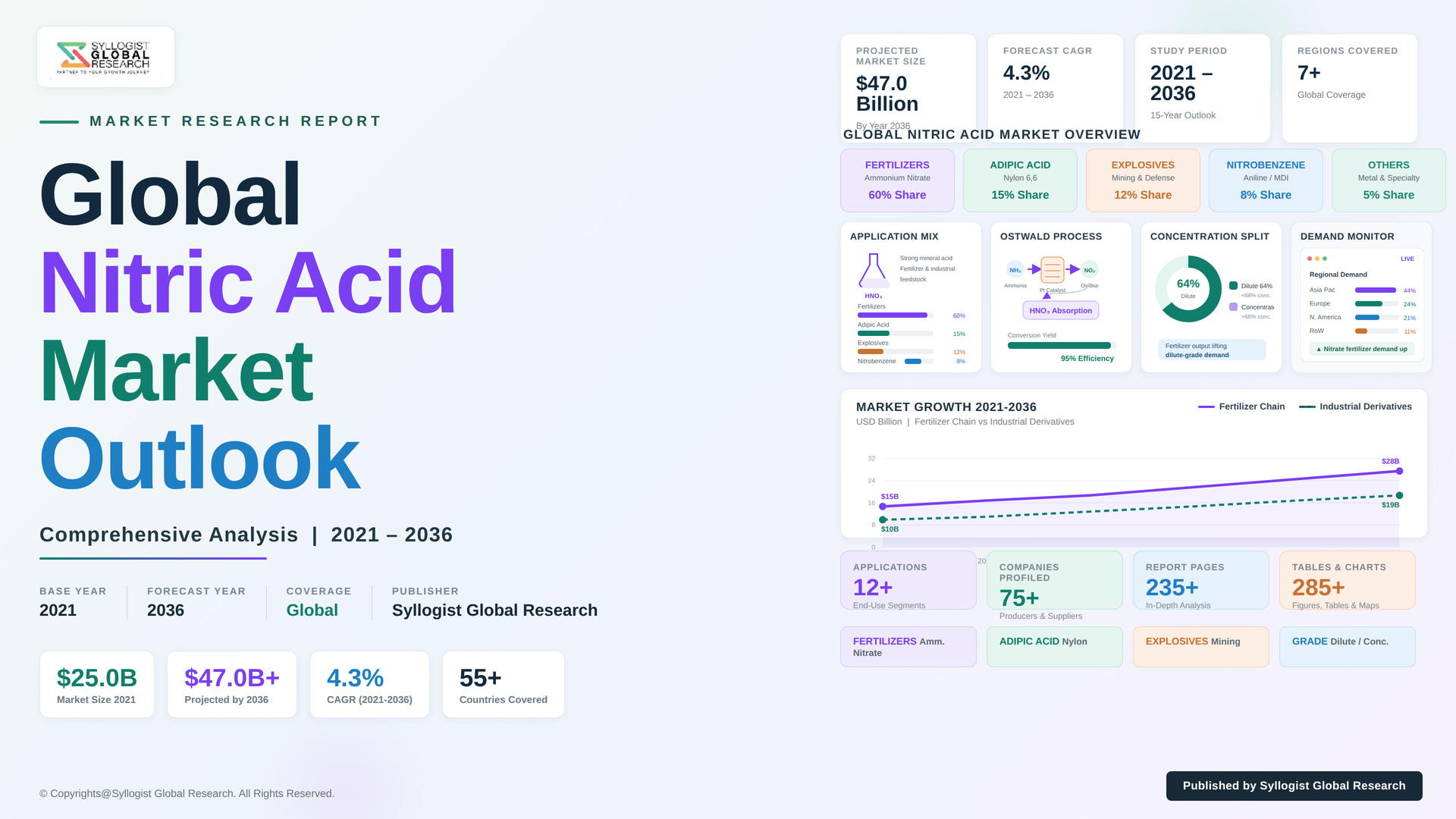
The global nitric acid market is moving through a steady expansion phase, shaped by rising nitrogen fertilizer demand for global food security, sustained explosives consumption across mining and infrastructure, growing adipic acid and polymer intermediate production, and accelerating investment in emission abatement and low-carbon ammonia feedstock that reshapes nitric acid production economics. The global nitric acid market was valued at USD 26.8 billion in 2025 and is projected to reach USD 38.4 billion by 2034, advancing at a compound annual growth rate of 4.1% through the forecast period, as fertilizer producers, explosives manufacturers, chemical intermediate makers, and metal processors scale nitric acid procurement across Asia-Pacific, North America, Europe, the Middle East and Africa, and Latin America.
The nitric acid market trajectory is being reshaped by the deployment of tertiary nitrous oxide and nitrogen oxide abatement technologies, the tightening of emission regulations at nitric acid plants, and the emergence of green ammonia as a low-carbon feedstock for nitric acid and downstream nitrogen fertilizers. Ammonium nitrate and calcium ammonium nitrate fertilizer production accounts for close to 75% of total global nitric acid demand, anchoring baseline consumption to global agricultural cycles and food production. Nitrous oxide abatement is scaling within the nitric acid market, with modern plants installing catalytic abatement systems that cut nitrous oxide emissions by more than 90%, driven by climate regulation and carbon credit mechanisms, while producers are increasingly integrating green ammonia and carbon capture to lower the lifecycle carbon intensity of nitric acid and nitrate fertilizers across major producing regions.
Fertilizer application remains the single largest end use within the global nitric acid market, sustained by ammonium nitrate, calcium ammonium nitrate, and nitrophosphate demand across global agriculture. Explosives represent the second largest application within the nitric acid market, anchored by ammonium nitrate consumption in mining, quarrying, and infrastructure blasting, where nitric acid is an essential precursor. Chemical intermediates, including adipic acid for nylon, toluene diisocyanate for polyurethanes, and nitrobenzene for aniline, are gaining strategic procurement traction within the nitric acid market, propelled by polymer, foam, and specialty chemical demand. Weak or dilute nitric acid represents the largest concentration grade within the nitric acid market, supported by fertilizer and ammonium nitrate production, while concentrated and fuming nitric acid serve explosives, nitration, and specialty applications. The dual-pressure Ostwald process represents the leading production process within the nitric acid market, favored for its efficiency and yield in large-scale weak acid production supporting fertilizer output.
Asia-Pacific represents the largest regional market within the global nitric acid market, supported by large fertilizer and ammonia capacity, sustained agricultural demand, and expanding chemical intermediate production across China, India, and Southeast Asia. China alone accounts for more than 30% of global nitric acid production and continues to operate extensive fertilizer and industrial nitric acid capacity. North America occupies a leading regional position within the nitric acid market, propelled by explosives demand for mining, ammonium nitrate production, and adipic acid and specialty chemical output supported by low-cost natural gas feedstock. Europe represents an established regional market within the nitric acid market, anchored by fertilizer production, stringent nitrous oxide abatement regulation, and specialty chemical demand, while the Middle East and Africa form a growing regional position within the nitric acid market driven by fertilizer capacity investment and mining explosives demand. Latin America represents an emerging position within the nitric acid market, supported by agricultural fertilizer demand and mining explosives consumption across the region.
Key Drivers
Rising Nitrogen Fertilizer Demand for Global Food Security Driving Ammonium Nitrate and Weak Nitric Acid Consumption
Rising nitrogen fertilizer demand driven by global food security priorities, growing population, and shrinking arable land per capita is generating durable procurement demand for weak nitric acid within the global nitric acid market. Nitric acid is the essential precursor to ammonium nitrate, calcium ammonium nitrate, and nitrophosphate fertilizers, which supply readily available nitrate nitrogen critical for crop yield across cereals, oilseeds, and horticulture. Global food demand continues to rise with population growth and changing diets, pressuring farmers to raise productivity per hectare and sustaining nitrogen fertilizer application across major agricultural regions. Calcium ammonium nitrate is favored in many temperate markets for its balanced nitrogen delivery and reduced soil acidification, driving steady weak nitric acid consumption within the nitric acid market. Government food security programs, fertilizer subsidies, and efforts to raise domestic agricultural output in populous economies further reinforce nitrate fertilizer demand and associated nitric acid consumption. Because fertilizer demand is structurally tied to food production and is relatively resilient to economic cycles, nitrate fertilizer provides the nitric acid market with a large, recurring baseline demand stream that anchors capacity utilization at integrated ammonia and nitric acid complexes. This structural link between food security, nitrogen fertilizer, and nitric acid secures long-term volume growth for producers and supports sustained investment in fertilizer-grade nitric acid capacity across major producing regions worldwide.
Sustained Explosives Demand From Mining, Quarrying, and Infrastructure Blasting Driving Ammonium Nitrate-Linked Nitric Acid Consumption
Sustained explosives demand from mining, quarrying, and infrastructure blasting is driving durable nitric acid consumption within the global nitric acid market through ammonium nitrate production. Ammonium nitrate, produced from nitric acid and ammonia, is the primary ingredient in industrial explosives and blasting agents used across metal mining, coal mining, quarrying, and construction excavation, linking nitric acid demand directly to mining and infrastructure activity. Growing demand for metals and minerals, including copper, iron ore, gold, and battery raw materials tied to the energy transition, is sustaining mining output and the explosives consumption that supports it. Infrastructure investment across roads, tunnels, dams, and urban development further reinforces blasting demand and associated ammonium nitrate and nitric acid consumption within the nitric acid market. Explosives-grade ammonium nitrate requires reliable, high-purity nitric acid supply, anchoring demand from integrated producers serving mining regions. Because mining and infrastructure activity is closely linked to commodity demand, urbanization, and the metals-intensive energy transition, explosives provides the nitric acid market with a resilient demand base that complements fertilizer consumption. This connection between mining growth, infrastructure investment, and explosives secures a durable nitric acid demand avenue and supports capacity investment near major mining and construction markets across multiple regions worldwide, reinforcing explosives as a stable pillar of long-term nitric acid demand.
Growing Chemical Intermediate Demand for Adipic Acid, Polyurethanes, and Nitroaromatics Driving Concentrated Nitric Acid Consumption
Growing chemical intermediate demand for adipic acid, polyurethanes, and nitroaromatic compounds is driving concentrated nitric acid consumption within the global nitric acid market. Nitric acid is a key oxidizing and nitrating agent in the production of adipic acid, which is used to manufacture nylon 6,6 for textiles, engineering plastics, and automotive components, linking nitric acid demand to global nylon and specialty polymer consumption. Toluene diisocyanate and other isocyanate intermediates that rely on nitration chemistry support polyurethane production for foams, coatings, and insulation, sustaining concentrated nitric acid demand within the nitric acid market. Nitrobenzene, an important precursor to aniline and downstream rubber chemicals, dyes, and agrochemicals, further reinforces industrial nitric acid consumption. Rising demand for lightweight engineering plastics in automotive and electronics, insulation materials for energy-efficient buildings, and specialty chemicals across coatings and agrochemicals is expanding the intermediate demand base within the nitric acid market. These industrial applications require concentrated and high-purity nitric acid, commanding higher value than fertilizer-grade acid and diversifying the nitric acid market beyond agricultural demand. The breadth of polymer, foam, and specialty chemical applications provides producers with a higher-value demand stream that supports investment in concentrated nitric acid capacity and value-added grades across major producing regions worldwide.
Key Challenges
Nitrous Oxide and Nitrogen Oxide Emissions, Tightening Climate Regulation, and Abatement Investment Cost Constraining Nitric Acid Producers
Significant nitrous oxide and nitrogen oxide emissions, tightening climate and air quality regulation, and the cost of abatement investment generate substantial environmental and compliance pressure that constrains the global nitric acid market. Nitric acid production is a major industrial source of nitrous oxide, a greenhouse gas with a global warming potential nearly 265 times that of carbon dioxide, placing nitric acid plants under intense regulatory scrutiny as climate frameworks tighten. Nitrogen oxide emissions from the Ostwald process also face strict air quality limits, requiring producers to install and maintain tertiary abatement and selective catalytic reduction systems. Meeting nitrous oxide abatement requirements demands substantial capital investment in catalytic reactors and continuous monitoring, raising the cost of participation and creating barriers for older plants unable to justify retrofit expenditure. Carbon pricing and emission trading schemes add further financial pressure, exposing higher-emitting producers to rising compliance costs within the nitric acid market. As climate regulation continues to tighten globally, producers face ongoing pressure to reduce lifecycle emissions across the ammonia-to-nitric acid chain. The combined burden of nitrous oxide regulation, nitrogen oxide limits, and abatement capital cost raises operating and investment costs, pressures margins, and constrains the pace at which the nitric acid market can expand capacity without significant environmental investment across major producing regions worldwide.
Ammonia Feedstock and Natural Gas Price Volatility Exposing Nitric Acid Production Economics to Energy Market Cycles
Dependence on ammonia feedstock, exposure to volatile natural gas prices, and the energy intensity of the nitrogen value chain generate persistent margin instability that constrains the global nitric acid market. Nitric acid production depends on ammonia, which is itself produced primarily from natural gas, tying nitric acid economics directly to natural gas and energy markets. Natural gas represents the dominant cost input for ammonia, and gas price volatility, including the severe spikes experienced across Europe, has repeatedly compressed nitrogen producer margins and forced ammonia and nitric acid plant curtailment. Because ammonia and nitric acid production is capital intensive and energy intensive, producers face difficulty passing through rapid feedstock cost increases, particularly where fertilizer prices are regulated or subsidized. Regional disparities in natural gas cost create significant competitive imbalances within the nitric acid market, advantaging producers in low-cost gas regions such as North America and the Middle East over import-dependent regions. Currency movements and logistics costs add further complexity for producers and distributors. These dynamics complicate long-term contract pricing, raise working capital requirements, and expose non-integrated and gas-import-dependent producers to margin pressure, leaving the nitric acid market vulnerable to energy market cycles and feedstock supply disruptions across key producing regions worldwide.
Safety, Security, and Regulatory Restrictions on Ammonium Nitrate and Nitric Acid Handling Adding Compliance Complexity
Stringent safety, security, and regulatory restrictions on the handling, storage, and transport of ammonium nitrate and concentrated nitric acid add compliance complexity that constrains the global nitric acid market. Ammonium nitrate, the primary downstream product of nitric acid, is a hazardous oxidizer with explosive potential, and high-profile industrial accidents have driven tighter regulation of its production, storage, transport, and sale across major markets. Concentrated and fuming nitric acid are highly corrosive and reactive, requiring specialized handling, corrosion -resistant storage and transport equipment, and strict occupational safety controls that raise operating cost and liability within the nitric acid market. Security regulations aimed at preventing the diversion of ammonium nitrate to illicit explosives impose registration, tracking, and controlled-sale requirements that add administrative and compliance burden on producers and distributors. Transport of nitric acid and ammonium nitrate is governed by hazardous materials rules that limit routing, require specialized carriers, and raise logistics costs. These safety, security, and regulatory requirements increase the cost and complexity of producing, storing, and distributing nitric acid and its derivatives, create barriers for smaller participants, and constrain the flexibility with which the nitric acid market can serve fertilizer, explosives, and industrial demand across major regions worldwide, raising entry barriers and ongoing compliance costs for producers and distributors alike.
Market Segmentation
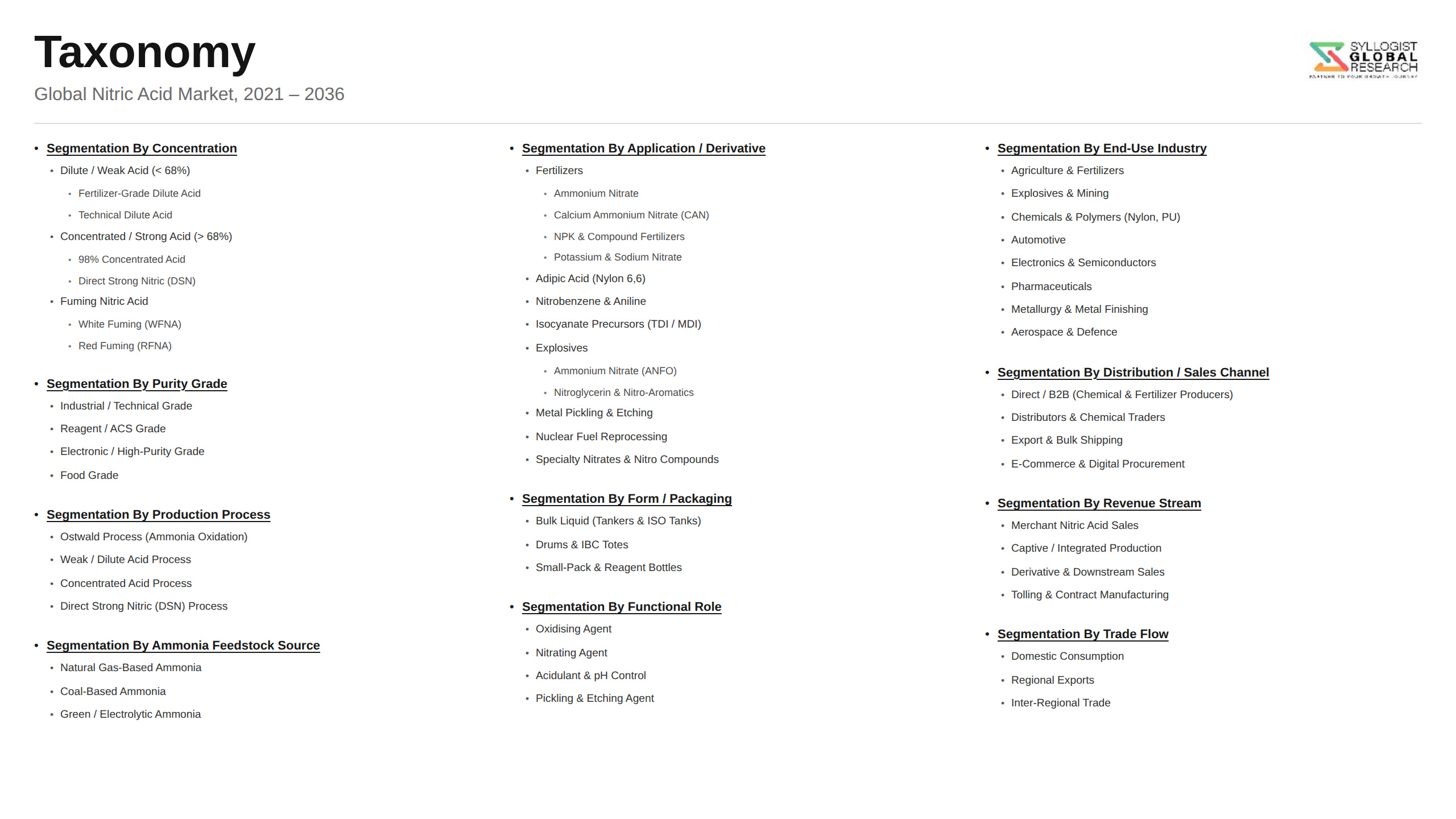
- Segmentation By Concentration
- Weak (Dilute) Nitric Acid
- Concentrated Nitric Acid
- Fuming Nitric Acid
- Segmentation By Production Process
- Single-Pressure Ostwald Process
- Dual-Pressure Ostwald Process
- High-Pressure Ostwald Process
- Segmentation By Application
- Ammonium Nitrate and Nitrate Fertilizers
- Explosives (Ammonium Nitrate-Based)
- Adipic Acid
- Toluene Diisocyanate and Isocyanates
- Nitrobenzene and Nitroaromatics
- Metal Pickling and Surface Treatment
- Electronics and Specialty Applications
- Others
- Segmentation By End User
- Fertilizers and Agriculture
- Explosives and Mining
- Chemical and Polymer Intermediates
- Metal Processing and Surface Treatment
- Electronics and Specialty Industries
- Others
- Segmentation By Region
- North America
- Europe
- Asia-Pacific
- Middle East and Africa
- Latin America
All market revenues are presented in USD
Historical Year: 2021-2024 | Base Year: 2025 | Estimated Year: 2026 | Forecast Period: 2027-2034
Key Questions this Study Will Answer
- What is the total global market valuation of the Nitric Acid Market in 2025, projected through 2034, segmented by concentration, production process, application, and end user, enabling nitric acid producers, fertilizer manufacturers, explosives producers, and chemical industry investors to identify highest-growth segments and the most durable revenue opportunities across the global nitric acid market?
- How are fertilizer producers, explosives manufacturers, chemical intermediate makers, and metal processors structuring nitric acid procurement, grade specification, and supplier qualification, and which commercial models, including integrated ammonia and nitric acid supply, merchant purchase, and long-term contracts, are shaping deployment economics within the nitric acid market through 2034?
- What nitrogen fertilizer demand, explosives consumption, and chemical intermediate growth trends are shaping the pace and geographic distribution of weak and concentrated nitric acid demand across mature and emerging markets within the nitric acid market?
- How are nitrous oxide abatement, green ammonia integration, and carbon reduction requirements, driven by tightening climate regulation, reshaping production economics, capacity investment, and lifecycle carbon intensity within the nitric acid market?
- How is the competitive structure organized among integrated ammonia and nitric acid producers, fertilizer manufacturers, explosives producers, and specialty chemical makers within the nitric acid market, and what integration, capacity expansion, acquisition, and emission-reduction strategies are enabling suppliers to defend and grow share across fertilizer, explosives, and intermediate segments?
- How are nitrous oxide and nitrogen oxide regulation, ammonia and natural gas price volatility, and ammonium nitrate safety and security restrictions reshaping production, sourcing, and compliance strategies across the nitric acid market?
- Which regional markets, including Asia-Pacific, North America, Europe, the Middle East and Africa, and Latin America, are projected to generate the largest incremental nitric acid demand through 2034, and what fertilizer demand, mining explosives consumption, chemical intermediate output, and emission regulation factors are shaping investment priorities and supplier selection decisions in each regional nitric acid market?
- Product Definition
- Research Methodology
- Research Design & Framework
- Overall Research Approach: Descriptive, Exploratory & Quantitative Mixed-Method Design
- Market Definition & Scope Boundaries: What is Included and Excluded
- Segmentation Framework
- Key Research Assumptions & Limitations
- Secondary Research
- Primary Research Design & Execution
- Data Triangulation & Validation
- Market Sizing & Forecasting Methodology
- Competitive Intelligence Methodology
- Quality Assurance & Peer Review
- Definitions, Abbreviations & Data Notes
- Executive Summary
- Market Snapshot & Headline Numbers
- Key Findings & Research Highlights
- Market Dynamics
- Regional Market Summary
- Competitive Landscape Snapshot
- Technology & Innovation Highlights
- Market Dynamics
- Drivers
- Restraints
- Opportunities
- Challenges
- Porter’s Five Forces Analysis
- PESTLE Analysis
- Market Trends & Developments
- Emerging Trends
- Technological Developments
- Regulatory & Policy Changes
- Supply Chain & Sourcing Trends
- Manufacturing & Process Trends
- Investment & Funding Activity
- Sustainability & ESG Trends
- Risk Assessment Framework
- Ammonia Feedstock Price Volatility & Nitric Acid Production Cost Escalation Risk
- Fertilizer Demand Cyclicality, Farm Economics & Volume Volatility Risk
- N2O and NOx Emission Regulation & Environmental Compliance Cost Risk
- Explosives-Grade Security, Dual-Use & Regulatory Restriction Risk
- Overcapacity, Import Competition & Merchant Margin Compression Risk
- Regulatory Framework & Standards
- Hazardous Chemical, Corrosive Substance & Transport (ADR/DOT) Standards
- N2O Greenhouse Gas, NOx Emission & Environmental Compliance Regulations
- Explosives Precursor, Security & Dual-Use Control Regulations
- Product Purity, Grade Specification & ISO Quality Standards
- Cross-Border Trade, REACH & Import-Export Compliance Frameworks
- Global Nitric Acid Market Outlook
- Market Size & Forecast by Value
- Market Size & Forecast by Volume (Nitric Acid Consumed in Million Tonnes per Year and Nameplate Production Capacity in Million Tonnes per Year)
- Market Size & Forecast by Grade
- Dilute (Weak) Nitric Acid
- Concentrated Nitric Acid
- Red Fuming Nitric Acid
- White Fuming Nitric Acid
- Others
- Market Size & Forecast by Production Process
- Single-Pressure Process
- Dual-Pressure Process
- High-Pressure Process
- Others
- Market Size & Forecast by Application
- Ammonium Nitrate
- Calcium Ammonium Nitrate (CAN)
- Adipic Acid
- Nitrobenzene and Aniline
- Toluene Diisocyanate (TDI)
- Explosives
- Metal Treatment and Pickling
- Nitrochlorobenzene
- Potassium Nitrate
- Others
- Market Size & Forecast by End-Use Industry
- Fertilizers and Agriculture
- Explosives and Mining
- Chemicals and Polymers
- Automotive and Transportation
- Electronics and Semiconductors
- Metallurgy and Metal Processing
- Pharmaceuticals
- Others
- Market Size & Forecast by Purity Grade
- Technical Grade
- Reagent (ACS) Grade
- Electronic Grade
- Others
- Market Size & Forecast by Packaging
- Bulk and Tanker
- Drums
- IBC Totes
- Carboys
- Others
- Market Size & Forecast by Feedstock Source
- Conventional Ammonia-Based
- Green Ammonia-Based
- Recycled and By-Product
- Others
- Market Size & Forecast by Sales Channel
- Direct Long-Term Supply Contract
- Merchant Spot Market
- Distributor and Trader Channel
- Integrated Captive Consumption
- Others
- North America Nitric Acid Market Outlook
- Market Size & Forecast
- By Value
- By Volume (Nitric Acid Consumed in Million Tonnes per Year and Nameplate Production Capacity in Million Tonnes per Year)
- By Grade
- By Production Process
- By Application
- By End-Use Industry
- By Purity Grade
- By Packaging
- By Feedstock Source
- By Country
- By Sales Channel
- Europe Nitric Acid Market Outlook
- Market Size & Forecast
- By Value
- By Volume (Nitric Acid Consumed in Million Tonnes per Year and Nameplate Production Capacity in Million Tonnes per Year)
- By Grade
- By Production Process
- By Application
- By End-Use Industry
- By Purity Grade
- By Packaging
- By Feedstock Source
- By Country
- By Sales Channel
- Asia-Pacific Nitric Acid Market Outlook
- Market Size & Forecast
- By Value
- By Volume (Nitric Acid Consumed in Million Tonnes per Year and Nameplate Production Capacity in Million Tonnes per Year)
- By Grade
- By Production Process
- By Application
- By End-Use Industry
- By Purity Grade
- By Packaging
- By Feedstock Source
- By Country
- By Sales Channel
- Latin America Nitric Acid Market Outlook
- Market Size & Forecast
- By Value
- By Volume (Nitric Acid Consumed in Million Tonnes per Year and Nameplate Production Capacity in Million Tonnes per Year)
- By Grade
- By Production Process
- By Application
- By End-Use Industry
- By Purity Grade
- By Packaging
- By Feedstock Source
- By Country
- By Sales Channel
- Middle East & Africa Nitric Acid Market Outlook
- Market Size & Forecast
- By Value
- By Volume (Nitric Acid Consumed in Million Tonnes per Year and Nameplate Production Capacity in Million Tonnes per Year)
- By Grade
- By Production Process
- By Application
- By End-Use Industry
- By Purity Grade
- By Packaging
- By Feedstock Source
- By Country
- By Sales Channel
- Country-Wise* Nitric Acid Market Outlook
- Market Size & Forecast
- By Value
- By Volume (Nitric Acid Consumed in Million Tonnes per Year and Nameplate Production Capacity in Million Tonnes per Year)
- By Grade
- By Production Process
- By Application
- By End-Use Industry
- By Purity Grade
- By Packaging
- By Feedstock Source
- By Country
- By Sales Channel
- Market Size & Forecast
- Market Size & Forecast
- Market Size & Forecast
- Market Size & Forecast
- Market Size & Forecast
- Market Size & Forecast
*Countries Analysed in the Global Research Portfolio: United States, Canada, Mexico, Germany, France, United Kingdom, Netherlands, Spain, Italy, Norway, Sweden, China, Japan, India, Australia, South Korea, Singapore, Brazil, Chile, Saudi Arabia, UAE, Egypt, South Africa, Israel
- Technology Landscape & Innovation Analysis
- Ostwald Process, Ammonia Oxidation & Nitric Acid Production Technology Deep-Dive
- Dual-Pressure & Energy-Optimised Nitric Acid Plant Technology
- N2O Abatement, Tertiary Catalyst & Emission Reduction Technology
- Concentrated and Fuming Nitric Acid Production Technology
- Green Ammonia, Electrified & Low-Carbon Nitric Acid Technology
- Platinum-Rhodium Gauze Catalyst & Recovery Technology
- Heat Recovery, Energy Integration & Plant Efficiency Technology
- Patent & IP Landscape in Nitric Acid Production Technologies
- Value Chain & Supply Chain Analysis
- Ammonia, Natural Gas & Feedstock Supply Chain
- Nitric Acid Production, Ammonia Oxidation & Absorption Supply Chain
- Concentration, Purification & Grade Separation Supply Chain
- Fertilizer (Ammonium Nitrate) & Derivative Producer Channel
- Explosives, Chemicals & Industrial Customer Channel
- Storage, Bulk Handling & Corrosive Chemical Logistics Network
- Merchant Trader, Distributor & Regional Supply Network
- Pricing Analysis
- Dilute Nitric Acid Pricing Across Contract & Spot Market Tiers
- Concentrated and Fuming Nitric Acid Pricing Differentials
- Ammonia Feedstock-Linked Pricing & Production Cost Economics
- Fertilizer-Grade vs Technical-Grade Pricing Analysis
- Electronic and Reagent Grade Premium Pricing Analysis
- Energy, Catalyst and Emission Cost Pass-Through Analysis
- Regional Pricing Benchmarks & Value-in-Use Pricing Models
- Sustainability & Environmental Analysis
- Lifecycle Assessment (LCA) of Nitric Acid Across Feedstock & Production
- N2O Abatement, Nitrous Oxide Reduction & Climate Impact Performance
- Green Ammonia, Electrified & Low-Carbon Nitric Acid Performance
- Catalyst Recovery, Precious Metal Reclaim & Circular Economy Performance
- Regulatory-Driven Sustainability, SDG 2 (Zero Hunger) & SDG 13 (Climate Action) Alignment & Green Finance Eligibility
- Competitive Landscape
- Market Structure & Concentration
- Market Consolidation Level (Fragmented vs. Consolidated by Grade & Geography)
- Top 10 Players Market Share
- HHI (Herfindahl-Hirschman Index) Concentration Analysis
- Competitive Intensity Map by Grade, Application & Geography
- Player Classification
- Integrated Fertilizer and Nitric Acid Producers
- Merchant Nitric Acid Producers
- Explosives and Ammonium Nitrate Producers
- Adipic Acid and Chemical Derivative Producers
- Electronic and High-Purity Grade Producers
- National and State-Owned Chemical Enterprises
- Regional and Independent Producers
- Merchant Traders and Distributors
- Competitive Analysis Frameworks
- Market Share Analysis by Grade, Application & Region
- Company Profile
- Company Overview & Headquarters
- Nitric Acid Production Portfolio & Capacity
- Key Customer Relationships & Reference Derivative Accounts
- Production Footprint & Nameplate Capacity Coverage
- Revenue (Nitric Acid Segment) & Offtake Contract Backlog
- Technology Differentiators & IP
- Key Strategic Partnerships, JVs & M&A Activity
- Recent Developments (Capacity Additions, Contract Wins, Project Launches)
- SWOT Analysis
- Strategic Focus Areas & Roadmap
- Competitive Positioning Map (Technology Capability vs. Market Penetration)
- Key Company Profiles
- Market Structure & Concentration
- Technology Landscape & Innovation Analysis
- Strategic Output
- Market Opportunity Matrix: By Grade, Production Process, Application, End-Use Industry & Geography
- White Space Opportunity Analysis
- Strategic Recommendations
- Production Portfolio & Technology Investment Strategy
- Operational Excellence & Capacity Expansion Strategy
- Geographic Expansion & Feedstock Localisation Strategy
- Customer & Derivative Account Engagement Strategy
- Partnership, M&A & Ecosystem Strategy
- Sustainability & Emission Reduction Strategy
- Risk Mitigation & Future Roadmap
- Strategic Priority Matrix & Roadmap
- Near-term (2025-2028)
- Mid-term (2029-2032)
- Long-term (2033-2037)