Global Propylene Glycol Market By Grade, By Source, By Application, By End User, By Region, Competition, Forecast & Opportunities, 2021-2034F
Market Definition
Propylene glycol is a colorless, nearly odorless, viscous diol with the chemical formula C3H8O2, valued for its low toxicity, high hygroscopicity, solvency, and its function as a humectant, emulsifier, heat transfer fluid, and reactive intermediate across food, pharmaceutical, cosmetic, and industrial formulations. The Global Propylene Glycol Market covers the production, distribution, and consumption of both industrial-grade and USP or pharmaceutical-grade propylene glycol produced through the hydration of propylene oxide as well as bio-based propylene glycol derived from glycerin and other renewable feedstocks. The propylene glycol market spans monopropylene glycol and dipropylene glycol grades supplied to unsaturated polyester resin manufacturing, functional fluids such as antifreeze, coolants, and aircraft de-icing fluids, liquid detergents and cleaners, paints and coatings, plasticizers, food and flavor carriers, oral and topical pharmaceutical formulations, personal care and cosmetic products, and pet food and animal feed applications. Market participants include propylene oxide producers, integrated glycol manufacturers, bio-based propylene glycol producers, specialty chemical distributors, and formulators that convert propylene glycol into finished consumer and industrial products. End users span the transportation and functional fluids industry, building and construction, food and beverage processing, pharmaceutical and healthcare manufacturing, personal care and cosmetics, and paints, coatings, and adhesives producers. The propylene glycol market excludes ethylene glycol, other polyol chemistries such as sorbitol and glycerin sold outside propylene glycol supply routes, and non-glycol solvents, concentrating on monopropylene and dipropylene glycol volumes that serve reactive, humectant, solvency, and functional fluid roles across regulated and industrial applications worldwide.
Market Insights
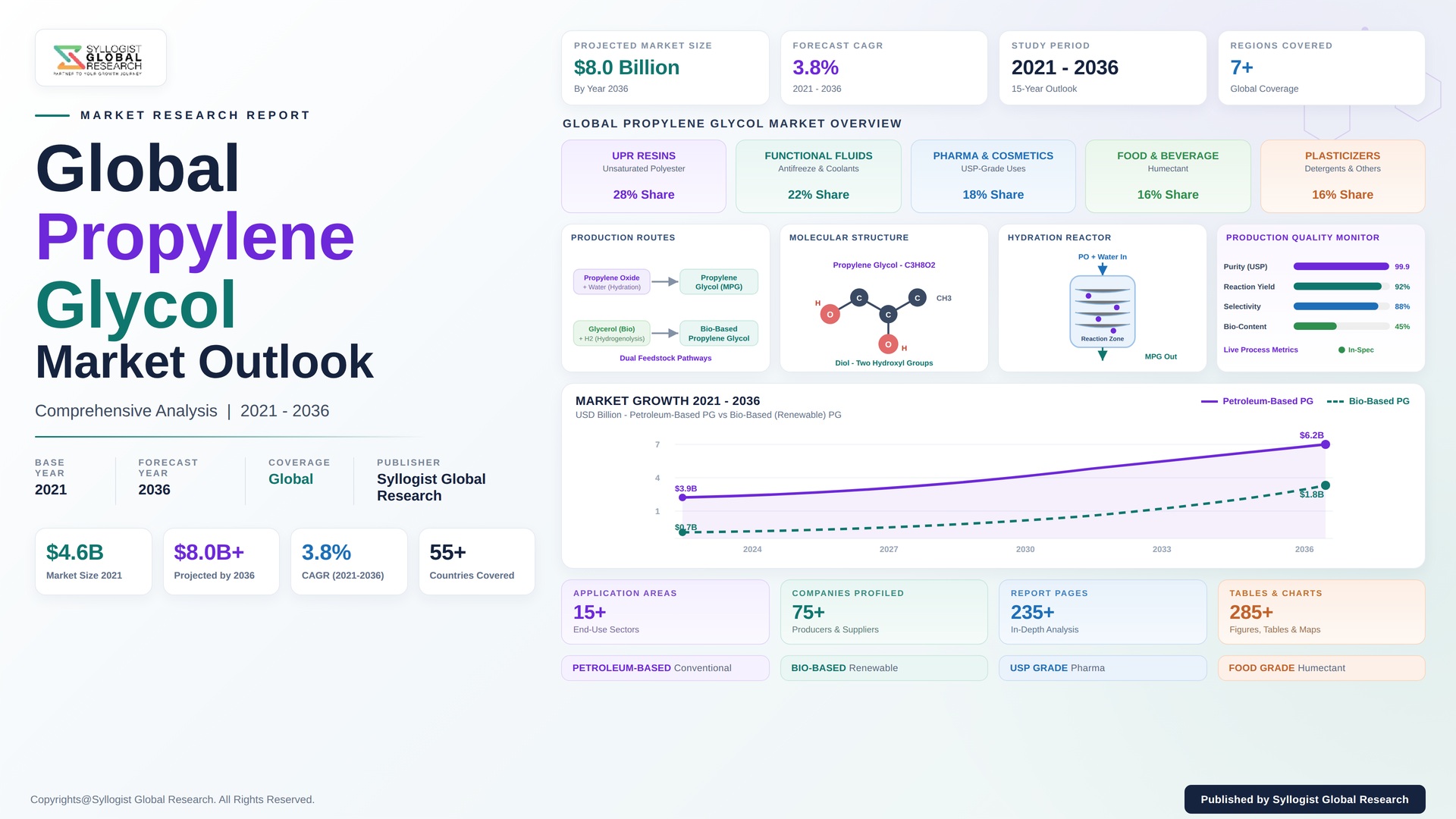
The global propylene glycol market is moving through a steady expansion phase, shaped by rising unsaturated polyester resin consumption in construction and marine composites, growing demand for non-toxic functional fluids, expanding pharmaceutical and food-grade requirements, and accelerating substitution toward bio-based propylene glycol driven by sustainability commitments across downstream brands. The global propylene glycol market was valued at USD 4.9 billion in 2025 and is projected to reach USD 7.6 billion by 2034, advancing at a compound annual growth rate of 5.1% through the forecast period, as resin producers, functional fluid formulators, food and beverage processors, pharmaceutical manufacturers, and personal care brands scale propylene glycol procurement across North America, Europe, Asia-Pacific, the Middle East, and Latin America.
The propylene glycol market trajectory is being reshaped by the commercial scaling of bio-based propylene glycol produced from glycerin and sugar-derived feedstocks, tightening food and pharmaceutical purity specifications, and the shift of functional fluid formulations toward low-toxicity propylene glycol grades in place of ethylene glycol. Bio-based propylene glycol now accounts for close to 12% of global capacity, with brand owners in food, personal care, and pet nutrition specifying renewable grades to meet sustainability targets and clean-label demand. Pharmaceutical and USP-grade propylene glycol is gaining share within the propylene glycol market, supported by expanding oral solution, topical, and injectable formulation volumes, with purity requirements exceeding 99.5% and tight controls on residual dipropylene glycol and diethylene glycol contamination following regulatory tightening across major pharmaceutical markets.
Unsaturated polyester resin remains the single largest application within the global propylene glycol market, sustained by construction, marine, automotive, and pipe and tank composite demand where propylene glycol serves as a core glycol building block. Functional fluids, including antifreeze, coolants, heat transfer fluids, and aircraft and runway de-icing fluids, form the fastest-growing application within the propylene glycol market, propelled by aviation traffic recovery, data center thermal management growth, and continued substitution away from toxic ethylene glycol in applications requiring human and environmental safety. Food, pharmaceutical, and personal care applications are gaining strategic procurement traction within the propylene glycol market, driven by humectant, solvent, and carrier demand across processed foods, flavors, oral care, cosmetics, and topical drug products, while industrial-grade monopropylene glycol continues to represent the largest volume grade within the propylene glycol market supported by resin and functional fluid consumption.
Asia-Pacific represents the largest regional market within the global propylene glycol market, supported by large propylene oxide and glycol capacity across China, sustained construction and composite resin demand, expanding food processing, and rapid growth of personal care and pharmaceutical manufacturing across China, India, South Korea, and Southeast Asia. China alone accounts for more than 40% of global propylene glycol consumption and continues to add integrated propylene oxide and glycol capacity. North America occupies the second regional position within the propylene glycol market, propelled by shale-advantaged propylene feedstock, strong functional fluid demand, aircraft de-icing consumption, and a mature pharmaceutical and food-grade base. Europe represents the third regional market within the propylene glycol market, anchored by specialty resin production, stringent food and pharmaceutical standards, and strong bio-based propylene glycol adoption, while the Middle East and Latin America form emerging positions within the propylene glycol market, driven by propylene oxide integration and rising downstream formulation demand.
Key Drivers
Rising Unsaturated Polyester Resin Demand From Construction, Marine, and Composite Applications Driving Core Monopropylene Glycol Consumption
Rising unsaturated polyester resin consumption across construction, marine, automotive, and composite pipe and tank applications is generating durable procurement demand for monopropylene glycol within the global propylene glycol market. Unsaturated polyester resin accounts for a large share of propylene glycol end use, where propylene glycol functions as an essential glycol building block that delivers rigidity, water resistance, and mechanical strength to cured composite parts. Global construction spending expanded steadily through 2025, lifting demand for glass-fiber reinforced composites in facades, sanitaryware, tanks, and infrastructure that consume resin-grade propylene glycol. Marine and wind energy composite manufacturing add a further demand layer, with fiberglass boat hulls and wind blade production requiring corrosion-resistant unsaturated polyester and vinyl ester resins built on propylene glycol chemistry. Automotive lightweighting and the substitution of metal parts with sheet molding compound and bulk molding compound composites further support resin-grade propylene glycol consumption. Because unsaturated polyester resin is deeply embedded across construction, transportation, and industrial value chains, it provides the propylene glycol market with a large, recurring baseline demand stream that is closely tied to global infrastructure investment and industrial output cycles, anchoring volume growth for integrated glycol producers and supporting steady capacity utilization across major propylene glycol manufacturing regions worldwide.
Expanding Non-Toxic Functional Fluid Demand in Antifreeze, De-Icing, and Thermal Management Applications Driving Substitution Away From Ethylene Glycol
Growing demand for low-toxicity functional fluids in antifreeze, coolants, aircraft and runway de-icing, and thermal management applications is driving sustained substitution toward propylene glycol in place of toxic ethylene glycol across the propylene glycol market. Propylene glycol is favored in applications where human, animal, and environmental safety is a priority, including food-grade heat transfer fluids, recreational vehicle and marine antifreeze, and cosmetic and pharmaceutical carriers, because of its low oral toxicity and favorable regulatory status. Aviation de-icing consumption is scaling with the recovery of global air traffic, with airports in cold-climate regions using large volumes of propylene glycol-based aircraft de-icing and anti-icing fluids that meet biodegradability and safety requirements. The rapid buildout of data centers is generating new demand for propylene glycol-based heat transfer and cooling fluids, as operators prioritize non-toxic, low-corrosion coolants for critical thermal management systems. Regulatory and consumer pressure to phase out ethylene glycol in consumer-facing and environmentally sensitive applications continues to shift formulation preference toward propylene glycol. Together, aviation recovery, data center growth, and non-toxic substitution trends secure a resilient and expanding functional fluid demand base that broadens propylene glycol consumption beyond traditional resin applications across every major region and supports steady grade-specific demand growth for producers serving safety-critical and environmentally sensitive end markets.
Growing Pharmaceutical, Food, and Personal Care Consumption Alongside Bio-Based Propylene Glycol Adoption Driven by Sustainability and Clean-Label Demand
Expanding pharmaceutical, food, and personal care consumption, together with accelerating adoption of bio-based propylene glycol, is driving high-value demand growth within the global propylene glycol market. Pharmaceutical-grade propylene glycol serves as a solvent and carrier in oral solutions, syrups, topical products, and injectable formulations, with demand rising alongside global pharmaceutical output and growing chronic disease treatment volumes. Food-grade propylene glycol functions as a humectant, solvent, and flavor carrier across processed foods, beverages, baked goods, and flavor concentrates, supported by expanding packaged food consumption in emerging economies. Personal care and cosmetic formulators use propylene glycol as a humectant and solvent in skincare, oral care, and hygiene products, a segment growing steadily with rising disposable income and premiumization. In parallel, brand owners are specifying bio-based propylene glycol produced from glycerin and renewable sugars to meet sustainability commitments, clean-label positioning, and carbon reduction targets, with renewable grades commanding premium pricing and expanding capacity investment. This convergence of regulated high-purity demand and sustainability -driven bio-based substitution raises the average value captured per tonne, diversifies the propylene glycol market beyond commodity industrial grades, and creates a durable, differentiation-led growth runway across consumer-facing applications worldwide, supporting premium grade demand and sustained capacity investment in high-purity and renewable propylene glycol production across major consuming regions.
Key Challenges
Propylene Oxide Feedstock Price Volatility and Propylene Value Chain Exposure Constraining Margin Stability Across the Propylene Glycol Market
Volatility in propylene oxide feedstock pricing, exposure to upstream propylene and crude oil value chains, and cyclical propylene oxide supply balances generate persistent margin instability that constrains the propylene glycol market. Propylene glycol production economics are tightly linked to propylene oxide, whose price moves with propylene, refinery and steam cracker operating rates, and crude oil, exposing producers to input cost swings that can exceed 30% within a single year. Propylene oxide is itself a co-product or dedicated-route chemical with concentrated global capacity, and unplanned outages or turnarounds at major propylene oxide plants can tighten propylene glycol supply and drive sharp price movements. Producers without upstream propylene oxide integration face particular margin pressure, as they must absorb feedstock volatility while competing against integrated players that capture value across the propylene-to-glycol chain. Currency movements and freight cost fluctuations add further complexity for producers and distributors serving cross-border propylene glycol demand. These dynamics complicate long-term contract pricing, raise working capital requirements, and constrain the ability of non-integrated producers to plan capacity investment with confidence, leaving margins in the propylene glycol market vulnerable to upstream petrochemical cycles and periodic feedstock supply disruptions across key producing regions, complicating capacity planning and pricing discipline for participants lacking full propylene-to-glycol integration.
Competition From Substitute Glycols and Alternative Chemistries in Price-Sensitive Industrial Applications Limiting Volume Capture
Competition from ethylene glycol, glycerin, and alternative humectant and solvent chemistries in price-sensitive industrial applications limits volume capture and pricing power within the propylene glycol market. In cost-driven applications where safety and toxicity are not binding constraints, ethylene glycol remains a cheaper glycol that competes directly with propylene glycol in antifreeze and functional fluid formulations, capping propylene glycol penetration where price is the primary selection criterion. Glycerin, which is often available as a low-cost biodiesel co-product, competes with propylene glycol as a humectant in personal care, food, and industrial applications, with glycerin price swings directly influencing formulator switching decisions. In unsaturated polyester resin, formulators can partially substitute propylene glycol with other glycols and diols depending on relative pricing and required resin properties, exposing resin-grade demand to substitution risk during periods of unfavorable propylene glycol pricing. This substitution flexibility across major applications constrains the ability of propylene glycol producers to pass through cost increases, compresses margins during periods of feedstock inflation, and requires suppliers to compete on integration, reliability, technical service, and grade differentiation rather than price alone, limiting the pace at which the propylene glycol market can expand volume in the most price-sensitive industrial segments across regions, keeping pricing power concentrated in safety-critical and regulated applications where substitution is limited by toxicity and purity requirements.
Tightening Pharmaceutical Purity Regulation, Contamination Risk, and Bio-Based Cost Premiums Adding Compliance and Adoption Complexity
Tightening pharmaceutical purity regulation, contamination and quality assurance risk, and the cost premium of bio-based grades add compliance and adoption complexity that constrains segments of the propylene glycol market. Regulatory scrutiny of pharmaceutical-grade propylene glycol has intensified following contamination incidents involving diethylene glycol and ethylene glycol impurities in oral medicines, prompting stricter testing, traceability, and supplier qualification requirements that raise compliance cost across the pharmaceutical supply chain. Producers serving USP and pharmaceutical markets must invest in analytical capability, documented quality systems, and contamination controls to maintain purity above 99.5% and to demonstrate consistent freedom from toxic glycol impurities. These requirements raise the barrier to entry for pharmaceutical-grade participation and expose the propylene glycol market to reputational and regulatory risk when quality failures occur anywhere in the value chain. Bio-based propylene glycol, while strategically important for sustainability positioning, typically carries a cost premium over conventional propylene oxide-derived grades, slowing adoption in price-sensitive applications and requiring brand-owner willingness to absorb higher input costs. The combined effect of stricter purity regulation, contamination liability, and bio-based cost premiums raises the cost and complexity of serving high-value, regulated, and sustainability-driven segments of the propylene glycol market across major consuming regions worldwide, requiring sustained investment in quality assurance, traceability, and renewable feedstock sourcing to compete in premium end markets.
Market Segmentation
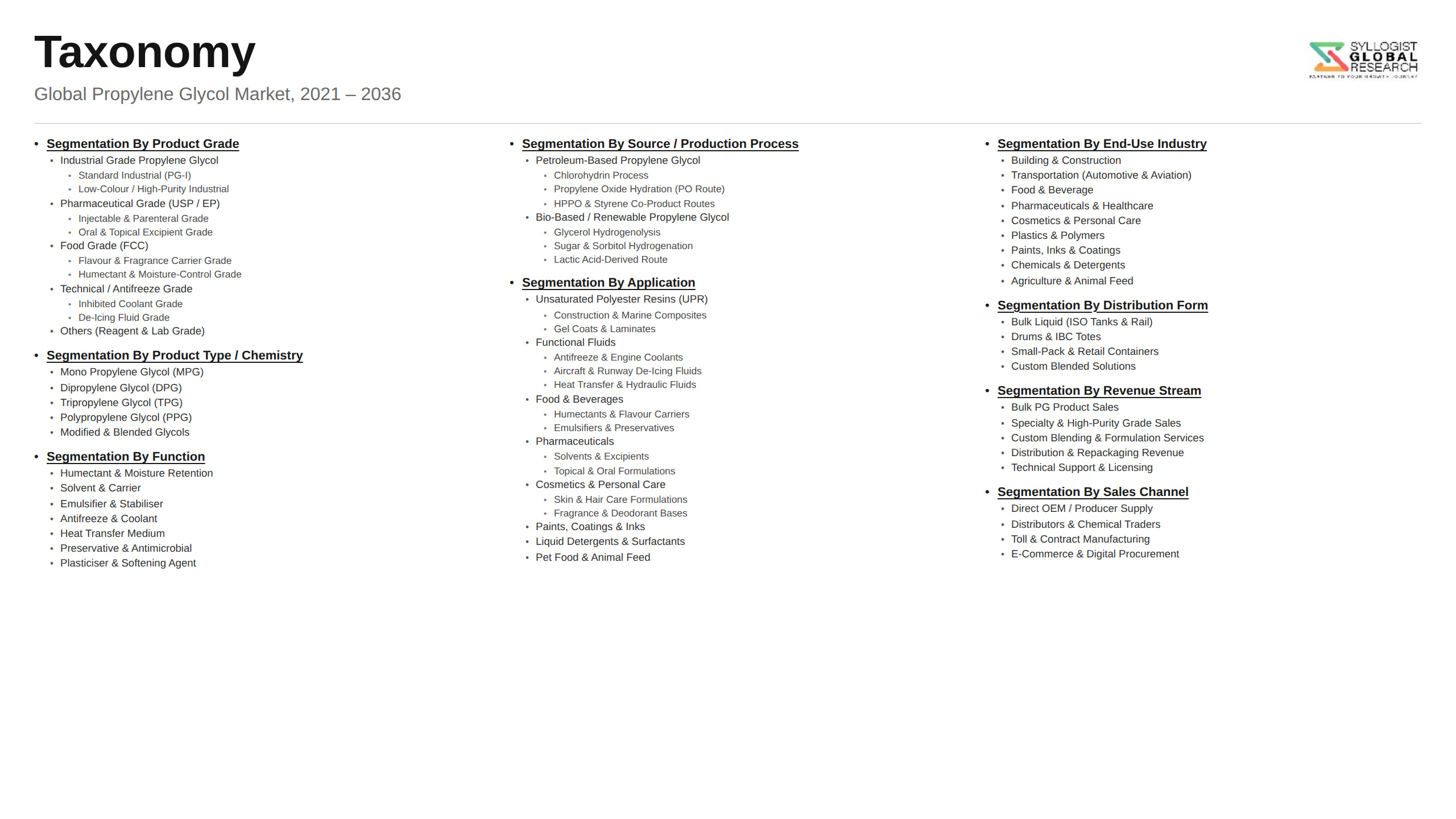
- Segmentation By Grade
- Industrial Grade
- Pharmaceutical and USP Grade
- Food Grade
- Segmentation By Product
- Monopropylene Glycol
- Dipropylene Glycol
- Segmentation By Source
- Petroleum-Based (Propylene Oxide Derived)
- Bio-Based (Glycerin and Renewable Feedstock Derived)
- Segmentation By Application
- Unsaturated Polyester Resins
- Functional Fluids (Antifreeze, Coolants, De-Icing, Heat Transfer)
- Food and Beverage
- Pharmaceuticals
- Cosmetics and Personal Care
- Liquid Detergents
- Paints and Coatings
- Plasticizers
- Others
- Segmentation By End User
- Transportation and Functional Fluids
- Building and Construction
- Food and Beverage Processing
- Pharmaceutical and Healthcare
- Personal Care and Cosmetics
- Paints, Coatings, and Adhesives
- Others
- Segmentation By Region
- North America
- Europe
- Asia-Pacific
- Middle East and Africa
- Latin America
All market revenues are presented in USD
Historical Year: 2021-2024 | Base Year: 2025 | Estimated Year: 2026 | Forecast Period: 2027-2034
Key Questions this Study Will Answer
- What is the total global market valuation of the Propylene Glycol Market in 2025, projected through 2034, segmented by grade, source, application, and end user, enabling propylene glycol producers, resin manufacturers, functional fluid formulators, and chemical industry investors to identify highest-growth segments and the most durable revenue opportunities across the global propylene glycol market?
- How are resin producers, functional fluid formulators, food and pharmaceutical manufacturers, and personal care brands structuring propylene glycol procurement, grade specification, and supplier qualification, and which commercial models, including integrated propylene oxide supply, merchant purchase, and long-term contracts, are shaping deployment economics within the propylene glycol market through 2034?
- What construction activity, composite resin demand, aviation de-icing, and data center thermal management trends are shaping the pace and geographic distribution of industrial and functional fluid propylene glycol demand across mature and emerging markets within the propylene glycol market?
- How is bio-based propylene glycol adoption, driven by sustainability commitments, clean-label demand, and carbon reduction targets, reshaping capacity investment, grade differentiation, and pricing across food, pharmaceutical, personal care, and pet nutrition applications within the propylene glycol market?
- How is the competitive structure organized among propylene oxide producers, integrated glycol manufacturers, bio-based propylene glycol producers, and specialty distributors within the propylene glycol market, and what integration, capacity expansion, acquisition, and sustainability-linked strategies are enabling suppliers to defend and grow share across industrial, food, and pharmaceutical segments?
- How are propylene oxide feedstock volatility, substitute glycol competition, pharmaceutical purity regulation, and bio-based cost premiums reshaping sourcing, formulation, and margin management strategies across the propylene glycol market?
- Which regional markets, including Asia-Pacific, North America, Europe, the Middle East, and Latin America, are projected to generate the largest incremental propylene glycol demand through 2034, and what resin consumption, functional fluid growth, food and pharmaceutical output, and bio-based adoption factors are shaping investment priorities and supplier selection decisions in each regional propylene glycol market?
- Product Definition
- Research Methodology
- Research Design & Framework
- Overall Research Approach: Descriptive, Exploratory & Quantitative Mixed-Method Design
- Market Definition & Scope Boundaries: What is Included and Excluded
- Segmentation Framework
- Key Research Assumptions & Limitations
- Secondary Research
- Primary Research Design & Execution
- Data Triangulation & Validation
- Market Sizing & Forecasting Methodology
- Competitive Intelligence Methodology
- Quality Assurance & Peer Review
- Definitions, Abbreviations & Data Notes
- Executive Summary
- Market Snapshot & Headline Numbers
- Key Findings & Research Highlights
- Market Dynamics
- Regional Market Summary
- Competitive Landscape Snapshot
- Technology & Innovation Highlights
- Market Dynamics
- Drivers
- Restraints
- Opportunities
- Challenges
- Porter’s Five Forces Analysis
- PESTLE Analysis
- Market Trends & Developments
- Emerging Trends
- Technological Developments
- Regulatory & Policy Changes
- Supply Chain & Sourcing Trends
- Manufacturing & Process Trends
- Investment & Funding Activity
- Sustainability & ESG Trends
- Risk Assessment Framework
- Feedstock Price Volatility (Propylene Oxide and Glycerol), Petrochemical Margin Compression & Raw Material Supply Risk
- Pharmaceutical Grade Compliance (USP and EP), Food-Contact Approval & Product Quality Assurance Risk
- Bio-Based versus Petro-Based Route Competition, Renewable Feedstock Availability & Cost Parity Risk
- Capacity Overbuild, Trade Tariff Exposure & Regional Price War Risk
- Product Substitution (Ethylene Glycol and Bio-Glycols), Toxicity Perception & End-Use Demand Shift Risk
- Regulatory Framework & Standards
- United States Pharmacopeia (USP) and European Pharmacopoeia (EP) Grade Standards for Pharmaceutical Propylene Glycol
- FDA GRAS Status, Food-Grade Specifications & Food-Contact Compliance Frameworks
- REACH Registration, GHS Classification & Chemical Safety Data Sheet Requirements
- Industrial-Grade Specifications, Heat-Transfer Fluid & Automotive/Aircraft Antifreeze Standards
- Bio-Based Content Certification, Sustainability Labelling & Renewable Feedstock Standards
- Global Propylene Glycol Market Outlook
- Market Size & Forecast by Value
- Market Size & Forecast by Volume (Kilotons Consumed per Year and Production Capacity Utilisation per Year)
- Market Size & Forecast by Grade
- Industrial Grade
- Pharmaceutical / USP Grade
- Food Grade
- Others
- Market Size & Forecast by Source & Feedstock
- Petroleum-Based (Propylene Oxide Route)
- Bio-Based (Renewable Glycerol & Sugar Route)
- Market Size & Forecast by Application
- Unsaturated Polyester Resins
- Functional Fluids (Antifreeze & Coolants)
- Pharmaceuticals & Personal Care
- Food & Beverages
- Cosmetics
- Paints & Coatings
- Liquid Detergents
- Plasticizers
- Others
- Market Size & Forecast by End-Use Industry
- Automotive & Transportation
- Building & Construction
- Food & Beverage
- Pharmaceuticals & Healthcare
- Cosmetics & Personal Care
- Plastics & Composites
- Chemicals
- Others
- Market Size & Forecast by Function
- Solvent
- Humectant
- Emulsifier & Stabiliser
- Heat-Transfer & Antifreeze Fluid
- Preservative & Moisturiser
- Others
- Market Size & Forecast by Product Variant
- Mono Propylene Glycol
- Dipropylene Glycol
- Tripropylene Glycol
- Market Size & Forecast by Sales Channel
- Direct & B2B Bulk Supply
- Distributors & Chemical Traders
- Online & Specialty Channels
- Aftermarket Service & Compliance Documentation Contracts
- North America Propylene Glycol Market Outlook
- Market Size & Forecast
- By Value
- By Volume (Kilotons Consumed per Year and Production Capacity Utilisation per Year)
- By Grade
- By Source & Feedstock
- By Application
- By End-Use Industry
- By Function
- By Product Variant
- By Country
- By Sales Channel
- Europe Propylene Glycol Market Outlook
- Market Size & Forecast
- By Value
- By Volume (Kilotons Consumed per Year and Production Capacity Utilisation per Year)
- By Grade
- By Source & Feedstock
- By Application
- By End-Use Industry
- By Function
- By Product Variant
- By Country
- By Sales Channel
- Asia-Pacific Propylene Glycol Market Outlook
- Market Size & Forecast
- By Value
- By Volume (Kilotons Consumed per Year and Production Capacity Utilisation per Year)
- By Grade
- By Source & Feedstock
- By Application
- By End-Use Industry
- By Function
- By Product Variant
- By Country
- By Sales Channel
- Latin America Propylene Glycol Market Outlook
- Market Size & Forecast
- By Value
- By Volume (Kilotons Consumed per Year and Production Capacity Utilisation per Year)
- By Grade
- By Source & Feedstock
- By Application
- By End-Use Industry
- By Function
- By Product Variant
- By Country
- By Sales Channel
- Middle East & Africa Propylene Glycol Market Outlook
- Market Size & Forecast
- By Value
- By Volume (Kilotons Consumed per Year and Production Capacity Utilisation per Year)
- By Grade
- By Source & Feedstock
- By Application
- By End-Use Industry
- By Function
- By Product Variant
- By Country
- By Sales Channel
- Country-Wise* Propylene Glycol Market Outlook
- Market Size & Forecast
- By Value
- By Volume (Kilotons Consumed per Year and Production Capacity Utilisation per Year)
- By Grade
- By Source & Feedstock
- By Application
- By End-Use Industry
- By Function
- By Product Variant
- By Country
- By Sales Channel
- Market Size & Forecast
- Market Size & Forecast
- Market Size & Forecast
- Market Size & Forecast
- Market Size & Forecast
- Market Size & Forecast
*Countries Analysed in the Global Research Portfolio: United States, Canada, Mexico, Germany, France, United Kingdom, Netherlands, Spain, Italy, Norway, Sweden, China, Japan, India, Australia, South Korea, Singapore, Brazil, Chile, Saudi Arabia, UAE, Egypt, South Africa, Israel
- Technology Landscape & Innovation Analysis
- Propylene Oxide Hydration & Catalytic Conversion Process Technology Deep-Dive
- Bio-Based Propylene Glycol via Glycerol Hydrogenolysis Technology
- Renewable Feedstock Routes (Sugar, Corn and Cellulosic Biomass) Process Technology
- Catalyst Innovation, Selectivity Improvement & Yield Optimisation Technology
- Process Intensification, Energy Efficiency & Emissions Reduction Technology
- Purification, Distillation & Grade Separation Technology
- Green Chemistry, Circular Feedstock & CO2-to-Glycol Emerging Technology
- Patent & IP Landscape in Propylene Glycol Production Technologies
- Value Chain & Supply Chain Analysis
- Propylene Oxide, Glycerol & Renewable Feedstock Supply Chain
- Producer, Refiner & Chemical Manufacturer Supply Chain
- Bulk Storage, Tank Terminal & Logistics Supply Chain
- Distributor, Trader & Specialty Chemical Channel
- Formulator, Compounder & Downstream Processor Network
- End-Use Customer Channel (Automotive, Food, Pharmaceutical, Cosmetics, Construction)
- Aftermarket, Recycling & Spent Glycol Recovery Network
- Pricing Analysis
- Propylene Glycol Pricing Across Industrial, Pharmaceutical & Food Grades
- Petro-Based versus Bio-Based Propylene Glycol Price Comparison & Cost Parity Analysis
- Feedstock-Linked Pricing: Propylene Oxide & Glycerol Cost Pass-Through Analysis
- Regional Price Benchmarking Across North America, Europe & Asia-Pacific
- Contract versus Spot Pricing Dynamics & Bulk Volume Discount Structures
- Dipropylene & Tripropylene Glycol Co-Product Pricing Economics
- Total Cost Economics, Margin Analysis & Price Forecast Across Grades
- Sustainability & Environmental Analysis
- Lifecycle Assessment (LCA) of Propylene Glycol Across Petro-Based & Bio-Based Production Routes
- Renewable Feedstock Adoption, Bio-Based Content & Carbon Footprint Reduction
- Process Energy Efficiency, Water Use & Emissions Performance
- Product Biodegradability, Low-Toxicity Profile & Environmental Fate
- Regulatory-Driven Sustainability, SDG 12 (Responsible Consumption) & SDG 13 (Climate Action) Alignment & Green Finance Eligibility
- Competitive Landscape
- Market Structure & Concentration
- Market Consolidation Level (Fragmented vs. Consolidated by Grade & Geography)
- Top 10 Players Market Share
- HHI (Herfindahl-Hirschman Index) Concentration Analysis
- Competitive Intensity Map by Grade, Application & Geography
- Player Classification
- Integrated Petrochemical Producers
- Bio-Based & Renewable Propylene Glycol Producers
- Specialty Chemical Manufacturers
- Regional & Merchant Producers
- Distributors & Chemical Traders
- Downstream Formulators & Compounders
- Competitive Analysis Frameworks
- Market Share Analysis by Grade, Application & Region
- Company Profile
- Company Overview & Headquarters
- Propylene Glycol Product Portfolio
- Key Customer Relationships & Reference Accounts
- Manufacturing Footprint & Production Capacity
- Revenue (Propylene Glycol Segment) & Capacity Utilisation
- Technology Differentiators & IP
- Key Strategic Partnerships, JVs & M&A Activity
- Recent Developments (Capacity Expansion, New Grades, Contract Wins)
- SWOT Analysis
- Strategic Focus Areas & Roadmap
- Competitive Positioning Map (Technology Capability vs. Market Penetration)
- Key Company Profiles
- Market Structure & Concentration
- Technology Landscape & Innovation Analysis
- Strategic Output
- Market Opportunity Matrix: By Grade, Source, Application, End-User & Geography
- White Space Opportunity Analysis
- Strategic Recommendations
- Product Portfolio & Technology Investment Strategy
- Operational Excellence & Capacity Expansion Strategy
- Geographic Expansion & Localisation Strategy
- Customer & Account Engagement Strategy
- Partnership, M&A & Ecosystem Strategy
- Sustainability & Circular Economy Strategy
- Risk Mitigation & Future Roadmap
- Strategic Priority Matrix & Roadmap
- Near-term (2025-2028)
- Mid-term (2029-2032)
- Long-term (2033-2037)