Global Specialty Gas Chemicals Market By Gas Type, By Purity Grade, By Application, By Delivery Mode, By Function, By End User Industry, By Region, Competition, Forecast & Opportunities, 2021-2034F
Market Definition
Specialty gas chemicals are high-purity, controlled-composition gases and gas mixtures manufactured to exacting specifications and tolerances supporting advanced manufacturing, analytical instrumentation, healthcare, and research applications across semiconductor and display fabrication, solar photovoltaic production, laser and lighting manufacturing, environmental monitoring, calibration standards, and clinical and laboratory operations. The Global Specialty Gas Chemicals Market encompasses the synthesis, purification, blending, cylinder filling, bulk distribution, and on-site generation of electronic-grade gases, ultra-high purity gases, calibration mixtures, medical specialty gases, laser gases, lighting gases, and specialty fluorocarbon gases delivered to demanding industrial and scientific end users with tightly controlled purity specifications, certified compositions, and validated supply continuity globally.
The specialty gas chemicals market includes electronic specialty gases such as silane, disilane, ammonia, nitrogen trifluoride, tungsten hexafluoride, fluorine, chlorine, hydrogen chloride, boron trichloride, phosphine, and arsine, alongside calibration and analytical gas mixtures, specialty medical gases, laser excimer gas mixtures, lighting gases including xenon, krypton, and neon, and high-purity rare and noble gases. Market participants include integrated industrial gas companies operating dedicated specialty gas production capacity, electronic specialty gas specialists, calibration gas formulators, on-site gas generation system providers, cylinder distribution operators, and end-user industries spanning semiconductor fabrication, display panel production, solar photovoltaic manufacturing, healthcare diagnostics, environmental monitoring laboratories, and research institutions. The specialty gas chemicals market also covers value-added services including ultra-high purity certification, custom calibration mixture formulation, on-site generator installation, cylinder management programs, and regulatory compliance documentation. The scope explicitly excludes bulk industrial gases including atmospheric oxygen, nitrogen, and argon supplied for general industrial applications without specialty purity certification, focusing exclusively on high-purity and certified-composition gas products globally.
Market Insights
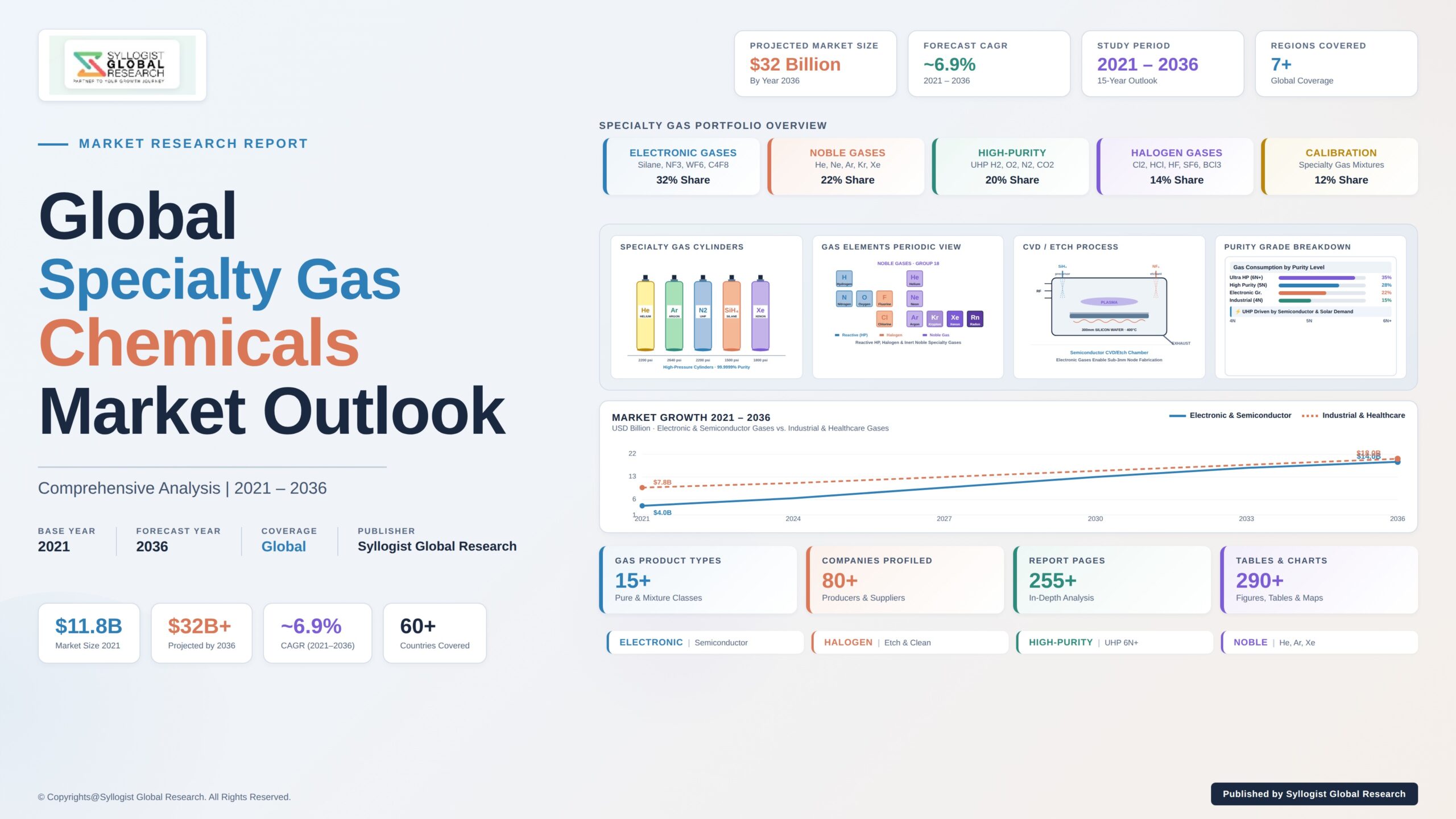
The global specialty gas chemicals market is undergoing a structural growth phase, shaped by accelerating global semiconductor manufacturing capacity expansion, sustained display panel production investment in Asia-Pacific, growing solar photovoltaic manufacturing capacity additions, tightening analytical and environmental monitoring compliance frameworks driving calibration gas procurement, and intensifying healthcare specialty gas consumption supporting diagnostic, anesthetic, and therapeutic applications. The specialty gas chemicals market was valued at approximately USD 14.5 billion in 2025 and is projected to reach USD 29.7 billion by 2034, advancing at a compound annual growth rate of 8.3% through the forecast period, as semiconductor fabricators, display panel manufacturers, solar PV producers, healthcare operators, and analytical laboratory operators scale specialty gas procurement across mature and emerging manufacturing operating regions globally.
The specialty gas chemicals market trajectory is being reshaped by the structural expansion of advanced semiconductor manufacturing capacity, accelerating procurement of ultra-high purity electronic specialty gases at 8N (99.999999%) and 9N (99.9999999%) purity grades, sustained transition toward larger 300-millimeter and emerging 450-millimeter wafer processing platforms, and growing demand for low global warming potential alternatives to traditional fluorinated electronic gases. The CHIPS and Science Act in the United States, the European Chips Act, China’s national semiconductor self-sufficiency programs, and Japan, Korea, and Taiwan manufacturing capacity investment are collectively driving over USD 500 billion of announced semiconductor fabrication capital investment through 2030, generating substantial multi-year specialty gas chemicals procurement commitments. Electronic specialty gas consumption per fab has scaled by over 35% with the transition to advanced nodes below 5 nanometers, propelled by additional deposition, etch, and clean process steps that elevate specialty gas consumption intensity within the specialty gas chemicals market.
Electronic specialty gases represent the largest application segment within the specialty gas chemicals market, propelled by sustained demand from semiconductor wafer fabrication, display panel manufacturing, and solar photovoltaic production requiring ultra-high purity reactive gases including silane, ammonia, nitrogen trifluoride, tungsten hexafluoride, hydrogen chloride, and specialty fluorocarbons. Calibration gas mixtures represent the second largest segment within the specialty gas chemicals market, supported by sustained demand from environmental monitoring, industrial emissions compliance, occupational health monitoring, and analytical instrumentation calibration applications globally. Semiconductor and display manufacturing represents the largest end-user segment within the specialty gas chemicals market, while solar photovoltaic manufacturing represents the fastest-growing end-user segment, propelled by accelerating global PV capacity additions and the transition toward higher-efficiency cell architectures including tunnel oxide passivated contact (TOPCon) and heterojunction technology (HJT) cells that require specialty gas-intensive deposition processes.
Asia-Pacific represents the largest regional market within the specialty gas chemicals market, anchored by extensive semiconductor fabrication capacity in Taiwan, South Korea, China, and Japan, sustained display panel manufacturing in China and South Korea, accelerating solar photovoltaic manufacturing capacity in China, and growing healthcare specialty gas consumption across the region. China hosts the largest concentration of semiconductor capacity additions globally, supported by sustained national semiconductor self-sufficiency investment programs and continued domestic specialty gas production capacity scaling. North America represents the second largest regional position within the specialty gas chemicals market, propelled by CHIPS Act-supported semiconductor fab construction in Arizona, Texas, Ohio, and New York, sustained healthcare specialty gas consumption, and accelerating calibration gas procurement supporting environmental monitoring frameworks. Europe occupies the third major regional position within the specialty gas chemicals market, shaped by European Chips Act-supported semiconductor capacity investment in Germany and the Netherlands, mature healthcare specialty gas consumption, and stringent environmental monitoring regulation driving calibration gas mixture procurement globally.
Key Drivers
Global Semiconductor Manufacturing Capacity Expansion, CHIPS Act-Supported Fab Construction, and Advanced Node Transition Driving Electronic Specialty Gas Procurement
The structural expansion of global semiconductor manufacturing capacity, accelerating CHIPS Act-supported fab construction in the United States and Europe, sustained capacity investment programs in Asia-Pacific, and continued transition toward advanced semiconductor process nodes are collectively driving sustained procurement of electronic specialty gases within the specialty gas chemicals market across major semiconductor manufacturing operating regions. Global cumulative semiconductor fabrication capital investment commitments exceeded USD 500 billion through 2030, with the United States CHIPS and Science Act providing approximately USD 52 billion in semiconductor manufacturing incentives, the European Chips Act mobilizing over EUR 43 billion in public and private semiconductor investment, and Korean, Taiwanese, and Japanese national programs adding substantial additional manufacturing capacity commitments. Electronic specialty gas consumption per semiconductor fab has scaled by over 35% with the transition to advanced nodes below 5 nanometers, propelled by additional deposition, etch, and clean process steps that elevate specialty gas consumption intensity within the specialty gas chemicals market. Major specialty gas suppliers are structuring multi-year electronic specialty gas supply commitments aligning capacity scaling with fab commissioning timelines, generating long-duration revenue commitments that anchor producer capacity scaling decisions across the specialty gas chemicals market value chain globally and reinforcing sustained capital investment in dedicated electronic gas production capacity, purification systems, and bulk gas distribution infrastructure.
Solar Photovoltaic Manufacturing Capacity Buildout, TOPCon and Heterojunction Technology Transition, and Renewable Energy Investment Driving Specialty Gas Procurement
The structural expansion of global solar photovoltaic manufacturing capacity, accelerating transition toward higher-efficiency cell architectures including tunnel oxide passivated contact (TOPCon) and heterojunction technology (HJT) cells, and sustained renewable energy investment globally are driving sustained procurement of specialty gases within the specialty gas chemicals market across solar manufacturing operating regions. Global cumulative solar photovoltaic capacity additions exceeded 350 gigawatts in 2024 and continue to scale at compound annual rates above 12% through 2030 as nations pursue energy transition commitments, decarbonization mandates, and renewable portfolio expansion targets. The transition from conventional PERC cells toward TOPCon and HJT architectures has materially elevated specialty gas consumption intensity per gigawatt of manufacturing capacity, propelled by additional silane, ammonia, and specialty deposition gas processes required for the advanced passivation, contact, and transparent conductive layer formation steps unique to these higher-efficiency cell architectures within the specialty gas chemicals market. China hosts the largest concentration of solar photovoltaic manufacturing capacity globally, supplemented by emerging manufacturing capacity in Vietnam, Malaysia, India, and the United States. Specialty gas suppliers are structuring multi-year supply commitments aligning specialty gas chemicals capacity with solar PV manufacturer expansion timelines, generating durable revenue commitments and reinforcing continued capital deployment toward electronic specialty gas production capacity scaling.
Environmental Monitoring Compliance, Healthcare Specialty Gas Procurement, and Analytical Instrumentation Calibration Mandates Driving Calibration and Medical Gas Demand
Tightening environmental monitoring compliance frameworks, sustained healthcare specialty gas procurement supporting diagnostic and therapeutic applications, and expanding analytical instrumentation calibration mandates are collectively driving sustained procurement of calibration gas mixtures, medical specialty gases, and laboratory analytical gases within the specialty gas chemicals market globally. Environmental monitoring compliance frameworks including the United States Clean Air Act, European Union Industrial Emissions Directive, China Ecological and Environmental Monitoring Network expansion, and the Continuous Emissions Monitoring System (CEMS) requirements across major industrial operating regions generate sustained procurement of calibration gas mixtures supporting stack emissions monitoring, ambient air quality monitoring, and occupational exposure assessment within the specialty gas chemicals market. Healthcare specialty gas procurement, including medical-grade nitrous oxide, helium-oxygen mixtures, nitric oxide, and specialty inhaled diagnostic and therapeutic gases, continues to scale across mature and emerging healthcare operating regions supporting anesthesia, neonatal intensive care, respiratory therapy, and diagnostic imaging applications. Analytical instrumentation calibration mandates supporting gas chromatography, mass spectrometry, and emerging laboratory instrumentation platforms generate sustained calibration gas mixture procurement across pharmaceutical, petrochemical, food and beverage, and environmental laboratory applications, reinforcing diversified demand patterns across the specialty gas chemicals market value chain globally.
Key Challenges
High Capital Intensity of Ultra-High Purity Production, Specialized Cylinder and Distribution Infrastructure Costs, and Customer-Specific Qualification Requirements
The specialty gas chemicals market continues to face material capital intensity for ultra-high purity production capacity, sustained specialized cylinder and distribution infrastructure costs, and customer-specific qualification requirements that collectively constrain market entry, elevate per-customer commercial development cost, and challenge operational scaling decisions across producers globally. Ultra-high purity electronic specialty gas production capacity requires sustained capital investment in dedicated synthesis reactors, multi-stage purification systems, in-line analytical instrumentation, and contamination-controlled filling environments, with new ultra-high purity production facilities typically requiring USD 50 million to USD 250 million in capital deployment per facility within the specialty gas chemicals market. Specialized cylinder and distribution infrastructure costs add further capital burden, with electronic specialty gas cylinders requiring corrosion-resistant materials, electropolished surfaces, dedicated valve assemblies, and validated cleaning protocols that elevate per-cylinder capital cost relative to general industrial gas cylinders. Customer-specific qualification requirements across semiconductor fabs, display manufacturers, and pharmaceutical manufacturers require extensive supply qualification, audit programs, and continuous quality monitoring documentation, with new supplier qualification timelines routinely extending 12 to 24 months across major specialty gas chemicals customers. The combined effect of capital intensity, specialized infrastructure costs, and customer-specific qualification requirements continues to constrain new entry, elevate per-customer commercial development cost, and reinforce structural advantages held by incumbent specialty gas chemicals producers globally.
F-Gas Phasedown Regulations, Global Warming Potential Restrictions, and Low-GWP Alternative Development Pressure Affecting Fluorinated Specialty Gas Producers
The specialty gas chemicals market continues to face F-gas phasedown regulations across mature operating regions, expanding global warming potential (GWP) restrictions affecting fluorinated specialty gases, and sustained low-GWP alternative development pressure that collectively constrain product portfolio breadth and require ongoing reformulation and substitute development investment across producers globally. The European Union F-Gas Regulation, United States American Innovation and Manufacturing (AIM) Act, and emerging Asian fluorinated gas restriction frameworks impose progressive phasedown schedules for high-GWP hydrofluorocarbons, sulfur hexafluoride, and select fluorinated specialty gases used across semiconductor manufacturing, refrigeration, and electrical insulation applications within the specialty gas chemicals market. Nitrogen trifluoride, sulfur hexafluoride, and select fluorocarbon etching and cleaning gases face sustained regulatory scrutiny driven by elevated atmospheric warming potential, with major semiconductor and display manufacturers committing to scope 3 emissions reduction targets that drive procurement preference toward lower-GWP alternative chemistries. Specialty gas chemicals producers are investing substantial research and development capital in low-GWP alternative gas development, abatement system optimization, and process emissions reduction support, but the multi-year development timelines and customer-specific qualification requirements governing alternative chemistry adoption continue to constrain the pace at which low-GWP alternatives can be commercialized within the specialty gas chemicals market value chain globally.
Toxic Gas Handling Risks, Regulatory Compliance Complexity, and Cross-Border Hazardous Material Transport Constraints Affecting Supply Chain Operations
The specialty gas chemicals market continues to confront sustained toxic gas handling risks, regulatory compliance complexity governing storage, transport, and end-user handling, and cross-border hazardous material transport constraints that collectively elevate operational risk, complicate cross-border supply commitments, and increase per-unit logistics and compliance cost across producers globally. Electronic specialty gases including silane, phosphine, arsine, hydrogen sulfide, and fluorinated gases present material toxicity, pyrophoric, and reactive hazards requiring dedicated transport packaging, certified driver training, sealed cylinder cabinets, gas detection monitoring, and emergency response protocols across producer facilities, transit routes, and customer use sites within the specialty gas chemicals market. Regulatory compliance complexity governing toxic gas storage limits, occupational exposure standards, hazardous material transport classifications under the United Nations Globally Harmonized System, the United States Department of Transportation, the European ADR framework, and emerging Asia-Pacific dangerous goods transport regulations requires producers to maintain region-specific transport licenses, packaging configurations, and emergency response protocols. Cross-border hazardous material transport constraints, including customs documentation requirements, certified packaging requirements, and route restrictions limiting tunnel and ferry transit options for certain specialty gas chemicals consignments, add further administrative burden and elevate per-shipment logistics cost across the specialty gas chemicals market value chain globally.
Market Segmentation
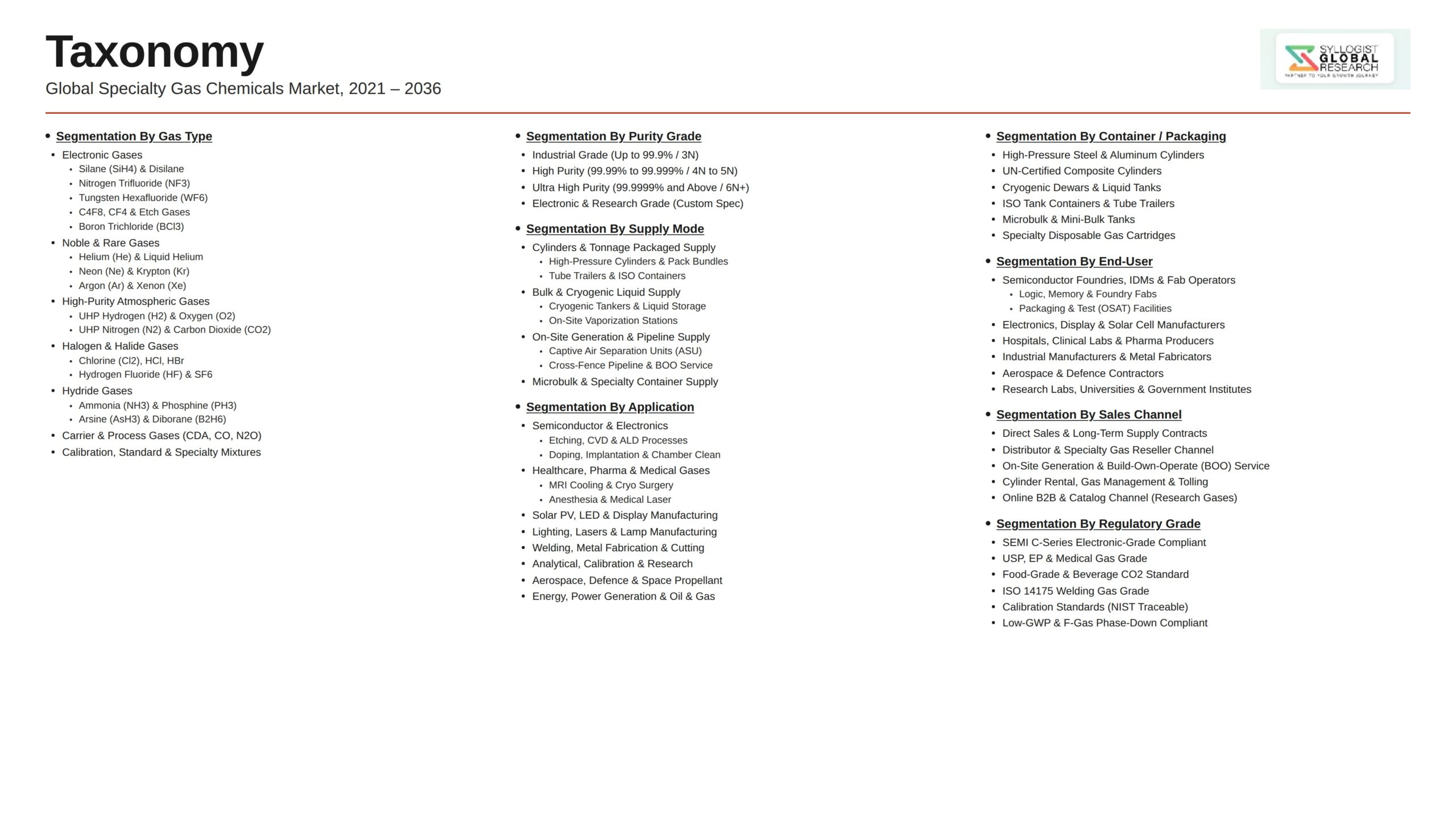
- Segmentation By Gas Type
- Electronic Specialty Gases (Silane, Disilane, Ammonia, Nitrogen Trifluoride, Tungsten Hexafluoride, Specialty Fluorocarbons)
- Calibration and Analytical Gas Mixtures
- Medical Specialty Gases (Nitric Oxide, Helium-Oxygen, Specialty Anesthetic Gases)
- Laser Gases (Excimer Mixtures)
- Lighting Gases (Xenon, Krypton, Neon)
- Rare and Noble Gases (High-Purity Argon, Helium, Xenon)
- Specialty Hydrocarbon Gases
- Others
- Segmentation By Purity Grade
- Industrial Purity (Up to 4N)
- Ultra-High Purity (5N to 6N)
- Semiconductor Grade (7N and Above)
- Calibration Standard Grade
- Medical Grade
- Segmentation By Application
- Semiconductor Wafer Fabrication
- Display Panel Manufacturing (LCD, OLED)
- Solar Photovoltaic Manufacturing
- Laser and Lighting Manufacturing
- Healthcare and Medical
- Environmental Monitoring and Calibration
- Analytical and Laboratory Instrumentation
- Industrial Welding and Specialty Processes
- Others
- Segmentation By Delivery Mode
- Cylinder Delivery
- Bulk Liquid Delivery
- On-Site Generation Systems
- Tube Trailer Delivery
- Microbulk Delivery
- Segmentation By Function
- Process Gas (Reactive)
- Inert Carrier Gas
- Etch and Clean Gas
- Deposition Gas
- Calibration and Reference Gas
- Specialty Therapeutic and Diagnostic Gas
- Segmentation By End User Industry
- Semiconductor and Display Manufacturers
- Solar Photovoltaic Manufacturers
- Healthcare Providers and Hospitals
- Environmental Monitoring Laboratories
- Pharmaceutical and Biotechnology Operators
- Petrochemical and Refining Operators
- Research Institutions and Universities
- Others
- Segmentation By Region
- North America
- Europe
- Asia-Pacific
- Middle East and Africa
- Latin America
All market revenues are presented in USD
Historical Year: 2021-2024 | Base Year: 2025 | Estimated Year: 2026 | Forecast Period: 2027-2034
Key Questions this Study Will Answer
- What is the total global market valuation of the Specialty Gas Chemicals Market in 2025, projected through 2034, segmented by gas type, purity grade, application, and delivery mode, enabling specialty gas producers, distributors, and end-user industry procurement teams to identify highest-growth segments and most durable revenue opportunities across the specialty gas chemicals landscape?
- How are semiconductor fabricators, display panel manufacturers, solar PV producers, healthcare operators, and analytical laboratory operators structuring procurement frameworks for specialty gas chemicals, and which commercial models, including cylinder supply, bulk liquid delivery, on-site generation, and tube trailer service, are shaping commercial deployment economics within the specialty gas chemicals market through 2034?
- What semiconductor manufacturing capacity expansion, CHIPS Act-supported fab construction, advanced node transition, and solar photovoltaic capacity addition dynamics are reshaping electronic specialty gas procurement timelines across mature and emerging manufacturing regions?
- Which specialty gas types, including silane, ammonia, nitrogen trifluoride, tungsten hexafluoride, calibration mixtures, medical specialty gases, and noble gases, are gaining the strongest procurement traction across semiconductor, display, solar PV, healthcare, and analytical applications, and what purity, supply continuity, and total cost of ownership metrics are shaping technology selection decisions?
- How is the competitive landscape structured among integrated industrial gas companies, electronic specialty gas specialists, calibration gas formulators, and on-site generation system providers within the specialty gas chemicals market, and what partnership, acquisition, and capacity expansion strategies are enabling new entrants to compete against incumbent specialty gas chemicals producers?
- What F-Gas phasedown regulations, low-GWP alternative development, and toxic gas handling compliance dynamics are reshaping product portfolio strategies, abatement system requirements, and customer technical support expectations across the specialty gas chemicals market globally?
- Which regional markets, including Asia-Pacific, North America, and Europe, are projected to generate the largest incremental specialty gas chemicals procurement opportunities through 2034, and what semiconductor investment, solar PV manufacturing, healthcare expansion, and environmental monitoring policy factors are shaping capability investment priorities and supplier selection decisions in each regional specialty gas chemicals market?
- Product Definition
- Research Methodology
- Research Design & Framework
- Overall Research Approach: Descriptive, Exploratory & Quantitative Mixed-Method Design
- Market Definition & Scope Boundaries: What is Included and Excluded
- Segmentation Framework
- Key Research Assumptions & Limitations
- Secondary Research
- Primary Research Design & Execution
- Data Triangulation & Validation
- Market Sizing & Forecasting Methodology
- Competitive Intelligence Methodology
- Quality Assurance & Peer Review
- Definitions, Abbreviations & Data Notes
- Research Design & Framework
- Executive Summary
- Market Snapshot & Headline Numbers
- Key Findings & Research Highlights
- Market Dynamics
- Regional Market Summary
- Competitive Landscape Snapshot
- Technology & Innovation Highlights
- Market Dynamics
- Drivers
- Restraints
- Opportunities
- Challenges
- Porter’s Five Forces Analysis
- PESTLE Analysis
- Market Trends & Developments
- Emerging Trends
- Technological Developments
- Regulatory & Policy Changes
- Supply Chain & Sourcing Trends
- Manufacturing & Process Trends
- Investment & Funding Activity
- Sustainability & ESG Trends
- Risk Assessment Framework
- Feedstock Supply, Helium Reserve Depletion & Rare-Gas Sourcing Risk
- Geopolitical, Trade Restriction & Export-Control Risk for Strategic Gases
- Regulatory, F-Gas Phase-Down & Hazardous-Substance Compliance Risk
- Cylinder Logistics, Cryogenic Distribution & High-Purity Containment Risk
- Technology Substitution, Process Migration & Customer Concentration Risk
- Regulatory Framework & Standards
- SEMI C-Series, JEDEC & Electronic-Grade Gas Purity Standards
- REACH, OSHA, EPA Air-Toxic & Hazardous Gas Handling Regulations
- Montreal Protocol, Kigali Amendment & F-Gas Phase-Down (SF6, NF3, PFAS) Regulations
- UN, DOT & ADR Cylinder, Pressure Vessel & Cryogenic Vessel Transport Standards
- USP, EP, FDA & Medical Gas Quality Standards (USP 797, ISO 7396)
- Global Specialty Gas Chemicals Market Outlook
- Market Size & Forecast by Value
- Market Size & Forecast by Volume (Tonnes and Million Standard Cubic Feet)
- Market Size & Forecast by Gas Type
- Electronic Gases (Silane, NF3, WF6, C4F8, BCl3, Tungsten Hexafluoride)
- Noble & Rare Gases (Helium, Neon, Argon, Krypton, Xenon)
- High-Purity Atmospheric Gases (UHP H2, O2, N2, CO2)
- Halogen & Halide Gases (Cl2, HCl, HBr, HF, SF6)
- Hydride Gases (NH3, PH3, AsH3, B2H6, SiH4)
- Carrier & Process Gases (CDA, CO, N2O)
- Calibration, Standard & Specialty Gas Mixtures
- Market Size & Forecast by Purity Grade
- Industrial Grade (Up to 99.9% / 3N)
- High Purity (99.99% to 99.999% / 4N to 5N)
- Ultra High Purity (99.9999% and Above / 6N+)
- Electronic & Research Grade (Customer-Specific Specification)
- Market Size & Forecast by Supply Mode
- Cylinders & Tonnage Packaged Supply
- Bulk & Cryogenic Liquid Supply
- On-Site Generation & Pipeline Supply
- Microbulk & Specialty Container Supply
- Market Size & Forecast by Application
- Semiconductor & Electronics (Etch, CVD/ALD, Doping, Chamber Clean)
- Healthcare, Pharma & Medical Gases (MRI Cooling, Anesthesia, Laser, Cryo)
- Solar Photovoltaic, LED & Display Manufacturing
- Lighting, Lamp & Laser Industry
- Welding, Metal Fabrication & Cutting
- Analytical, Calibration & Scientific Research
- Aerospace, Defence & Space Propellant
- Energy, Power Generation, Oil & Gas
- Market Size & Forecast by End-User
- Semiconductor Foundries, IDMs & Fab Operators
- Electronics, Display & Solar Cell Manufacturers
- Hospitals, Clinical Laboratories & Pharmaceutical Producers
- Industrial Manufacturers & Metal Fabricators
- Aerospace & Defence Contractors
- Research Laboratories, Universities & Government Institutes
- Market Size & Forecast by Sales Channel
- Direct Sales & Long-Term Supply Contracts
- Distributor & Specialty Gas Reseller Channel
- On-Site Generation & Build-Own-Operate (BOO) Service
- Cylinder Rental, Gas Management Services & Tolling
- North America Specialty Gas Chemicals Market Outlook
- Market Size & Forecast
- By Value
- By Volume (Tonnes and Million Standard Cubic Feet)
- By Gas Type
- By Purity Grade
- By Supply Mode
- By Application
- By End-User
- By Country
- By Sales Channel
- Market Size & Forecast
- Europe Specialty Gas Chemicals Market Outlook
- Market Size & Forecast
- By Value
- By Volume (Tonnes and Million Standard Cubic Feet)
- By Gas Type
- By Purity Grade
- By Supply Mode
- By Application
- By End-User
- By Country
- By Sales Channel
- Market Size & Forecast
- Asia-Pacific Specialty Gas Chemicals Market Outlook
- Market Size & Forecast
- By Value
- By Volume (Tonnes and Million Standard Cubic Feet)
- By Gas Type
- By Purity Grade
- By Supply Mode
- By Application
- By End-User
- By Country
- By Sales Channel
- Market Size & Forecast
- Latin America Specialty Gas Chemicals Market Outlook
- Market Size & Forecast
- By Value
- By Volume (Tonnes and Million Standard Cubic Feet)
- By Gas Type
- By Purity Grade
- By Supply Mode
- By Application
- By End-User
- By Country
- By Sales Channel
- Market Size & Forecast
- Middle East & Africa Specialty Gas Chemicals Market Outlook
- Market Size & Forecast
- By Value
- By Volume (Tonnes and Million Standard Cubic Feet)
- By Gas Type
- By Purity Grade
- By Supply Mode
- By Application
- By End-User
- By Country
- By Sales Channel
- Market Size & Forecast
- Country-Wise* Specialty Gas Chemicals Market Outlook
- Market Size & Forecast
- By Value
- By Volume (Tonnes and Million Standard Cubic Feet)
- By Gas Type
- By Purity Grade
- By Supply Mode
- By Application
- By End-User
- By Country
- By Sales Channel
- Market Size & Forecast
- *Countries Analyzed in the Syllogist Global Research Portfolio: United States, Canada, Mexico, Germany, France, United Kingdom, Netherlands, Spain, Italy, Norway, Sweden, China, Japan, South Korea, Taiwan, India, Singapore, Australia, Brazil, Chile, Saudi Arabia, UAE, Egypt, South Africa, Israel
- Technology Landscape & Innovation Analysis
- Electronic Gas Synthesis (Silane, NF3, WF6) & Ultra-High Purity Purification Technology Deep-Dive
- Cryogenic Air Separation & Noble Gas Recovery Technology
- On-Site Hydrogen Generation (Electrolyser, SMR) & Bio-Sourced Gas Technology
- Helium Liquefaction, Recovery & Recycling Technology
- Gas Purification, Filtration & Sub-PPB Contamination Removal Technology
- Smart Cylinder, IoT-Enabled Gas Cabinet & Digital Supply Tracking Technology
- Low-GWP F-Gas Alternative & SF6 Substitute Development Technology
- Patent & IP Landscape in Specialty Gas Chemicals Technologies
- Value Chain & Supply Chain Analysis
- Feedstock Sourcing (Helium Reserves, Air Separation Output & Petrochemical By-Products) Supply Chain
- Specialty Gas Manufacturing, Purification & Blending Equipment Supply Chain
- Cylinder, Cryogenic Vessel, Pressure Equipment & Valve OEM Supply Chain
- Logistics, Cylinder Filling, ISO Tank & Cryogenic Distribution Network
- Distributor, Gas Manager & Specialty Reseller Procurement Landscape
- End-User Procurement (Semiconductor Fab, Hospital & Industrial) Channel
- Cylinder Reverse Logistics, Recovery & Recycling Loop
- Pricing Analysis
- Electronic & High-Purity Gas Price Benchmarking by Purity Grade and Region
- Noble Gas (Helium, Neon, Xenon) Price Volatility & Allocation Analysis
- On-Site Generation vs. Bulk Liquid vs. Cylinder Supply Cost Comparison
- Long-Term Supply Contract, Take-or-Pay & Spot Pricing Mechanism Analysis
- Specialty Gas Cylinder Rental, Demurrage & Total Cost of Ownership Analysis
- Geographic Price Differential & Logistics-Driven Cost Structure Analysis
- Sustainability & Environmental Analysis
- Lifecycle Assessment (LCA) of Specialty Gas Chemicals: Carbon Footprint & Energy Intensity Across Production Routes
- F-Gas Phase-Down, GWP Reduction & Low-Impact Alternative Adoption Pathway
- Cylinder Reuse, Cylinder-Loss Reduction & Circular Container Management
- Helium Conservation, Recovery & Closed-Loop Recycling for Sustainability
- Regulatory-Driven Sustainability, SDG 9 (Industry & Innovation) & SDG 12 (Responsible Production) Alignment
- Competitive Landscape
- Market Structure & Concentration
- Market Consolidation Level (Fragmented vs. Consolidated by Gas Type & Geography)
- Top 10 Players Market Share
- HHI (Herfindahl-Hirschman Index) Concentration Analysis
- Competitive Intensity Map by Gas Type, Application & Geography
- Player Classification
- Integrated Industrial Gas Majors with Specialty Gas Divisions
- Specialist Electronic Gas Producers
- Noble Gas & Rare Gas Specialty Suppliers
- On-Site Gas Generation & BOO Service Providers
- Cylinder, Cryogenic Vessel & Gas Handling Equipment OEMs
- Gas Purification, Blending & Calibration Mixture Specialists
- Regional Specialty Gas Distributors & Resellers
- Low-GWP Alternative & Next-Generation Gas Developers
- Competitive Analysis Frameworks
- Market Share Analysis by Gas Type, Application & Region
- Company Profile
- Company Overview & Headquarters
- Specialty Gas Products & Portfolio
- Key Customer Relationships & Reference Account Installations
- Manufacturing Footprint & Production Capacity
- Revenue (Specialty Gas Segment) & Backlog
- Technology Differentiators & IP
- Key Strategic Partnerships, JVs & M&A Activity
- Recent Developments (Contract Wins, Capacity Expansion, Product Launches)
- SWOT Analysis
- Strategic Focus Areas & Roadmap
- Competitive Positioning Map (Technology Capability vs. Market Penetration)
- Key Company Profiles
- Market Structure & Concentration
- Technology Landscape & Innovation Analysis
- Strategic Output
- Market Opportunity Matrix: By Gas Type, Application, End-User & Geography
- White Space Opportunity Analysis
- Strategic Recommendations
- Product Portfolio & Technology Investment Strategy
- Manufacturing & Operational Excellence Strategy
- Geographic Expansion & Localisation Strategy
- Customer & End-User Engagement Strategy
- Partnership, M&A & Ecosystem Strategy
- Sustainability & Circular Economy Strategy
- Risk Mitigation & Future Roadmap
- Strategic Priority Matrix & Roadmap
- Near-term (2025-2028)
- Mid-term (2029-2032)
- Long-term (2033-2037)