India UV Curing Resin Market By Resin Type, By Chemistry, By Application, By End Use Industry, By Curing Technology, By Region, Competition, Forecast & Opportunities, 2021-2036F
Market Definition
The India UV Curing Resin Market encompasses the formulation, production, and commercial distribution of photopolymerizable oligomer and monomer systems including urethane acrylates, epoxy acrylates, polyester acrylates, acrylic monomers, and cationic resins that undergo rapid cross-linking polymerization upon exposure to ultraviolet or visible light radiation, serving as functional components in UV-curable coatings, inks, adhesives, 3D printing photopolymers, optical fiber coatings, and dental materials across Indian printing, packaging, electronics, automotive, wood finishing, and healthcare end use industries.
Market Insights
The India UV curing resin market is at a compelling growth inflection, driven by the convergence of tightening volatile organic compound emission regulations compelling Indian manufacturers to transition from solvent-based to radiation-curable coating and ink formulations, the rapid expansion of packaging and printing industries serving India’s growing consumer economy, and the growing recognition among Indian industrial coatings users that UV curing technology delivers superior production throughput, energy efficiency, and finish quality advantages over thermal drying alternatives that are increasingly difficult to justify against the operational performance gap. The market was valued at approximately USD 148.6 million in 2025 and is projected to expand at a compound annual growth rate of 14.3% through 2034, as India’s manufacturing sector deepening, rising quality standards across consumer goods and automotive production, and the progressive adoption of UV LED curing technology that extends UV curing applicability to heat-sensitive substrates and reduces energy consumption per cure cycle collectively expand the addressable market for UV curing resins beyond the traditional printing and electronics applications that have historically anchored Indian UV curing resin demand.
The printing and packaging application segment represents the largest and most commercially established demand channel for UV curing resins in India, as the combination of high-quality offset, digital, and flexographic printing operations serving fast-moving consumer goods label, folding carton, flexible packaging, and commercial print markets increasingly specify UV-cured overprint varnishes and inks for their superior scratch resistance, chemical resistance, immediate post-print handling capability, and regulatory compliance advantages over solvent-based alternatives. The rapid growth of e-commerce-driven packaging demand, premium food and beverage label requirements, and pharmaceutical packaging quality standards is elevating the proportion of Indian printing and packaging production specifying UV-cured finishes, expanding resin consumption volumes and shifting the product mix toward higher-performance acrylate oligomer formulations that command premium pricing relative to commodity photoinitiator and monomer blends. Wood coatings represent the second most commercially developed UV curing resin application in India, with furniture manufacturers, flooring producers, and wood panel laminators increasingly adopting UV-cured polyester and urethane acrylate coating systems that deliver the surface hardness, scratch resistance, and chemical durability required for premium furniture and interior product market positioning while reducing production cycle time and energy consumption compared to conventional multi-coat air-dried or baking enamel wood finish systems.
UV LED curing technology adoption is reshaping the India UV curing resin market by enabling curing on substrates previously incompatible with conventional mercury arc lamp UV systems due to heat sensitivity, including heat-shrink labels, thin film electronics substrates, and flexible packaging films whose dimensional stability cannot be maintained under the radiant heat output of high-intensity mercury lamp UV curing equipment. The significantly lower energy consumption, mercury-free operation, instant on-off capability, and extended operational lifetime of LED UV curing systems relative to mercury arc lamps are generating compelling total cost of ownership advantages for Indian printing and coating operators that are accelerating LED UV system installation in new and retrofit applications. The electronics manufacturing segment, driven by India’s expanding printed circuit board assembly, semiconductor packaging, and consumer electronics manufacturing base supported by government production-linked incentive programs, is generating growing demand for conformal coating UV resins, optical clear adhesives, and encapsulant photopolymers that serve the functional protection and assembly bonding requirements of electronic components.
Western India, encompassing the Maharashtra, Gujarat, and Rajasthan industrial corridors, represents the largest regional UV curing resin consumption geography within India, reflecting the concentration of printing and packaging, pharmaceuticals, automotive components, adhesives, and electronics manufacturing industries across Mumbai, Pune, Ahmedabad, and Surat that collectively constitute the primary demand base for UV curing resins in Indian industrial applications. Southern India, centered on Karnataka, Tamil Nadu, and Telangana, is the second largest and fastest-growing regional market, driven by the concentration of electronics manufacturing, automotive assembly, furniture production, and premium printing operations across the Bangalore, Chennai, Hyderabad, and Coimbatore industrial ecosystems. Northern India, particularly the Delhi-NCR region, represents the third major consumption area anchored by packaging printing, pharmaceuticals, and automotive component manufacturing activity.
Key Drivers
Tightening Indian VOC Emission Regulations and Solvent-Based Coating Compliance Costs Compelling Manufacturing Sector Transition to UV-Curable Low-Emission Coating and Ink Formulations
India’s progressive tightening of volatile organic compound emission standards under the Environment Protection Act amendments, combined with increasing enforcement action against industrial solvent emissions by the Central Pollution Control Board and state pollution control authorities across major manufacturing states, is creating compliance cost pressure and permit risk for Indian manufacturers relying on solvent-based coating, printing ink, and adhesive formulations that emit significant quantities of organic solvents during application and drying. UV-curable coating and ink formulations based on reactive acrylate oligomers and monomers offer near-zero VOC emission profiles that simplify regulatory compliance, reduce environmental liability exposure, and eliminate the solvent recovery or abatement infrastructure investment required for continued operation of conventional solvent-based coating processes under tightening emission permit conditions.
Rapid Expansion of Indian Packaging, Printing, and Consumer Goods Manufacturing Sectors Driving Growing Volume Demand for High-Performance UV-Cured Coatings and Ink Finishes
India’s fast-moving consumer goods, food and beverage, pharmaceutical, and e-commerce sectors are generating robust and accelerating demand growth for high-quality printed packaging, premium labels, and protective coated surfaces that increasingly specify UV-cured finishes for their combination of superior mechanical and chemical durability, high-gloss optical appearance, immediate cure enabling rapid downstream handling, and compatibility with food-contact regulatory requirements that solvent-based alternatives increasingly struggle to satisfy under evolving Indian food safety standards. The rapid scaling of Indian pharmaceutical packaging output serving both domestic consumption growth and export market opportunities for generics and over-the-counter products is contributing growing UV-curable coating and varnish procurement demand from pharmaceutical blister packaging, folding carton, and secondary packaging printing operations.
Government Production-Linked Incentive Programs for Electronics and Automotive Manufacturing Expanding UV Curing Resin Demand Across Functional Coating, Adhesive, and Encapsulant Applications
India’s production-linked incentive schemes for semiconductor fabrication, electronics manufacturing, and automotive components production are generating substantial new manufacturing investment that is expanding the addressable market for UV curing resins in functional electronic coating, printed circuit board conformal coating, optical adhesive, and encapsulant applications that require the precision cure control, thermal stability, and electrical insulation properties achievable with specialized UV-curable resin formulations. The localization of electronics and automotive component manufacturing through Make in India policy programs is progressively increasing domestic UV curing resin procurement volumes from these technically demanding industrial segments as production capacity scales and supply chain localization requirements favor domestic and domestically qualified UV resin suppliers over import-dependent procurement strategies.
Key Challenges
High Dependence on Imported UV Curing Resin Raw Materials and Photoinitiator Supply Creating Foreign Exchange Exposure and Supply Continuity Risk for Indian Formulators
India’s UV curing resin industry depends heavily on imported acrylate monomers, urethane acrylate oligomers, epoxy acrylate base resins, and specialty photoinitiators sourced predominantly from Chinese, European, and American chemical suppliers whose supply continuity, pricing, and minimum order volume requirements create structural supply security and cost volatility challenges for Indian UV resin formulators operating in a market characterized by relatively small order quantities, diverse application specifications, and limited domestic production of the specialized petrochemical and photochemical intermediates required for UV resin manufacturing. Indian rupee depreciation against the United States dollar and euro periodically elevates import costs for these foreign currency-denominated raw materials, compressing formulator margins and creating pass-through pricing pressures that disrupt customer relationships and delay UV curing technology adoption among cost-sensitive Indian end users.
Limited UV Curing Equipment Installed Base and Technical Knowledge Gaps Among Potential End Users Slowing Market Penetration Beyond Established Printing and Coating Application Segments
The adoption of UV curing technology in India beyond its established printing, labels, and wood coating application bases is constrained by the limited awareness among potential end users in adhesives, electronics, automotive refinish, and industrial maintenance coatings segments of UV curing’s performance and cost efficiency advantages, combined with the capital investment requirement for UV curing lamp or LED system installation that creates a technology adoption barrier for small and medium enterprises lacking the capital budget or technical justification framework to authorize UV curing equipment procurement alongside formulation change investment. The shortage of technically trained application engineers and UV curing process specialists within the Indian industrial coating and chemical distribution ecosystem limits the quality of technical support available to prospective UV curing adopters during the critical evaluation and implementation phases of technology transition.
Price Competition from Established Solvent-Based and Waterborne Coating Alternatives and Customer Switching Cost Inertia Slowing UV Resin Adoption in Price-Sensitive Indian Market Segments
UV curing resin formulations carry higher raw material costs per unit weight relative to conventional solvent-based and waterborne coating and ink alternatives at current Indian market pricing, creating a price competitiveness challenge in cost-sensitive small and medium enterprise manufacturing segments where purchasing decisions are predominantly governed by raw material acquisition cost rather than total cost of ownership calculations that would capture UV curing’s offsetting advantages in energy consumption, production throughput, reject rate reduction, and floor space efficiency. The established supply chain familiarity, existing application equipment compatibility, and switching cost inertia associated with incumbent solvent-based and waterborne coating formulations creates organizational resistance to UV curing adoption that requires sustained technical sales effort and demonstration investment from UV resin suppliers seeking to develop new application segments beyond the established UV curing user base in premium printing and wood finishing.
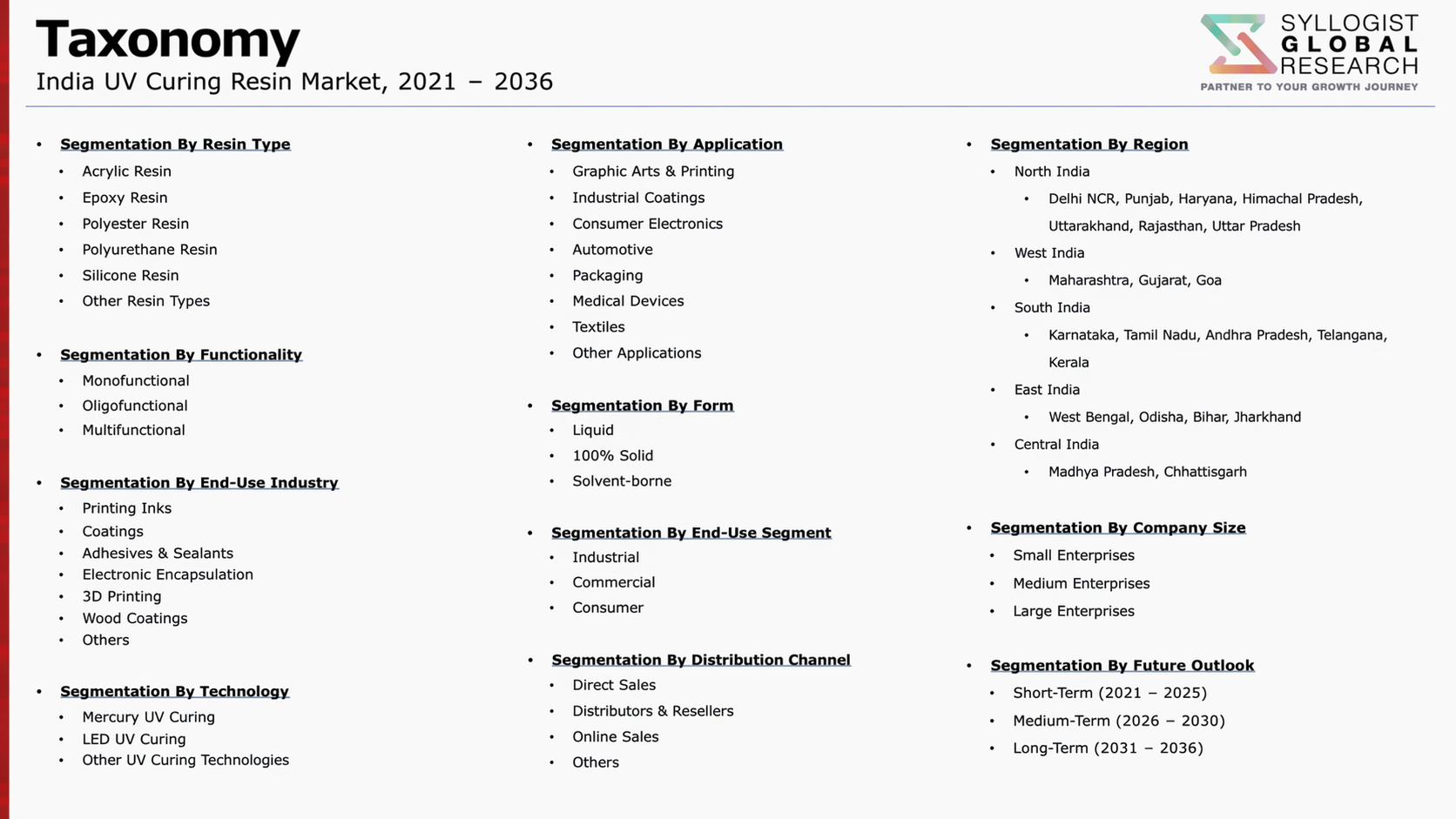
Market Segmentation
- Segmentation By Resin Type
- Urethane Acrylate Oligomers
- Epoxy Acrylate Oligomers
- Polyester Acrylate Oligomers
- Acrylic Monofunctional and Multifunctional Monomers
- Cationic Epoxy Resins
- Silicone Acrylate and Specialty Oligomers
- Others
- Segmentation By Chemistry
- Free Radical Photopolymerization Systems
- Cationic Photopolymerization Systems
- Hybrid Free Radical and Cationic Systems
- Thiol-Ene Photopolymerization Systems
- Others
- Segmentation By Application
- UV-Curable Coatings and Overprint Varnishes
- UV-Curable Inks for Offset, Flexo, and Digital Printing
- UV-Curable Adhesives and Pressure-Sensitive Adhesives
- 3D Printing Photopolymers and Stereolithography Resins
- Optical Fiber Coatings and Electronic Encapsulants
- Dental and Medical Device Materials
- Others
- Segmentation By End Use Industry
- Printing and Packaging
- Wood and Furniture Finishing
- Electronics and Printed Circuit Board Assembly
- Automotive Coatings and Refinish
- Pharmaceuticals and Medical Devices
- Graphic Arts and Commercial Printing
- Flooring and Building Materials
- Others
- Segmentation By Curing Technology
- Mercury Arc Lamp UV Curing Systems
- UV LED Curing Systems
- Visible Light and Electron Beam Curing
- Others
- Segmentation By Region
- West India (Maharashtra, Gujarat, Rajasthan)
- South India (Karnataka, Tamil Nadu, Telangana)
- North India (Delhi-NCR, Uttar Pradesh, Punjab)
- East India (West Bengal, Odisha)
- Central India
All market revenues are presented in USD
Historical Year: 2021-2024 | Base Year: 2025 | Estimated Year: 2026 | Forecast Period: 2027-2034
Key Questions this Study Will Answer
- What is the total India UV curing resin market valuation in 2025, projected through 2034, segmented by resin type, application, and end use industry, enabling UV resin formulators, raw material suppliers, and end use industry technology buyers to identify the highest-growth resin categories and most commercially significant adoption expansion opportunities across the Indian UV curing resin market?
- How are India’s tightening VOC emission regulations, Central Pollution Control Board enforcement actions against solvent emission industries, and state-level environmental compliance pressure programs influencing the pace of conversion from solvent-based to UV-curable coating, ink, and adhesive formulations across Indian printing, packaging, wood finishing, and industrial coating manufacturing sectors through 2034?
- Which UV curing resin application segments beyond established printing, packaging, and wood coating markets, specifically electronics conformal coatings, UV-curable adhesives, 3D printing photopolymers, and automotive refinish coatings, are demonstrating the most promising near-term commercial adoption momentum in India, and what technical performance requirements, quality certification standards, and customer application development investment are shaping market entry conditions in each segment?
- How is UV LED curing technology adoption progressing in India relative to conventional mercury arc lamp systems, and what energy efficiency, substrate compatibility, mercury elimination, and total cost of ownership advantages are compelling printing, packaging, and electronics manufacturing operators to invest in LED UV curing system upgrades and how does this technology shift affect UV resin formulation and oligomer specification requirements?
- What raw material import dependency constraints, photoinitiator and acrylate oligomer domestic production limitations, foreign exchange volatility exposure, and minimum order volume barriers from international suppliers are most significantly affecting Indian UV resin formulator competitiveness and supply security, and what domestic production investment programs, backward integration strategies, and alternative supplier development initiatives are being pursued to reduce import dependency?
- How is the competitive landscape structured among multinational UV resin suppliers with Indian operations, domestic Indian UV resin formulators, and trading company importers serving Indian end users, and what product quality differentiation, technical application support capability, local warehousing and logistics infrastructure, and customer-specific formulation development services are enabling leading suppliers to build durable customer relationships in the fragmented Indian market?
- Which regional Indian UV curing resin markets, specifically West India, South India, and North India, are expected to generate the highest incremental demand growth through 2034, and what combinations of packaging and printing industry expansion, electronics and automotive manufacturing cluster growth, government production-linked incentive investments, and industrial coating technology upgrade activity are defining regional market growth trajectories and competitive supplier positioning?
- Product Definition
- Research Methodology
- Research Design & Framework
- Overall Research Approach: Descriptive, Exploratory & Quantitative Mixed-Method Design
- Market Definition & Scope Boundaries: What is Included and Excluded
- Segmentation Framework
- Key Research Assumptions & Limitations
- Secondary Research
- Primary Research Design & Execution
- Data Triangulation & Validation
- Market Sizing & Forecasting Methodology
- Competitive Intelligence Methodology
- Quality Assurance & Peer Review
- Definitions, Abbreviations & Data Notes
- Research Design & Framework
- Executive Summary
- Market Snapshot & Headline Numbers
- Key Findings & Research Highlights
- Market Dynamics
- Regional Market Summary
- Competitive Landscape Snapshot
- Technology & Innovation Highlights
- Market Dynamics
- Drivers
- Restraints
- Opportunities
- Challenges
- Porter’s Five Forces Analysis
- PESTLE Analysis
- Market Trends & Developments
- Emerging Trends
- Technological Developments
- Regulatory & Policy Changes
- Supply Chain & Sourcing Trends
- Manufacturing & Process Trends
- Investment & Funding Activity
- Sustainability & ESG Trends
- Risk Assessment Framework
- Raw Material Import Dependency, Foreign Exchange Volatility & Customs Duty Escalation Risk
- Acrylate Monomer & Oligomer Price Volatility & Supply Disruption Risk
- Health & Safety Regulatory Tightening, Acrylate Skin Sensitisation & REACH-Equivalent Standards Risk
- Transition to LED UV Curing Technology, Equipment Upgrade Cost & Industry Readiness Risk
- Competition from Solvent-Borne, Waterborne & Thermal Cure Systems in Price-Sensitive Segments Risk
- Counterfeit & Low-Quality Imported Resin Products & Domestic Brand Erosion Risk
- Regulatory Framework & Standards
- BIS Compulsory Registration Order (CRO), Quality Control Orders & Chemical Import Licensing Standards for UV Resins in India
- MoEFCC VOC Emission Standards, Solvent-Borne Coating Phase-Out Policy & UV Curing as Low-VOC Regulatory Incentive
- Food Safety & Standards Authority of India (FSSAI) Food Contact Coating & Printing Ink Standards for UV-Cured Applications
- Factories Act, Chemical Handling Safety & OSHA-Equivalent Standards for UV Resin Manufacture & Processing in India
- Make in India, PLI Scheme for Specialty Chemicals & Atmanirbhar Bharat Policy Frameworks for UV Resin Domestic Production
- E-Waste, Plastic Packaging Waste & Extended Producer Responsibility (EPR) Regulatory Impact on UV-Cured Coating & Ink Producers
- India UV-Curing Resins Market Outlook
- Market Size & Forecast by Value
- Market Size & Forecast by Volume (Tonnes per Annum, TPA)
- Market Size & Forecast by Resin Type
- Epoxy Acrylate Resins
- Polyurethane Acrylate (PUA) Resins
- Polyester Acrylate Resins
- Acrylic Acrylate & Pure Acrylic Resins
- Amine-Modified Polyether Acrylate Resins
- Silicone Acrylate & Fluorinated Acrylate Resins
- Unsaturated Polyester Resins for UV Curing
- Waterborne UV Acrylate Dispersions & Emulsions
- Market Size & Forecast by Curing Technology
- Conventional Mercury Arc Lamp UV Curing
- LED UV Curing Technology
- Electron Beam (EB) Curing Technology
- Hybrid UV-Thermal Dual-Cure Technology
- Market Size & Forecast by Functionality
- Monofunctional Acrylate Monomers & Reactive Diluents
- Difunctional Acrylate Monomers & Crosslinkers
- Multifunctional (Tri- & Higher Functionality) Acrylate Monomers
- Oligomers & Pre-Polymers
- Market Size & Forecast by Application
- Printing Inks: Offset, Flexographic, Digital Inkjet & Screen Printing
- Coatings: Wood, Furniture & Flooring Coatings
- Coatings: Plastic, Automotive & Appliance Surface Coatings
- Coatings: Paper, Packaging & Label Coatings
- Coatings: Metal, Industrial & Anti-Corrosion Coatings
- Adhesives & Sealants for Electronics, Medical Device & Optical Applications
- Electronics: PCB Conformal Coating, Solder Mask & Potting Compounds
- 3D Printing & Additive Manufacturing (SLA, DLP & Inkjet Photopolymers)
- Dental, Medical & Optical Lens UV-Cured Applications
- Textile, Leather & Nonwoven Surface Finishing
- Market Size & Forecast by End-User Industry
- Printing & Packaging Industry
- Wood, Furniture & Flooring Industry
- Automotive & Transportation Industry
- Electronics & Electrical Industry
- Plastic, Consumer Goods & FMCG Packaging Industry
- Pharmaceutical, Medical Device & Healthcare Industry
- Construction, Building Materials & Flooring Industry
- Textile, Leather & Apparel Industry
- Market Size & Forecast by Sales Channel
- Direct Manufacturer-to-Industrial End-User Sales
- Specialty Chemical Distributor & Dealer Network
- Import Agents, Trading Companies & Multinational Subsidiary Channel
- Online & B2B E-Commerce Platform Channel
- West India UV-Curing Resins Market Outlook
- Market Size & Forecast
- By Value
- By Volume (TPA)
- By Resin Type
- By Curing Technology
- By Application
- By End-User Industry
- By State
- By Sales Channel
- Market Size & Forecast
- South India UV-Curing Resins Market Outlook
- Market Size & Forecast
- By Value
- By Volume (TPA)
- By Resin Type
- By Curing Technology
- By Application
- By End-User Industry
- By State
- By Sales Channel
- Market Size & Forecast
- North India UV-Curing Resins Market Outlook
- Market Size & Forecast
- By Value
- By Volume (TPA)
- By Resin Type
- By Curing Technology
- By Application
- By End-User Industry
- By State
- By Sales Channel
- Market Size & Forecast
- East India UV-Curing Resins Market Outlook
- Market Size & Forecast
- By Value
- By Volume (TPA)
- By Resin Type
- By Curing Technology
- By Application
- By End-User Industry
- By State
- By Sales Channel
- Market Size & Forecast
- Central India UV-Curing Resins Market Outlook
- Market Size & Forecast
- By Value
- By Volume (TPA)
- By Resin Type
- By Curing Technology
- By Application
- By End-User Industry
- By State
- By Sales Channel
- Market Size & Forecast
- State-Wise* India UV-Curing Resins Market Outlook
- Market Size & Forecast
- By Value
- By Volume (TPA)
- By Resin Type
- By Curing Technology
- By Application
- By End-User Industry
- By State
- By Sales Channel
- Market Size & Forecast
- *States & Union Territories Analyzed in the Syllogist India Research Portfolio: Maharashtra, Gujarat, Karnataka, Tamil Nadu, Telangana, Delhi NCT, Haryana, Punjab, Uttar Pradesh, Rajasthan, West Bengal, Andhra Pradesh, Madhya Pradesh, Kerala, Goa
- Technology Landscape & Innovation Analysis
- LED UV Curing Technology Adoption in India: Mercury Lamp Replacement, Cost-of-Conversion, Energy Saving & Industry Readiness
- Waterborne UV Acrylate Dispersion Technology: Low-VOC Formulation, Water Reduction & Two-Stage UV-Thermal Cure Process
- Polyurethane Acrylate (PUA) Resin Technology: Aliphatic vs. Aromatic PUA, Flexibility-Hardness Balance & High-Performance Application Development
- 3D Printing Photopolymer Resin Technology: SLA, DLP, CLIP & Inkjet Photopolymer Development for India Additive Manufacturing Market
- Epoxy Acrylate & Bisphenol A-Free (BPA-Free) Formulation Technology for Regulated Food Contact & Healthcare Applications
- Dual-Cure & Hybrid UV-Moisture/UV-Thermal Technology for Shadow Area Cure in Electronics & Automotive Assembly in India
- Domestic R&D Capability in UV Resin Synthesis: IIT, CSIR & Indian Chemical Industry Research Collaboration Landscape
- Patent & IP Landscape in UV-Curing Resin Technologies Relevant to India
- Value Chain & Supply Chain Analysis
- Acrylate Monomer, Acrylic Acid & Key Raw Material Import Dependency & Domestic Availability Supply Chain in India
- Epoxy Resin, Isocyanate, Polyol & Base Resin Intermediate Supply Chain for Domestic UV Resin Formulation
- Photoinitiator Import & Domestic Manufacture Supply Chain (China & European Source Dependency)
- UV Resin Blending, Formulation, Packaging & Quality Testing Supply Chain in India
- UV Curing Equipment (Lamp, LED & Conveyor System) Import & Domestic Assembly Supply Chain
- Specialty Chemical Distributor, Dealer & Regional Stockist Channel
- Technical Service, Application Development & Customer Support Channel
- Pricing Analysis
- India UV-Curing Resin Price Analysis by Resin Type & Grade (INR/kg & USD/kg)
- Import Price vs. Domestic Manufacture Cost Comparison & Import Duty Impact Analysis
- Raw Material Cost Breakdown: Acrylate Monomer, Photoinitiator & Base Resin Contribution to Finished Resin Price
- UV Resin vs. Solvent-Borne & Waterborne Coating System Total Cost of Ownership (TCO) Comparison
- LED vs. Mercury UV Lamp System Cost-per-Cure Analysis & Transition Economics for India End-Users
- Price Trend Analysis: INR/USD Exchange Rate, Crude Oil & Acrylate Feedstock Impact on India UV Resin Pricing
- Sustainability & Environmental Analysis
- Lifecycle Assessment (LCA) of UV-Curing Resins in India: Carbon Footprint vs. Solvent-Borne Systems, VOC Reduction & Energy Efficiency
- MoEFCC VOC Emission Standards, India Solvent-Borne Coating Regulation & UV Curing as a Compliant Low-VOC Alternative
- Acrylate Skin Sensitisation, Occupational Exposure & Safe Handling Standards for UV Resin Workers in India
- India Plastic Packaging Waste & EPR Rules Impact on UV-Cured Coating & Label Recyclability
- Sustainable UV Resin Formulation: Bio-Acrylates, Renewable Feedstock & Green Chemistry Development for India Market
- Competitive Landscape
- Market Structure & Concentration
- Market Consolidation Level (Fragmented vs. Consolidated by Resin Type & Region)
- Top 10 Players Market Share in India
- HHI (Herfindahl-Hirschman Index) Concentration Analysis
- Competitive Intensity Map by Resin Type, Application & Region in India
- Player Classification
- Multinational Specialty Chemical Companies with India Manufacturing or Import Operations
- Domestic Indian UV Resin & Specialty Acrylate Manufacturers
- Indian Printing Ink & Coating Companies with UV Product Lines
- Specialty Chemical Distributors & Importers Serving India UV Resin Market
- UV Curing Equipment Suppliers with India Service & Application Support
- Competitive Analysis Frameworks
- Market Share Analysis by Resin Type, Application & Region in India
- Company Profile
- Company Overview & India Operations Headquarters
- UV-Curing Resin Products, Grade Portfolio & Application Coverage in India
- Key Customer Relationships & Reference End-User Deployments in India
- India Manufacturing Footprint, Production Capacity & Import Sourcing Model
- India Revenue (UV Resin Segment) & Distribution Network
- Technology Differentiators & IP
- Key Strategic Partnerships, Distributor Agreements & M&A Activity in India
- Recent Developments (Product Launches, Capacity Additions, Certification Approvals)
- SWOT Analysis
- Strategic Focus Areas & India Roadmap
- Competitive Positioning Map (Product Grade Breadth vs. Application Technical Support)
- Key Company Profiles
- Market Structure & Concentration
- Technology Landscape & Innovation Analysis
- Strategic Output
- Market Opportunity Matrix: By Resin Type, Application, End-User Industry & Region
- White Space Opportunity Analysis
- Strategic Output
- Strategic Recommendations
- Product Portfolio, Grade Development & Technology Investment Strategy for India
- Domestic Manufacturing, Localisation & Import Substitution Strategy
- Geographic Expansion & Tier-2 Industrial Cluster Penetration Strategy
- Customer, End-User Application Development & Technical Service Strategy
- Channel, Distribution & Dealer Partner Strategy for India
- Regulatory Engagement, BIS & FSSAI Certification Strategy
- Sustainability, Low-VOC Positioning & Green Chemistry Strategy for India
- Risk Mitigation & Future Roadmap
- Strategic Priority Matrix & Roadmap
- Near-term (2025-2028)
- Mid-term (2029-2032)
- Long-term (2033-2037)