Market Definition
The Carbon Black market comprises a wide range of engineered carbon materials, including furnace black, thermal black, acetylene black, lamp black, and advanced specialty/conductive grades, used extensively across the tire, rubber goods, plastics, inks, coatings, batteries, and electronics industries. Carbon black is valued for its reinforcing strength, conductivity, UV protection, pigmentation properties, and ability to significantly enhance the durability and performance of end-use products. It plays a critical role in tire tread reinforcement, mechanical rubber product formulation, plastics modification, and conductive or anti-static applications.
Over the past two years, the carbon black industry has been significantly influenced by fluctuations in oil & feedstock prices, tightening environmental regulations, the global shift toward EV (electric vehicle) tire technologies, capacity additions in Asia, supply-chain imbalances, and accelerating demand for sustainable solutions such as recovered carbon black (rCB).
Market Insights
Global demand for carbon black has been strongly shaped by rising consumption of automotive tires, industrial rubber goods, engineering plastics, printing inks, and specialty conductive applications. A major driver has been the expansion of global vehicle production, especially EVs, which require high-performance and abrasion-resistant tire compounds. Additionally, rapid growth in packaging, plastics compounding, and electronics applications has contributed to rising demand for specialty carbon blacks.
However, fluctuations in oil-derived feedstocks (such as TDAE, decant oil, coal tar derivatives), driven by geopolitical tensions and energy market volatility, significantly impacted production costs and pricing cycles during 2021–2023. Environmental compliance pressures, especially in the EU and North America, also influenced plant upgrades, emission control investments, and operating costs across global producers.
In 2023, global supply stabilized with new capacity additions in Asia-Pacific and improved feedstock availability. Yet industry consumption remains robust, driven by tire replacement demand, growth in plastics and coatings markets, and increasing adoption of conductive black in lithium-ion batteries, electronics, and EV components. The sector is increasingly shaped by sustainability priorities such as low-PAH (polycyclic aromatic hydrocarbons) grades, high-quality recovered carbon black, and carbon footprint reduction across manufacturing.
The global carbon black market will grow at a steady CAGR of 5.12% between 2026 and 2035, with Asia-Pacific, North America, and Europe remaining dominant production and consumption hubs. Growth is further enabled by expansion in tire manufacturing, rising industrial activity in emerging markets, and increasing R&D investments in advanced specialty grades.
Regulatory tightening, particularly around emissions, air quality control, REACH compliance, and adoption of circular economy models, is reshaping product development and manufacturing strategies. Producers are investing in cleaner production technologies, feedstock diversification, post-treatment enhancements, and rCB integration to remain competitive. However, the market remains vulnerable to oil price volatility, stricter environmental norms, and high capital intensity required for modern production plants.
Market Dynamics: Drivers
Key factors driving carbon black demand include growth in global tire production, expansion of automotive and industrial rubber sectors, rising consumption of plastics and coatings, and increasing use of conductive carbon black in electronics and batteries. Reinforcement requirements for EV tires, infrastructure development boosting rubber product usage, and higher demand for UV protection in plastics also strengthen market momentum. In addition, the shift toward sustainable materials is accelerating interest in recovered carbon black, low-emission grades, and energy-efficient production technologies.
Market Dynamics: Challenges
The carbon black industry faces major challenges such as dependency on volatile oil-based feedstocks, stringent environmental regulations, and increasing pressure to reduce emissions and PAH content. High energy costs, feedstock shortages, plant modernization requirements, and capital-intensive manufacturing lines also impact profitability. Sustainability-driven expectations, such as incorporation of rCB, lower carbon footprint, and increased transparency, pose structural challenges for traditional producers. Furthermore, competition from alternative fillers, quality variations in recycled materials, and logistic constraints in emerging markets influence market penetration and supply reliability.
Market Segmentation
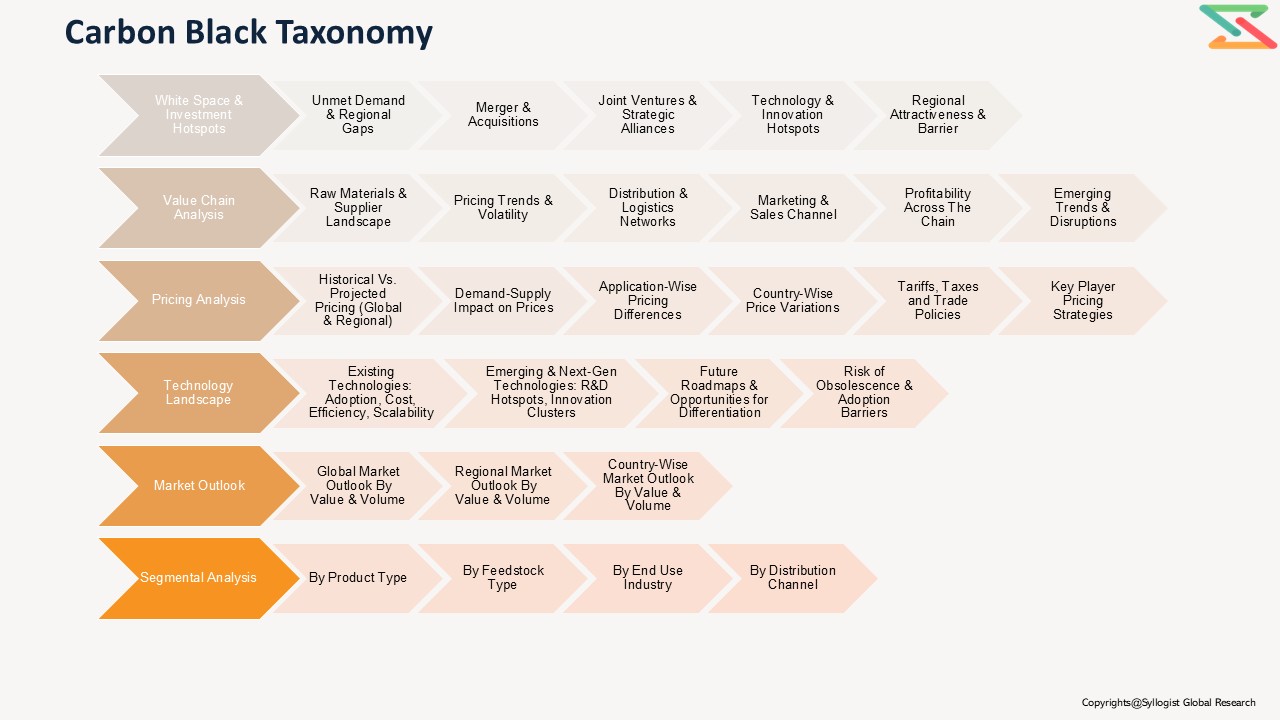
Based on Product Type, the Global Carbon Black Market is segmented into:
- Furnace Black
• Thermal Black
• Acetylene Black
• Lamp Black
• Specialty Blacks (Conductive, Ultra-Fine, High-Purity)
• Others
Based on Application / End Use:
- Tires (Tread, Sidewall, Innerliner)
• Mechanical Rubber Goods (Seals, Belts, Hoses)
• Plastics (Masterbatch, UV Stabilization, Pigmentation)
• Inks & Coatings (Printing, Automotive Coatings, Industrial Coatings)
• Batteries & Conductive Applications
• Others
Based on Feedstock / Material Type:
- Oil-Derived Carbon Black
• Gas-Based Carbon Black
• Recovered Carbon Black (rCB)
• Low-PAH / Specialty Grades
Based on Distribution Channel:
- Direct Supply to Tire & Rubber OEMs
• Distributors / Dealers
• Contract Manufacturers
• Industrial & Specialty Chemical Suppliers
All market revenues are presented in USD, with volumes expressed in kilotons (KT).
Historical Year: 2020–2025 | Base Year: 2026 | Estimated Year: 2027 | Forecast Period: 2028–2035
Key Questions this Study Will Answer
- What are the key market statistics and forecasts (market size by value & volume, segment shares, application trends) for the Global Carbon Black Market?
- What are the regional demand patterns, growth drivers, challenges, and sustainability-led transition trends?
- What technological innovations, recycling developments (including rCB), regulatory changes, and environmental mandates are shaping the carbon black ecosystem?
- Who are the leading competitors, and how do they benchmark across capacity, product range, feedstock integration, sustainability commitments, and pricing?
- What insights emerge from OEM interviews, supply chain assessments, and environmental compliance evaluations conducted during the market study?
- Market Foundations & Dynamics
- Introduction
- Product Overview (Definition & Scope of Carbon Black: Furnace Black, Thermal Black, Acetylene Black, Specialty & Conductive Grades)
- Carbon Black Value Chain Overview (Feedstocks → Production → Pelletizing → Quality Testing → Distribution → End-Use Applications)
- Research Methodology
- Executive Summary
- Major Trends Shaping the Market (EV Tire Demand, Specialty Grades, rCB Adoption, Sustainability Regulations)
- Short-Term vs. Long-Term Opportunities
- Comparison of Key Carbon Black Types (Tire Grade, Rubber Grade, Specialty, Conductive Blacks)
- Scenario Planning (Base, Optimistic, Conservative Demand Across Tire & Non-Tire Segments)
- Sensitivity Analysis (Oil Prices, Feedstock Costs, Emission Norms, Regulatory Shifts)
- Identification of Regional Growth Hotspots
- Market Dynamics
- Drivers
- Restraints
- Opportunities
- Challenges
- Porter’s Five Forces Analysis
- PESTLE Analysis
- Market Ecosystem & Value Chain
- Overview of Value Chain Participants
- Raw Material Suppliers (TDAE Oil, Coal Tar, Petroleum Feedstocks)
- Carbon Black Manufacturers
- Processing & Pelletizing Technology Providers
- Distribution Channels (Tire OEMs, Rubber Goods, Plastics, Inks & Coatings)
- Recycling & Recovered Carbon Black (rCB) Networks
- Raw Material & Equipment Suppliers
- Flow of Value & Material Through the Chain
- Value Addition & Margins at Each Stage
- Carbon Black Production
- Pelletizing & Specialty Modification
- Distribution & OEM Supply
- Recycling & rCB Integration
- Integration Trends (Backward Integration into Feedstocks; Forward Integration with Tire Manufacturers)
- Impact of Vertical Integration
- Mapping of Roles & Interdependencies
- Market Trends & Developments
- White Space Analysis
- Demand Supply Analysis
- Demand–Supply Gaps (Specialty Carbon Black Shortage, Feedstock Tightness)
- Unmet Needs (Low-PAH Grades, High-Purity Conductive Black, Sustainable rCB)
- Risk Assessment Framework
- Political / Geopolitical Risk (Feedstock Imports, Energy & Oil Price Volatility)
- Operational Risk (Emission Compliance, Plant Outages)
- Environmental Risk (Carbon Emissions, Air Quality Regulations)
- Financial Risk (Oil Price Fluctuations, High CAPEX Requirements)
- Regulatory Framework & Standards
- Global Regulatory Overview
- Industrial Safety & Environmental Standards (EPA, EU REACH, OSHA)
- Recycling & Circular Economy Norms (Recovered Carbon Black Standards)
- Carbon Emissions & ESG Reporting Regulations
- Local Country Regulations (Emission Norms, Plant Licensing)
- Manufacturing & Process Compliance Standards
- Quality Standards (Tint Strength, Particle Size, Structure)
- Environmental Compliance (Air Emission Limits, Waste Disposal)
- Liability & Insurance Requirements
- Digital Traceability (Batch Tracking, QR-Based Material Monitoring)
- Technology Landscape
- Furnace Black Production Technologies
- Thermal & Acetylene Black Innovations
- Conductive & Specialty Carbon Black Advancements
- Automation & Digital Process Control
- Recovered Carbon Black (rCB) Technologies
- Future Outlook (Green Carbon Black, Low-Carbon Feedstocks, AI-Based Quality Control)
- Global, Regional & Country Forecasts (2019–2029)
- Global Carbon Black Market Outlook (Value & Volume)
- Market Share by:
- Product Type: Furnace Black, Thermal Black, Acetylene Black, Specialty Black
- Feedstock Type (Oil-Derived, Gas-Derived, Recovered Carbon Black)
- End-Use Industry (Tires, Mechanical Rubber Goods, Plastics, Inks & Coatings, Batteries)
- Distribution Channel (Direct Supply, Distributors)
- Price Range (Standard, Premium, Specialty)
- Ownership Model (Integrated, Independent)
- Company
- Regional Outlook (North America, Europe, Asia-Pacific, Latin America, Middle East & Africa)
- Pricing Analysis
- Overview of Pricing Structures (Per Ton Basis)
- Price Trends by Product Type (Tire Grade, Specialty Grade, Conductive Black)
- Cost Benchmark
- Feedstock-Based Cost Comparison (Oil vs Gas vs rCB)
- Imported vs Domestic Production
- Price Sensitivity (Oil Price, Energy Costs, Logistics)
- Historical Pricing (2019–2023)
- Forecast Pricing (2024–2029)
- Factors Influencing Price
- Raw Material Availability
- Energy Costs
- Logistics
- Regulatory Burden
- R&D & Certification Costs
- Regional Pricing Differentiation
- Impact of Sustainability Transition
- Competition Outlook
- Market Concentration vs Fragmentation
- Company Market Shares
- Competitive Strategies
- Capacity Expansion
- Specialty & Conductive Carbon Black Diversification
- rCB Integration & Sustainability Initiatives
- Technology Partnerships
- Benchmarking Matrix (Technology vs Price vs Sustainability)
- Recent Developments (M&A, New Plants, Green Carbon Black Initiatives)
- Cost Structure & Margin Analysis
- Detailed Cost Breakdown
- Average Cost per Stage
- Profitability & Margin Distribution
- Sensitivity Analysis (Oil Prices, Energy Costs)
- Cost Reduction Opportunities (Energy Efficiency, rCB Adoption, Automation)
- Business Models & Strategic Insights
- Integrated Carbon Black Producers
- Independent Producers
- Tire OEM Backward Integration
- Circular Economy & rCB-Centric Models
- PPP Models for Recycling & Waste Management
- SWOT of Leading Business Models
- Investment & Financial Analysis
- CAPEX & OPEX Benchmarks for Carbon Black Plants
- Payback & IRR Sensitivity
- Financial Modeling Assumptions
- Revenue Streams: Commodity Grades, Specialty Grades, rCB Credits
- Investment Case Studies
- Funding Landscape (Industrial Funds, ESG Investors, Private Equity)
- Sales & Distribution Channel Analysis
- GTM Channels (Tire OEMs, Rubber Goods, Plastics, Inks & Coatings)
- Channel Share by Region
- Typical Channel Flow Diagram (Feedstock → Manufacturer → OEM → End User)
- Sales Process & Customer Engagement
- Distribution Strategy of Leading Players
- Emerging Trends (Sustainability Certifications, rCB Integration)
- Strategic Recommendations & Roadmap
- Competitor Strategic Initiatives
- Future Outlook (2024–2029: Specialty Carbon Black, rCB Scaling, Low-Carbon Production)
- Strategic Recommendations for Stakeholders
- Adoption Roadmap for Sustainable Carbon Black
- Tailored Recommendations (Carbon Black Producers, Tire OEMs, Regulators)
- Key Success Factors (Sustainability, Scale Efficiency, Technology Advancement)
- Introduction