Market Definition
The global energy transition metals market encompasses the extraction, processing, refining, trading, and downstream supply of the metallic elements and mineral commodities whose unique electrochemical, magnetic, and physical properties make them structurally irreplaceable inputs in the technologies required to decarbonise the global economy, principally lithium, cobalt, nickel, copper, manganese, graphite, rare earth elements, and a secondary tier of critical minerals including vanadium, platinum group metals (PGMs), silicon metal, molybdenum, and indium. The defining characteristic of energy transition metals is their simultaneous, non-substitutable demand across multiple clean energy technology platforms: lithium is the fundamental electrochemical coupling agent in lithium-ion batteries across electric vehicles, stationary energy storage, and consumer electronics, with no commercially deployed battery chemistry at scale that operates without lithium in the electrolyte or cathode; cobalt provides thermal stability and cycle life performance in NMC cathode chemistries and remains a critical component in aerospace alloys; nickel, in its Class I high-purity sulphate form, is the primary energy density determinant in NMC 811 and NCA battery cathodes and is simultaneously a structural steel alloying element; copper is the fundamental electrical conductor of the energy transition, present in EV motors, charging infrastructure, grid cables, solar panel ribbon, and wind turbine windings, with a Class 8 battery-electric truck requiring seven times the copper content of its diesel equivalent; and rare earth elements including neodymium, praseodymium, dysprosium, and terbium are the magnetic materials in permanent magnet synchronous motors used in EV drivetrains and direct-drive wind turbines. The market is defined across the full value chain from primary mining (hard rock, brine, laterite, placer, and artisanal extraction) through beneficiation, hydrometallurgical and pyrometallurgical processing, refining to battery-grade or metallurgical-grade specification, and finally to downstream cathode active material, anode material, and permanent magnet production, as well as the secondary market encompassing battery recycling, e-waste recovery, scrap metal refining, and circular material flows that are becoming increasingly significant as the first generation of large-format EV battery packs approach end-of-first-life. The market is further shaped by the geopolitical concentration of primary supply, the Democratic Republic of Congo produces 70%+ of global cobalt, China refines 60%+ of global lithium chemical, 80%+ of global rare earth oxides, and processes 65%+ of global cobalt; Chile and Australia dominate lithium brine and hard rock extraction respectively; the Philippines, Indonesia, and Russia anchor nickel laterite and sulphide production, creating supply chain security risks that are driving sovereign mineral strategies, industrial policy interventions, and strategic stockpiling programmes across the United States, European Union, Japan, South Korea, India, and Australia.
Market Insights
The most consequential strategic development reshaping the global energy transition metals market in 2026 is the structural bifurcation between the extraordinary long-term demand trajectory implied by net-zero energy scenario modelling and the cyclical demand correction, inventory surplus, and price deflation that has characterised the near-term market across lithium, cobalt, and nickel since mid-2023, a disconnect that has triggered project deferrals, company restructurings, and a fundamental reassessment of the investment cycle timing required to meet 2030–2035 clean energy deployment targets. Lithium carbonate prices, which peaked at approximately USD 80,000 per tonne in November 2022 driven by speculative inventory accumulation and supply anxiety, collapsed to USD 10,000–12,000 per tonne by early 2025 as Chinese lepidolite hard rock production and South American brine expansion flooded the market, triggering the suspension of more than 40 development-stage projects across Australia, Argentina, Chile, and Canada representing approximately 800,000 tonnes per annum of planned future production capacity. The cobalt market has experienced a parallel structural dislocation: artisanal mining expansion in the DRC combined with Indonesian nickel laterite HPAL production generating cobalt hydroxide as a by-product has depressed cobalt prices to multi-year lows of USD 24,000–28,000 per tonne, below the cash cost of operation for many primary cobalt producers, while the simultaneous diffusion of LFP (lithium iron phosphate) battery chemistry in the mass-market EV segment, which contains no cobalt, has materially altered cobalt’s medium-term demand growth trajectory. Yet the IEA’s Critical Minerals Market Review 2025 projects that demand for lithium will grow 900% by 2040 in a 1.5°C pathway scenario, nickel demand 200%, cobalt 230%, and copper 50%, creating the paradox of a market simultaneously experiencing near-term price collapse and long-term structural undersupply risk as the project deferrals triggered by low prices erode the supply pipeline for the late 2020s and 2030s.
The competitive and geopolitical landscape of energy transition metals is being reshaped by the most significant industrial policy interventions in the global mining and metals sector since the Cold War, as Western governments, led by the United States Inflation Reduction Act (IRA), the European Union Critical Raw Materials Act (CRMA), Canada’s Critical Mineral Strategy, Australia’s Critical Minerals Strategy, and Japan’s Economic Security Promotion Act, attempt to restructure supply chains that are currently dominated by Chinese refining and processing capacity in ways that directly challenge decades of capital allocation decisions made on the basis of production cost minimisation rather than supply chain security. The IRA’s Foreign Entity of Concern (FEOC) provisions, which from 2025 progressively exclude EV batteries containing materials sourced from Chinese, Russian, North Korean, or Iranian entities from the USD 7,500 consumer tax credit, represent the most significant trade policy instrument applied to critical mineral supply chains in history, forcing US and allied automotive OEMs to construct entirely new supply chains from mine to cathode to cell that bypass Chinese processing intermediaries. The EU CRMA’s binding targets, that EU member states collectively achieve 10% domestic extraction, 40% domestic processing, and 25% recycling of annual consumption for each strategic raw material by 2030, are similarly unprecedented in scope and are driving a wave of European lithium, nickel, and rare earth development projects from Portugal, Finland, and Sweden that would not be economically viable without the implicit policy support and offtake certainty these frameworks provide. China’s response has been equally aggressive: export controls on gallium and germanium (August 2023), graphite (December 2023), antimony (September 2024), and bismuth and molybdenum (March 2025) have demonstrated Beijing’s willingness to weaponise its processing dominance across the critical minerals supply chain as a strategic trade countermeasure, and have dramatically accelerated Western investment in graphite anode production outside China, synthetic graphite development, and sodium-ion battery chemistry as a lithium and graphite substitute for stationary storage applications.
The primary structural growth driver of the energy transition metals market across the medium and long term remains the legally binding net-zero commitments of 196 nations under the Paris Agreement, the concrete clean energy deployment policies enacted to operationalise those commitments, and the commercial momentum of the automotive electrification transition that has now achieved a tipping point in multiple major markets where internal combustion engine vehicles are structurally losing market share regardless of subsidy levels. Global EV sales reached 17.1 million units in 2024, representing 21% of all new vehicle sales globally, up from 4% in 2020, with China, Europe, and North America accounting for 85%+ of volume but Southeast Asia, India, and Latin America delivering the highest year-on-year growth rates as EV price parity with ICE vehicles is achieved in more markets driven by LFP cathode cost reduction and manufacturing scale. The IEA’s Stated Policies Scenario projects 55 million annual EV sales by 2035 and 85 million by 2040, implying battery capacity deployment of 3,500–6,000 GWh per year against a current global manufacturing capacity of approximately 1,800 GWh, a doubling-to-tripling of manufacturing capacity that translates directly into metals demand of approximately 2.5 million tonnes of lithium carbonate equivalent, 2.8 million tonnes of nickel sulphate, 500,000+ tonnes of cobalt sulphate, and 30+ million tonnes of copper cathode per year by 2040. Battery energy storage system (BESS) deployment for grid stabilisation, which reached 120 GW in 2024 and is projected to require 1,000 GW of cumulative installed capacity by 2030 to support the integration of variable renewable energy at projected penetration levels, adds an incremental lithium demand source that was largely absent from 2020 metal demand forecasts but which now represents 15–25% of projected lithium demand growth through 2035, diversifying the demand base beyond the automotive cycle and creating a more structurally resilient demand floor for energy transition metals over the forecast period.
Key Drivers
- The foundational and irreversible demand driver for energy transition metals is the structural transformation of the global vehicle fleet from internal combustion engines to battery-electric powertrains, a transition that is now past the technology adoption threshold where reversal is commercially conceivable and that creates a metals demand profile with no historical precedent in scale, composition, or rate of acceleration. The battery cathode chemistry of a single NMC 811 battery pack for a 75 kWh mid-range EV contains approximately 8–10 kg of lithium, 35–40 kg of nickel, 6–8 kg of cobalt, and 7–10 kg of manganese, and the vehicle’s motor, copper wiring, and charging infrastructure add a further 80–100 kg of copper. At 55 million annual EV sales in 2035, the cathode materials demand from automotive applications alone reaches approximately 440,000 tonnes of lithium, 1.9 million tonnes of nickel, and 330,000 tonnes of cobalt per year from EV cathodes alone, against 2024 primary production of approximately 180,000 tonnes of lithium, 3.4 million tonnes of nickel (of which only 15–20% is Class I battery-grade), and 200,000 tonnes of cobalt. The simultaneous expansion of grid-scale battery storage, electrolytic green hydrogen production (which requires platinum group metal electrolysis catalysts), offshore wind turbine permanent magnets (each requiring 600–1,200 kg of rare earth NdFeB magnet per MW of rated capacity), and EV charging infrastructure copper investment is creating a concurrent demand acceleration across six separate metals, lithium, cobalt, nickel, copper, rare earths, and PGMs, at a pace that the global mining development cycle, which requires 10–16 years from discovery to first production for a major mine, is structurally incapable of matching through organic development alone, creating the supply gap that underpins the long-term investment thesis for every critical mineral across the energy transition.
- The second transformative growth driver is the unprecedented scale and design of industrial policy interventions by the United States, European Union, China, Japan, South Korea, Canada, and Australia that are directing capital toward domestic and allied critical mineral supply chains through a combination of production tax credits, direct grant funding, loan guarantees, offtake backstops, and trade policy instruments that collectively represent the largest government-directed resource industry investment programme since the post-war reconstruction of European industrial capacity. The US IRA’s Section 45X Advanced Manufacturing Production Credit provides USD 35 per kWh for battery cells and USD 10 per kWh for battery modules manufactured in the US, directly subsidising cathode active material production, and the Section 48C Qualifying Advanced Energy Project Credit provides a 30% investment tax credit for domestic critical mineral processing facilities. The Department of Energy’s Loan Programs Office has provided or committed USD 20+ billion in loans to battery manufacturing, lithium processing, and critical mineral projects since 2022. The EU CRMA’s Strategic Projects designation, which grants accelerated permitting, access to finance, and regulatory priority status to critical mineral projects of strategic importance, had by early 2026 designated 47 projects across 20 EU member states covering lithium, nickel, cobalt, graphite, manganese, and rare earths. Japan’s Economic Security Promotion Act has established a JPY 2 trillion critical mineral fund for government-guaranteed offtake from allied nation mining projects, while South Korea’s K-Battery initiative is funding nickel sulphate refining capacity in Indonesia and Australia under bilateral mineral security agreements. The aggregate effect of these programmes is to fundamentally alter the economics of critical mineral projects in Western-aligned jurisdictions, making projects viable at metal price levels that would previously have rendered them uneconomic, and creating a policy-underwritten investment environment that is attracting institutional capital at a scale the sector has not previously experienced, even accounting for the near-term price correction that has temporarily dampened speculative enthusiasm.
- The third critical structural driver is the accelerating decarbonisation imperative in the steel, aluminium, cement, and chemical industries that is creating new and fast-growing demand vectors for energy transition metals, particularly nickel for green steel, molybdenum for hydrogen infrastructure alloys, vanadium for flow batteries and high-strength low-alloy steel, and platinum group metals for green hydrogen electrolysis catalysts, that supplement and in some cases dwarf the direct battery and EV demand that has dominated market attention. Green hydrogen production via proton exchange membrane (PEM) electrolysis requires iridium and platinum catalysts; the IEA’s Net Zero by 2050 scenario projects 850 million tonnes of annual green hydrogen production by 2050, requiring electrolyser catalyst demand that could absorb multiple times the current annual primary production of iridium, stimulating a fundamental challenge to iridium supply that is driving intensive R&D into iridium loading reduction and non-platinum group metal catalyst alternatives. Direct reduced iron (DRI) and electric arc furnace (EAF) green steel production, which is replacing blast furnace steelmaking to eliminate coking coal, requires significantly higher nickel content in the steel grades produced, creating an incremental nickel demand source estimated at 300,000–500,000 tonnes per year by 2035 that operates independently of the battery supply chain. The battery recycling market, which by 2030 is projected to recover 600,000+ tonnes of lithium carbonate equivalent, 1.5+ million tonnes of nickel, and 300,000+ tonnes of cobalt from end-of-life batteries annually, represents both a supply supplement that progressively eases primary mine supply pressures and a market in its own right for hydrometallurgical recycling technology, battery collection infrastructure, and recovered material trading, creating a circular metals economy layer that will account for 15–30% of cathode material inputs by 2035 and fundamentally reshape the supply-demand balance for cobalt, nickel, and lithium in ways that current linear supply models significantly underestimate.
Key Challenges
- The most structurally significant challenge confronting the energy transition metals market is the profound misalignment between the speed at which clean energy policy mandates, EV adoption curves, and battery manufacturing capacity expansion are generating demand for critical minerals, and the decade-long development timelines, capital intensity, community and regulatory complexity, and geological scarcity constraints that govern the pace at which new primary mineral supply can be brought into production. The average lead time from discovery to first commercial production for a major hard rock lithium mine is 14–16 years; for a copper mine, 18–22 years; for a nickel sulphide mine, 12–16 years; and for a rare earth project with processing infrastructure, 15–20 years. These timelines are being actively compressed by industrial policy, the US Permitting Reform provisions of the Fiscal Responsibility Act, the EU CRMA’s two-year permitting deadline for strategic projects, and Australia’s streamlined critical mineral approvals process, but permitting reform can do nothing to accelerate the geological discovery cycle, the social licence negotiation process with First Nations communities in Canada and Australia or artisanal mining communities in the DRC, or the fundamental metallurgical development work required to characterise complex ore bodies containing co-mingled sulphide and oxide mineralisation. The IEA’s 2025 Critical Minerals Market Review estimates that meeting 2030 clean energy deployment targets requires an 80–140% increase in cobalt supply, 50–90% increase in lithium supply, and 40–70% increase in nickel supply against current announced project pipelines, and concludes that even with maximum acceleration of approved projects, there is an 18–30% probability of a structurally significant supply shortfall for lithium and cobalt between 2028 and 2033 that would translate into price spikes capable of delaying EV adoption, increasing battery pack costs, and raising the levelised cost of grid-scale storage by USD 8–20 per MWh, compounding the economic challenge of accelerating renewable energy integration.
- A parallel and geopolitically acute challenge is the dangerous concentration of critical mineral processing and refining capacity in China that creates a structural dependency across the entire Western clean energy industrial base that cannot be resolved within a commercially viable timeframe through market mechanisms alone, and which China’s demonstrated willingness to weaponise through export controls has transformed from a theoretical supply chain risk into an operationally demonstrated strategic vulnerability. China’s dominance in critical mineral processing is not primarily a function of geological endowment, the US, Australia, Canada, and sub-Saharan Africa hold vast primary mineral reserves, but of three decades of deliberate, state-directed industrial policy investment in processing chemistry, skilled metallurgical workforce development, environmental regulatory arbitrage, and integration of the full battery value chain from precursor cathode active material (pCAM) through cathode active material (CAM), cell manufacture, and battery pack assembly. The December 2023 Chinese export controls on synthetic and flake graphite, the primary anode material in all lithium-ion batteries, for which China produces 77% of global flake graphite and 91% of processed spherical graphite, demonstrated the existential vulnerability of Western battery supply chains with a single regulatory announcement. American companies including EV battery manufacturers, consumer electronics producers, and defence contractors hold graphite inventories measured in months, not years, and the 3–5 years required to develop ex-China synthetic graphite capacity at scale means that graphite anode supply chain diversification cannot be achieved through a policy announcement but requires sustained capital commitment at scale that has historically been deterred by the ability of Chinese producers to reduce prices below the economic viability threshold of Western competitors whenever Western supply chain investment gains commercial momentum. This dynamic, which played out in rare earths in 2010–2015 when China’s temporary export restrictions stimulated Western rare earth development investment that China then undermined by resuming full exports at low prices, represents the fundamental strategic dilemma of energy transition metal supply chain diversification and explains why binding regulatory instruments such as the IRA FEOC provisions and EU CRMA Strategic Projects designation, rather than price signals alone, are necessary to sustain the capital commitment required to build genuinely resilient supply chains.
Market Segmentation
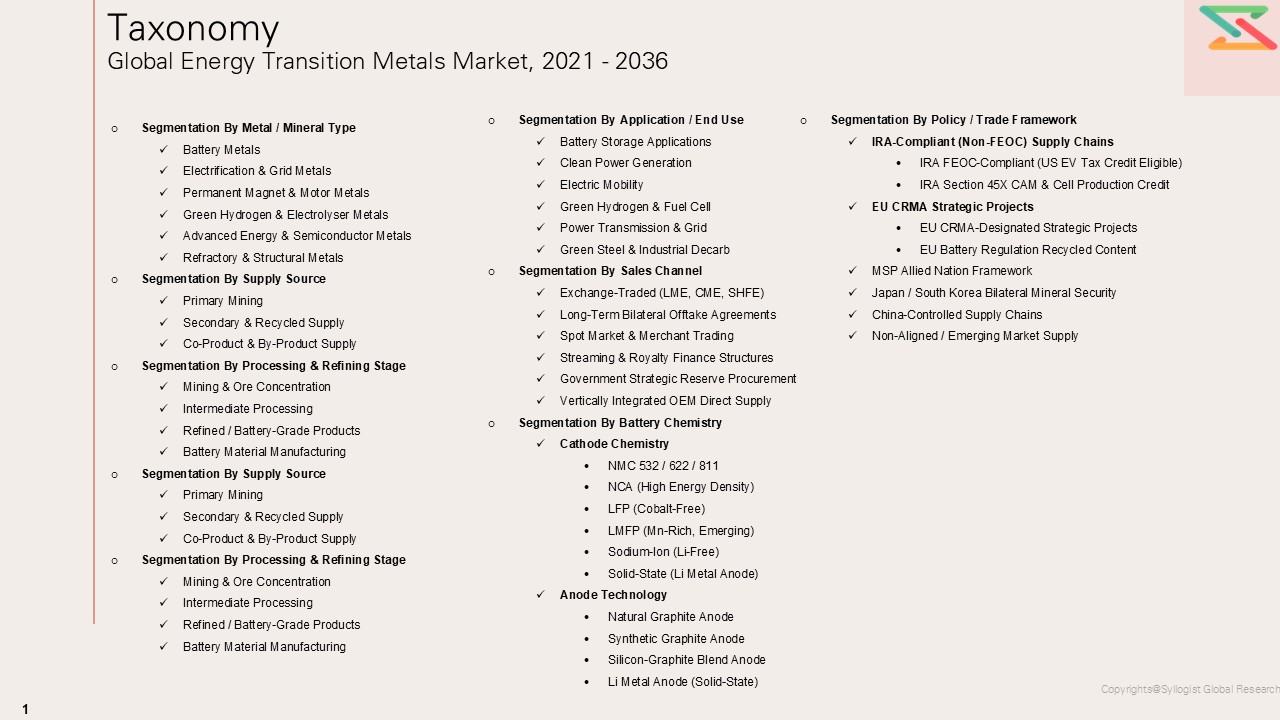
- Segmentation by Metal / Mineral Type
- Battery Metals
- Lithium (Spodumene, Brine, Lepidolite)
- Cobalt (Sulphide, Laterite, Artisanal)
- Nickel (Class I Sulphate, Laterite HPAL)
- Manganese (Battery-Grade Sulphate, HPMSM)
- Graphite (Flake, Spherical, Synthetic Anode)
- Electrification & Grid Metals
- Copper (Cathode, Rod, Sulphate)
- Aluminium (Primary Smelter-Grade)
- Silver (Solar PV Busbars & Contacts)
- Zinc (Grid-Scale Zinc-Air / Zinc-Ion Battery)
- Permanent Magnet & Motor Metals
- Neodymium (NdFeB Magnet Alloy)
- Praseodymium (NdPr Oxide, NdFeB Magnets)
- Dysprosium (Heavy Rare Earth, Magnet Coercivity)
- Terbium (Heavy Rare Earth, Magnet Heat Resistance)
- Boron (NdFeB Magnet Synthesis)
- Green Hydrogen & Electrolyser Metals
- Platinum (PEM Electrolyser Cathode Catalyst)
- Iridium (PEM Electrolyser Anode Catalyst)
- Palladium (Automotive Catalytic Convertor Transition)
- Ruthenium (Advanced PEM Catalyst)
- Advanced Energy & Semiconductor Metals
- Vanadium (Vanadium Redox Flow Battery, Green Steel)
- Molybdenum (Hydrogen Pipeline & Reactor Alloys)
- Gallium (III-V Semiconductors, Solar PV)
- Germanium (Fibre Optics, Solar PV)
- Indium (Thin-Film Solar PV, ITO Coatings)
- Silicon Metal (Solar Wafer, Battery Anode)
- Tellurium (CdTe Thin-Film Solar PV)
- Selenium (CIGS Thin-Film Solar PV)
- Refractory & Structural Transition Metals
- Chromium (EV Battery Cell Housing, Stainless Steel)
- Titanium (Offshore Wind Structure, H2 Equipment)
- Antimony (Flame Retardants, Flow Battery Electrolyte)
- Bismuth (Pb-Free Solder, Thermoelectric)
- Segmentation by Supply Source
- Primary Mining
- Hard Rock / Underground Mining
- Open Pit / Surface Mining
- Brine / Salar Extraction
- Laterite / Saprolite Mining
- Placer / Alluvial Mining
- Artisanal & Small-Scale Mining (ASM)
- Secondary & Recycled Supply
- Battery Recycling (Hydrometallurgical / Pyrometallurgical)
- EV Battery Second-Life & Repurposing
- E-Waste & Consumer Electronics Recovery
- Industrial Scrap Metal Recycling
- Catalyst Recovery & PGM Recycling
- Co-Product & By-Product Supply
- Cobalt from Copper Mining (DRC)
- Nickel from HPAL Laterite (Indonesia)
- PGMs from Nickel/Copper Sulphide (South Africa)
- Germanium & Gallium from Zinc Smelting
- Segmentation by Processing & Refining Stage
- Mining & Ore Concentration
- Flotation Concentrate
- Direct Shipping Ore (DSO)
- Heap Leach & SX-EW Cathode
- Hydrometallurgical & Pyrometallurgical Processing
- Lithium Hydroxide Monohydrate (LHM)
- Lithium Carbonate Equivalent (LCE)
- Cobalt Sulphate & Hydroxide
- Nickel Sulphate & Mixed Hydroxide Precipitate (MHP)
- Manganese Sulphate & HPMSM
- NdPr Oxide & Separated Rare Earth Oxides
- Battery Material Manufacturing
- Precursor Cathode Active Material (pCAM)
- Cathode Active Material (NMC, NCA, LFP, LMFP)
- Anode Active Material (Graphite, Silicon)
- Electrolyte & Separator Materials
- Segmentation by Application / End Use
- Battery Storage Applications
- Electric Vehicle Battery Packs (BEV, PHEV)
- Grid-Scale Battery Energy Storage (BESS)
- Consumer Electronics & Portable Battery
- Industrial & Commercial Battery
- Clean Power Generation
- Solar PV (Monocrystalline, Polycrystalline, Thin-Film)
- Offshore Wind (Permanent Magnet Generators)
- Onshore Wind
- Concentrated Solar Power (CSP)
- Electric Mobility
- Passenger EV Drivetrains & Motors
- Commercial EV & Electric Trucks
- Electric Two & Three-Wheelers
- EV Charging Infrastructure (Copper Cabling & Connectors)
- Green Hydrogen & Fuel Cell
- PEM Electrolyser Catalysts & Membrane
- Alkaline Electrolyser Components
- Hydrogen Fuel Cell Vehicles (FCEV)
- Hydrogen Storage & Distribution Infrastructure
- Power Transmission & Grid Infrastructure
- Green Steel, Aluminium & Industrial Decarbonisation
- Battery Storage Applications
- Segmentation by Mining Jurisdiction
- Australia (Lithium, Nickel, Rare Earths)
- Democratic Republic of Congo (Cobalt, Copper)
- Chile & Argentina (Lithium Brine, Copper)
- Indonesia (Nickel Laterite, Bauxite)
- South Africa (PGMs, Manganese, Chrome)
- China (Rare Earths, Graphite, Lithium)
- Canada (Nickel, Cobalt, Lithium, Rare Earths)
- Brazil (Lithium, Nickel, Niobium, Graphite)
- USA (Lithium, Rare Earths, Copper, Vanadium)
- Other (Philippines, Russia, Zimbabwe, Namibia, Morocco)
- Segmentation by Sales Channel
- Exchange-Traded (LME, CME, SHFE)
- Long-Term Bilateral Offtake Agreements
- Spot Market & Merchant Trading
- Streaming & Royalty Finance Structures
- Government Strategic Reserve Procurement
- Vertically Integrated OEM Direct Supply
- Mining & Ore Concentration
- Primary Mining
- Battery Metals
All market revenues are presented in USD; volume in metric tonnes of contained metal or lithium carbonate equivalent (LCE) as applicable
Historical Year: 2021–2024 | Base Year: 2025 | Estimated Year: 2026 | Forecast Period: 2027–2036
Key Questions this Study Will Answer
- What are the critical market metrics and forward-looking projections for the Global Energy Transition Metals Market, including total market value (USD), production volume (metric tonnes of contained metal), price forecast by metal (USD per tonne or per kg), and supply-demand balance analysis, segmented across Metal / Mineral Type (Lithium, Cobalt, Nickel, Manganese, Graphite, Copper, Aluminium, Rare Earths/NdPr/Dy/Tb, PGMs/Platinum/Iridium, Vanadium, Molybdenum, Gallium, Germanium, Silicon Metal, Tellurium, Indium, Antimony), Supply Source (Primary Mining sub-type, Secondary Recycled, Co-Product), Processing & Refining Stage (Concentrate, Hydroxide/Sulphate, pCAM/CAM/Anode), Application / End Use (EV Battery, BESS, Solar PV, Wind, Green Hydrogen, Power Transmission, Green Steel), Mining Jurisdiction, and Sales Channel?
- How are the IRA Foreign Entity of Concern (FEOC) provisions, the EU Critical Raw Materials Act Strategic Projects designation and 2030 processing targets, China’s export controls on graphite, gallium, germanium, antimony, and molybdenum, the Minerals Security Partnership (MSP) allied nation framework, the UK-Australia and US-Japan bilateral critical mineral agreements, and national critical mineral strategies in Canada, India, and South Korea collectively restructuring global energy transition metal trade flows, processing geography, project economics, and supply chain risk premiums, and what is the realistic timeline and total capital investment required for allied nations to achieve meaningful processing independence from Chinese refining capacity for each critical mineral?
- In what ways are battery chemistry evolution, specifically the global diffusion of LFP chemistry reducing cobalt demand, the development of LMFP and sodium-ion chemistries, silicon anode adoption reducing graphite intensity, solid-state battery commercialisation timelines, direct lithium extraction (DLE) technology maturation, and deep-sea nodule polymetallic mining development, altering metal-specific demand trajectories, project viability thresholds, long-term price equilibria, and the competitive positioning of mining jurisdictions whose ore body chemistry is optimised for currently dominant but potentially transitioning cathode chemistries?
- Who are the leading primary miners, integrated processing companies, cathode active material manufacturers, battery recyclers, and commodity trading houses across each energy transition metal, and how do they benchmark across key competitive dimensions including production cost per tonne at current price environments (cash cost, all-in sustaining cost), resource quality and reserve life (grade, mineralogy, strip ratio), processing capability maturity and battery-grade specification attainment, geographical footprint and jurisdictional risk profile, decarbonisation credentials (Scope 1, 2 and 3 intensity), ESG and responsible sourcing certifications (RMI RMAP, IRMA, CRAFT), strategic partnerships with EV OEMs and battery manufacturers, project development pipeline and growth optionality, and resilience to near-term price cycle volatility relative to the long-term supply-demand thesis?
- What strategic insights emerge from primary engagement with mining executives, battery technology developers, EV and clean energy OEM procurement heads, commodity traders, investment banks covering the metals complex, government critical mineral programme directors, and ESG and responsible sourcing specialists regarding the credible timeline for sufficient ex-China graphite anode and rare earth processing capacity to remove FEOC exposure from allied nation battery supply chains, the realistic economics of direct lithium extraction (DLE) from brine and geothermal sources under current and projected project financing conditions, the ESG performance gaps and human rights risks in DRC artisanal cobalt supply chains and the commercial viability of cobalt-free battery chemistry alternatives as a supply chain risk mitigation strategy, the actual versus modelled performance of battery hydrometallurgical recycling operations at commercial scale and the metal recovery economics that determine whether recycled supply is commercially competitive with primary supply at various metal price levels, and the critical investment priorities, in geology, metallurgy, processing technology, workforce, and infrastructure, that would most effectively close the supply gap for each energy transition metal between current announced project pipelines and the volumes required by 2030 net-zero pathway scenarios?
- Market Overview
- Product Overview
- Research Methodology
- Executive Summary
- Market Dynamics
- Market Dynamics (Drivers, Restraints, Opportunities, Challenges, Porter’s Five Forces Analysis, PESTLE Analysis)
- Market Trends & Developments
- Risk Assessment Framework
- Geopolitical & Supply Chain Concentration Risk
- Price Cycle & Commodity Volatility Risk
- Technology Substitution & Demand Displacement Risk
- ESG, Community & Regulatory Permitting Risk
- Regulatory Framework & Standards
- Global Regulatory Overview
- Key Industrial Policy & Critical Mineral Frameworks by Region
- USA: Inflation Reduction Act (IRA)
- USA: Bipartisan Infrastructure Law
- USA: Defense Production Act Title III
- USA: Minerals Security Partnership (MSP)
- EU: Critical Raw Materials Act (CRMA)
- EU: Net-Zero Industry Act (NZIA)
- EU: Corporate Sustainability Due Diligence Directive (CSDDD)
- EU: Battery Regulation (2023/1542)
- UK: Critical Minerals Strategy & Refresh
- Canada: Critical Minerals Strategy
- Australia: Critical Minerals Strategy
- Japan: Economic Security Promotion Act
- South Korea: K-Battery Initiative
- China: Export Controls on Gallium, Germanium, Graphite, Antimony, Molybdenum
- India: National Critical Mineral Mission
- Mining & Environmental Permitting Standards
- US NEPA Environmental Review & FAST-41 Permitting Reform
- EU CRMA Two-Year Permitting Deadline for Strategic Projects
- Australia EPBC Act & Critical Mineral Approvals Streamlining
- IFC Performance Standards for Mining (Environmental & Social)
- Equator Principles
- Responsible Sourcing & ESG Certification Standards
- Responsible Minerals Initiative (RMI) RMAP
- Initiative for Responsible Mining Assurance (IRMA) Standard for Responsible Mining
- CRAFT (Code of Risk-Mitigation for Artisanal Mining)
- ISO 14001
- London Metal Exchange (LME) Responsible Sourcing Requirements
- EU Battery Regulation
- Commodity Trading & Market Standards
- LME (London Metal Exchange)
- CME Group
- SHFE (Shanghai Futures Exchange)
- IUPAC Standards for Battery-Grade Metal Specification
- ASTM International Standards for Metal Quality & Testing
- Regulatory Impact on Market
- Global Energy Transition Metals Market Outlook
- Market Size & Forecast by Value
- Market Size & Forecast by Volume (Metric Tonnes Contained Metal)
- Market Size & Forecast by Metal / Mineral Type
- Battery Metals
- Lithium (Spodumene, Brine, Lepidolite)
- Cobalt (Sulphide, Laterite, Artisanal)
- Nickel (Class I Sulphate, Laterite HPAL)
- Manganese (Battery-Grade Sulphate, HPMSM)
- Graphite (Flake, Spherical, Synthetic Anode)
- Electrification & Grid Metals
- Copper (Cathode, Rod, Sulphate)
- Aluminium (Primary Smelter-Grade)
- Silver (Solar PV Busbars & Contacts)
- Zinc (Grid-Scale Zinc-Air / Zinc-Ion Battery)
- Permanent Magnet & Motor Metals
- Neodymium (NdFeB Magnet Alloy)
- Praseodymium (NdPr Oxide, NdFeB Magnets)
- Dysprosium (Heavy REE, Magnet Coercivity)
- Terbium (Heavy REE, Magnet Heat Resistance)
- Boron (NdFeB Magnet Synthesis)
- Green Hydrogen & Electrolyser Metals
- Platinum (PEM Electrolyser Cathode Catalyst)
- Iridium (PEM Electrolyser Anode Catalyst)
- Palladium (Automotive Catalyst Transition)
- Ruthenium (Advanced PEM Catalyst)
- Advanced Energy & Semiconductor Metals
- Vanadium (Redox Flow Battery, Green Steel)
- Molybdenum (H2 Pipeline & Reactor Alloys)
- Gallium (III-V Semiconductors, Solar PV)
- Germanium (Fibre Optics, Thin-Film Solar)
- Indium (Thin-Film Solar PV, ITO Coatings)
- Silicon Metal (Solar Wafer, Battery Anode)
- Tellurium (CdTe Thin-Film Solar PV)
- Selenium (CIGS Thin-Film Solar PV)
- Refractory & Structural Transition Metals
- Chromium (EV Battery Cell Housing, Stainless Steel)
- Titanium (Offshore Wind, H2 Equipment)
- Antimony (Flame Retardants, Flow Battery Electrolyte)
- Bismuth (Pb-Free Solder, Thermoelectric)
- Battery Metals
- Market Size & Forecast by Supply Source
- Primary Mining
- Hard Rock / Underground Mining
- Open Pit / Surface Mining
- Brine / Salar Extraction
- Laterite / Saprolite Mining
- Placer / Alluvial Mining
- Artisanal & Small-Scale Mining (ASM)
- Deep-Sea Nodule Mining (Emerging)
- Secondary & Recycled Supply
- Battery Recycling
- Battery Recycling
- EV Battery Second-Life & Repurposing
- E-Waste & Consumer Electronics Recovery
- Industrial Scrap Metal Recycling
- Catalyst Recovery & PGM Recycling
- Co-Product & By-Product Supply
- Cobalt from Copper Mining (DRC)
- Nickel from HPAL Laterite (Indonesia)
- PGMs from Nickel/Copper Sulphide (South Africa)
- Germanium & Gallium from Zinc Smelting
- Tellurium & Selenium from Copper Refining
- Primary Mining
- Market Size & Forecast by Processing & Refining Stage
- Mining & Ore Concentration
- Flotation Concentrate
- Direct Shipping Ore (DSO)
- Heap Leach & SX-EW Copper Cathode
- Brine Evaporation & Lithium Concentrate
- Intermediate Processing
- Mixed Hydroxide Precipitate (MHP)
- Mixed Sulphide Precipitate (MSP)
- Cobalt Hydroxide & Crude Cobalt Sulphate
- Spodumene Concentrate (SC6)
- Rare Earth Carbonate & Chloride Intermediate
- Refined / Battery-Grade Products
- Lithium Hydroxide Monohydrate (LHM)
- Lithium Carbonate Equivalent (LCE)
- Cobalt Sulphate: Battery Grade
- Nickel Sulphate: Battery Grade
- Manganese Sulphate & HPMSM
- NdPr Oxide & Separated Rare Earth Oxides
- High-Purity Spherical Graphite (CSPG)
- Copper Cathode (Grade A, LME Registered)
- Battery Material Manufacturing
- Precursor Cathode Active Material (pCAM)
- Cathode Active Material
- Cathode Active Material
- Cathode Active Material
- Cathode Active Material
- Anode Active Material
- Anode Active Material
- Anode Active Material
- Electrolyte Salts & Solvents
- Separator Materials
- Mining & Ore Concentration
- Market Size & Forecast by Application / End Use
- Battery Storage Applications
- Electric Vehicle Battery Packs (BEV)
- Plug-In Hybrid EV Battery Packs (PHEV)
- Grid-Scale Battery Energy Storage (BESS)
- Consumer Electronics & Portable Battery
- Industrial & Commercial Battery (UPS, Forklifts)
- Clean Power Generation
- Solar PV: Monocrystalline (PERC, TOPCon, HJT)
- Solar PV: Polycrystalline
- Solar PV: Thin-Film (CdTe, CIGS, Perovskite)
- Offshore Wind: Permanent Magnet Generators
- Onshore Wind: Permanent Magnet & Wound Rotor
- Concentrated Solar Power (CSP)
- Electric Mobility
- Passenger EV Drivetrains & Permanent Magnet Motors
- Commercial EV & Electric Heavy-Duty Trucks
- Electric Two & Three-Wheelers
- EV Charging Infrastructure (Copper Cabling & Connectors)
- Electric Aviation & Marine (Emerging)
- Green Hydrogen & Fuel Cell
- PEM Electrolyser
- Alkaline Electrolyser
- Hydrogen Fuel Cell Vehicles (FCEV)
- Hydrogen Storage & Distribution Infrastructure
- Ammonia Synthesis
- Power Transmission & Grid Infrastructure
- High-Voltage Direct Current (HVDC) Cables
- Transformer Windings & Substation Equipment
- Smart Grid Sensors & Monitoring
- Green Steel, Aluminium & Industrial Decarbonisation
- Direct Reduced Iron (DRI) & Electric Arc Furnace (EAF) Steel
- Primary Aluminium Smelting (Renewable-Powered)
- Green Ammonia & Fertiliser Production
- Industrial Heat Electrification
- Battery Storage Applications
- Market Size & Forecast by Mining Jurisdiction
- Australia (Lithium, Nickel, Rare Earths, Copper)
- Democratic Republic of Congo (Cobalt, Copper)
- Chile & Argentina (Lithium Brine, Copper, Manganese)
- Indonesia (Nickel Laterite, Bauxite)
- South Africa (PGMs, Manganese, Chrome, Vanadium)
- China (Rare Earths, Graphite, Lithium, Antimony)
- Canada (Nickel, Cobalt, Lithium, Rare Earths, Copper)
- Brazil (Lithium, Nickel, Niobium, Graphite, Rare Earths)
- USA (Lithium, Rare Earths, Copper, Vanadium, Graphite)
- Russia (Nickel, PGMs, Cobalt, Copper)
- Philippines (Nickel Laterite)
- Zimbabwe (Lithium, Chrome, PGMs)
- Namibia (Lithium, Rare Earths, Copper, Uranium)
- Morocco (Cobalt, Manganese, Phosphates)
- Other Jurisdictions
- Market Size & Forecast by Sales Channel
- Exchange-Traded (LME, CME, SHFE)
- Long-Term Bilateral Offtake Agreements
- Spot Market & Merchant Trading
- Streaming & Royalty Finance Structures
- Government Strategic Reserve Procurement
- Vertically Integrated OEM Direct Supply
- Market Size & Forecast by Region
- Asia-Pacific
- North America
- Europe
- Latin America
- Middle East & Africa
- Lithium Market Outlook
- Market Size & Forecast
- By Value
- By Volume (Metric Tonnes Contained Metal)
- By Supply Source
- By Processing & Refining Stage
- By Application / End Use
- By Mining Jurisdiction
- By Sales Channel
- By Lithium Compound (LCE vs LHM)
- By Extraction Technology (Hard Rock, Brine, DLE, Lepidolite)
- Supply-Demand Balance & Price Forecast (USD/tonne LCE)
- Market Size & Forecast
- Cobalt Market Outlook
- Market Size & Forecast
- By Value
- By Volume (Metric Tonnes Contained Metal)
- By Supply Source
- By Processing & Refining Stage
- By Application / End Use
- By Mining Jurisdiction
- By Sales Channel
- By Cobalt Form (Sulphate, Hydroxide, Metal, Alloy)
- DRC ASM vs Integrated Mine Supply Analysis
- Supply-Demand Balance & Price Forecast (USD/tonne)
- Market Size & Forecast
- Nickel Market Outlook
- Market Size & Forecast
- By Value
- By Volume (Metric Tonnes Contained Metal)
- By Supply Source
- By Processing & Refining Stage
- By Application / End Use
- By Mining Jurisdiction
- By Sales Channel
- By Nickel Class (Class I Sulphate, Class II, NPI, FeNi)
- Laterite HPAL vs Sulphide Processing Economics
- Supply-Demand Balance & Price Forecast (USD/tonne)
- Market Size & Forecast
- Copper Market Outlook
- Market Size & Forecast
- By Value
- By Volume (Metric Tonnes Contained Metal)
- By Supply Source
- By Processing & Refining Stage
- By Application / End Use
- By Mining Jurisdiction
- By Sales Channel
- By Copper Form (Cathode, Rod, Concentrate, Sulphate)
- Smelter Treatment Charges & Refinery Premium Analysis
- Supply-Demand Balance & Price Forecast (USD/tonne)
- Market Size & Forecast
- Graphite Market Outlook
- Market Size & Forecast
- By Value
- By Volume (Metric Tonnes Contained Metal)
- By Supply Source
- By Processing & Refining Stage
- By Application / End Use
- By Mining Jurisdiction
- By Sales Channel
- By Graphite Type (Flake, Spherical, Synthetic, Expandable)
- China Dominance Risk & Ex-China Production Pathway
- Supply-Demand Balance & Price Forecast (USD/tonne)
- Market Size & Forecast
- Rare Earth Elements (NdPr, Dy, Tb) Market Outlook
- Market Size & Forecast
- By Value
- By Volume (Metric Tonnes Contained Metal)
- By Supply Source
- By Processing & Refining Stage
- By Application / End Use
- By Mining Jurisdiction
- By Sales Channel
- By REE Compound (NdPr Oxide, Dy Oxide, Tb Oxide, Separated REOs)
- China Dominance & Western Rare Earth Supply Build-Up
- Supply-Demand Balance & Price Forecast (USD/kg)
- Market Size & Forecast
- Platinum Group Metals (Platinum, Iridium, Palladium) Market Outlook
- Market Size & Forecast
- By Value
- By Volume (Metric Tonnes Contained Metal)
- By Supply Source
- By Processing & Refining Stage
- By Application / End Use
- By Mining Jurisdiction
- By Sales Channel
- By PGM (Platinum, Iridium, Palladium, Rhodium, Ruthenium)
- Automotive Catalyst vs Electrolyser Demand Transition
- Supply-Demand Balance & Price Forecast (USD/troy oz)
- Market Size & Forecast
- Manganese Market Outlook
- Market Size & Forecast
- By Value
- By Volume (Metric Tonnes Contained Metal)
- By Supply Source
- By Processing & Refining Stage
- By Application / End Use
- By Mining Jurisdiction
- By Sales Channel
- By Manganese Grade (Battery-Grade HPMSM, Electrolytic, Metallurgical)
- Supply-Demand Balance & Price Forecast (USD/tonne)
- Market Size & Forecast
- Vanadium Market Outlook
- Market Size & Forecast
- By Value
- By Volume (Metric Tonnes Contained Metal)
- By Supply Source
- By Processing & Refining Stage
- By Application / End Use
- By Mining Jurisdiction
- By Sales Channel
- By Vanadium Form (V2O5, Ferrovanadium, Vanadium Electrolyte)
- Supply-Demand Balance & Price Forecast (USD/lb V2O5)
- Market Size & Forecast
- Gallium & Germanium Market Outlook
- Market Size & Forecast
- By Value
- By Volume (Metric Tonnes Contained Metal)
- By Supply Source
- By Processing & Refining Stage
- By Application / End Use
- By Mining Jurisdiction
- By Sales Channel
- China Export Control Impact & Supply Diversification
- Supply-Demand Balance & Price Forecast (USD/kg)
- Market Size & Forecast
- Asia-Pacific Energy Transition Metals Market Outlook
- Market Size & Forecast
- By Value
- By Metal / Mineral Type
- By Supply Source
- By Processing & Refining Stage
- By Application / End Use
- By Mining Jurisdiction
- By Sales Channel
- Market Size & Forecast
- North America Energy Transition Metals Market Outlook
- Market Size & Forecast
- By Value
- By Metal / Mineral Type
- By Supply Source
- By Processing & Refining Stage
- By Application / End Use
- By Mining Jurisdiction
- By Sales Channel
- Market Size & Forecast
- Europe Energy Transition Metals Market Outlook
- Market Size & Forecast
- By Value
- By Metal / Mineral Type
- By Supply Source
- By Processing & Refining Stage
- By Application / End Use
- By Mining Jurisdiction
- By Sales Channel
- Market Size & Forecast
- Latin America Energy Transition Metals Market Outlook
- Market Size & Forecast
- By Value
- By Metal / Mineral Type
- By Supply Source
- By Processing & Refining Stage
- By Application / End Use
- By Mining Jurisdiction
- By Sales Channel
- Market Size & Forecast
- Middle East & Africa Energy Transition Metals Market Outlook
- Market Size & Forecast
- By Value
- By Metal / Mineral Type
- By Supply Source
- By Processing & Refining Stage
- By Application / End Use
- By Mining Jurisdiction
- By Sales Channel
- Market Size & Forecast
- Country & Jurisdiction Wise* Energy Transition Metals Market Outlook
- Market Size & Forecast
- By Value
- By Metal / Mineral Type
- By Supply Source
- By Processing & Refining Stage
- By Application / End Use
- By Sales Channel
- Market Size & Forecast
- *Countries & Jurisdictions Analyzed in the Syllogist Global Research Portfolio: Australia, Democratic Republic of Congo, Chile, Argentina, Indonesia, South Africa, China, Canada, Brazil, United States, Russia, Philippines, Zimbabwe, Namibia, Morocco, Japan, South Korea, Germany, United Kingdom, France, Portugal, Finland, Sweden, Norway, Belgium, Netherlands, Spain, India, Bolivia, Peru
- Technology Analysis
- Mining Technology Assessment by Metal & Deposit Type
- Hard Rock Lithium: Spodumene Flotation & Calcination
- Lithium Brine: Evaporation Pond, Selective Adsorption, DLE
- Direct Lithium Extraction (DLE): Sorbent, Ion Exchange, Membrane
- Nickel Laterite Processing: RKEF vs HPAL Technology Comparison
- Nickel Sulphide Processing: Flotation, Smelting, Refining
- Cobalt Hydrometallurgical Processing: Solvent Extraction & Electrowinning
- Rare Earth Processing: Cracking, Separation & Purification
- Deep-Sea Nodule Mining Technology: TRL Assessment
- Battery Chemistry Evolution & Metal Demand Implications
- NMC 523 vs NMC 622 vs NMC 811
- NCA Chemistry: High Energy Density, Al Substitution
- LFP (Lithium Iron Phosphate): Cobalt-Free, Lower Energy Density
- LMFP (Lithium Manganese Iron Phosphate): Mn Demand Driver
- Sodium-Ion Battery: Li-Free Option, Fe & Mn Demand Implications
- Solid-State Battery Commercialisation: Li Metal Anode Implications
- Silicon Anode Adoption: Graphite Intensity Reduction Pathway
- Lithium-Sulphur & Lithium-Air: Long-Term Research Options
- Cathode Active Material (CAM) & pCAM Processing Technology
- Co-Precipitation for NMC pCAM: Process Variables & Metal Specs
- Solid-State Sintering for CAM: Temperature, Atmosphere, Yield
- Single Crystal vs Polycrystalline CAM: Performance Trade-Offs
- LFP Hydrothermal & Solid-State Synthesis Routes
- Battery Recycling Technology
- Pyrometallurgical Recycling
- Hydrometallurgical Recycling
- Direct Cathode Recycling
- Battery Disassembly Automation
- Metal Recovery Rates by Technology (Li, Co, Ni, Mn, Cu, Al)
- Economics of Recycled Supply vs Primary Supply at Varying Metal Prices
- Green Hydrogen Production Technology & PGM Demand
- PEM Electrolyser
- Alkaline Electrolyser
- SOEC (Solid Oxide Electrolyser)
- Iridium Supply Constraint Modelling
- Permanent Magnet Technology & Rare Earth Demand
- NdFeB Sintered vs Bonded Magnet Comparison
- Heavy REE (Dy, Tb) Grain Boundary Diffusion Technology
- REE Recycling from End-of-Life Motors & Generators
- REE-Free Motor Alternatives: Induction, Wound Rotor, Ferrite Magnet
- Advanced Mining Technology & Digital Innovation
- Geometallurgical Modelling & AI-Assisted Ore Body Characterisation
- Autonomous Mining Equipment Deployment
- Digital Twins for Mine Planning & Processing Optimisation
- Real-Time Sensor Fusion for Grade Control
- Water Recycling & Tailings Dry Stacking Technology
- Emerging Extraction & Processing Technologies
- Direct Lithium Extraction (DLE) from Geothermal Brines
- Bio-Hydrometallurgy for Low-Grade Nickel & Cobalt Ores
- Electrochemical Lithium Recovery from Seawater
- Ionic Liquid Solvent Extraction for REE Separation
- Carbon-Neutral Smelting for Copper & Nickel
- Mining Technology Assessment by Metal & Deposit Type
- Value Chain & Supply Chain Analysis
- Exploration & Resource Definition
- Mining & Ore Extraction
- Beneficiation & Concentration
- Hydrometallurgical / Pyrometallurgical Processing
- Refining to Battery-Grade or Metal Specification
- Cathode Active Material (CAM) & pCAM Manufacturing
- Anode Material & Electrolyte Manufacturing
- Battery Cell & Pack Manufacturing
- End-Use Clean Energy Technology OEM
- Battery Recycling & Secondary Material Recovery
- Ecosystem Map
- Supply Chain Analysis
- Upstream Mining Concentration by Metal & Jurisdiction
- Processing & Refining Concentration: China Dominance Map
- CAM & pCAM Manufacturing Geography: China, Korea, Japan, Europe
- Ex-China Processing Pipeline: Capital Committed & Timeline
- Supply Chain Risk Scoring by Metal (Geopolitical, Environmental, Social)
- Artisanal Mining Integration: DRC Cobalt Formalisation Progress
- Trade Flow Analysis
- Major Exporting Jurisdictions by Metal (Concentrate, Refined, Processed)
- Major Importing Nations by Metal & Processing Stage
- Chinese Processing Dominance in Bilateral Trade Flows
- IRA & CRMA Impact on Trade Route Restructuring
- Sanctions, Export Controls & Critical Mineral Trade Policy Effects
- Pricing Analysis
- Historical Price Review by Metal (2019–2025)
- Lithium (LCE & LHM): 2022 Peak, 2023–2025 Correction Analysis
- Cobalt (Sulphate & Metal): DRC Supply Surplus & LFP Demand Impact
- Nickel (LME, NPI, Class I Sulphate Premium)
- Copper (LME Grade A Cathode)
- Rare Earths (NdPr Oxide, Dy Oxide, Tb Oxide)
- PGMs (Platinum, Iridium, Palladium, Rhodium): Automotive Transition
- Graphite (Flake & Spherical)
- Vanadium (V2O5 & Ferrovanadium)
- Gallium & Germanium: Pre & Post-Export Control Price Analysis
- Price Driver Analysis by Metal
- Supply-Demand Balance Sensitivity
- Inventory Cycle & Speculative Position Analysis
- Battery Chemistry Evolution Impact on Metal Price Equilibria
- Chinese Production Cost & Export Price Policy
- Energy & Reagent Cost Pass-Through to Metal Price
- Price Forecast by Metal (2026–2036)
- Lithium: Base, Bull, Bear Scenario (USD/tonne LCE)
- Cobalt: Base, Bull, Bear Scenario (USD/tonne)
- Nickel: Class I Sulphate Premium (USD/tonne)
- Copper: Long-Run Equilibrium (USD/tonne)
- NdPr Oxide: Price Forecast with REE Supply Build-Up
- Platinum & Iridium: Electrolyser Demand Uplift Scenarios
- Price Tier Analysis by Processing Stage
- Ore / Concentrate Pricing vs Refinery Products Premium
- Battery-Grade Premium vs Metallurgical-Grade Differential
- Recycled Supply Discount / Premium vs Primary Metal
- Ex-China Processing Premium under IRA FEOC Compliance
- Cost Curve Analysis by Metal
- Lithium: Quartile Cash Cost Curve by Source Type
- Cobalt: DRC vs Non-DRC Production Cost Comparison
- Nickel: HPAL Laterite vs Sulphide Cost Comparison
- Copper: C1, C2, C3 All-In Sustaining Cost Distribution
- Historical Price Review by Metal (2019–2025)
- Sustainability, ESG & Responsible Sourcing
- Carbon Footprint by Metal & Processing Route (Scope 1, 2, 3 tCO2e/tonne)
- Mining Water Consumption & Scarcity Risk by Jurisdiction
- Biodiversity & Land Use Impact Assessment: Critical Habitat Proximity
- Tailings Management & Environmental Liability
- Human Rights & Labour Standards in Mining Supply Chains
- DRC Artisanal Cobalt: Child Labour Risk & CRAFT/RMAP Compliance
- Philippines Nickel: Indigenous Community Rights
- Bolivia & Argentina Lithium Brine: Water Rights & Community Consent
- Due Diligence Requirements under EU CSDDD & Battery Regulation
- Responsible Sourcing Certification Landscape
- RMI RMAP: Cobalt, Tin, Tantalum, Gold Smelter Programme
- IRMA: Independent Audit Standard for Mine Sites
- CRAFT: Artisanal Cobalt Formalisation in DRC
- LME Responsible Sourcing Requirements
- ISO 14001 & ISO 45001 Mine Site Certification
- Green Mining Technology & Decarbonisation
- Renewable Energy Transition for Mining Operations
- Electric & Hydrogen-Powered Mining Equipment
- Carbon-Neutral Smelting & Processing Pathways
- Mine Closure, Rehabilitation & Remediation Standards
- ESG Reporting Frameworks for Mining & Metals
- GRI Mining & Metals Sector Supplement
- TCFD Physical & Transition Risk Disclosure for Mining Assets
- Science Based Targets for Nature (SBTn): Mining Sector
- ISSB IFRS S1/S2: Sustainability & Climate Disclosures
- EU Taxonomy Alignment: Critical Mineral Extraction as Enabling Activity
- Circular Economy & Battery Recycling Policy
- EU Battery Regulation: Mandatory Recycled Content by 2031 & 2036
- US Battery Recycling Incentives under IRA
- China Extended Producer Responsibility for EV Batteries
- Collection Infrastructure Development: National Schemes
- Go-to-Market & Distribution
- Sales Channel Overview
- Exchange-Traded Markets: LME, CME, SHFE Mechanics
- Bilateral Offtake Agreements: Structure, Duration & Pricing Formulae
- Spot Market & Merchant Trading Houses
- Streaming & Royalty Financing Structures
- Government Strategic Reserve Procurement & Stockpiling
- Vertically Integrated OEM Direct-from-Mine Supply
- Offtake Agreement Landscape by Metal
- Lithium Offtake: Auto OEM & Battery Manufacturer Direct Procurement
- Cobalt Offtake: DRC Integrated vs Spot Purchase
- Nickel Sulphate Offtake: CAM Manufacturer Long-Term Agreements
- Copper Offtake: Smelter TC/RC Negotiations & Concentrate Purchase
- Rare Earth Offtake: Motor Manufacturer & Magnet Producer Direct
- Merchant Trading & Physical Commodity Flows
- Major Commodity Traders in Critical Minerals (Glencore, Trafigura, Traxys)
- Physical Arbitrage Between LME, SHFE & Regional Spot Markets
- Logistics, Shipping & Warehousing for Energy Transition Metals
- Financing Structures for Mining & Processing Projects
- Project Finance: Debt, Equity & Royalty Structures
- Government-Backed Loans & Export Credit Agency Guarantees
- Streaming Finance: Royal Gold, Wheaton Precious Metals, Franco-Nevada
- Strategic Equity Investment by OEMs in Mine & Refinery Assets
- Sales Channel Overview
- Competitive Landscape
- Market Structure & Concentration
- Market Concentration by Metal: HHI Analysis
- Top 10 Producers by Metal (Volume & Market Share)
- Chinese vs Non-Chinese Processing Share by Metal
- Competitive Intensity Map: Metal vs Jurisdiction
- Player Classification
- Diversified Global Mining Majors
- BHP: Copper, Nickel, Potash
- Rio Tinto: Lithium, Copper, Titanium, Boron, Rare Earths
- Glencore: Cobalt, Copper, Nickel, Zinc
- Anglo American: Platinum Group Metals, Copper, Nickel
- Vale: Nickel, Copper, Cobalt, Manganese
- Lithium Specialists
- Albemarle Corporation: Global Lithium Chemicals Leader
- SQM (Sociedad Quimica y Minera): Chile Lithium Brine
- Livent (Now Arcadium Lithium): Lithium Hydroxide
- Pilbara Minerals: Pilgangoora Spodumene, Australia
- Allkem / Arcadium: Integrated Lithium Producer
- Cobalt & Nickel Specialists
- Umicore: Cobalt Refining, CAM, Battery Recycling
- Freeport Cobalt (Now Koboltti Chemicals)
- Norilsk Nickel: Nickel, PGMs, Cobalt, Copper (Russia)
- Nickel Industries: Indonesian RKEF & HPAL
- Wyloo Metals / Kambalda Nickel: Australia
- Rare Earth Producers
- MP Materials: Mountain Pass, California
- Lynas Rare Earths: Mt Weld Australia, Malaysia Processing
- Energy Fuels: White Mesa Mill, US REE Processing
- Iluka Resources: Australian Synthetic Rutile & REE
- China Northern Rare Earth Group: Dominant Global Producer
- Battery Recyclers & Circular Economy Players
- Li-Cycle: Spoke & Hub Hydrometallurgical Recycling
- Redwood Materials: Integrated Li-Ion Battery Recycling
- Umicore: Battery Recycling & Precious Metal Recovery
- BASF: Battery Recycling & CAM
- Retriev Technologies: Battery Recycling
- Chinese Integrated Processors
- CATL: Battery Manufacturing & Vertical Mineral Integration
- Ganfeng Lithium: Lithium Mining, Processing & Battery
- Huayou Cobalt: DRC Cobalt, Ni/Co Sulphate, CAM
- Zhejiang Huafon: Nickel Sulphate
- CMOC Group: DRC Cobalt & Copper
- Emerging & Development-Stage Producers
- Diversified Global Mining Majors
- Competitive Analysis Frameworks
- Market Share Analysis by Metal, Volume & Revenue
- Company Profile
- Company Overview, HQ & Listing
- Metal Portfolio: Primary & Secondary Commodities
- Resource Base: Measured, Indicated, Inferred (Tonnes & Grade)
- Reserve Life Index (RLI) & Mine Life
- Production Volume (Current & Guidance)
- Cash Cost & AISC per Tonne of Contained Metal
- Processing Capability: Battery-Grade Specification Attainment
- Revenue & Critical Mineral Segment Revenue
- Geographic Footprint & Jurisdictional Risk Diversification
- ESG Rating & Responsible Sourcing Certification Status
- Strategic Offtake & OEM Partnership Portfolio
- Government Support: Grants, Loans, Tax Credits Received
- Recent Developments (Acquisitions, Project FID, Offtake, Partnerships)
- SWOT Analysis
- Growth Pipeline: Development Projects & Exploration Assets
- Competitive Positioning Map (Cost Curve vs Scale vs ESG)
- Patent & Technology Landscape: DLE, CAM Synthesis, Recycling
- Market Structure & Concentration
- Investment & Project Finance Landscape
- Total Capital Required to Meet 2030 & 2040 Supply Targets by Metal
- Government Investment & Incentive Programmes
- US: IRA Section 45X, 48C, DOE LPO Loans (USD 20B+ Committed)
- EU: CRMA Strategic Projects: 47 Projects Designated (2026)
- EU: European Investment Bank Critical Mineral Facility
- Canada: Critical Mineral Infrastructure Fund
- Australia: Critical Minerals Facility: Export Finance Australia
- Japan: JOGMEC Equity Participation & Offtake Guarantee Fund
- UK: UK Export Finance Critical Mineral Support
- India: National Critical Mineral Mission Fund
- Private Capital & Investment Activity (2021–2026)
- Mining Equity Capital Markets: IPO, Secondary, Private Placement
- Private Equity & Infrastructure Fund Critical Mineral Activity
- Venture Capital in DLE, Battery Recycling & Alternative Chemistry
- OEM Strategic Investment in Mine & Refinery Equity (GM, Tesla, VW, Ford)
- Streaming & Royalty Finance
- Royal Gold, Wheaton Precious Metals, Franco-Nevada: Critical Mineral Expansion
- Triple Flag, Osisko Royalties: Emerging Base & Critical Metal Royalties
- Project Finance for Large Critical Mineral Assets
- Debt vs Equity Structure for Mine Development
- Export Credit Agency (ECA): US EXIM, UKEF, EDC, Euler Hermes
- Project Risk Allocation: Offtake, Political Risk Insurance, Performance Bonds
- M&A Activity: Consolidation & Strategic Acquisitions (2021–2026)
- Project Pipeline: Development, Construction & First Production (2025–2036)
- Strategic Recommendations
- For Mining Companies & Integrated Processors
- Portfolio Strategy: Metal Mix for Optimal Clean Energy Demand Exposure
- Processing Capability Investment: Battery-Grade Specification Roadmap
- Cost Curve Positioning: Operational Excellence in Low-Price Environment
- Jurisdictional Risk Diversification: IRA/CRMA-Aligned Asset Portfolio
- ESG & Responsible Sourcing as Competitive Differentiator
- Downstream Integration Strategy: CAM, Recycling, Battery Materials
- M&A & Joint Venture Strategy for Processing Scale
- For Battery Manufacturers & EV OEMs
- Critical Mineral Supply Security Strategy: Long-Term Offtake Design
- FEOC Compliance Roadmap: Chinese Processing Bypass Timeline by Metal
- Vertical Integration Assessment: Mine Equity vs Offtake vs Spot
- Battery Chemistry Portfolio: Cobalt Risk vs Energy Density Trade-Off
- Recycling Investment: Closed-Loop Supply Chain Development
- Supplier ESG Due Diligence Programme: EU CSDDD & Battery Regulation
- For Commodity Traders & Financial Investors
- Critical Mineral Positioning Strategy: Long-Term Structural vs Cyclical
- Metal-Specific Supply-Demand Thesis by Price Cycle Stage
- Streaming & Royalty Opportunity Map: Critical Mineral Expansion
- Physical vs Derivatives Exposure Optimisation
- ESG Integration in Mining Investment Due Diligence
- For Governments & Policy Makers
- Critical Mineral Strategy Design: IRA & CRMA as Implementation Templates
- Permitting Reform: Timeline Compression Without Environmental Compromise
- Allied Nation Supply Chain Coordination: MSP Deepening
- China Export Control Response: Strategic Stockpile & Alternative Supply
- Responsible Sourcing Minimum Standards for Government Procurement
- R&D Investment in DLE, CAM Synthesis, Recycling & Alternative Chemistry
- For ESG & Sustainability Professionals
- Supply Chain Scope 3 Accounting for Mining Inputs
- Responsible Sourcing Programme Architecture: RMI, IRMA, CRAFT Integration
- Community & Free Prior Informed Consent (FPIC) Best Practice
- Circular Economy KPIs for Battery Metal Recovery Rates
- White Space & Opportunity Analysis
- Technology White Spaces: DLE Scale-Up, Bio-Hydromet, Deep-Sea Nodules
- Geographic White Spaces: Greenland, Kazakhstan, East Africa
- Emerging Business Models: Metal-as-a-Service, Circular Offtake
- Undersupplied Metals: Iridium, Tellurium, Gallium, Scandium
- Strategic Priority Matrix & Roadmap
- Near-term (2025–2028): Supply Gap Management & FEOC Compliance
- Mid-term (2029–2032): Ex-China Processing Scale & Recycling Ramp
- Long-term (2033–2036): Circular Supply Dominance & New Chemistry Transition
- For Mining Companies & Integrated Processors