Market Definition
The Global Autonomous Mining Equipment Market encompasses the design, engineering, manufacturing, integration, deployment, and after-sale support of self-operating and remotely supervised mining machinery that utilises advanced perception, navigation, communication, and artificial intelligence systems to execute mining production tasks with reduced or eliminated requirement for onboard human operators, spanning open pit surface mining, underground hard rock and coal mining, quarrying, and in-situ extraction applications across the complete spectrum of mining commodity sectors. Autonomous mining equipment includes autonomous haulage systems comprising large-capacity dump trucks operating without cab-based drivers under supervisory control from remote operations centres; automated drilling and blast hole drilling rigs that position, align, and execute drilling programs using machine guidance and geospatial positioning systems; autonomous dozing and grading systems for waste dump and haul road management; automated underground load-haul-dump machines and mine trucks operating in trackless underground environments; autonomous longwall mining systems; automated tunnel boring and development heading equipment; robotic rock bolting and ground support installation systems; and the enabling technology infrastructure encompassing high-precision global navigation satellite system positioning, underground wireless communication networks, three-dimensional mine environment perception and mapping systems, collision avoidance and proximity detection platforms, fleet management and dispatch systems, and remote operations centre hardware and software that collectively constitute the complete autonomous mining equipment ecosystem. The market value chain extends from original equipment manufacturers and autonomous technology system integrators through mining technology software vendors, communication infrastructure suppliers, training and simulation system providers, to the mining operators whose productivity, safety, and cost imperatives drive autonomous equipment procurement, deployment, and lifecycle management decisions. Key participants include global mining equipment original equipment manufacturers integrating autonomous capability into standard equipment platforms, specialist autonomous system technology developers, mining automation software companies, communications infrastructure providers, and the large-scale mining operators whose fleet size, operational scale, and technology investment capacity have positioned them as the primary early adopters and commercial development partners for autonomous mining equipment technology.
Market Insights
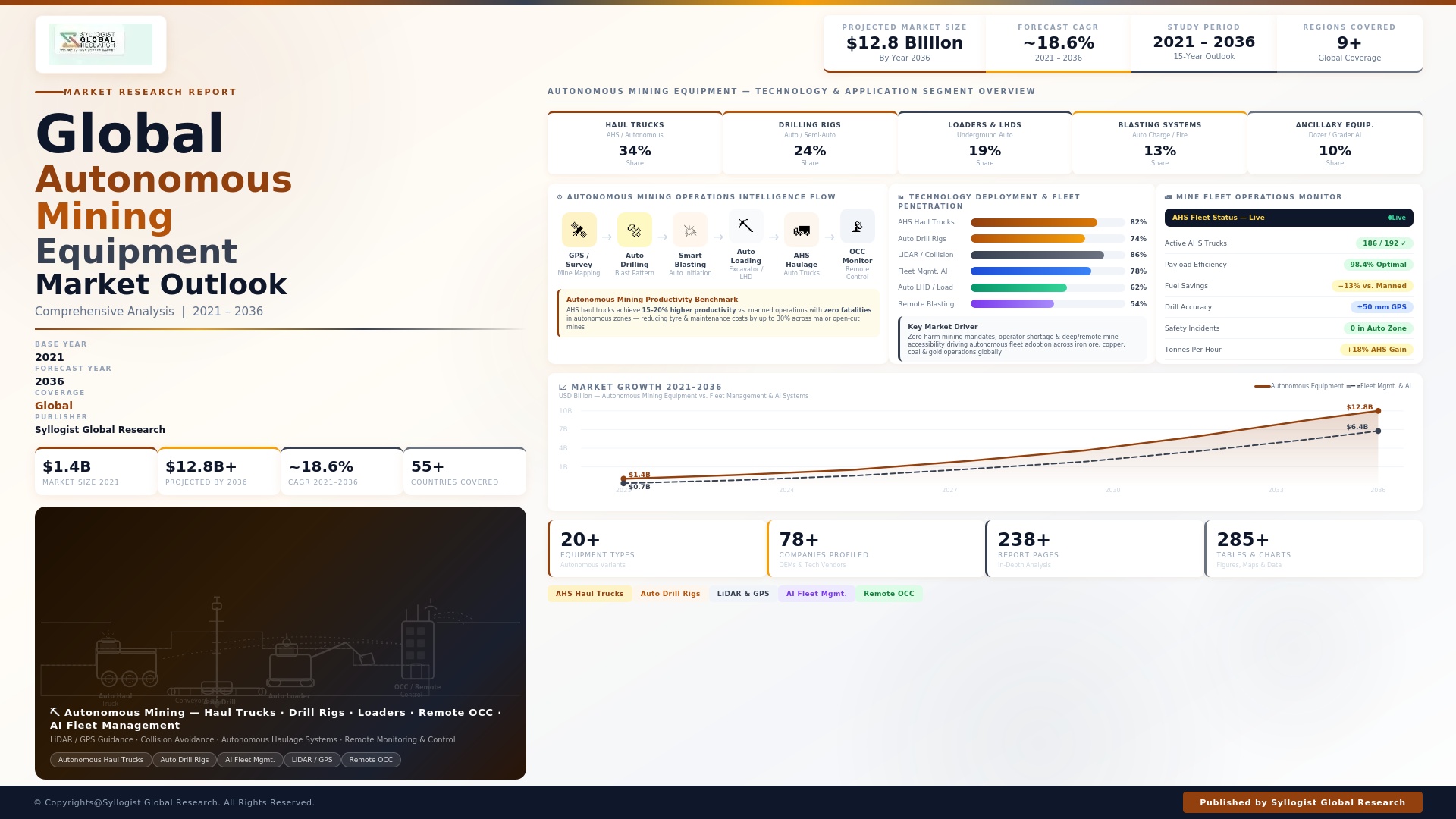
The global autonomous mining equipment market was valued at approximately USD 4.3 billion in 2025 and is projected to reach USD 11.6 billion by 2034, advancing at a compound annual growth rate of 11.5% over the forecast period from 2027 to 2034, driven by the mining industry’s sustained imperative to improve worker safety by removing personnel from hazardous operating environments, reduce unit production costs against a backdrop of declining ore grades and rising labour and energy costs, and improve asset utilisation by enabling 24-hour continuous production operation with reduced dependence on shift change cycles, fatigue management constraints, and extreme weather work stoppages that interrupt human-operated mining production. The global autonomous haulage system fleet exceeded 830 deployed units across iron ore, copper, coal, oil sands, and gold mining operations in 2025, concentrated primarily in Australia, Canada, Chile, and the United States, and is projected to surpass 1,900 units by 2034 as mid-tier mining companies progressively commission autonomous truck fleets that follow the operational precedents and documented productivity benchmarks established by the major mining company early adopters who have operated autonomous haulage at commercial scale since the early 2010s.
Autonomous haulage systems represent the largest and most commercially mature product segment within the autonomous mining equipment market, accounting for approximately 58% of total market revenue in 2025, with the documented operational performance of large-scale commercial deployments at iron ore operations in the Pilbara region of Western Australia and copper operations in Chile providing a compelling evidence base of 10% to 20% improvement in truck productivity, 13% to 17% reduction in fuel consumption per tonne hauled, and near-elimination of haul road collision fatalities that drives autonomous haulage system procurement justification across the mining industry globally. Automated drilling and blast hole drilling systems constitute the second-largest equipment segment, growing at approximately 13.8% annually as the demonstrated accuracy, consistency, and operational availability advantages of autonomous drill rigs translate into measurable improvements in blast fragmentation outcomes, downstream crusher throughput, and explosive consumption efficiency at surface mining operations where drill pattern execution quality directly governs the economics of the entire mine-to-mill production system. Underground autonomous equipment, encompassing battery electric load-haul-dump machines, autonomous underground trucks, and robotic rock bolting systems, is the fastest-growing equipment category within the market, advancing at approximately 17.2% annually, driven by the safety imperative of removing operators from underground stopes and development headings where seismic activity, poor ventilation, and confined space hazards represent the highest risk concentrations in the global mining industry, and by the enabling effect of battery electric underground vehicle adoption which simplifies automation integration by eliminating diesel exhaust ventilation requirements that have historically constrained the density of simultaneous autonomous machine operations in underground environments.
Australia maintains its position as the world’s leading national market for autonomous mining equipment deployment, accounting for approximately 41% of the global installed autonomous haulage system fleet in 2025, driven by the combination of the country’s large-scale bulk commodity mining operations that provide the optimal economic conditions for autonomous haulage deployment, the highly supportive regulatory environment for autonomous equipment operation established through collaboration between mining companies, equipment manufacturers, and state mining regulatory authorities, the labour market characteristics of the Pilbara and other remote Australian mining regions that provide the strongest economic case for labour substitution through automation, and the proximity and partnership relationships between Australian mining majors and the original equipment manufacturers and autonomous system developers who have prioritised Australia as the primary commercial development market for new autonomous mining products. Chile and Peru are emerging as the most dynamic growth markets for autonomous mining equipment in Latin America, with the operational scale and capital intensity of large porphyry copper mining operations providing the fleet size and haul distance characteristics that maximise autonomous haulage system productivity and return on investment, and with the major copper producers having committed to autonomous equipment expansion programs that collectively represent approximately USD 2.1 billion in autonomous mining equipment procurement investment across the 2025 to 2030 period. North America’s autonomous mining market is growing robustly, driven by oil sands operations in Alberta, copper mining in Arizona and Nevada, and a rapidly expanding underground autonomous equipment adoption program across the hard rock mining sector in Ontario, Quebec, and Nevada where a combination of deep underground mine safety requirements and skilled operator labour shortages is accelerating the business case for autonomous underground equipment investment.
The convergence of autonomous equipment platforms with battery electric drive systems is creating a transformative technology integration opportunity within the underground mining equipment segment, with battery electric autonomous load-haul-dump machines and underground trucks eliminating the diesel exhaust ventilation requirement that has historically been the primary operational constraint on underground mine productivity and the principal barrier to deploying multiple simultaneous autonomous machines in single underground production zones, enabling mine designs with reduced ventilation infrastructure capital requirements, lower ventilation energy operating costs, and higher autonomous machine fleet density per underground level that collectively improve the unit economics of underground autonomous mining relative to diesel-autonomous and manually operated diesel underground configurations. The artificial intelligence and machine learning capability embedded in autonomous mining equipment platforms is advancing beyond basic obstacle avoidance and path following toward predictive operational optimization, with autonomous haulage systems incorporating real-time load optimization algorithms that reduce cycle time variability, fleet management artificial intelligence that dynamically reassigns autonomous trucks to queuing crushers or shovel positions based on real-time production system state, and predictive maintenance models that schedule component replacement interventions based on condition monitoring data from thousands of sensor channels per vehicle, collectively generating productivity and cost management benefits that extend well beyond the direct labour substitution value that initially justified autonomous equipment investment. The emerging market for autonomous equipment retrofit and upgrade programs, where legacy manually operated mining equipment is converted to autonomous operation through the addition of perception, navigation, and communication technology systems without full machine replacement, is growing at approximately 19.3% annually and represents an increasingly significant commercial opportunity as the global installed base of large mining trucks, drill rigs, and underground equipment that can be economically retrofitted expands with fleet age and as retrofit technology costs decline.
Key Drivers
Mining Industry Labour Scarcity, Workforce Safety Imperatives, and Remote Location Operating Challenges Creating Structural Demand for Autonomous Equipment Deployment
The structural shortage of skilled mining equipment operators across major mining jurisdictions including Australia, Canada, Chile, and South Africa, combined with the escalating cost of recruiting, training, accommodating, and retaining workforce at remote mine site locations, is creating an economically compelling and operationally urgent driver for autonomous mining equipment adoption that extends well beyond the safety case for removing operators from hazardous environments to encompass a fundamental workforce availability constraint that threatens production continuity at remote mining operations dependent on fly-in, fly-out labour models. Average annual labour costs per heavy equipment operator at remote Australian and Canadian mining operations exceed USD 120,000 to USD 160,000 when total employment cost including accommodation, travel, training, and turnover replacement cost is fully accounted, compared to the annualised technology and maintenance cost of an autonomous haulage system of approximately USD 40,000 to USD 65,000 per truck per year when amortised over system lifecycle, creating a direct cost substitution economics that generates payback periods of three to six years at full fleet deployment scale even before accounting for the productivity improvement premium from continuous operation and elimination of fatigue-related performance degradation. Worker safety statistics from autonomous haulage system operations consistently report the near-elimination of haul road vehicle interaction fatalities, which historically constituted one of the leading causes of fatal injury at surface mining operations globally, with the removal of operators from autonomous truck cabs eliminating the occupant fatality risk from rollover, collision, and fire incidents that represent the majority of haul truck-related fatalities in the global mining industry, providing an unambiguous and regulatorily compelling safety justification for autonomous equipment investment that reinforces the economic rationale.
Declining Ore Grades and Increasing Mine Depth Requiring Production System Efficiency Improvements That Autonomous Equipment Productivity Gains Are Uniquely Positioned to Deliver
The mining industry’s structural challenge of extracting economically viable ore from progressively lower-grade, deeper, and more geologically complex deposits is creating an operational cost escalation dynamic that autonomous equipment productivity improvements are well positioned to partially offset, with the combination of higher haulage cycle count per operating hour, more consistent drill pattern execution, and 24-hour continuous production capability delivered by autonomous systems generating unit cost reductions that are increasingly necessary to maintain economic viability at operations whose revenue per tonne of material moved is declining as ore grades deteriorate. Global copper ore grades have declined from an average of approximately 1.2% copper in 2000 to approximately 0.65% in 2025, requiring mining operations to move approximately 85% more total material per unit of metal produced relative to two decades ago, placing a premium on haulage system efficiency and throughput that autonomous truck fleet deployment is documented to improve by 10% to 20% relative to equivalent manually operated fleets through elimination of operator performance variability, fatigue-related slowdowns, and shift change production gaps. Autonomous blast hole drilling systems deliver drill pattern accuracy improvements of 15% to 25% relative to manual drilling operations at surface mining sites, directly reducing oversize fragmentation in blasted ore, decreasing primary crusher downtime from oversize events, and lowering explosive consumption per tonne of ore fragmented, generating downstream processing plant throughput improvements of 3% to 8% that compound the direct drilling productivity benefit and create a mine-to-mill value chain optimization effect whose total economic impact significantly exceeds the productivity improvement attributable to autonomous drilling alone.
Original Equipment Manufacturer Autonomous Technology Integration, Ecosystem Standardisation, and Declining System Cost Broadening Market Accessibility Beyond Early Adopting Mining Majors
The progressive integration of autonomous operation capability as standard or readily available optional equipment on new mining truck and drill rig platforms by major original equipment manufacturers, combined with declining autonomous system hardware costs as sensor, computing, and communication technology components benefit from scale economies driven by automotive and industrial automation markets, is broadening the commercial accessibility of autonomous mining equipment adoption beyond the small group of large-scale mining majors whose fleet sizes and operational profiles justified first-generation autonomous system investment at the higher per-unit technology costs of the early commercial deployment period. Leading mining equipment original equipment manufacturers have committed to making autonomous capability a standard feature on new large mining truck platforms above 200-tonne payload capacity by 2027 to 2028, eliminating the retrofit complexity and integration risk that has historically been a barrier to autonomous adoption for mining operators preferring to commission new fleets with fully integrated autonomous capability rather than retrofitting autonomy onto existing manually operated equipment. The development of interoperability standards for autonomous mining equipment communication protocols, perception system data formats, and fleet management system interfaces by industry bodies and standards organisations is progressively reducing the vendor lock-in concern that has caused some mining operators to delay autonomous equipment investment pending the establishment of open architecture frameworks that allow mixed-fleet autonomous operations with equipment from multiple original equipment manufacturers managed by a single fleet management platform, lowering the switching cost risk of autonomous equipment investment and expanding the addressable market for autonomous system technology developers beyond single-vendor fleet deployment programs.
Key Challenges
High Capital Cost of Autonomous System Integration, Long Payback Periods at Smaller Operations, and Uncertainty in Total Cost of Ownership Modelling Constraining Adoption
The capital cost of equipping a mining truck fleet with autonomous haulage system technology, including on-board perception, navigation, and control hardware on each truck, the high-precision positioning infrastructure, wireless communication network, remote operations centre facility, fleet management system software, and system integration and commissioning services, typically adds USD 400,000 to USD 700,000 per vehicle to the cost of a new autonomous mining truck relative to an equivalent manually operated unit, generating a capital premium whose justification requires a fleet size of at least 15 to 25 trucks to achieve the fleet management and operations centre cost amortisation economics that deliver competitive total cost of ownership against manually operated alternatives. Mid-tier and smaller mining operations with truck fleets below the economic threshold for autonomous haulage deployment face a structural accessibility barrier to autonomous equipment adoption that limits the addressable market for full autonomous haulage system deployment to the top tier of large-scale mining operations and constrains the pace of market penetration beyond the current early adopter concentration among mining majors. The total cost of ownership modelling for autonomous mining equipment is complicated by the variability of productivity improvement outcomes across different mine geometries, haul road conditions, and operational management practices, with documented productivity gains ranging from 5% to 25% across different deployment reference sites, creating uncertainty in return on investment projection accuracy that makes capital investment committee approval processes more complex and creates conservative adoption postures among mining finance and operational decision makers who lack robust site-specific benchmark data to validate autonomous equipment business case assumptions.
Regulatory Framework Complexity, Jurisdictional Variation in Autonomous Equipment Operating Standards, and Safety Case Demonstration Requirements Delaying Deployment Approvals
The regulatory environment governing autonomous mining equipment operation varies materially across major mining jurisdictions, with some states and countries having established clear and workable regulatory frameworks for autonomous equipment safety case assessment and operating approval while others maintain equipment operating regulations that were written for human-operated machinery and require significant regulatory engagement, safety case documentation, and incremental approval processes before autonomous equipment can be operated at commercial production scale in those jurisdictions. In Australia, Western Australian and Queensland mine safety regulators have developed autonomous equipment operating frameworks through collaborative engagement with mining companies and original equipment manufacturers that provide a workable pathway to autonomous deployment approval, while regulatory frameworks in some Latin American, African, and Asian jurisdictions require extensive safety case documentation and regulator engagement that can add 12 to 36 months to autonomous equipment deployment timelines relative to Australian benchmarks, creating a regulatory friction cost that reduces the financial attractiveness of autonomous investment in those jurisdictions. The demonstration of safety equivalence or superiority for autonomous equipment systems operating in proximity to manually operated vehicles and pedestrian workers in mixed-fleet mining environments requires extensive hazard identification, risk assessment, and safety function validation documentation whose preparation requires specialist autonomous equipment safety engineering expertise that is currently scarce globally, creating a bottleneck in the safety case development process that limits the pace at which autonomous equipment deployment programs can receive regulatory approval across multiple simultaneous mine site commissioning programs.
Communication Infrastructure Limitations, Cybersecurity Vulnerability, and System Reliability Requirements in Remote and Underground Operating Environments
Autonomous mining equipment operation is fundamentally dependent on the continuous availability of high-bandwidth, low-latency wireless communication networks that transmit real-time perception data, control commands, and fleet management information between autonomous machines and their remote supervision infrastructure, creating a critical infrastructure dependency whose provision in the remote surface locations and underground environments where mining operations are conducted presents significant engineering and capital investment challenges that represent a meaningful barrier to autonomous equipment deployment at mine sites where existing communications infrastructure is inadequate for autonomous operation requirements. Underground autonomous equipment deployments require leaky feeder or distributed antenna system wireless communication infrastructure capable of providing continuous coverage throughout the three-dimensional underground mine environment including active working areas, travel ways, ore passes, and service areas whose combined extent can exceed hundreds of kilometres of underground development at a mature hard rock mine, with the requirement for communication network redundancy to prevent simultaneous single-point-of-failure outages that could strand multiple autonomous machines requiring capital investment in communication infrastructure that adds materially to total autonomous equipment program deployment cost. The cybersecurity risk profile of autonomous mining equipment systems, which connect operational technology controlling physical equipment with information technology networks accessible to remote operators and vendor support personnel, creates attack surface vulnerabilities whose exploitation could result in autonomous equipment control compromise, collision risk, production disruption, or safety system bypass, requiring mining operators to implement comprehensive operational technology cybersecurity programs including network segmentation, access control, continuous monitoring, and incident response capabilities that add operational overhead and require specialized cybersecurity expertise that is currently scarce in the mining industry workforce.
Market Segmentation
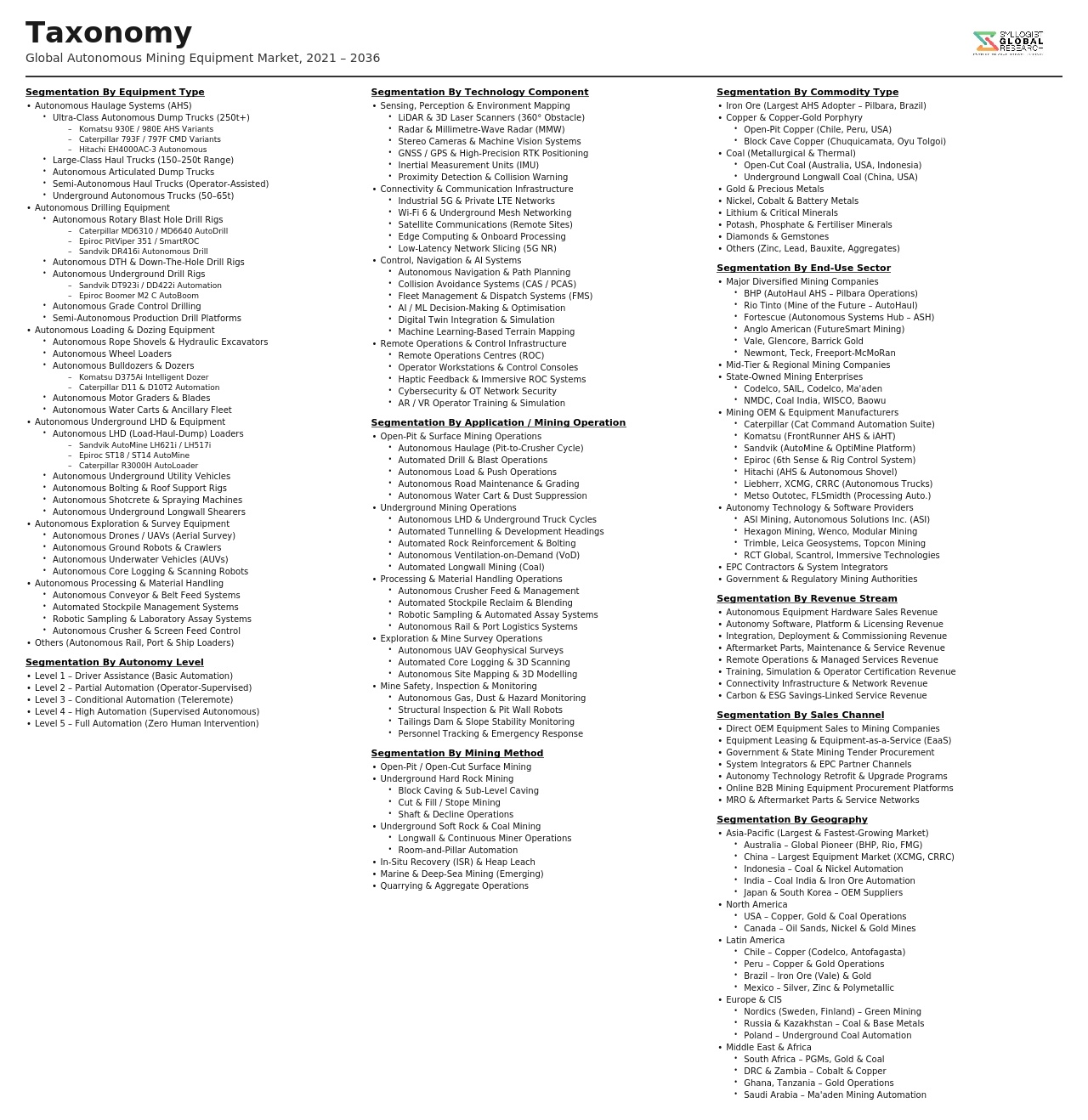
- Segmentation By Equipment Type
- Autonomous Haulage Systems (Surface Mining Trucks)
- Automated Blast Hole and Rotary Drilling Rigs
- Autonomous Underground Load-Haul-Dump (LHD) Machines
- Autonomous Underground Mine Trucks
- Robotic Rock Bolting and Ground Support Systems
- Autonomous Dozing and Grading Equipment
- Automated Longwall Mining Systems
- Autonomous Tunnel Boring and Development Equipment
- Automated Continuous Miners
- Others
- Segmentation By Autonomy Level
- Fully Autonomous (No Onboard Operator Required)
- Remotely Operated with Supervisory Control
- Semi-Autonomous with Operator Assistance
- Teleoperated with Remote Cab
- Segmentation By Mining Type
- Open Pit and Surface Mining
- Underground Hard Rock Mining
- Underground Coal Mining
- Quarrying and Aggregate Extraction
- Oil Sands Mining
- In-Situ and Solution Mining
- Others
- Segmentation By Commodity
- Iron Ore
- Copper
- Gold and Silver
- Coal (Thermal and Metallurgical)
- Battery Metals (Lithium, Cobalt, and Nickel)
- Bauxite and Aluminium
- Diamonds and Precious Stones
- Potash and Fertilizer Minerals
- Others
- Segmentation By Propulsion Type
- Diesel-Powered Autonomous Equipment
- Battery Electric Autonomous Equipment
- Trolley-Assisted Electric Autonomous Equipment
- Hydrogen Fuel Cell Autonomous Equipment
- Hybrid Diesel-Electric Autonomous Equipment
- Segmentation By Technology Component
- Autonomous Navigation and Path Planning Systems
- Perception and Environment Mapping (LiDAR, Radar, and Camera)
- High-Precision GNSS Positioning and Localisation
- Collision Avoidance and Proximity Detection Systems
- Fleet Management and Dispatch Software
- Remote Operations Centre Hardware and Software
- Underground Wireless Communication Networks
- Predictive Maintenance and Equipment Health Monitoring
- Others
- Segmentation By Deployment Model
- New Equipment with Integrated Autonomous Systems (Factory-Fit)
- Retrofit Autonomous System Installations on Existing Equipment
- Autonomous System Software-as-a-Service and Managed Services
- Full Turnkey Autonomous Mining System Deployment
- Segmentation By Region
- Asia-Pacific (Australia, China, Indonesia, and Others)
- Latin America (Chile, Peru, Brazil, and Others)
- North America (United States and Canada)
- Europe (Scandinavia, Russia, and Eastern Europe)
- Middle East and Africa (South Africa, West Africa, and Others)
All market revenues are presented in USD
Historical Year: 2021-2024 | Base Year: 2025 | Estimated Year: 2026 | Forecast Period: 2027-2034
Key Questions this Study Will Answer
- What is the total global market valuation of the Autonomous Mining Equipment Market in the base year 2025, and what is the projected market size and compound annual growth rate through 2034, disaggregated by equipment type, autonomous haulage systems, automated drilling rigs, autonomous underground equipment, and autonomous dozing and auxiliary equipment, by mining type, open pit and underground, by commodity sector, and by geography, to enable mining equipment manufacturers, autonomous technology developers, mining operators, and investors to identify which equipment categories, operating environments, and regional markets will generate the highest absolute revenue and most commercially significant technology adoption momentum across the forecast period?
- How is the autonomous haulage system fleet expected to expand from approximately 830 deployed units in 2025 to its projected 2034 installed base across the global mining industry, which mining commodity sectors, mine sizes, and geographic markets represent the highest near-term autonomous haulage system adoption opportunity beyond the current iron ore and coal early adopter concentration, and what are the documented productivity, fuel efficiency, safety, and total cost of ownership performance benchmarks from commercial-scale autonomous haulage deployments that provide the most robust return on investment validation for mid-tier copper, gold, and battery metals mining companies evaluating autonomous truck fleet commissioning decisions?
- What is the projected growth trajectory and competitive landscape of underground autonomous mining equipment through 2034, encompassing battery electric autonomous load-haul-dump machines, autonomous underground trucks, and robotic rock bolting and ground support systems, which underground mining commodity sectors and geographic markets are generating the most significant near-term adoption momentum, and how is the convergence of battery electric drive and autonomous operation technologies reshaping underground mine design principles, ventilation infrastructure capital requirements, and the economic case for underground autonomous equipment investment relative to diesel-autonomous and manually operated underground mining configurations?
- How are the original equipment manufacturer autonomous capability integration roadmaps of leading mining truck and drill rig manufacturers expected to evolve through 2034, at what pace will autonomous capability transition from premium option to standard feature on new large mining equipment platforms, what are the interoperability and open architecture standards developments that will determine the pace of multi-vendor autonomous fleet adoption, and how will the declining per-unit hardware cost of autonomous system components driven by automotive and industrial automation scale economies reshape the autonomous mining equipment total cost of ownership trajectory and market accessibility for mid-tier and smaller mining operations through the forecast period?
- Who are the leading autonomous mining equipment original equipment manufacturers, autonomous system technology integrators, mining fleet management software vendors, and communication infrastructure providers currently defining the competitive landscape of the global autonomous mining equipment market, and what are their respective product portfolio coverage across equipment types and mining applications, commercial deployment reference site track records and documented operational performance outcomes, research and development investment in next-generation perception and artificial intelligence capability, partnership and ecosystem development strategies, and competitive positioning responses to the capital cost, regulatory framework, and communication infrastructure challenges constraining autonomous mining equipment adoption across mid-tier and smaller mining operators globally?
- Product Definition
- Research Methodology
- Research Design & Framework
- Overall Research Approach: Descriptive, Exploratory & Quantitative Mixed-Method Design
- Market Definition & Scope Boundaries: What is Included and Excluded
- Segmentation Framework
- Key Research Assumptions & Limitations
- Secondary Research
- Primary Research Design & Execution
- Data Triangulation & Validation
- Market Sizing & Forecasting Methodology
- Competitive Intelligence Methodology
- Quality Assurance & Peer Review
- Definitions, Abbreviations & Data Notes
- Research Design & Framework
- Executive Summary
- Market Snapshot & Headline Numbers
- Key Findings & Research Highlights
- Market Dynamics
- Regional Market Summary
- Competitive Landscape Snapshot
- Technology & Innovation Highlights
- Market Dynamics
- Drivers
- Restraints
- Opportunities
- Challenges
- Porter’s Five Forces Analysis
- PESTLE Analysis
- Market Trends & Developments
- Emerging Trends
- Technological Developments
- Regulatory & Policy Changes
- Supply Chain & Sourcing Trends
- Manufacturing & Process Trends
- Investment & Funding Activity
- Sustainability & ESG Trends
- Risk Assessment Framework
- Technology Reliability, System Failure & Functional Safety Risk
- Cybersecurity, Connectivity & Remote Operations Vulnerability Risk
- Regulatory, Certification & Autonomous Operations Compliance Risk
- Workforce Transition, Labour Relations & Social Acceptance Risk
- Capital Investment, ROI Uncertainty & Technology Obsolescence Risk
- Regulatory Framework & Standards
- Mine Safety Regulations & Autonomous Equipment Operating Standards by Jurisdiction
- Functional Safety Standards (ISO 13849, IEC 62061 & ISO 17757) for Autonomous Mining Machinery
- Telecommunications, Spectrum Allocation & Wireless Connectivity Regulations for Underground & Surface Mining
- Environmental Impact, Emissions & Noise Regulations Applicable to Autonomous Mining Equipment
- Labour, Workforce Transition & Remote Operations Regulatory Requirements
- Global Autonomous Mining Equipment Market Outlook
- Market Size & Forecast by Value
- Market Size & Forecast by Volume (Units)
- Market Size & Forecast by Equipment Type
- Autonomous Haul Trucks
- Autonomous Drilling & Blasthole Drilling Rigs
- Autonomous Load-Haul-Dump (LHD) Loaders
- Autonomous Dozers & Graders
- Autonomous Shovels & Excavators
- Autonomous Underground Bolting & Roof Support Equipment
- Autonomous Water & Dust Suppression Vehicles
- Autonomous Exploration & Survey Drones (UAV & UGV)
- Other Autonomous Mining Ancillary Equipment
- Market Size & Forecast by Technology
- LiDAR, Radar & Perception Sensor Systems
- AI & Machine Learning-Based Navigation & Decision Systems
- Real-Time Kinematic (RTK) GPS & Precision Positioning Technology
- 5G, Wi-Fi 6 & Private Wireless Network Communication Technology
- Fleet Management & Autonomous Control Software Platforms
- Collision Avoidance & Proximity Detection Systems
- Digital Twin & Simulation Integration Technology
- Market Size & Forecast by Autonomy Level
- Teleoperation (Level 1)
- Semi-Autonomous (Level 2 & 3)
- Fully Autonomous (Level 4 & 5)
- Market Size & Forecast by Mining Type
- Surface Mining (Open Pit & Strip Mining)
- Underground Mining
- In-Situ & Solution Mining
- Market Size & Forecast by Application
- Haulage & Material Transport
- Drilling & Blasting
- Loading & Excavation
- Grading, Dozing & Site Preparation
- Exploration & Geological Surveying
- Safety Inspection & Environmental Monitoring
- Market Size & Forecast by Mineral Segment
- Coal Mining
- Iron Ore Mining
- Copper Mining
- Gold Mining
- Lithium & Battery Minerals Mining
- Potash & Fertiliser Minerals Mining
- Other Metals & Industrial Minerals
- Market Size & Forecast by End-User
- Large-Scale Mining Corporations
- Mid-Tier & Junior Mining Companies
- Contract Mining & Mining Services Operators
- Government & State-Owned Mining Enterprises
- Market Size & Forecast by Sales Channel
- Direct OEM Sales & Equipment Leasing
- Authorised Dealer & Distributor Network
- Retrofit & Technology Upgrade Service Providers
- Managed Equipment & Performance-Based Contracts
- North America Autonomous Mining Equipment Market Outlook
- Market Size & Forecast
- By Value
- By Volume (Units)
- By Equipment Type
- By Technology
- By Autonomy Level
- By Mining Type
- By Application
- By End-User
- By Country
- By Sales Channel
- Market Size & Forecast
- Europe Autonomous Mining Equipment Market Outlook
- Market Size & Forecast
- By Value
- By Volume (Units)
- By Equipment Type
- By Technology
- By Autonomy Level
- By Mining Type
- By Application
- By End-User
- By Country
- By Sales Channel
- Market Size & Forecast
- Asia-Pacific Autonomous Mining Equipment Market Outlook
- Market Size & Forecast
- By Value
- By Volume (Units)
- By Equipment Type
- By Technology
- By Autonomy Level
- By Mining Type
- By Application
- By End-User
- By Country
- By Sales Channel
- Market Size & Forecast
- Latin America Autonomous Mining Equipment Market Outlook
- Market Size & Forecast
- By Value
- By Volume (Units)
- By Equipment Type
- By Technology
- By Autonomy Level
- By Mining Type
- By Application
- By End-User
- By Country
- By Sales Channel
- Market Size & Forecast
- Middle East & Africa Autonomous Mining Equipment Market Outlook
- Market Size & Forecast
- By Value
- By Volume (Units)
- By Equipment Type
- By Technology
- By Autonomy Level
- By Mining Type
- By Application
- By End-User
- By Country
- By Sales Channel
- Market Size & Forecast
- Country-Wise* Autonomous Mining Equipment Market Outlook
- Market Size & Forecast
- By Value
- By Volume (Units)
- By Equipment Type
- By Technology
- By Autonomy Level
- By Mining Type
- By Application
- By End-User
- By Country
- By Sales Channel
- Market Size & Forecast
- *Countries Analyzed in the Syllogist Global Research Portfolio: United States, Canada, Mexico, Germany, France, United Kingdom, Netherlands, Spain, Italy, Norway, Sweden, China, Japan, India, Australia, South Korea, Singapore, Brazil, Chile, Saudi Arabia, UAE, Egypt, South Africa, Israel
- Technology Landscape & Innovation Analysis
- Autonomous Haul Truck Technology & Onboard Control System Deep-Dive
- Autonomous Drill Rig Navigation, Bit Positioning & Auto-Rod Handling Technology
- LHD Loader Autonomy, Tele-Remote Operation & Tunnel Navigation Technology
- Perception, Sensor Fusion & Obstacle Detection Technology for Mining Equipment
- AI-Based Fleet Management, Dispatch Optimisation & Predictive Maintenance Platform Technology
- 5G, Private LTE & Mesh Wireless Communication Technology for Mine Connectivity
- UAV & UGV Drone Technology for Autonomous Exploration & Safety Inspection
- Patent & IP Landscape in Autonomous Mining Equipment Technologies
- Value Chain & Supply Chain Analysis
- Mining Equipment OEM Design, Engineering & Manufacturing Supply Chain
- Autonomy Hardware (Sensors, LiDAR, Radar & Computing Units) Supply Chain
- Autonomy Software, AI Platform & Fleet Management Systems Supply Chain
- Telecommunications & Connectivity Infrastructure Supply Chain for Mining
- Retrofit & Aftermarket Autonomy Upgrade Provider Channel
- EPC, System Integrator & Mine Automation Consultant Channel
- Mining Operator Procurement, Maintenance & Long-Term Service Channel
- Pricing Analysis
- Autonomous Haul Truck Capital Cost & Total Cost of Ownership (TCO) Analysis
- Autonomous Drill Rig & LHD Loader Pricing & Payback Period Analysis
- Retrofit Autonomy Kit & Technology Upgrade Cost Analysis
- Fleet Management Software Licensing & Subscription Pricing Analysis
- Managed Equipment, Performance-Based & Operating Lease Contract Pricing Analysis
- ROI & Productivity Gain Analysis: Autonomous vs. Conventional Mining Equipment
- Sustainability & Environmental Analysis
- Lifecycle Assessment (LCA) of Autonomous Mining Equipment: Carbon Footprint, Energy Consumption & Material Use
- Fuel Efficiency, Electrification & Emissions Reduction Contribution of Autonomous Mining Equipment
- Safety Performance, Fatality Reduction & Occupational Health Impact of Autonomous Operations
- Environmental Footprint Reduction Through Optimised Haulage, Reduced Tyre Wear & Precision Drilling
- Regulatory-Driven Sustainability, SDG Alignment & ESG Reporting Linked to Autonomous Mining Adoption
- Competitive Landscape
- Market Structure & Concentration
- Market Consolidation Level (Fragmented vs. Consolidated by Equipment Type, Technology & Geography)
- Top 10 Players Market Share
- HHI (Herfindahl-Hirschman Index) Concentration Analysis
- Competitive Intensity Map by Equipment Type, Technology & Geography
- Player Classification
- Integrated Mining OEMs with Full Autonomous Equipment Portfolios
- Specialist Autonomy Technology & Software Platform Providers
- Sensor, LiDAR & Perception Hardware Suppliers
- Telecommunications & Connectivity Infrastructure Providers for Mining
- Retrofit & Aftermarket Autonomy Upgrade Specialists
- Contract Mining & Mining Services Companies Deploying Autonomous Fleets
- Competitive Analysis Frameworks
- Market Share Analysis by Equipment Type, Technology & Region
- Company Profile
- Company Overview & Headquarters
- Autonomous Mining Equipment Products & Technology Portfolio
- Key Customer Relationships & Reference Mining Project Deployments
- Manufacturing Footprint & Production Capacity
- Revenue (Autonomous Mining Equipment Segment) & Order Backlog
- Technology Differentiators & IP
- Key Strategic Partnerships, JVs & M&A Activity
- Recent Developments (Contract Wins, Product Launches, Capacity Expansion)
- SWOT Analysis
- Strategic Focus Areas & Roadmap
- Competitive Positioning Map (Technology Capability vs. Market Penetration)
- Key Company Profiles
- Market Structure & Concentration
- Technology Landscape & Innovation Analysis
- Strategic Output
- Market Opportunity Matrix: By Equipment Type, Technology, Autonomy Level, Application, Mineral Segment & Geography
- White Space Opportunity Analysis
- Strategic Recommendations
- Product Portfolio & Technology Investment Strategy
- Manufacturing & Operational Excellence Strategy
- Geographic Expansion & Localisation Strategy
- Customer & End-User Engagement Strategy
- Partnership, M&A & Ecosystem Strategy
- Sustainability & Circular Economy Strategy
- Risk Mitigation & Future Roadmap
- Strategic Priority Matrix & Roadmap
- Near-term (2025-2028)
- Mid-term (2029-2032)
- Long-term (2033-2037)
- Strategic Output