Market Definition
The Middle East and Africa Battery Metals Supply Chain Market encompasses the exploration, extraction, primary processing, chemical refining, and downstream value-added transformation of critical mineral resources essential to the manufacture of rechargeable battery cells, modules, and energy storage systems deployed across electric vehicles, utility-scale and distributed stationary energy storage, portable consumer electronics, and grid balancing applications, spanning the complete upstream-to-midstream supply chain from geological resource characterisation and mine development through ore extraction, beneficiation, hydrometallurgical and pyrometallurgical processing, and the production of battery-grade refined materials and precursor active compounds. The market covers the supply chains of cobalt, copper, nickel, lithium, manganese, graphite, and rare earth elements across the mineral-endowed nations of the African continent and the emerging battery value chain investment programs of Gulf Cooperation Council states in the Middle East. The Democratic Republic of Congo occupies a uniquely dominant position within the regional and global battery metals landscape as the source of approximately 73% of global mined cobalt supply and a substantial proportion of global artisanal and industrial copper production, while the broader sub-Saharan African mineral belt extends across Zambia, Zimbabwe, South Africa, Mozambique, Tanzania, Ghana, Guinea, Mali, and Morocco with significant battery-relevant mineral endowments encompassing lithium, nickel, manganese, vanadium, and graphite resources at various stages of exploration and development. Gulf Cooperation Council nations, led by Saudi Arabia and the United Arab Emirates, are pursuing active battery metals supply chain investment strategies that leverage sovereign wealth capital, renewable energy infrastructure, and strategic geographic positioning between Asian battery manufacturing hubs and European electric vehicle markets to develop midstream processing, battery material manufacturing, and energy storage system assembly capabilities that monetise the region’s financial resources and strategic location rather than its geological endowment. Key participants include artisanal and large-scale mining operators, national mining enterprises, international mining majors, sovereign wealth fund investment vehicles, chemical processing operators, battery material offtakers, and multilateral development finance institutions whose capital and technical assistance are shaping the pace of regional battery metals supply chain development.
Market Insights
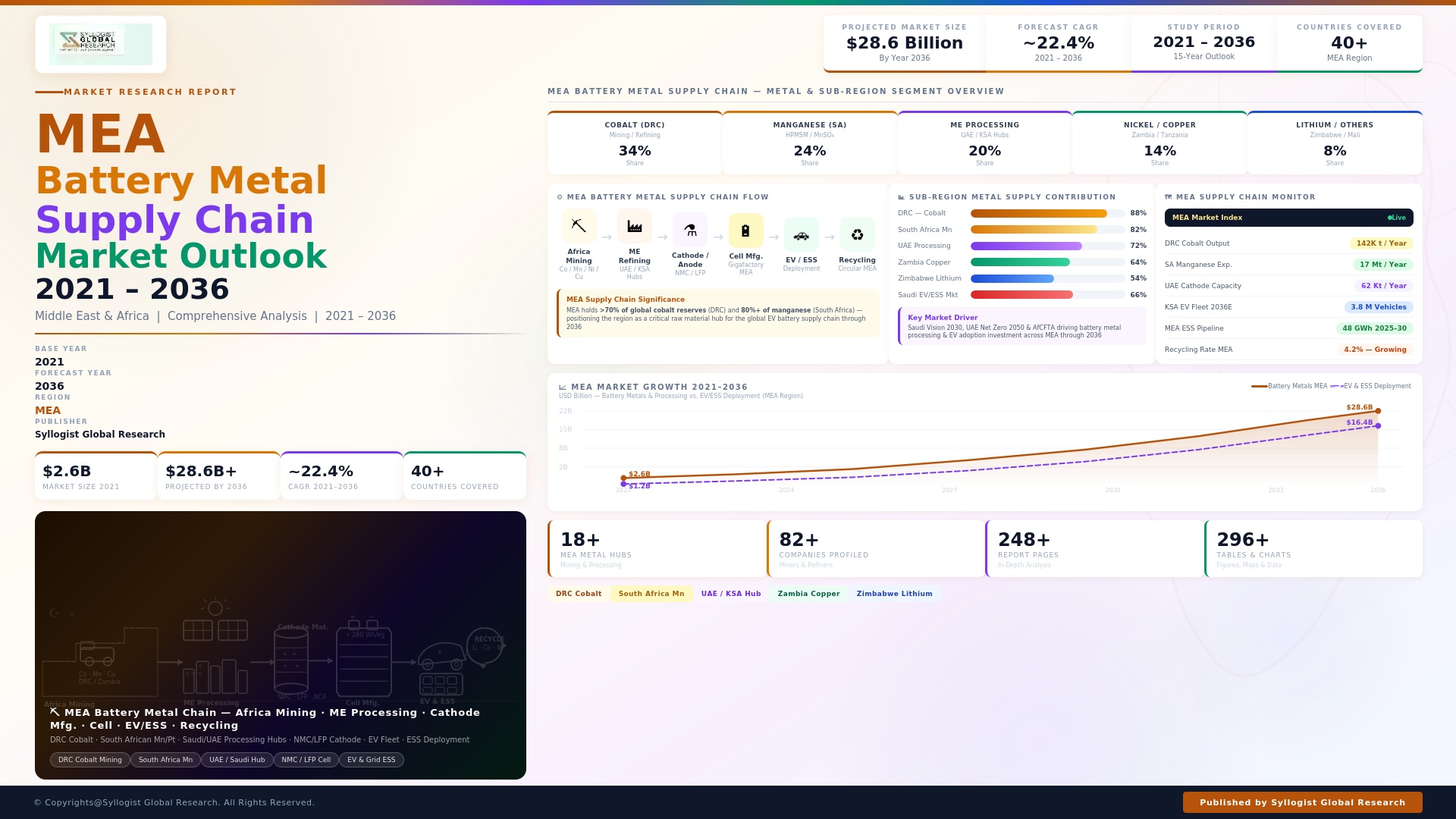
The Middle East and Africa battery metals supply chain market was valued at approximately USD 11.4 billion in 2025 and is projected to reach USD 28.9 billion by 2034, advancing at a compound annual growth rate of 10.8% over the forecast period from 2027 to 2034, driven by the accelerating global demand for cobalt, copper, nickel, and lithium from the electric vehicle and energy storage industries whose battery metal requirements are expanding at rates that are structurally transforming the strategic and commercial importance of the region’s mineral resource base. The Democratic Republic of Congo produced approximately 175,000 metric tons of cobalt in 2025, representing approximately 73% of global mined cobalt output, while Zambia contributed an additional 14,000 metric tons, establishing the Central African Copperbelt as the world’s irreplaceable primary cobalt supply region whose production trajectory directly governs the economics and availability of cobalt for global battery cathode active material manufacturing. The region’s battery metals market is defined by the simultaneous tension between Africa’s extraordinary geological endowment and the infrastructure, governance, and processing capability gaps that have historically constrained the region’s ability to capture downstream value from mineral resource extraction, and by the Gulf states’ financial capital and strategic intent to develop midstream and downstream battery supply chain positions that complement rather than compete with African resource production.
The cobalt supply chain dynamics of the Democratic Republic of Congo are the most strategically consequential battery metal market development in the Middle East and Africa region, with the country’s cobalt production underpinning the global supply of a battery metal for which no fully viable large-scale alternative supply geography exists in the near term and for which demand from nickel-manganese-cobalt and nickel-cobalt-aluminium cathode active material manufacturing continues to grow despite the competing trend toward higher-nickel lower-cobalt cathode formulations and the commercial scaling of cobalt-free lithium iron phosphate chemistry in the electric vehicle market. The artisanal and small-scale mining sector in the Democratic Republic of Congo accounts for approximately 15% to 20% of national cobalt production and represents a persistent supply chain transparency and responsible sourcing challenge for battery manufacturers and automotive original equipment manufacturers whose environmental, social, and governance commitments require verified supply chain traceability from mine to battery cell, driving investment in blockchain-based mineral provenance tracking systems, independent third-party audit programs, and responsible sourcing certification frameworks across Congolese cobalt supply chains. The Zambia-Democratic Republic of Congo Copperbelt additionally hosts substantial copper resources whose production of approximately 870,000 metric tons annually in the Democratic Republic of Congo and 780,000 metric tons in Zambia in 2025 contributes materially to global copper supply for battery current collector, motor winding, and electric vehicle wiring harness applications.
Africa’s lithium resource development is entering an accelerated phase, with significant hard rock spodumene and lepidolite lithium deposits across Zimbabwe, Mali, Ghana, Mozambique, Namibia, and the Democratic Republic of Congo attracting exploration investment and project development financing from international mining companies and battery supply chain participants seeking to diversify lithium supply beyond the established Australian hard rock and South American brine production base. Zimbabwe’s Arcadia and Kamativi lithium deposits have advanced to production stage, with Zimbabwe emerging as Africa’s leading lithium producing nation and positioning itself as a significant hard rock spodumene supplier to Chinese and international lithium processing operations, while governments across East and West Africa are implementing preferential mining legislation and local beneficiation requirements designed to attract lithium project investment and retain a greater proportion of mineral processing value within their national economies. Morocco occupies a distinctive position within the regional battery metals landscape as the world’s largest phosphate producer and the host of significant cobalt, manganese, and nickel mineral resources, while additionally pursuing an active battery value chain development strategy that leverages the country’s geographic proximity to European electric vehicle manufacturing markets, its association agreement with the European Union, and its established position as a minerals export hub to attract battery material processing and cathode precursor manufacturing investment from European and Asian battery supply chain participants seeking geographically diversified and EU-market-preferential supply chain positions.
The Gulf Cooperation Council states, led by Saudi Arabia through its Vision 2030 industrial diversification program and the United Arab Emirates through its clean energy transition investment strategy, are pursuing a fundamentally different battery metals supply chain development model than the resource-based approach of African mineral producing nations, leveraging sovereign wealth capital estimated at approximately USD 3.8 trillion across the region’s major funds, access to low-cost renewable energy for energy-intensive processing operations, strategic geographic positioning at the intersection of Asian and European trade routes, and existing industrial and logistics infrastructure to develop midstream battery material processing, cathode active material manufacturing, and gigafactory investment positions that capture battery supply chain value without reliance on domestic geological endowment. Saudi Arabia’s Public Investment Fund has committed capital to battery material processing joint ventures, electric vehicle manufacturing partnerships, and lithium processing facility development programs as part of a broader industrial strategy to position the Kingdom as a diversified materials and manufacturing economy whose revenue base extends beyond hydrocarbon export. The United Arab Emirates is developing battery storage manufacturing capacity, rare earth processing capability, and battery metal trading and logistics infrastructure in free zone industrial parks including those in Abu Dhabi and Dubai that leverage the country’s established position as a global commodity trading and logistics hub to attract battery supply chain participants requiring accessible, well-regulated, and strategically located midstream processing and distribution platforms serving both Asian supply and European demand.
Key Drivers
Global Electric Vehicle and Energy Storage Demand Growth Establishing Structural Long-Term Off-Take Requirements for Middle East and Africa Battery Metal Production
The accelerating global deployment of electric vehicles and stationary energy storage systems is creating a demand trajectory for battery metals that establishes the Middle East and Africa region’s mineral and processing assets as strategically indispensable components of the global clean energy transition supply chain, with global electric vehicle sales reaching approximately 17.1 million units in 2025 and projected to exceed 45 million units annually by 2034, each battery electric vehicle requiring cobalt, nickel, copper, and manganese in quantities whose aggregate demand growth rate substantially exceeds the capacity expansion timelines of alternative supply sources in other geographies. The Democratic Republic of Congo’s cobalt production base, representing approximately 73% of global mined cobalt supply with no comparable alternative supply geography in prospect over the near to medium term, places the country in a structurally indispensable position within the global battery metals supply chain regardless of the ongoing commercial effort by battery manufacturers to reduce cobalt intensity per kilowatt hour of cell capacity through cathode chemistry evolution. Grid-scale energy storage deployment, driven by the renewable energy integration requirements of energy transition programs in Europe, North America, Asia-Pacific, and increasingly within the Middle East and Africa region itself, is generating additional and structurally durable demand for battery metals beyond the electric vehicle application base, with utility-scale lithium iron phosphate and nickel manganese cobalt battery storage installations adding an incremental demand stream for copper, lithium, and manganese that reinforces the long-term volume growth foundation supporting Middle East and Africa battery metals supply chain investment.
Strategic Mineral Partnership Frameworks and Foreign Direct Investment Mobilisation Accelerating African Battery Metal Project Development and Processing Capacity
The intensifying competition among the United States, European Union, China, Japan, South Korea, and Gulf Cooperation Council states to secure long-term battery metal supply commitments from African resource nations is generating a wave of bilateral critical minerals partnership frameworks, concessional development finance facility programs, infrastructure co-investment commitments, and preferential trade agreement provisions that are collectively mobilising foreign direct investment into African battery metal exploration, mine development, and processing capacity at a rate materially exceeding the investment flows of the preceding decade. The European Union Global Gateway initiative has committed substantial capital to critical mineral supply chain development in partner African nations, with specific programs targeting cobalt and copper supply chain development in the Democratic Republic of Congo and Zambia, lithium project development in Zimbabwe and Namibia, and manganese and graphite resource development across multiple African jurisdictions, framed within the EU Critical Raw Materials Act’s strategic objective of diversifying European battery material supply away from single-source dependencies. The United States Partnership for Global Infrastructure and Investment and its Minerals Security Partnership program, the Japan-Africa critical minerals cooperation framework, and equivalent South Korean and British investment mobilisation programs are providing project financing, technical assistance, and offtake market access commitments that reduce the investment risk profile of African battery metal projects and accelerate development timelines for mine and processing facility construction that would otherwise be constrained by the high capital cost and perceived governance risk of operating in frontier mining jurisdictions.
Gulf Cooperation Council Sovereign Wealth Capital and Renewable Energy Advantage Enabling Midstream Battery Material Processing Hub Development
The Gulf Cooperation Council states possess a unique combination of financial capital, renewable energy resource abundance, strategic geographic location, and political stability that positions them as credible and commercially attractive hosts for energy-intensive battery material processing and midstream supply chain investment in a global battery supply chain landscape increasingly seeking alternatives to the current concentration of battery material refining and cathode active material manufacturing in China. Saudi Arabia and the United Arab Emirates both benefit from some of the world’s lowest-cost solar and wind electricity generation economics, with utility-scale solar power purchase agreement prices reaching below USD 0.02 per kilowatt hour in recent tenders, providing a compelling cost advantage for electrochemical lithium processing, nickel sulphate refining, and cathode active material calcination operations whose electricity consumption represents 20% to 35% of total processing operating cost. The geographic positioning of Gulf Cooperation Council industrial zones within approximately 10 days shipping distance of both major Asian battery manufacturing clusters and European electric vehicle assembly facilities, combined with free trade zone regulatory frameworks, established commodity trading infrastructure, and sovereign creditworthiness that enables competitive project financing, creates a midstream battery supply chain hosting environment whose commercial and logistical attributes are competitive with established processing locations in Asia and potentially superior for suppliers seeking to serve both Asian and European end markets from a single processing facility location.
Key Challenges
Governance Risk, Artisanal Mining Informality, and Supply Chain Transparency Deficits Constraining Responsible Sourcing Compliance Across African Battery Metal Supply Chains
The governance environment across several of the most resource-endowed African battery metal jurisdictions, including the Democratic Republic of Congo, Zimbabwe, Mali, and Guinea, presents persistent and structurally embedded challenges for international mining investors and battery supply chain participants whose responsible sourcing policies, environmental, social, and governance reporting obligations, and downstream customer due diligence requirements demand supply chain transparency standards and human rights compliance frameworks that are difficult to implement and verify across complex, multi-tier African mineral supply chains characterised by artisanal mining informality, weak regulatory enforcement capacity, and conflict-affected operating environments. The artisanal and small-scale cobalt mining sector in the Democratic Republic of Congo, which supplies approximately 15% to 20% of national cobalt output through informal supply networks whose labour conditions, child labour risks, and environmental practices have been extensively documented as inconsistent with international responsible sourcing standards, represents the most acute supply chain transparency challenge facing global battery manufacturers, with the traceability systems and audit programs currently deployed across Congolese cobalt supply chains providing incomplete and inconsistently verified assurance of responsible sourcing compliance from mine to smelter. Political instability, security risks from armed non-state actor activity in mining regions of eastern Democratic Republic of Congo, and the risk of sudden policy changes in resource taxation, export restriction, or mining title allocation in multiple African jurisdictions impose risk premiums on African battery metal project investment that reduce the competitiveness of African assets relative to comparable resource endowments in jurisdictions with more stable governance environments.
Infrastructure Deficits in Power, Transport, and Water Supply Imposing High Capital Costs and Operational Constraints on African Battery Metal Project Development
The infrastructure gap across Sub-Saharan Africa’s battery metal mining regions represents one of the most significant structural constraints on the pace and economics of battery metal project development, with the absence of reliable grid electricity, paved road access, rail freight connectivity, and port export infrastructure in many of the continent’s most prospective battery metal resource areas imposing capital expenditure requirements for enabling infrastructure construction that substantially increase project development costs and financing requirements relative to comparable mining projects in regions with established industrial infrastructure. Power supply is the most acute infrastructure constraint for battery metal processing operations, with hydrometallurgical nickel and cobalt processing, lithium chemical conversion, and copper electrorefining all requiring reliable and cost-competitive electricity supply whose provision from diesel generation in off-grid mining locations adds operating costs of USD 0.15 to USD 0.35 per kilowatt hour compared to grid electricity costs of USD 0.03 to USD 0.08 per kilowatt hour in industrialised economies, creating a structural processing cost disadvantage that limits the economic viability of in-country value addition relative to exporting ore or concentrate for processing in Asia. Transport infrastructure limitations, including the inadequacy of road and rail networks connecting the Democratic Republic of Congo’s Copperbelt to Atlantic and Indian Ocean port facilities, drive export logistics costs for Congolese battery metals that are among the highest per metric ton of any major mining region globally and constrain the competitiveness of Congolese processed materials in international battery metal markets where logistics cost is a material component of delivered product economics.
Chinese Supply Chain Dominance in Midstream Processing, Cobalt Chemistry Evolution Reducing Demand Intensity, and Competing Supply Source Development Introducing Market Risk
The Middle East and Africa battery metals supply chain faces competitive and structural market risks arising from the established dominance of Chinese companies in cobalt and battery metal midstream processing, the accelerating commercial penetration of cobalt-free lithium iron phosphate battery chemistry in the electric vehicle market, and the development of competing battery metal supply sources in alternative geographies that may reduce the incremental demand premium available to new African battery metal projects entering commercial production through the forecast period. China’s battery material processing industry, which controls approximately 80% of global cobalt chemical refining capacity, 65% of global lithium hydroxide processing capacity, and the majority of global precursor cathode active material and cathode active material manufacturing, means that the majority of African battery metal output is currently exported as concentrate or intermediate product to Chinese processors at relatively modest value-added margins, with the economic benefit of downstream processing captured in China rather than in the resource-producing African nation. The sustained commercial scaling of lithium iron phosphate battery chemistry in electric vehicles, particularly in the Chinese market where lithium iron phosphate accounted for approximately 67% of new electric vehicle battery installations in 2025, is structurally reducing cobalt demand intensity per unit of battery capacity deployed, creating a long-term demand ceiling risk for cobalt that constrains the confidence of battery supply chain investors in committing capital to new high-cost cobalt mining and processing projects whose payback periods extend into a period of uncertain cobalt demand trajectory driven by cathode chemistry evolution dynamics beyond the control of African cobalt producers.
Market Segmentation
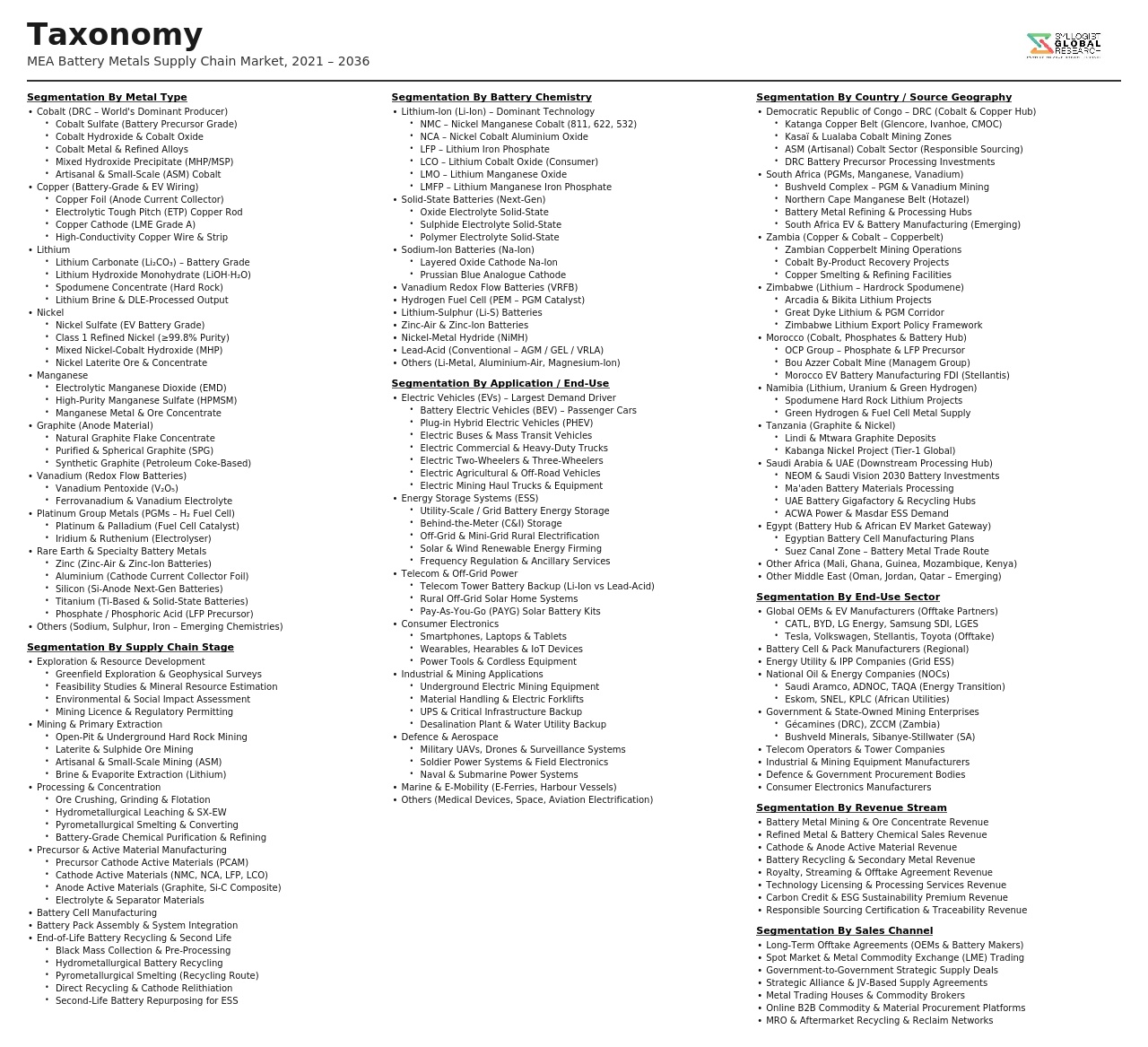
- Segmentation By Metal Type
- Cobalt (Cobalt Hydroxide and Cobalt Sulphate)
- Copper (Refined Copper Cathode and Copper Sulphate)
- Nickel (Mixed Hydroxide Precipitate and Nickel Sulphate)
- Lithium (Spodumene Concentrate, Lithium Carbonate, and Lithium Hydroxide)
- Manganese (Battery-Grade Manganese Sulphate and Electrolytic Manganese Dioxide)
- Graphite (Natural Flake Graphite and Spherical Graphite)
- Vanadium (Vanadium Pentoxide and Vanadium Electrolyte)
- Rare Earth Elements (Neodymium and Dysprosium for Motor Magnets)
- Others
- Segmentation By Value Chain Stage
- Geological Exploration and Resource Delineation
- Artisanal and Small-Scale Mining
- Large-Scale Industrial Mining and Extraction
- Ore Beneficiation and Concentration
- Hydrometallurgical and Pyrometallurgical Refining
- Battery-Grade Chemical Material Production
- Precursor Cathode Active Material Manufacturing
- Cathode and Anode Active Material Production
- Battery Cell Component Supply
- Segmentation By End-Use Application
- Electric Vehicle Battery Packs
- Utility-Scale and Grid Stationary Energy Storage
- Distributed and Commercial Energy Storage
- Consumer Electronics Batteries
- Industrial and Off-Grid Energy Storage
- Others
- Segmentation By Battery Chemistry Served
- Lithium Nickel Manganese Cobalt Oxide (NMC) Batteries
- Lithium Nickel Cobalt Aluminium Oxide (NCA) Batteries
- Lithium Iron Phosphate (LFP) Batteries
- Lithium Cobalt Oxide (LCO) Batteries
- Solid-State and Next-Generation Chemistries
- Others
- Segmentation By Country and Sub-Region
- Democratic Republic of Congo
- Zambia
- Zimbabwe
- South Africa
- Morocco
- Tanzania, Mozambique, and East Africa
- Ghana, Mali, Guinea, and West Africa
- Saudi Arabia and Gulf Cooperation Council States
- United Arab Emirates
- Other Middle East and Africa Nations
- Segmentation By Ownership and Investment Structure
- State-Owned Mining Enterprises and National Resource Companies
- Large Diversified International Mining Companies
- Mid-Tier and Junior Exploration and Mining Companies
- Artisanal and Small-Scale Mining Operators
- Sovereign Wealth Fund and Strategic Investment Vehicles
- Battery Manufacturer and Automotive OEM Direct Investments
- Joint Ventures and Public-Private Partnership Structures
- Segmentation By Processing Technology
- Conventional Sulphide Ore Smelting and Refining
- High-Pressure Acid Leach Laterite Processing
- Solvent Extraction and Electrowinning
- Direct Cobalt and Nickel Hydroxide Precipitation
- Lithium Hard Rock Concentration and Spodumene Calcination
- Electrochemical Battery-Grade Metal Sulphate Production
- Others
- Segmentation By Off-Take Destination
- China (Battery Material Processors and Cell Manufacturers)
- European Union (Battery Manufacturers and Automotive OEMs)
- United States and Canada
- Japan and South Korea
- Gulf Cooperation Council Midstream Processing Hubs
- Domestic and Intra-Regional Battery Value Chain
- Others
All market revenues are presented in USD
Historical Year: 2021-2024 | Base Year: 2025 | Estimated Year: 2026 | Forecast Period: 2027-2034
Key Questions this Study Will Answer
- What is the total valuation of the Middle East and Africa Battery Metals Supply Chain Market in the base year 2025, and what is the projected market size and compound annual growth rate through 2034, disaggregated by metal type, cobalt, copper, nickel, lithium, manganese, and graphite, by sub-region, Central Africa, Southern Africa, East Africa, West Africa, North Africa, and Gulf Cooperation Council states, and by value chain stage, mining, primary processing, and refined battery material production, to enable mining investors, battery manufacturers, sovereign wealth funds, and development finance institutions to identify which metal categories, jurisdictions, and supply chain stages will generate the highest absolute revenue and most strategically significant supply contributions across the forecast period?
- How is the Democratic Republic of Congo cobalt supply chain expected to evolve through 2034 in terms of production volume growth from industrial and artisanal mining operations, the trajectory of supply chain formalisation and responsible sourcing certification, the development of in-country cobalt hydroxide and cobalt sulphate chemical processing capacity, and the implications of cathode chemistry evolution toward lower-cobalt and cobalt-free formulations for the long-term demand outlook and price trajectory of Congolese cobalt, and which investment and policy interventions are most likely to improve supply chain transparency, community benefit distribution, and downstream value capture within the Democratic Republic of Congo cobalt supply chain?
- What is the projected development trajectory of Africa’s lithium supply chain through 2034, encompassing hard rock spodumene projects in Zimbabwe, Mali, Ghana, and Namibia, the timeline and capital requirements for in-country lithium carbonate and lithium hydroxide conversion capacity development, and how are African government local beneficiation requirements, bilateral investment treaties with lithium consuming nations, and development finance institution project financing programs expected to accelerate or constrain the pace of African lithium project commissioning and downstream processing investment relative to competing supply sources in Australia and South America?
- How are Gulf Cooperation Council sovereign wealth fund investment strategies, renewable energy cost advantages, and free trade zone industrial development programs in Saudi Arabia and the United Arab Emirates expected to shape the development of midstream battery material processing, cathode active material manufacturing, and energy storage system assembly capacity in the Gulf region through 2034, which battery metal processing value chain stages offer the most commercially viable near-term investment opportunities for Gulf-hosted operations given regional cost structures and logistics positioning, and what are the implications for African battery metal producers seeking offtake partnerships with Gulf-based processing facilities?
- Who are the leading mining companies, national government enterprises, sovereign wealth fund investment vehicles, battery material chemical processors, and development finance institutions currently defining the competitive and investment landscape of the Middle East and Africa battery metals supply chain market, and what are their respective resource portfolios and production capacity positions across cobalt, copper, nickel, and lithium, project development and expansion timelines through 2034, responsible sourcing and environmental, social, and governance program commitments, offtake agreements and strategic partnerships with battery manufacturers and automotive original equipment manufacturers, and strategic responses to the governance, infrastructure, and competitive market challenges reshaping the regional battery metals supply chain?
- Product Definition
- Research Methodology
- Research Design & Framework
- Overall Research Approach: Descriptive, Exploratory & Quantitative Mixed-Method Design
- Market Definition & Scope Boundaries: What is Included and Excluded
- Segmentation Framework
- Key Research Assumptions & Limitations
- Secondary Research
- Primary Research Design & Execution
- Data Triangulation & Validation
- Market Sizing & Forecasting Methodology
- Competitive Intelligence Methodology
- Quality Assurance & Peer Review
- Definitions, Abbreviations & Data Notes
- Research Design & Framework
- Executive Summary
- Market Snapshot & Headline Numbers
- Key Findings & Research Highlights
- Market Dynamics
- Regional Market Summary
- Competitive Landscape Snapshot
- Technology & Innovation Highlights
- Market Dynamics
- Drivers
- Restraints
- Opportunities
- Challenges
- Porter’s Five Forces Analysis
- PESTLE Analysis
- Market Trends & Developments
- Emerging Trends
- Technological Developments
- Regulatory & Policy Changes
- Supply Chain & Sourcing Trends
- Mining, Processing & Refining Trends
- Investment & Funding Activity
- Sustainability & ESG Trends
- Risk Assessment Framework
- Political Instability, Conflict Risk & Governance Deficits in Key African Battery Metal Mining Jurisdictions
- Resource Nationalism, Royalty Regime Uncertainty & Government Intervention Risk Across MEA Mining Countries
- Artisanal and Small-Scale Mining (ASM) Prevalence, Child Labour Risk & Responsible Sourcing Compliance Exposure in the DRC Cobalt Supply Chain
- Infrastructure Deficit: Port Capacity, Rail and Road Connectivity Constraints Affecting Ore, Concentrate and Refined Metal Export Logistics
- Commodity Price Volatility Risk: Cobalt, Nickel, Lithium and Manganese Price Cycle Exposure for MEA Supply Chain Participants
- Regulatory Framework & Standards
- DRC Mining Code, Cobalt Royalty Structures & State Participation via Gecamines: Legal and Fiscal Framework for Battery Metal Production
- South African Mineral and Petroleum Resources Development Act (MPRDA), BEE Mining Charter & Manganese and PGM Regulatory Framework
- Zambia, Zimbabwe and Tanzania Mining Codes, Royalty Regimes & Local Content Requirements for Battery Metal Producers
- Gulf Cooperation Council (GCC) Industrial Strategy, Saudi Vision 2030 & UAE Net Zero 2050: Battery Metal Processing and EV Supply Chain Policy Frameworks
- EU Battery Regulation Due Diligence, OECD Responsible Minerals Guidance & US Dodd-Frank Section 1502 Conflict Minerals Reporting for MEA Sourced Battery Metals
- Middle East & Africa Battery Metals Supply Chain Market Outlook
- Market Size & Forecast by Value
- Market Size & Forecast by Volume (Metric Tons of Metal Content)
- Market Size & Forecast by Metal Type
- Cobalt (DRC-Sourced and By-Product Cobalt from Copper Mining)
- Lithium (Hard Rock and Brine Sources Across Eastern Africa and the Middle East)
- Nickel (Sulphide and Laterite Sources)
- Manganese (South Africa, Gabon and Other African Producers)
- Copper (Central African Copperbelt and Other Sources)
- Graphite (Mozambique, Tanzania and Madagascar Natural Graphite)
- Rare Earth Elements (REEs) from South Africa, Tanzania and Gulf Region
- Other Battery Metals (Vanadium, Titanium and Aluminium)
- Market Size & Forecast by Supply Chain Stage
- Mining and Ore Extraction
- Ore Processing and Beneficiation
- Smelting, Refining and Hydrometallurgical Processing
- Battery-Grade Chemical Production (Cobalt Sulphate, Lithium Carbonate, Lithium Hydroxide, Nickel Sulphate and MnSO4)
- Precursor Cathode Active Material (PCAM) Manufacturing
- Cathode Active Material (CAM) Manufacturing
- Battery Cell and Pack Assembly
- Battery Recycling and Secondary Supply
- Market Size & Forecast by Battery Chemistry
- Lithium Iron Phosphate (LFP)
- Nickel Manganese Cobalt (NMC: 111, 532, 622 and 811)
- Nickel Cobalt Aluminium (NCA)
- Solid-State and Next-Generation Battery Chemistries
- Other Battery Chemistries (LMO, NiMH and Vanadium Redox Flow)
- Market Size & Forecast by Application
- Electric Vehicles (Passenger EVs, Commercial EVs and Two and Three Wheelers)
- Energy Storage Systems (Grid-Scale, Industrial and Behind-the-Meter)
- Consumer Electronics (Smartphones, Laptops and Portable Devices)
- Industrial and Other Applications (Material Handling, Telecom Backup and Defence)
- Market Size & Forecast by End-User
- Global Battery Cell and Gigafactory Manufacturers (Asia, Europe and North America)
- Automotive OEMs and EV Manufacturers
- Energy Storage System Developers and Utilities
- MEA Domestic Industrial, EV and Energy Storage End-Users
- Market Size & Forecast by Trade Flow Type
- Raw Ore and Concentrate Exports
- Intermediate Refined Metal and Chemical Exports
- Battery-Grade Refined Product Exports (Cobalt Sulphate, Lithium Hydroxide and Nickel Sulphate)
- Domestic Value-Addition and In-Country Processing
- Market Size & Forecast by Sales and Offtake Channel
- Long-Term Offtake Agreements with Global Battery Manufacturers and Automakers
- Spot Market and Commodity Exchange Trading
- Government-to-Government Supply and Strategic Reserve Agreements
- Joint Venture and Equity Participation Offtake Structures
- Central Africa (DRC, Zambia and Zimbabwe) Battery Metals Supply Chain Market Outlook
- Market Size & Forecast
- By Value
- By Volume (Metric Tons of Metal Content)
- By Metal Type
- By Supply Chain Stage
- By Battery Chemistry
- By Application
- By End-User
- By Trade Flow Type
- By Country
- By Sales and Offtake Channel
- Market Size & Forecast
- Southern Africa (South Africa, Mozambique, Tanzania, Madagascar and Namibia) Battery Metals Supply Chain Market Outlook
- Market Size & Forecast
- By Value
- By Volume (Metric Tons of Metal Content)
- By Metal Type
- By Supply Chain Stage
- By Battery Chemistry
- By Application
- By End-User
- By Trade Flow Type
- By Country
- By Sales and Offtake Channel
- Market Size & Forecast
- West Africa (Ghana, Guinea, Nigeria and Rest of West Africa) Battery Metals Supply Chain Market Outlook
- Market Size & Forecast
- By Value
- By Volume (Metric Tons of Metal Content)
- By Metal Type
- By Supply Chain Stage
- By Battery Chemistry
- By Application
- By End-User
- By Trade Flow Type
- By Country
- By Sales and Offtake Channel
- Market Size & Forecast
- East Africa and North Africa (Kenya, Ethiopia, Egypt, Morocco and Others) Battery Metals Supply Chain Market Outlook
- Market Size & Forecast
- By Value
- By Volume (Metric Tons of Metal Content)
- By Metal Type
- By Supply Chain Stage
- By Battery Chemistry
- By Application
- By End-User
- By Trade Flow Type
- By Country
- By Sales and Offtake Channel
- Market Size & Forecast
- Middle East (Saudi Arabia, UAE, Jordan and Rest of GCC) Battery Metals Supply Chain Market Outlook
- Market Size & Forecast
- By Value
- By Volume (Metric Tons of Metal Content)
- By Metal Type
- By Supply Chain Stage
- By Battery Chemistry
- By Application
- By End-User
- By Trade Flow Type
- By Country
- By Sales and Offtake Channel
- Market Size & Forecast
- Country-Wise* Battery Metals Supply Chain Market Outlook
- Market Size & Forecast
- By Value
- By Volume (Metric Tons of Metal Content)
- By Metal Type
- By Supply Chain Stage
- By Battery Chemistry
- By Application
- By End-User
- By Trade Flow Type
- By Country
- By Sales and Offtake Channel
- Market Size & Forecast
- *Countries Analyzed in the Syllogist Global Research Portfolio: Democratic Republic of Congo (DRC), Zambia, Zimbabwe, South Africa, Mozambique, Tanzania, Madagascar, Namibia, Ghana, Guinea, Morocco, Egypt, Kenya, Ethiopia, Nigeria, Gabon, Saudi Arabia, UAE, Jordan
- Technology Landscape & Innovation Analysis
- DRC Cobalt and Copper Hydrometallurgical Processing Technology Deep-Dive: SX-EW, Leaching and Battery-Grade Cobalt Sulphate Conversion
- African Hard Rock Lithium Processing: Spodumene and Petalite Ore Concentration and Conversion to Lithium Carbonate and Lithium Hydroxide
- South African Manganese Ore Processing and High-Purity Manganese Sulphate (HPMS) Production Technology for Battery Applications
- Mozambique and Tanzania Natural Graphite Beneficiation, Purification and Spheronisation Technology for Anode Material Supply
- GCC Battery Processing Hub Development: Saudi Arabia and UAE Refining, PCAM and Gigafactory Investment Technology Landscape
- Artisanal Mining Formalisation Technology: Traceability Systems, Sensor-Based Ore Sorting and ASM-to-Industrial Supply Chain Integration
- Battery Recycling Technology for MEA Markets: Black Mass Processing, Hydrometallurgical Recovery and Closed-Loop Secondary Supply
- Patent & IP Landscape in Battery Metal Extraction and Processing Technologies Relevant to MEA
- Value Chain & Supply Chain Analysis
- Upstream Mining and Resource Development: Exploration, Reserve Certification and Mine Construction in MEA Jurisdictions
- Ore Processing, Beneficiation and Concentrate Logistics to Port and Smelter Across African Supply Corridors
- Refining and Hydrometallurgical Processing: In-Country vs. Export of Intermediate for Offshore Refining in Asia and Europe
- Battery-Grade Chemical Production and Specification Compliance for Global Gigafactory Qualification
- Export Logistics: Port Infrastructure, Rail Corridors and Shipping Route Analysis for MEA Battery Metal Exports
- Offtake and Trading: Chinese Battery Majors, European Automakers and US IRA-Compliant Procurement Landscape
- Battery Recycling and Closed-Loop Secondary Supply Chain Development in the MEA Region
- Pricing Analysis
- Cobalt Price Cycle Analysis: LME, Fastmarkets and Benchmark Mineral Intelligence Cobalt Sulphate Price Trends and Forecast
- Lithium, Nickel and Manganese Spot and Contract Price Benchmarking for Battery-Grade African-Sourced Products
- MEA Production Cost Analysis: Cash Cost Per Tonne for Cobalt, Lithium, Graphite and Manganese vs. Global Peers
- Value-Addition Premium: Price Differential Between Raw Ore, Concentrate, Refined Metal and Battery-Grade Chemical Across MEA Supply Chain Stages
- Offtake Agreement Pricing Structures: Fixed Price, Index-Linked and Floor-Price Mechanisms in MEA Battery Metal Contracts
- Export Tax, Royalty and Local Value-Addition Policy Impact on Netback Pricing and Project Economics in MEA
- Sustainability & Environmental Analysis
- Lifecycle Assessment (LCA) of MEA Battery Metal Supply Chains: Carbon Footprint, Water Intensity and Biodiversity Impact Across Mining and Processing Routes
- Artisanal and Small-Scale Mining (ASM) in the DRC Cobalt Supply Chain: Human Rights, Child Labour and Responsible Sourcing Frameworks
- Water Stress, Tailings Management & Land Rehabilitation Standards in African Battery Metal Mining Operations
- Responsible Sourcing Certification: OECD Due Diligence Guidance, RMI Cobalt Refiner Scheme, IRMA and EU Battery Regulation Supply Chain Obligations
- Decarbonisation of MEA Battery Metal Mining and Processing: Renewable Energy Integration, Green Hydrogen and Net-Zero Mining Pathway Initiatives
- Competitive Landscape
- Market Structure & Concentration
- Market Consolidation Level (Fragmented vs. Consolidated by Metal Type and Supply Chain Stage)
- Top 10 Players Market Share
- HHI (Herfindahl-Hirschman Index) Concentration Analysis
- Competitive Intensity Map by Metal Type, Supply Chain Stage and Country
- Player Classification
- Integrated Global Mining Majors with MEA Battery Metal Operations
- African State-Owned Enterprises and National Mining Companies (Gecamines, ZCCM-IH and Others)
- Junior and Mid-Tier Cobalt, Lithium, Graphite and Manganese Exploration and Development Companies
- Chinese Battery Manufacturers and Traders with MEA Upstream Equity Investments and Offtake Positions
- GCC-Based Battery Processing, Refining and Gigafactory Investment Vehicles
- Battery Recyclers and Secondary Supply Chain Operators Active in MEA
- Competitive Analysis Frameworks
- Market Share Analysis by Metal Type, Supply Chain Stage and Country
- Company Profile
- Company Overview & Headquarters
- Battery Metal Asset Portfolio: Mine, Processing and Chemical Plant Holdings in MEA
- Production Capacity, Annual Output and Reserve Base
- Key Offtake Agreements and Customer Relationships
- Revenue (Battery Metals Segment) and Capital Expenditure
- Technology Differentiators, Processing IP & Responsible Sourcing Certifications
- Key Strategic Partnerships, JVs & M&A Activity
- Recent Developments (Mine Expansions, New Projects, Offtake Deals and Regulatory Milestones)
- SWOT Analysis
- Strategic Focus Areas & Roadmap
- Competitive Positioning Map (Resource Scale vs. Processing Integration and ESG Compliance)
- Key Company Profiles
- Market Structure & Concentration
- Strategic Outlook & Opportunity Analysis
- Strategic Output
- Market Opportunity Matrix: By Metal Type, Supply Chain Stage, Battery Chemistry, Application and Country
- White Space Opportunity Analysis
- Strategic Recommendations
- Resource Development & Mining Asset Strategy
- In-Country Value-Addition & Processing Integration Strategy
- Offtake, Trading & Customer Diversification Strategy
- Regulatory Navigation, Government Relations & Local Content Strategy
- Partnership, M&A & Ecosystem Strategy
- Sustainability, Responsible Sourcing & ESG Strategy
- Risk Mitigation & Future Roadmap
- Strategic Priority Matrix & Roadmap
- Near-term (2025-2028)
- Mid-term (2029-2032)
- Long-term (2033-2037)
- Strategic Output