
Market Definition
The India Ethanol Fuel Market encompasses the production, processing, blending, distribution, and commercial deployment of ethanol as a fuel additive and standalone energy source across the transportation, industrial, and power generation sectors. Ethanol, a biologically derived alcohol produced through the fermentation of sugar- and starch-rich agricultural feedstocks, functions as a renewable, domestically producible fuel that reduces dependence on imported crude oil while simultaneously lowering tailpipe emissions of particulate matter, carbon monoxide, and unburned hydrocarbons. The Indian market is principally structured around the national Ethanol Blended Petrol (EBP) Programme, through which ethanol derived from sugarcane juice, B-heavy molasses, C-heavy molasses, damaged food grains, and other surplus agricultural produce is blended with petrol at progressively increasing ratios, with the Government of India having set a target of achieving 20% ethanol blending with petrol by 2025. Beyond automotive blending, the market encompasses ethanol supplied to chemical manufacturers, the potable alcohol industry, the pharmaceutical sector, and emerging applications in aviation fuel and power generation. Key participants in this market include sugar mills and standalone distilleries operating first-generation (1G) production facilities, integrated grain-based distilleries, Oil Marketing Companies (OMCs) responsible for procurement, blending, and distribution, regulatory bodies including the Ministry of Petroleum and Natural Gas and the Ministry of Food and Consumer Affairs, and technology providers advancing second-generation (2G) cellulosic ethanol production from agricultural residues such as rice straw and bagasse. The market operates within a tightly regulated pricing and procurement framework governed by administered prices set by the central government, which distinguishes it structurally from commodity energy markets in other global economies.
Market Insights
India’s ethanol fuel market has entered a phase of structural acceleration that few sectors within the country’s broader energy transition narrative can match in terms of policy coherence, industrial momentum, and measurable outcomes. The national ethanol blending ratio with petrol reached approximately 14.6% in the ethanol supply year 2023-24, up from a negligible 1.5% in 2013-14, representing a compounded expansion that has drawn significant attention from energy policymakers globally. The cumulative ethanol procurement by Oil Marketing Companies surpassed 5.7 billion litres in the 2022-23 supply year, translating into foreign exchange savings of over USD 3.7 billion and reducing carbon dioxide equivalent emissions by approximately 10.8 million metric tonnes. This performance underscores how effectively India has converted a policy aspiration into a measurable industrial reality within a single decade, driven by consistent administered price revisions, expanding procurement frameworks, and an increasingly incentivized distillery investment environment. The market valuation of the India Ethanol Fuel sector stood at approximately USD 4.1 billion in 2025 and is projected to reach USD 9.8 billion by 2034, expanding at a compound annual growth rate of 10.2% over the forecast period from 2027 to 2034.
A defining structural evolution in the India ethanol market is the rapid and deliberate diversification of feedstock sources beyond the traditional reliance on C-heavy molasses, which historically constrained supply volumes and introduced cyclicality tied to sugarcane production patterns. Under successive policy revisions, the government has enabled and financially incentivized ethanol production from B-heavy molasses, sugarcane juice, sugar syrup, maize, broken rice, and other damaged food grains procured through the Food Corporation of India. This feedstock pluralism has fundamentally altered the supply architecture of the market by decoupling ethanol availability from the sugar sector’s own cyclical dynamics and by engaging a significantly broader base of agri-processing enterprises. Grain-based distilleries, which utilize surplus rice and maize as primary feedstocks, have emerged as major contributors to national ethanol supply, particularly in states such as Uttar Pradesh, Punjab, Haryana, and Telangana, which maintain substantial surplus cereal grain reserves. The administered price for ethanol derived from maize was set at USD 0.72 per litre for the 2023-24 supply year, providing commercially viable economics for grain-based producers and incentivizing capacity additions in non-traditional ethanol-producing geographies.
The investment landscape within India’s distillery and ethanol production sector has undergone a material transformation over the past five years, catalyzed by a combination of long-term off-take certainty through OMC procurement agreements, concessional financing schemes administered through the Department of Food and Public Distribution, and state-level capital subsidy programs in major ethanol-producing states. Aggregate distillery capacity additions sanctioned under the central government’s scheme for Enhancing Ethanol Production Capacity exceed 15 billion litres of annual installed capacity as of 2025, although effective utilization rates vary considerably based on feedstock availability, working capital access, and infrastructure connectivity. A particularly significant emerging dimension of this investment cycle is the scaling of second-generation (2G) ethanol plants that utilize lignocellulosic agricultural residues, primarily rice straw, wheat straw, and sugarcane bagasse, as feedstocks. India generates approximately 683 million metric tonnes of crop residue annually, a substantial portion of which is currently burned in fields, contributing to severe seasonal air quality degradation. Operationalization of commercial-scale 2G ethanol facilities would simultaneously address feedstock diversification, reduce stubble burning, and expand the addressable supply base for the blending programme without creating additional competition for food grain supplies.
Regional production dynamics within the India ethanol market are highly asymmetric, with Uttar Pradesh and Maharashtra collectively accounting for the majority of national ethanol supply, reflecting the concentration of sugarcane cultivation and integrated sugar-distillery complexes in these states. Uttar Pradesh has emerged as the single largest contributing state, having established over 100 distilleries with combined ethanol production capacity exceeding 4 billion litres per annum, supported by state government policies that mandate blending, simplify licensing, and provide concessional financing to new entrants. The geographic concentration of supply introduces logistical asymmetries, as ethanol must be transported in dedicated tank wagons or road tankers to OMC blending depots spread across states with limited or no indigenous production. Inland states such as Rajasthan, Madhya Pradesh, and Chhattisgarh are increasingly prioritized for capacity development to rationalize supply chains and reduce transportation costs, which currently constitute a non-trivial component of delivered ethanol economics. The emergence of cluster-based distillery models, in which multiple smaller facilities share infrastructure including storage, laboratory, and transportation assets, is being explored as a mechanism to improve capital efficiency in lower-density agricultural geographies and extend the market’s production base beyond its current concentration zones.
Key Drivers
Government’s Ethanol Blended Petrol Programme and Escalating Mandatory Blending Targets
The single most consequential driver of demand growth in the India ethanol fuel market is the Government of India’s consistently articulated and progressively strengthened commitment to the Ethanol Blended Petrol Programme, which has transitioned over the past decade from a loosely incentivized voluntary scheme into a regulated, time-bound national mandate with quantified blending percentage targets and legal enforceability at the OMC level. The National Policy on Biofuels, originally enacted in 2009 and comprehensively revised in 2018 and again in 2022, provides the overarching legislative and administrative framework within which all market participants operate, establishing indicative targets, feedstock eligibility criteria, administered price-setting mechanisms, and priority access provisions for ethanol procurement. The government’s acceleration of its original 2030 blending target to 2025 created an urgent investment imperative across the distillery sector, compelling both greenfield capacity additions and brownfield expansions to proceed on compressed timelines. This policy certainty, expressed through multi-year administered price notifications and long-term procurement commitments from OMCs, effectively de-risks capital investment in ethanol production infrastructure in a manner that commercial commodity markets rarely replicate, thereby catalyzing sustained capacity expansion that constitutes the foundational supply response to growing blending obligations.
Energy Security Imperatives and the Strategic Case for Reducing Crude Oil Import Dependence
India imports approximately 85% of its crude oil requirements, generating a structurally significant and persistently growing foreign exchange burden that directly shapes the country’s current account dynamics and exposes the macroeconomy to global energy price volatility. The ethanol blending programme represents the most operationally advanced and commercially scalable component of India’s broader strategy to substitute imported petroleum with domestically producible renewable fuels, and the foreign exchange savings generated by the programme have become an important metric of its strategic value beyond its environmental credentials. In the ethanol supply year 2022-23 alone, approximately 5.7 billion litres of ethanol were blended into the petrol pool, displacing an estimated 4.9 million kilolitres of petrol and yielding foreign exchange savings exceeding USD 3.7 billion at prevailing crude oil prices. As India’s vehicle fleet continues to expand, with two-wheeler and passenger car registrations growing at approximately 8.2% and 6.9% respectively in fiscal year 2024-25, the volumetric demand for transportation fuel will continue to rise, intensifying both the economic and strategic imperative to maximize the ethanol blending ratio. The government’s concurrent push toward flex-fuel vehicle adoption, which would enable vehicles to operate on any ethanol-petrol blend ratio from E0 to E100, represents a structural market expansion mechanism that could unlock demand growth substantially beyond the current E20 target ceiling.
Agricultural Income Enhancement and the Rural Economic Multiplier of Ethanol Production
The India ethanol fuel programme functions simultaneously as an agricultural policy instrument of considerable reach, providing farmers and agri-processing enterprises with an incremental, price-supported, government-guaranteed revenue stream that is insulated from the open market price volatility that characterizes most agricultural commodity cycles. For sugarcane farmers and sugar mill operators, ethanol production from juice, syrup, and molasses fractions provides a financially superior alternative to converting all available cane into sugar during periods of market surplus, directly supporting sugarcane prices and improving the ability of mills to service their statutory cane price obligations. The Minimum Support Price-linked administered price for grain-based ethanol provides similar income assurance for maize and paddy farmers operating in surplus-producing states, incentivizing crop production in geographies where alternative market linkages are limited. The broader rural economic multiplier effect of distillery investment includes direct employment in plant operations, indirect employment in feedstock logistics, ancillary employment in construction and maintenance, and fiscal revenue generation for state governments through excise and goods and services tax collections. This multi-layered alignment between energy policy and agricultural welfare has been a critical political and administrative factor sustaining the programme’s momentum across successive central and state governments, lending it a durability that purely energy-sector policies often lack.
Key Challenges
Feedstock Supply Volatility, Food-Fuel Competition, and Agricultural Cyclicality
The most structurally embedded challenge confronting the India ethanol fuel market is the inherent supply volatility introduced by the dependence of first-generation ethanol production on agricultural feedstocks whose availability is governed by monsoon patterns, crop disease cycles, agronomic productivity fluctuations, and the competing demands of the food, animal feed, and potable alcohol sectors. In years of below-normal sugarcane production, such as occurred in Maharashtra and Karnataka during the 2023-24 cropping season due to deficient rainfall, ethanol supplies from molasses and juice fractions contract sharply, compelling the government to either reduce blending targets temporarily or accelerate grain-based procurement to bridge the supply shortfall. The food-fuel tension inherent in grain-based ethanol production, particularly the use of broken rice and maize, has attracted criticism from food security advocates who argue that directing food grains toward fuel production could exert upward pressure on domestic staple prices during supply-deficit years, creating a politically sensitive policy trade-off that constrains the government’s ability to rely exclusively on grain-based supply during sugar crop shortfalls. Managing this structural tension requires sophisticated supply planning, strategic feedstock reserves, and accelerated progress in 2G ethanol commercialization using non-food lignocellulosic materials, all of which represent medium-term responses to a challenge that exerts near-term supply pressure on the blending programme on a near-annual basis.
Blending Infrastructure Deficits, Cold-Chain Logistics Gaps, and Last-Mile Distribution Constraints
The physical infrastructure required to receive, store, blend, test, and distribute ethanol-petrol blends at the scale demanded by a national 20% blending programme represents a capital investment challenge that has not yet been fully resolved, particularly in geographically dispersed, lower-volume retail markets in Tier-3 and Tier-4 towns and rural distribution points. OMC blending depots, which serve as the primary nodes at which ethanol is mixed with petrol in precise ratios before dispatch to retail outlets, require dedicated ethanol storage tanks with appropriate stainless steel or epoxy-coated mild steel construction to prevent material degradation, along with metering and quality-control infrastructure to ensure blend accuracy and product certification. The transportation of ethanol from producing states to consuming states introduces logistical complexity, as ethanol is classified as a hazardous material requiring specialized tank wagons on the rail network and dedicated tanker trucks on road, both of which have experienced capacity constraints during peak supply movement periods. The high hygroscopicity of ethanol, its tendency to absorb atmospheric moisture, imposes strict anhydrous specification requirements on fuel-grade ethanol and necessitates investment in molecular sieve dehydration technology at the distillery level and careful moisture management through the entire supply chain, adding capital and operating cost layers that smaller distilleries may find economically challenging to absorb without financial support.
Administered Pricing Constraints, Financial Viability of Producers, and Capital Access Barriers for Distillery Expansion
While the government’s administered pricing framework provides revenue certainty that underpins distillery investment decisions, the absolute price levels for ethanol across multiple feedstock categories have in certain periods lagged behind the actual cost of production, particularly for producers whose feedstock procurement costs and capital servicing obligations have risen materially in an environment of elevated agricultural commodity prices and higher borrowing costs. The administered price for C-heavy molasses-based ethanol, which remains the largest single feedstock category by volume, has faced criticism from distillery operators and sugar industry associations for not adequately compensating for the opportunity cost of diverting molasses from the industrial alcohol and potable spirits markets, where prices are market-determined and frequently more remunerative. Smaller and medium-scale standalone distilleries, which account for a meaningful share of ethanol supply in several producing states, face disproportionate difficulty in accessing long-tenor concessional financing from scheduled commercial banks, as lenders continue to apply higher risk premiums to agri-processing enterprises due to perceived feedstock revenue cyclicality. The capital intensity of establishing new grain-based or 2G ethanol facilities, with greenfield plant costs ranging from USD 18 million to USD 85 million depending on technology and capacity, represents a significant barrier to entry for new participants without access to institutional equity capital or government concessional financing windows, potentially constraining supply-side capacity expansion at precisely the moment when blending programme ambitions are at their most demanding.
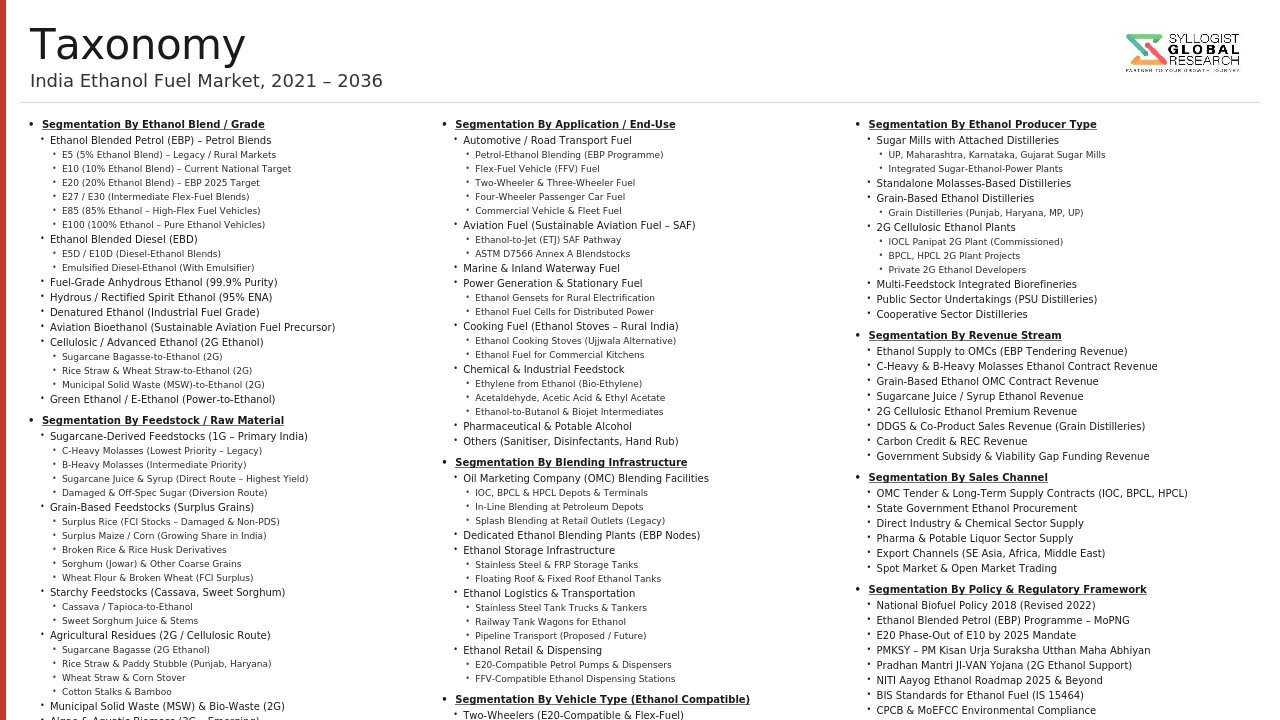
Market Segmentation
- Segmentation By Feedstock Type
- C-Heavy Molasses
- B-Heavy Molasses
- Sugarcane Juice and Syrup
- Broken Rice and Damaged Food Grains
- Maize (Corn)
- Agricultural Residues and Lignocellulosic Biomass (2G Ethanol)
- Others
- Segmentation By Blend Type
- E5 (5% Ethanol Blend)
- E10 (10% Ethanol Blend)
- E12 and E15 (Intermediate Blends)
- E20 (20% Ethanol Blend)
- E85 (High-Blend Flex-Fuel)
- E100 (Neat Ethanol for Flex-Fuel Vehicles)
- Others
- Segmentation By Application
- Transportation Fuel (Petrol Blending)
- Aviation Turbine Fuel (Sustainable Aviation Fuel Blending)
- Industrial Solvent and Chemical Feedstock
- Pharmaceutical and Healthcare Applications
- Power Generation and Direct Combustion
- Others
- Segmentation By Production Technology
- First-Generation (1G) Fermentation from Sugar-Based Feedstocks
- First-Generation (1G) Fermentation from Grain-Based Feedstocks
- Second-Generation (2G) Cellulosic / Lignocellulosic Ethanol
- Integrated 1G-2G Hybrid Production Systems
- Others
- Segmentation By Production Capacity
- Below 30 Kilolitres Per Day (KLPD)
- 30 KLPD to 100 KLPD
- 100 KLPD to 300 KLPD
- Above 300 KLPD
- Segmentation By Producer Type
- Integrated Sugar Mill-Distillery Complexes
- Standalone Molasses-Based Distilleries
- Grain-Based Standalone Distilleries
- Public Sector Undertaking (PSU) Distilleries
- Others
- Segmentation By Distribution Channel
- Oil Marketing Company (OMC) Direct Procurement
- Tendering and Competitive Bidding
- Industrial and Commercial Direct Supply
- Others
- Segmentation By End User
- Oil Marketing Companies (IOC, BPCL, HPCL)
- Automotive and Fleet Operators (Flex-Fuel Vehicles)
- Chemical and Pharmaceutical Manufacturers
- Power Generation Utilities
- Aviation Operators
- Others
- Segmentation By Region
- North India (Uttar Pradesh, Punjab, Haryana, Uttarakhand)
- Western India (Maharashtra, Gujarat, Rajasthan)
- Southern India (Karnataka, Tamil Nadu, Andhra Pradesh, Telangana)
- Eastern India (West Bengal, Odisha, Bihar)
- Central India (Madhya Pradesh, Chhattisgarh)
- Northeastern India
All market revenues are presented in USD
Historical Year: 2021–2024 | Base Year: 2025 | Estimated Year: 2026 | Forecast Period: 2027–2034
Key Questions this Study Will Answer
- What is the total market valuation of the India Ethanol Fuel Market in the base year 2025, what compound annual growth rate is projected through 2034, and how does this trajectory differ across key feedstock-based supply segments, specifically sugarcane-derived versus grain-derived versus second-generation cellulosic ethanol, in terms of volume, revenue contribution, and growth velocity over the forecast period?
- How will the government’s E20 blending target translate into incremental ethanol demand volumes on a state-by-state basis through 2034, and which producing states are expected to bear the largest share of supply expansion requirements to bridge the gap between current blending percentages and the mandated national average, given existing distillery capacity distributions and feedstock availability profiles?
- What is the current status and projected commercial trajectory of second-generation (2G) cellulosic ethanol production in India, and which agricultural residue feedstocks, including rice straw, wheat straw, sugarcane bagasse, and maize stover, are expected to achieve techno-economically viable production costs per litre within the forecast horizon, and at what scale of deployment?
- How are the administered pricing revisions for various feedstock categories, C-heavy molasses, B-heavy molasses, sugarcane juice, broken rice, and maize, affecting distillery investment economics, capacity utilization rates, and the competitive positioning of different producer types, and what pricing adjustments would be required to maintain supply-side investment momentum consistent with E20 programme requirements?
- Who are the leading ethanol producers, major integrated sugar mill-distillery groups, and grain-based distillery operators currently shaping the competitive landscape of the India Ethanol Fuel Market, and what are their respective capacity expansion plans, feedstock procurement strategies, geographic presence, and financial structures as they navigate the regulatory and logistical demands of the accelerating national blending programme through the forecast period?
- Product Definition
- Research Methodology
- Research Design & Framework
- Overall Research Approach: Descriptive, Exploratory & Quantitative Mixed-Method Design
- Market Definition & Scope Boundaries: What is Included and Excluded
- Segmentation Framework
- Key Research Assumptions & Limitations
- Secondary Research
- Primary Research Design & Execution
- Data Triangulation & Validation
- Market Sizing & Forecasting Methodology
- Competitive Intelligence Methodology
- Quality Assurance & Peer Review
- Definitions, Abbreviations & Data Notes
- Research Design & Framework
- Executive Summary
- Market Snapshot & Headline Numbers
- Key Findings & Research Highlights
- Market Dynamics
- State-wise Market Summary
- Competitive Landscape Snapshot
- Technology & Innovation Highlights
- India Ethanol Blending Programme (EBP) Progress Summary
- Market Dynamics
- Drivers
- Restraints
- Opportunities
- Challenges
- Porter’s Five Forces Analysis
- PESTLE Analysis
- Market Trends & Developments
- Emerging Trends
- Technological Developments
- Regulatory & Policy Changes
- Supply Chain & Feedstock Sourcing Trends
- Distillery Capacity Expansion Trends
- Investment & Funding Activity
- Sustainability & ESG Trends
- State-level & Regional Trends
- Risk Assessment Framework
- Feedstock Availability & Monsoon / Agri-Production Risk
- Policy & Regulatory Risk (EBP Programme Revision, Price Fixation)
- Food vs. Fuel Conflict Risk
- Sugar Sector Cyclicality Risk
- Logistics & Infrastructure Risk
- Environmental & Water Stress Risk
- Financial / Market Risk
- Technology Maturity & 2G Ethanol Adoption Risk
- Regulatory Framework & Standards
- National Biofuel Policy (NBP) – 2018 & Amendments
- Ethanol Blending Programme (EBP) – Targets & Timelines
- E20 Roadmap (2025) & Flex-Fuel Vehicle (FFV) Policy
- Pricing Mechanism: FRP-Linked & Administered Ethanol Prices
- Bureau of Indian Standards (BIS) – Fuel Ethanol Quality Specifications
- FSSAI Regulations – Potable Alcohol / ENA Standards
- Ministry of Petroleum & Natural Gas (MoPNG) – Supply Guidelines
- Ministry of Food Processing Industries (MoFPI) – Grain Ethanol Policy
- CPCB / State Pollution Control Boards – Effluent & Environmental Norms
- GST & Tax Regime for Ethanol
- India Ethanol Fuel Market Outlook
- Market Size & Forecast by Value
- Market Size & Forecast by Volume
- Market Size & Forecast by Feedstock Type
- Sugarcane & Molasses-Based Ethanol
- C-Heavy Molasses
- B-Heavy Molasses
- Direct Sugarcane Juice (DSJ)
- Sugarcane Press Mud
- Grain-Based Ethanol
- Broken Rice
- Maize / Corn
- Wheat
- Barley
- Other Food Grains
- Cellulosic / Second Generation (2G) Ethanol
- Rice Straw & Paddy Residue
- Wheat Straw & Agricultural Residues
- Bamboo & Dedicated Energy Crops
- Municipal Solid Waste (MSW)
- Bagasse & Press Mud (Advanced Conversion)
- Others
- Other Feedstocks
- Sweet Sorghum
- Cassava / Tapioca
- Others
- Market Size & Forecast by Blending Mandate / EBP Target
- E5 (5% Ethanol Blend)
- E10 (10% Ethanol Blend)
- E12 (12% Ethanol Blend)
- E15 (15% Ethanol Blend)
- E20 (20% Ethanol Blend)
- E85 / Flex-Fuel Vehicles (FFV)
- Pure Ethanol / E100
- Market Size & Forecast by Purity Grade / Product Type
- Anhydrous Ethanol (Fuel-Grade, 99.9%+)
- Rectified Spirit (RS)
- Extra Neutral Alcohol (ENA)
- Denatured Spirit
- Other Grades
- Market Size & Forecast by End-Use Application
- Fuel Blending (Ethanol Blending Programme)
- Industrial Solvents & Chemical Feedstock
- Potable Alcohol & Beverages (IMFL / Country Liquor)
- Pharmaceutical & Sanitizer Manufacturing
- Cosmetics & Personal Care
- Others
- Market Size & Forecast by Distillery Type
- Integrated Sugar Mill Distilleries
- Standalone Molasses-Based Distilleries
- Grain-Based Distilleries
- Multi-Feed / Dual-Feed Distilleries
- Second Generation (2G) Cellulosic Ethanol Plants
- Market Size & Forecast by Technology
- First Generation (1G) – Conventional Fermentation & Distillation
- Batch Fermentation
- Continuous Fermentation
- Fed-Batch Fermentation
- Second Generation (2G) – Cellulosic / Lignocellulosic
- Enzymatic Hydrolysis + Fermentation
- Acid Hydrolysis
- Gasification & Syngas Fermentation
- Third Generation (3G) – Algae-Based & Advanced Bioconversion
- Dehydration & Purification Technologies
- Molecular Sieve Dehydration
- Membrane-Based Dehydration
- Market Size & Forecast by Distribution Channel
- Oil Marketing Companies (OMCs)
- Indian Oil Corporation Limited (IOCL)
- Bharat Petroleum Corporation Limited (BPCL)
- Hindustan Petroleum Corporation Limited (HPCL)
- Direct Distillery-to-OMC Tender Supply
- Government Agencies & Nodal Bodies (NITI Aayog, DFPD)
- Others
- Oil Marketing Companies (OMCs)
- Market Size & Forecast by Sustainability Attribute
- Conventional (Molasses-Based, Standard 1G)
- Low-Carbon / Reduced GHG Emission Ethanol
- Advanced Biofuel (2G Cellulosic – ASTM / IS Certified)
- Waste-to-Fuel / Circular Economy Ethanol
- Water-Efficient / Sustainable Production Certified
- First Generation (1G) – Conventional Fermentation & Distillation
- Sugarcane & Molasses-Based Ethanol
- North India Ethanol Fuel Market Outlook
- Market Size & Forecast
- By Value
- By Volume
- By Feedstock Type
- By Blending Mandate / EBP Target
- By Purity Grade / Product Type
- By End-Use Application
- By Distillery Type
- By Technology
- By Distribution Channel
- By Sustainability Attribute
- Key States: Uttar Pradesh, Punjab, Haryana, Uttarakhand, Rajasthan
- Market Size & Forecast
- West India Ethanol Fuel Market Outlook
- Market Size & Forecast
- By Value
- By Volume
- By Feedstock Type
- By Blending Mandate / EBP Target
- By Purity Grade / Product Type
- By End-Use Application
- By Distillery Type
- By Technology
- By Distribution Channel
- By Sustainability Attribute
- Key States: Maharashtra, Gujarat, Goa, Madhya Pradesh
- Market Size & Forecast
- South India Ethanol Fuel Market Outlook
- Market Size & Forecast
- By Value
- By Volume
- By Feedstock Type
- By Blending Mandate / EBP Target
- By Purity Grade / Product Type
- By End-Use Application
- By Distillery Type
- By Technology
- By Distribution Channel
- By Sustainability Attribute
- Key States: Karnataka, Tamil Nadu, Andhra Pradesh, Telangana, Kerala
- Market Size & Forecast
- East India Ethanol Fuel Market Outlook
- Market Size & Forecast
- By Value
- By Volume
- By Feedstock Type
- By Blending Mandate / EBP Target
- By Purity Grade / Product Type
- By End-Use Application
- By Distillery Type
- By Technology
- By Distribution Channel
- By Sustainability Attribute
- Key States: Bihar, Odisha, West Bengal, Jharkhand
- Market Size & Forecast
- Central & Northeast India Ethanol Fuel Market Outlook
- Market Size & Forecast
- By Value
- By Volume
- By Feedstock Type
- By Blending Mandate / EBP Target
- By Purity Grade / Product Type
- By End-Use Application
- By Distillery Type
- By Technology
- By Distribution Channel
- By Sustainability Attribute
- Key States: Chhattisgarh, Madhya Pradesh, Assam, Manipur, Meghalaya
- Market Size & Forecast
- State-wise* India Ethanol Fuel Market Outlook
- Market Size & Forecast
- By Value
- By Volume
- By Feedstock Type
- By Blending Mandate / EBP Target
- By Purity Grade / Product Type
- By End-Use Application
- By Distillery Type
- By Technology
- By Distribution Channel
- By Sustainability Attribute
- Market Size & Forecast
States Analyzed in the Research Portfolio: Uttar Pradesh, Maharashtra, Karnataka, Tamil Nadu, Andhra Pradesh, Gujarat, Punjab, Bihar, Haryana, Telangana, Odisha, West Bengal, Madhya Pradesh, Rajasthan, Uttarakhand, Chhattisgarh, Assam
- Technology Landscape & Innovation Analysis
- Value Chain & Supply Chain Analysis
- Feedstock Procurement & Agri-Sourcing
- Distillery Operations & Processing
- Dehydration, Storage & Logistics
- OMC Blending Depots & Distribution Network
- Retail / End-Consumer Fuel Dispensation
- By-Products: DDGS, CO2, Spent Wash Treatment
- Pricing Analysis
- Government-Administered Ethanol Prices (FRP-Linked)
- Feedstock-Wise Pricing Differential
- State-wise Price Variation Analysis
- Price Trend & Forecast Analysis
- Comparison with Petrol / International Ethanol Benchmarks
- Sustainability & Environmental Impact
- GHG Emission Reduction Potential from EBP
- Water Consumption & Zero Liquid Discharge (ZLD) Compliance
- Waste Management: Spent Wash, Press Mud & CO2 Valorisation
- Carbon Credit & Clean Development Mechanism (CDM) Opportunities
- Sustainability Certifications & Standards
- Competitive Landscape
- Market Structure & Concentration
- Market Consolidation Level (Fragmented Vs Consolidated)
- Top 5 Players Market Share
- HHI (Herfindahl–Hirschman Index) Concentration Analysis
- Competitive Intensity Map
- Player Classification
- Market Leaders (Large Integrated Sugar-Ethanol Complexes)
- Strong Challengers (Mid-size Distilleries & Grain Players)
- Specialist / Niche Players (2G & Cellulosic Ethanol)
- Emerging Players (New Entrants & Startups)
- Regional / State-level Players
- Competitive Analysis Frameworks
- Market Share Analysis
- Company Profile
- Company Overview & Headquarters
- Products & Solutions Portfolio (Ethanol, ENA, IMFL, By-Products)
- Overall Revenue & Segmental Revenue
- Distillery Capacity & Production Volume
- Geographic Presence (States / Plants)
- Recent Developments (Capacity Expansion, M&A, JVs, Policy Wins)
- SWOT Analysis
- Strategic Focus Areas
- Competitive Positioning Map
- Market Structure & Concentration
- Strategic Output
- Market Opportunity Matrix
- White Space Opportunity Analysis
- Strategic Recommendations
- Feedstock Diversification & Raw Material Sourcing Strategy
- Capacity Expansion & Greenfield / Brownfield Distillery Strategy
- 2G & Advanced Biofuel Technology Adoption Strategy
- EBP Compliance & OMC Partnership Strategy
- Pricing, Tender Participation & Commercial Strategy
- Regulatory Compliance, Licensing & Quality Certification Strategy
- Sustainability, ZLD & ESG Strategy
- By-Product Valorisation Strategy (DDGS, CO2, Biogas)
- State-level Market Entry & Expansion Strategy
- Partnership, M&A & Vertical Integration Strategy
- Risk Mitigation & Resilience Roadmap
- Strategic Priority Matrix & Roadmap
- Near-term (2025–2027): E20 Ramp-up & Capacity Build
- Mid-term (2028–2031): 2G Scale-up & Multi-feedstock Transition
- Long-term (2032–2036): Flex-Fuel Ecosystem & Green Hydrogen Integration