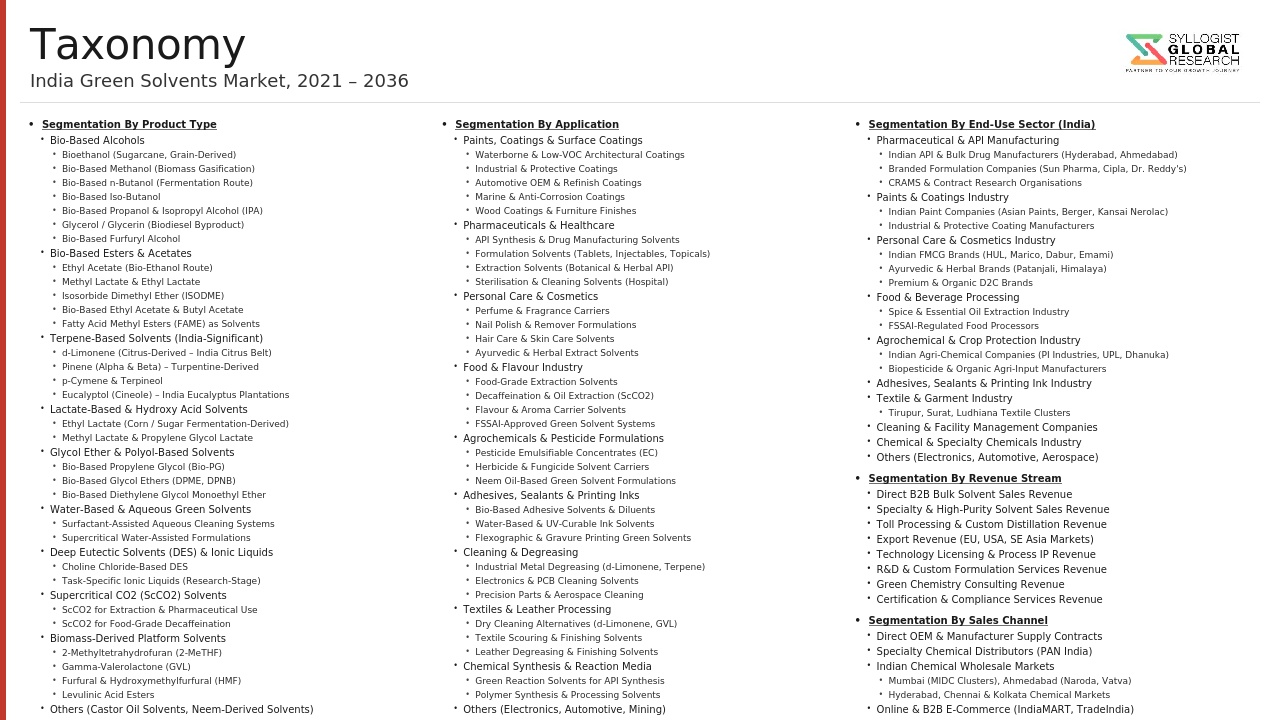

Market Definition
The India Green Solvents Market encompasses the production, formulation, distribution, and end-use application of solvents derived from renewable biological feedstocks or manufactured through environmentally benign chemical processes that deliver functional performance equivalent to or superior to conventional petroleum-derived solvents while generating substantially lower life-cycle environmental burdens in terms of volatile organic compound emissions, aquatic toxicity, human health risk, carbon footprint, and end-of-life biodegradability. Green solvents, also referred to as bio-based solvents, sustainable solvents, or environmentally preferred solvents, encompass a chemically diverse portfolio of compounds including ethanol and other fermentation-derived alcohols, ethyl lactate and other lactic acid esters produced from agricultural biomass, methyl soyate and other fatty acid methyl esters derived from vegetable oils, d-limonene and other terpene solvents extracted from citrus fruit processing residues, glycerol-derived solvents including propylene glycol and glycerol formal produced from biodiesel co-product streams, supercritical carbon dioxide used as a processing solvent in extraction and cleaning applications, and ionic liquids and deep eutectic solvents representing next-generation low-volatility solvent platforms. The market additionally encompasses partially bio-derived and low-toxicity reformulated solvent products, including bio-glycol ethers, bio-acetone, bio-methanol, and bio-based methyltetrahydrofuran, that offer improved environmental profiles relative to fully petroleum-derived equivalents even when not produced entirely from renewable feedstocks. End-use applications span the paints and coatings industry, pharmaceuticals and active pharmaceutical ingredient manufacturing, agrochemical formulations, personal care and cosmetics, food processing and flavour extraction, industrial cleaning and degreasing, adhesives and sealants, textile processing, and printing inks. Key market participants include specialty chemical manufacturers, bio-refinery operators, agrochemical and pharmaceutical companies transitioning formulations toward sustainable solvent platforms, domestic solvent distributors, and regulatory bodies including the Ministry of Environment Forest and Climate Change and the Bureau of Indian Standards whose evolving chemical safety and sustainability frameworks are progressively shaping demand for greener solvent alternatives across Indian industry.
Market Insights
The India green solvents market is transitioning from a nascent specialty chemical segment serving a narrow set of compliance-driven and export-oriented applications toward a commercially mainstream industrial inputs market whose growth is being reinforced by converging forces of tightening domestic environmental regulation, accelerating global supply chain sustainability mandates imposed on Indian exporters by European and North American brand owners, and the improving cost competitiveness of bio-based solvent production as agricultural feedstock availability and bio-refinery processing efficiency advance in parallel. India’s chemical industry, the sixth largest in the world by output value with an estimated production value of approximately USD 220 billion in fiscal year 2024-25, is a structurally significant consumer of industrial solvents across its pharmaceutical, agrochemical, paints, textile, and specialty chemical manufacturing sub-sectors, yet the penetration of bio-based and environmentally preferred solvents within this industry remains at approximately 8% to 11% of total solvent consumption by volume as of 2025, underscoring both the commercial immaturity of the current market and the scale of the substitution opportunity available to green solvent producers as regulatory and commercial pressures accelerate adoption. The India green solvents market was valued at approximately USD 780 million in 2025 and is projected to reach USD 1.96 billion by 2034, advancing at a compound annual growth rate of 10.8% over the forecast period from 2027 to 2034, as pharmaceutical export compliance requirements, paints and coatings industry reformulation investment, and the scaling of domestic bio-refinery capacity collectively drive the progressive displacement of petroleum-derived conventional solvents across the country’s most solvent-intensive manufacturing sectors.
India’s pharmaceutical and active pharmaceutical ingredient manufacturing sector represents the most commercially advanced and compliance-driven application domain for green solvents within the domestic market, reflecting the sector’s deep integration into global pharmaceutical supply chains in which multinational drug manufacturers and contract research and manufacturing organizations are subject to International Council for Harmonisation of Technical Requirements for Pharmaceuticals for Human Use guidelines that classify solvents by residual solvent class and impose strict limits on the use of Class 1 and Class 2 toxic solvents in drug substance manufacturing, creating a continuous regulatory incentive to substitute higher-toxicity petroleum-derived solvents with greener alternatives where technically feasible within validated pharmaceutical manufacturing processes. India is the world’s largest producer of generic pharmaceuticals by volume, supplying approximately 20% of global generic drug exports by value and operating over 3,000 pharmaceutical manufacturing facilities, of which a significant proportion hold US Food and Drug Administration, European Medicines Agency, or equivalent multinational regulatory authority approvals that impose current Good Manufacturing Practice compliance obligations including solvent management and residual solvent control requirements. The adoption of ethyl lactate as a green alternative to ethyl acetate and acetone in pharmaceutical crystallization and extraction processes, the use of supercritical carbon dioxide for natural product extraction replacing hexane in phytochemical manufacturing, and the substitution of propylene glycol for glycol ethers in topical drug formulation manufacturing represent documented green solvent adoption pathways within Indian pharmaceutical manufacturing that are generating measurable demand growth for bio-based solvent products from domestic and import sources, with Indian pharmaceutical manufacturers collectively estimated to consume approximately 85,000 metric tonnes of green solvents annually in 2025.
The paints and coatings industry represents the second most significant and volumetrically largest application sector for green solvents in India, where the dual pressure of the government’s Volatile Organic Compound emission reduction agenda under the National Clean Air Programme and the export market requirement for low-VOC and sustainable coating formulations from Indian coatings manufacturers supplying European and North American customers is compelling formulation reformulation investment across both architectural and industrial coating product lines. India’s paints and coatings market, valued at approximately USD 9.4 billion in 2024-25, consumes an estimated 380,000 metric tonnes of solvents annually across decorative, automotive, protective, and industrial coating applications, of which conventional aromatic and aliphatic petroleum-derived solvents including xylene, toluene, and mineral spirits currently constitute the overwhelming majority of solvent input by volume despite their well-documented health and environmental liabilities. The National Clean Air Programme’s targeted 40% reduction in particulate matter and nitrogen oxide concentrations in 122 non-attainment cities by 2026, combined with the Central Pollution Control Board’s VOC emission norms for the paints manufacturing industry notified under Environment Protection Act rules, is compelling paints manufacturers operating in designated industrial areas to reduce solvent emission intensity of their manufacturing and formulation processes, creating an immediate compliance-driven demand signal for low-VOC green solvent alternatives. D-limonene-based terpene solvents, bio-ethanol, and methyl soyate are emerging as commercially viable green alternatives in specific coating and industrial cleaning formulations where their solvency parameters are compatible with existing formulation chemistry, with domestic terpene solvent demand from the paints and cleaning applications segments growing at approximately 14.2% annually as formulation technologists in Indian coatings companies develop validated alternative formulations around available bio-based solvent inputs.
From a regional production and consumption standpoint, Maharashtra, Gujarat, and Tamil Nadu collectively constitute the primary centers of green solvent demand and emerging domestic production activity within India, reflecting the concentration of the country’s pharmaceutical manufacturing clusters in Pune, Hyderabad, and Ahmedabad, its paints and coatings manufacturing base in Mumbai, Ahmedabad, and Chennai, and its specialty chemical processing industry in the Gujarat Chemical Zone and the Maharashtra Industrial Development Corporation’s industrial estates. Gujarat has emerged as the most strategically significant state for green solvent production investment, anchored by its established bio-refinery infrastructure producing ethanol and bio-based chemicals from sugarcane and grain feedstocks, its port connectivity enabling cost-effective import of bio-based solvent intermediates, and its large specialty chemical manufacturing cluster that generates captive demand for green solvents in agrochemical and specialty chemical formulation applications. The government of India’s Production Linked Incentive scheme for specialty chemicals and the Department of Chemicals and Petrochemicals’ chemical industry vision document identifying bio-based chemicals as a priority development segment are creating an enabling policy environment for domestic green solvent production capacity investment, with announced investments in bio-refinery expansion and bio-based chemical production facilities in Gujarat, Uttar Pradesh, and Maharashtra aggregating over USD 340 million across fiscal years 2023-24 to 2025-26 and expected to meaningfully expand the domestic production base for ethanol-derived, lactic acid-based, and terpene green solvents over the forecast period.
Key Drivers
Tightening Domestic Environmental Regulations and the Central Pollution Control Board’s Escalating Volatile Organic Compound Emission Enforcement
The progressive tightening of India’s industrial environmental regulatory framework, most consequentially through the Central Pollution Control Board’s Volatile Organic Compound emission norms, the Environment Protection Act’s Hazardous Waste Management Rules governing solvent storage and disposal, and the National Clean Air Programme’s city-level air quality improvement mandates, is creating an increasingly binding compliance imperative for solvent-intensive industries to evaluate and adopt green solvent alternatives that reduce fugitive VOC emissions, occupational exposure liabilities, and hazardous waste generation at their manufacturing facilities. The CPCB’s notified emission standards for solvent-using industries including paints manufacturing, pharmaceutical production, printing and packaging, and leather processing impose specific VOC emission rate limits per unit of production that are progressively approaching levels achievable only through the reformulation of solvent systems toward lower-volatility and lower-aromatic-content green alternatives, as end-of-pipe emission control equipment alone cannot bridge the gap between achievable capture efficiencies and mandated emission thresholds at production volumes typical of large-scale Indian manufacturing operations. Occupational safety enforcement under the Factories Act and the Ministry of Labour’s revised chemical exposure limit notifications, which have reduced permissible exposure limits for toluene, xylene, n-hexane, and other conventional petroleum solvents to levels requiring costly engineering controls in solvent-intensive production environments, are creating an additional economic incentive to substitute regulated conventional solvents with green alternatives carrying more favorable occupational exposure profiles, independently of the environmental compliance driver that is simultaneously operating across the same user industries.
Export Market Sustainability Requirements and the Green Chemistry Mandates of Global Pharmaceutical and Specialty Chemical Supply Chains
India’s position as a major global exporter of pharmaceutical active ingredients, specialty chemicals, agrochemical formulations, and textile products places its manufacturing industry under the direct influence of sustainability and chemical safety requirements imposed by the importing countries and multinational brand owner customers whose procurement standards increasingly extend beyond the product itself to encompass the environmental and safety profile of the manufacturing processes and input chemicals used in its production. The European Union’s Chemical Regulation REACH, its Restriction of Hazardous Substances directive in electronics, and the emerging Corporate Sustainability Due Diligence Directive collectively impose chemical safety and process sustainability obligations on European importers of Indian-manufactured chemicals and formulations that flow upstream as supply chain qualification requirements onto Indian exporters who must demonstrate compliance with restricted substance lists, VOC content limits, and green chemistry principles to maintain market access. Indian pharmaceutical manufacturers exporting to regulated markets under US FDA and EMA Good Manufacturing Practice authorizations face ICH Q3C solvent classification compliance requirements that mandate the use of Class 3 preferred solvents where technically feasible and impose strict residual limits on Class 2 solvents, generating a specific and growing demand for green solvent alternatives that meet the required purity specifications and carry validated analytical methods for residual solvent testing, creating commercial demand that is contractually anchored to export market access rather than subject to the adoption discretion that characterizes domestically-driven green purchasing decisions.
Expanding Domestic Bio-Refinery Capacity and Improving Cost Competitiveness of Bio-Based Solvent Production from Indigenous Agricultural Feedstocks
India’s structural agricultural surplus in sugarcane, molasses, grain, and oilseed crops, combined with the government’s sustained policy support for bio-based chemical production through the National Biofuel Policy, the ethanol blending programme’s production capacity incentive structure, and the Production Linked Incentive scheme for specialty chemical manufacturing, is creating an expanding and progressively more cost-competitive domestic feedstock and production infrastructure base for bio-based green solvents that is gradually reducing the price premium of green solvent alternatives relative to conventional petroleum-derived equivalents in the Indian market. Ethanol produced from sugarcane molasses and grain at India’s rapidly expanding distillery network, whose aggregate licensed capacity exceeded 15 billion litres per annum as of 2025, provides the primary domestic feedstock for bio-ethanol solvent and bio-ethyl acetate production, with the availability of competitively priced domestic fermentation ethanol enabling Indian bio-based solvent producers to offer ethanol-derived green solvents at delivered costs approaching petroleum-derived ethanol prices in multiple solvent end-use applications. Lactic acid and its ester derivatives including ethyl lactate, which represent some of the most functionally versatile and commercially promising green solvent platforms for pharmaceutical and coatings applications, are increasingly being produced from domestic agricultural carbohydrate feedstocks by Indian specialty chemical manufacturers investing in fermentation and esterification capacity, with production cost reductions from scale-up and process optimization estimated to bring Indian-produced ethyl lactate within 15% to 18% of conventional solvent price parity by 2028, a threshold at which adoption driven by compliance and sustainability benefits alone becomes commercially self-sustaining without requiring price subsidies or regulatory mandates.
Key Challenges
Persistent Price Premium of Green Solvents Relative to Petroleum-Derived Conventional Solvents and the Cost Sensitivity of Indian Industrial Buyers
The most commercially significant and immediately constraining challenge facing the India green solvents market is the persistent price premium of bio-based and environmentally preferred solvents relative to the petroleum-derived conventional solvent alternatives they seek to replace, in a market environment where Indian industrial solvent buyers across pharmaceuticals, paints, agrochemicals, and textile processing are acutely cost-sensitive and where procurement decisions in the majority of industrial segments remain primarily price-driven rather than sustainability or compliance-driven in the absence of directly applicable mandatory regulatory requirements. Green solvents produced from agricultural feedstocks are subject to production cost structures that include fermentation, separation, and purification process costs absent from the relatively straightforward distillation-based production of petroleum-derived solvents, and that are sensitive to agricultural commodity price cycles rather than petroleum price cycles, creating a cost relationship with conventional solvents that is highly variable and in periods of low crude oil prices may produce price differentials of 30% to 80% that are commercially prohibitive for adoption in price-competitive commodity chemical manufacturing segments. Small and medium-scale Indian chemical manufacturers, which constitute the majority of solvent-consuming enterprises in the country’s highly fragmented specialty chemical, paint formulation, and adhesive manufacturing sectors, operate on thin margins that structurally limit their ability to absorb green solvent price premiums without demonstrably quantifiable cost savings elsewhere in their manufacturing or compliance cost structure, meaning that green solvent adoption in these segments requires either regulatory compulsion, customer-mandated specification change, or green solvent price convergence to within approximately 10% to 15% of conventional alternatives before market penetration can accelerate meaningfully beyond early-adopter and compliance-driven volumes.
Limited Domestic Production Scale, Technology Maturity Gaps, and Dependence on Imported Green Solvent Intermediates and Finished Products
The India green solvents market is structurally constrained by the limited scale and technology maturity of domestic green solvent manufacturing capacity, with a significant proportion of commercially deployed bio-based solvents including ethyl lactate, d-limonene, methyl soyate, and bio-based glycol ethers currently supplied through imports from European, North American, and Chinese producers whose larger-scale manufacturing operations and more advanced process technology deliver lower production costs and more consistent product quality specifications than most currently available domestically produced equivalents. The domestic bio-based solvent production infrastructure that does exist in India is largely concentrated in ethanol and bio-ethyl acetate manufacturing, leaving a wide range of functionally important green solvent chemistries including lactic acid esters, terpene solvents, and fatty acid esters served predominantly by imports that are subject to currency exchange rate risk, import duty structures, and supply chain disruptions that undermine the supply security and total delivered cost competitiveness of these green solvent options relative to domestically produced petroleum-derived alternatives. Technology gaps in downstream processing, specifically in the separation, purification, and stabilization steps required to produce pharmaceutical-grade and high-purity industrial-grade bio-based solvents from fermentation and bio-refinery intermediate streams, represent a critical bottleneck limiting the ability of Indian bio-refinery operators to capture the higher-value solvent market segments where green solvent price premiums are most commercially tolerable, and where domestic supply capability would most effectively reduce import dependence and improve market competitiveness.
Technical Performance Limitations, Formulation Compatibility Challenges, and the Validation Investment Required for Regulated Industry Solvent Substitution
The substitution of established petroleum-derived solvents with bio-based green alternatives in regulated and technically demanding applications including pharmaceutical manufacturing, agrochemical formulation, and high-performance industrial coatings requires a structured and resource-intensive process of formulation development, technical performance validation, stability testing, regulatory submission, and in some cases re-registration of end products that imposes significant time, cost, and organizational capability burdens on adopting manufacturers, particularly in a domestic industrial environment where dedicated green chemistry and formulation development capabilities remain concentrated in a limited number of large-scale companies with the engineering resources and regulatory expertise to manage complex multi-year substitution programs. Pharmaceutical manufacturers operating under US FDA or EMA Good Manufacturing Practice approvals must submit process validation data, comparative impurity profiling, and in some cases formal regulatory change notifications when substituting solvents used in approved drug substance manufacturing processes, with the associated analytical development and stability testing investment per substitution program estimated at USD 150,000 to USD 450,000 depending on the complexity of the manufacturing process and the regulatory filing category, a cost burden that is commercially prohibitive for small and medium Indian API manufacturers without the financial resources to fund multiple simultaneous solvent substitution validation programs. Green solvents in coatings and adhesives applications may exhibit solvency parameters, evaporation rates, and compatibility characteristics that differ from their petroleum-derived counterparts in ways that require reformulation of the entire coating system rather than simple solvent substitution, with reformulation programs requiring application testing, storage stability evaluation, customer approval, and potentially product re-registration under applicable chemical notification frameworks, extending the adoption timeline well beyond the procurement decision and creating organizational inertia that slows even commercially motivated green solvent transitions.
Market Segmentation
- Segmentation By Product Type
- Bio-Alcohols (Bio-Ethanol, Bio-Methanol, Bio-Butanol)
- Lactate Esters (Ethyl Lactate, Methyl Lactate)
- Fatty Acid Methyl Esters (Methyl Soyate, Methyl Cocoate)
- Terpene Solvents (D-Limonene, Alpha-Pinene, Terpineol)
- Glycerol-Derived Solvents (Propylene Glycol, Glycerol Formal, Glycerol Carbonate)
- Bio-Based Esters (Bio-Ethyl Acetate, Bio-n-Butyl Acetate)
- Bio-Based Ketones (Bio-Acetone, Bio-Methyl Ethyl Ketone)
- Supercritical Carbon Dioxide (SC-CO2)
- Ionic Liquids and Deep Eutectic Solvents
- Bio-Based Glycol Ethers
- Others
- Segmentation By Feedstock
- Sugarcane and Molasses
- Corn and Grain Starch
- Vegetable Oils (Soybean, Coconut, Palm)
- Citrus Fruit Processing Residues
- Lignocellulosic Agricultural Residues
- Carbon Dioxide (Industrial By-Product)
- Others
- Segmentation By Application
- Paints and Coatings
- Pharmaceuticals and Active Pharmaceutical Ingredient (API) Manufacturing
- Agrochemical Formulations and Crop Protection
- Personal Care and Cosmetics
- Industrial Cleaning and Degreasing
- Food Processing and Flavour Extraction
- Adhesives and Sealants
- Printing Inks and Graphic Arts
- Textile Processing and Dyeing
- Electronics Cleaning and PCB Manufacturing
- Others
- Segmentation By Nature
- Fully Bio-Based Green Solvents (100% Renewable Feedstock)
- Partially Bio-Based Green Solvents (Blended Bio and Synthetic)
- Reformulated Low-VOC and Low-Toxicity Solvents
- Others
- Segmentation By Process Technology
- Fermentation-Derived Solvents
- Esterification and Trans-Esterification
- Cold Press and Steam Distillation Extraction
- Supercritical Fluid Extraction and Processing
- Hydrogenation and Catalytic Conversion
- Others
- Segmentation By Physical Form
- Liquid Solvents
- Supercritical Fluid Solvents
- Solid Ionic Liquid and Deep Eutectic Solvent Matrices
- Others
- Segmentation By End User
- Pharmaceutical and Biotechnology Manufacturers
- Paints and Coatings Manufacturers
- Agrochemical and Pesticide Formulators
- Personal Care and Cosmetics Manufacturers
- Food and Beverage Processors
- Industrial and Institutional Cleaning Product Manufacturers
- Adhesive and Sealant Producers
- Textile Mills and Dyehouses
- Printing and Packaging Companies
- Electronics and Semiconductor Manufacturers
- Others
- Segmentation By Sales Channel
- Direct Sales to Industrial End Users
- Specialty Chemical Distributors and Wholesalers
- Online Chemical Procurement Platforms
- Government Procurement and Public Sector Enterprises
- Others
- Segmentation By Region
- Western India (Maharashtra, Gujarat, Rajasthan)
- Southern India (Tamil Nadu, Telangana, Andhra Pradesh, Karnataka)
- Northern India (Uttar Pradesh, Haryana, Punjab, Delhi NCR)
- Eastern India (West Bengal, Odisha, Jharkhand)
- Central India (Madhya Pradesh, Chhattisgarh)
All market revenues are presented in USD
Historical Year: 2021–2024 | Base Year: 2025 | Estimated Year: 2026 | Forecast Period: 2027–2034
Key Questions this Study Will Answer
- What is the total market valuation of the India Green Solvents Market in the base year 2025, and what is the projected market size and compound annual growth rate through 2034, disaggregated by product type, bio-alcohols, lactate esters, terpene solvents, fatty acid methyl esters, glycerol-derived solvents, and supercritical carbon dioxide, and by application, pharmaceuticals, paints and coatings, agrochemicals, personal care, and industrial cleaning, to enable domestic chemical manufacturers, green solvent importers, bio-refinery investors, and specialty chemical distributors to identify the highest-growth product and application combinations driving the market through the forecast period?
- How is the tightening regulatory environment across the Central Pollution Control Board’s VOC emission norms, the Ministry of Environment Forest and Climate Change’s Hazardous Waste Management Rules, and the National Clean Air Programme’s non-attainment city air quality improvement mandates expected to accelerate the mandatory substitution of petroleum-derived solvents with green alternatives across India’s paints, pharmaceutical, textile, and agrochemical manufacturing industries on a sector-by-sector and timeline-specific basis through 2034, and what estimated volume of conventional solvent displacement does each regulatory action represent in terms of green solvent demand generation?
- What is the current production capacity, technology readiness level, feedstock sourcing strategy, and cost competitiveness trajectory of domestic Indian green solvent manufacturers across the bio-ethanol, ethyl lactate, d-limonene, methyl soyate, and bio-based ester product categories, and at what production scale and process efficiency level does domestically produced bio-based solvent achieve price parity with imported green solvents and with petroleum-derived conventional solvent alternatives across the pharmaceutical, paints, and industrial cleaning application segments?
- How are Indian pharmaceutical API exporters, generic drug manufacturers, and contract research and manufacturing organizations managing the transition from ICH Q3C Class 2 restricted solvents to Class 3 preferred green solvent alternatives within their US FDA and EMA-approved manufacturing processes, and what is the estimated aggregate annual volume of green solvent demand generated by this compliance-driven substitution activity across India’s approximately 3,000 pharmaceutical manufacturing facilities, projected through 2034 as regulatory guidance on preferred solvent use continues to evolve?
- Who are the leading domestic producers, specialty chemical importers, bio-refinery operators, and distribution channel participants currently defining the competitive landscape of the India Green Solvents Market, and what are their respective product portfolios, feedstock procurement strategies, application development investment priorities, geographic market presence across India’s major industrial chemical consuming regions, pricing strategies relative to conventional solvent alternatives, and medium-term capacity expansion plans as the domestic green solvents market accelerates toward its projected valuation of USD 1.96 billion by 2034?
- Product Definition
- Research Methodology
- Research Design & Framework
- Overall Research Approach: Descriptive, Exploratory & Quantitative Mixed-Method Design
- Market Definition & Scope Boundaries: What is Included and Excluded
- Segmentation Framework
- Key Research Assumptions & Limitations
- Secondary Research
- Primary Research Design & Execution
- Data Triangulation & Validation
- Market Sizing & Forecasting Methodology
- Competitive Intelligence Methodology
- Quality Assurance & Peer Review
- Definitions, Abbreviations & Data Notes
- Research Design & Framework
- Executive Summary
- Market Snapshot & Headline Numbers
- Key Findings & Research Highlights
- Market Dynamics
- Regional & State-Wise Market Summary
- Competitive Landscape Snapshot
- Technology & Innovation Highlights
- Market Dynamics
- Drivers
- Restraints
- Opportunities
- Challenges
- Porter’s Five Forces Analysis
- PESTLE Analysis
- Market Trends & Developments
- Emerging Trends
- Technological Developments
- Regulatory & Policy Changes
- Supply Chain & Sourcing Trends
- Manufacturing & Processing Trends
- Investment & Funding Activity
- Sustainability & ESG Trends
- Risk Assessment Framework
- Raw Material & Feedstock Supply Risk
- Regulatory & Compliance Risk
- Market & Competitive Risk
- Technology & Performance Risk
- Environmental & ESG Risk
- Regulatory Framework & Standards
- Indian Environmental & Chemical Regulations Impacting Green Solvent Market
- Indian Standards for Solvents & Green Chemicals
- Indian Pharmaceutical & Agrochemical Solvent Standards
- International Standards Applicable to Indian Green Solvent Exporters
- Green Chemistry Policy & Government Programmes
- India Green Solvents Market Outlook
- Market Size & Forecast by Value
- Market Size & Forecast by Volume (Thousand Tonnes)
- Market Size & Forecast by Solvent Type
- Bio-Based / Naturally Derived Solvents
- Ethanol (Bio-Ethanol from Fermentation)
- Ethyl Acetate (from Bio-Ethanol & Acetic Acid)
- Ethyl Lactate (from Lactic Acid & Ethanol)
- Methyl Soyate & Soy-Based Solvents
- d-Limonene & Terpene-Based Solvents (from Citrus, Pine)
- Glycerol & Glycerol-Derived Solvents (Solketal, Diethylene Glycol Dibenzoate)
- Fatty Acid Methyl Esters (FAME) as Bio-Solvent
- Isosorbide Dimethyl Ether (from Sorbitol / Starch)
- Furfural & Furfuryl Alcohol (from Pentose-Rich Agro-Residue)
- 2-Methyltetrahydrofuran (2-MeTHF from Bio-Derived Furfural)
- Levulinic Acid & Levulinate Esters (from Cellulose)
- Succinic Acid-Derived Solvents (Bio-Succinic Acid Platform)
- Others (Hydroxymethylfurfural HMF Derivatives, Itaconate Esters)
- Bio-Based Drop-In Solvents (Identical Structure to Petrochemical, Bio-Sourced Feedstock)
- Bio-Based Acetone (Acetone-Butanol-Ethanol – ABE Fermentation)
- Bio-Based n-Butanol
- Bio-Based Isobutanol
- Bio-Based Propylene Glycol
- Bio-Based 1,3-Propanediol
- Bio-Based Acetic Acid & Acetate Esters
- Supercritical & CO₂-Based Solvents
- Supercritical Carbon Dioxide (scCO₂)
- Sub-Critical Water as Green Solvent
- Ionic Liquids & Deep Eutectic Solvents (DES)
- Choline Chloride-Based Deep Eutectic Solvents
- Amino Acid-Based Deep Eutectic Solvents
- Task-Specific Ionic Liquids for Pharma & Specialty Applications
- Conventional Green-Approved Solvents (Low-Toxicity, High-Biodegradability)
- Dimethyl Carbonate (DMC)
- Dimethyl Sulfoxide (DMSO) – Pharmaceutical Grade
- Cyclopentyl Methyl Ether (CPME)
- 2-Butanol
- Propylene Carbonate
- Dihydrolevoglucosenone (Cyrene™)
- Gamma-Valerolactone (GVL)
- Methyl THF (2-MeTHF)
- Water-Based Systems (Aqueous Green Solvents)
- Ultrapure Water as Reaction Solvent (Pharmaceutical)
- Aqueous Micellar Systems for Green Synthesis
- Waterborne Solvent Systems for Coatings & Adhesives
- Market Size & Forecast by Application / End-Use Industry
- Pharmaceuticals & API Manufacturing
- API Synthesis & Reaction Solvent
- Crystallisation & Purification Solvent
- Formulation & Drug Delivery Solvent
- Cleaning & Equipment Washing Solvent in Pharma Plants
- HPLC & Analytical Grade Green Solvent
- Agrochemicals & Crop Protection
- Pesticide & Herbicide Formulation Solvent
- Technical Grade Active Ingredient Dilution & Carrier Solvent
- Seed Treatment Formulation Solvent
- Bio-Pesticide & Biopesticide Suspension Concentrate Solvent
- Paints, Coatings & Varnishes
- Waterborne Architectural Coating Co-Solvent
- Industrial Maintenance Coating Green Solvent
- Automotive OEM & Refinish Waterborne Coating Solvent
- Powder Coating Cure Aid & Low-VOC Coating Solvent
- Decorative Paint & Varnish Low-VOC Green Solvent
- Printing Inks & Packaging
- Water-Based Flexographic & Gravure Ink Solvent
- Energy-Curable (UV/EB) Ink Green Diluent & Monomer
- Food-Safe Packaging Ink Green Solvent
- Digital Ink & Inkjet Printing Green Fluid
- Adhesives & Sealants
- Water-Based Construction Adhesive Green Solvent
- Pressure-Sensitive Adhesive (PSA) Green Carrier Solvent
- Rubber-Based Adhesive Low-VOC Solvent
- Structural Adhesive & Epoxy Cure Green Diluent
- Personal Care & Cosmetics
- Hair Care Formulation Green Solvent (Ethanol, Propylene Glycol Bio-Based)
- Skin Care & Moisturiser Bio-Solvent & Carrier
- Perfume & Fragrance Green Alcohol Carrier
- Nail Care & Cosmetic Colour Green Solvent
- Oral Care Formulation Green Solvent
- Food & Beverage Processing
- Edible Oil Extraction Green Solvent (Ethyl Acetate, Ethanol replacing Hexane)
- Natural Flavour, Colour & Spice Oleoresin Extraction
- Decaffeination of Tea & Coffee (scCO₂, Ethyl Acetate)
- Food-Grade Hop Extraction & Botanical Extract Solvent
- Nutraceutical & Herbal Extract Green Solvent
- Textile, Leather & Dyeing
- Textile Scouring & Pre-Treatment Green Solvent
- Dyeing Auxiliary & Levelling Agent Green Carrier Solvent
- Dry-Cleaning Green Solvent (Replacing PERC)
- Leather Finishing & Degreasing Green Solvent
- Electronics & Semiconductor Manufacturing
- PCB Cleaning & Flux Removal Green Solvent
- Photoresist Stripping & Developer Green Solvent
- Display Panel Cleaning Green Solvent
- Battery Electrolyte Bio-Based Solvent (Propylene Carbonate, Dimethyl Carbonate)
- Industrial Cleaning & Degreasing
- Metal Parts Degreasing & Surface Preparation Green Solvent
- Precision Cleaning (Optical, Aerospace Component) Green Solvent
- Maintenance Cleaning & Solvent Wipe Applications
- Mould Release Agent Green Solvent
- Rubber & Polymer Processing
- Rubber Compounding & Processing Green Solvent
- Polymer Solution & Film Casting Green Solvent
- Resin Dissolution & Coating Binder Green Solvent
- Construction & Infrastructure
- Waterborne Primer & Anti-Corrosion Coating Green Solvent
- Low-VOC Tile Adhesive & Grout Solvent
- Concrete Release Agent & Formwork Treatment Green Solvent
- Waterproof Membrane & Sealer Green Solvent
- Others (Automotive, Energy, Mining, Research & Laboratory)
- Automotive Refinish & Underbody Coating Green Solvent
- Lithium-Ion Battery Electrolyte Green Solvent
- Laboratory Synthesis & Analytical Chemistry Green Solvent
- Mining & Mineral Processing Extraction Green Solvent
- Market Size & Forecast by Product Source
- Agricultural Feedstock-Derived Green Solvents
- Sugarcane & Molasses-Derived (Ethanol, Ethyl Acetate, Ethyl Lactate)
- Maize & Starch-Derived (Bio-Acetone, Isobutanol, Bio-n-Butanol)
- Castor Oil-Derived (Ricinoleic Acid Derivatives)
- Rice & Grain-Derived (Furfural, Levulinic Acid)
- Citrus & Terpene-Derived (d-Limonene, Pinene, Terpinolene)
- Coconut & Palm-Derived (Fatty Acid Methyl Esters, Methyl Caprylate)
- Vegetable Oil-Derived (Methyl Soyate, Methyl Esters)
- Forest & Lignocellulosic Biomass-Derived Green Solvents
- Wood Pulp Derived (Levulinic Acid, Cellulose Acetate Solvent)
- Lignin-Derived Aromatic Green Solvents
- Algae & Microbial Fermentation-Derived Green Solvents
- Recycled & Recovered Solvents (Solvent Reclamation)
- CO₂ & Non-Biotic Source Green Solvents
- Agricultural Feedstock-Derived Green Solvents
- Market Size & Forecast by Technology
- Fermentation-Based Green Solvent Production
- Chemical Catalysis (Bio-Feedstock Conversion) Green Solvent Production
- Enzymatic Conversion & Biotransformation
- Supercritical Fluid Technology (scCO₂)
- Solvent Recovery, Distillation & Recycling Technology
- Ionic Liquid & Deep Eutectic Solvent Synthesis
- Market Size & Forecast by Grade
- Technical Grade Green Solvents
- Industrial Grade Green Solvents
- Pharmaceutical / USP / BP Grade Green Solvents
- Food Grade Green Solvents (FSSAI Approved)
- Electronic / Semiconductor Grade Green Solvents
- Cosmetic / Personal Care Grade Green Solvents
- Market Size & Forecast by Distribution Channel
- Direct Sales (Manufacturer to Large Industrial User)
- Chemical Distributors & Wholesale Traders
- Specialty Chemical Dealers & Importers
- Online Chemical B2B Platforms (IndiaMART, TradeIndia, ChemBizR)
- Government & Institutional Procurement Channels
- Pharmaceuticals & API Manufacturing
- Bio-Based / Naturally Derived Solvents
- India Green Solvents Market Outlook – Zone-Wise
- Market Size & Forecast
- By Value
- By Volume
- By Solvent Type
- By Application / End-Use Industry
- By Product Source
- By Grade
- North India
- Key States: Uttar Pradesh, Rajasthan, Haryana, Punjab, Delhi NCR, Uttarakhand, Himachal Pradesh, J&K
- Key Industrial Clusters: Noida, Gurgaon, Panipat, Haridwar, Ludhiana, Agra, Kanpur Chemical Belt
- Dominant Applications: Agrochemicals, Paints & Coatings, Textile, Pharmaceuticals, Personal Care
- Green Solvent Demand Drivers & State Policy Environment
- Key Manufacturers & Distributors in North India
- West India
- Key States: Gujarat, Maharashtra, Goa, Madhya Pradesh, Rajasthan (West)
- Key Industrial Clusters: Ankleshwar, Vapi, Dahej, Surat GIDC, Mumbai, Pune, Tarapur, Navi Mumbai
- Dominant Applications: Pharmaceuticals & API, Agrochemicals, Specialty Chemicals, Paints, Textiles
- Green Solvent Demand Drivers & State Chemical Policy
- Gujarat & Maharashtra Green Chemistry Initiative Impact
- Key Manufacturers & Distributors in West India
- South India
- Key States: Telangana, Andhra Pradesh, Karnataka, Tamil Nadu, Kerala
- Key Industrial Clusters: Hyderabad (Patancheru, Bollaram), Bengaluru, Chennai, Visakhapatnam, Kochi
- Dominant Applications: Pharmaceuticals & API, Electronics, Agrochemicals, Food Processing, Rubber
- Green Solvent Demand Drivers & Telangana / Karnataka Pharma Hub Policy
- Key Manufacturers & Distributors in South India
- East India
- Key States: West Bengal, Odisha, Bihar, Jharkhand, Chhattisgarh, Assam & North-East States
- Key Industrial Clusters: Kolkata, Haldia, Durgapur, Bhubaneswar, Guwahati
- Dominant Applications: Paper & Pulp, Chemical Processing, Food & Agricultural Products, Rubber
- Green Solvent Demand Drivers & State Industrial Policy
- Key Manufacturers & Distributors in East India
- Central India
- Key States: Madhya Pradesh (Central), Chhattisgarh, Vidarbha (Maharashtra)
- Key Industrial Clusters: Bhopal, Indore, Raipur, Nagpur Industrial Areas
- Dominant Applications: Agrochemicals, Construction, Adhesives, Paints
- Green Solvent Demand Drivers & Regional Industrial Development
- Key Manufacturers & Distributors in Central India
- Market Size & Forecast
- India Green Solvents Market Outlook – State-Wise
- Market Size & Forecast by State
- By Value & Volume
- By Solvent Type
- By Application / End-Use Industry
- Gujarat
- Market Size & Forecast
- Key Industrial Clusters: Ankleshwar, Vapi, Dahej, GIDC Baroda, Surat, Rajkot
- Dominant End-Use Sectors: Pharmaceutical API, Agrochemical, Specialty Chemical, Textile, Paints
- Key Green Solvent Producers & Consumers in Gujarat
- Gujarat Government Chemical Industry Policy & Green Chemistry Incentives
- Growth Outlook & Key Projects
- Maharashtra
- Market Size & Forecast
- Key Industrial Clusters: Tarapur, Navi Mumbai, Pune, Nashik, Nagpur, Aurangabad
- Dominant End-Use Sectors: Pharmaceuticals, Paints & Coatings, Adhesives, Food Processing, Personal Care
- Key Green Solvent Producers & Consumers in Maharashtra
- Maharashtra Industrial Policy & MIDC Green Zone Initiatives
- Growth Outlook & Key Projects
- Telangana & Andhra Pradesh
- Market Size & Forecast
- Key Industrial Clusters: Patancheru, Bollaram, Nacharam, Genome Valley, Visakhapatnam
- Dominant End-Use Sectors: Pharmaceutical API, Agrochemical, Electronics, Fine Chemicals
- Key Green Solvent Producers & Consumers in Telangana & AP
- TS-iPASS & AP Industrial Policy Green Chemistry Provisions
- Growth Outlook & Key Projects
- Karnataka
- Market Size & Forecast
- Key Industrial Clusters: Bengaluru, Hubli-Dharwad, Mangalore, Mysuru
- Dominant End-Use Sectors: Electronics, Pharmaceutical, Food Processing, Biotech
- Key Green Solvent Producers & Consumers in Karnataka
- Karnataka Industrial Policy & Bio-Economy Initiatives
- Tamil Nadu
- Market Size & Forecast
- Key Industrial Clusters: Chennai, Coimbatore, Salem, Cuddalore, Tuticorin
- Dominant End-Use Sectors: Automotive, Textile, Leather, Pharmaceutical, Rubber
- Key Green Solvent Producers & Consumers in Tamil Nadu
- Tamil Nadu Industrial Policy & Green Manufacturing Incentives
- Uttar Pradesh
- Market Size & Forecast
- Key Industrial Clusters: Noida, Greater Noida, Agra, Kanpur, Lucknow, Bareilly
- Dominant End-Use Sectors: Agrochemicals, Paints, Personal Care, Food Processing, Leather
- Key Green Solvent Producers & Consumers in Uttar Pradesh
- Rajasthan
- Market Size & Forecast
- Key Industrial Clusters: Jodhpur, Jaipur, Alwar, Bhiwadi, Kota
- Dominant End-Use Sectors: Agrochemicals, Textiles, Dyes & Chemicals, Pharmaceuticals
- Key Green Solvent Producers & Consumers in Rajasthan
- Haryana & Punjab
- Market Size & Forecast
- Key Industrial Clusters: Gurgaon, Faridabad, Panipat, Ludhiana, Amritsar
- Dominant End-Use Sectors: Automotive, Textiles, Agrochemicals, Paints, Rubber
- Key Green Solvent Producers & Consumers in Haryana & Punjab
- West Bengal & Odisha
- Market Size & Forecast
- Key Industrial Clusters: Kolkata, Haldia Petrochemical Complex, Durgapur, Bhubaneswar, Angul
- Dominant End-Use Sectors: Paper, Rubber, Chemical Processing, Food, Paint
- Key Green Solvent Producers & Consumers in West Bengal & Odisha
- Other States (Madhya Pradesh, Kerala, Bihar, Assam, Goa, Himachal Pradesh, Uttarakhand)
- Market Size & Forecast
- Key Industrial Activities & Green Solvent Applications by State
- Growth Potential & State-Specific Market Entry Considerations
- Market Size & Forecast by State
- Technology Landscape & Innovation Analysis
- Fermentation & Bio-Based Green Solvent Production Technology
- Supercritical Fluid Technology for Indian Green Chemistry Applications
- Ionic Liquids & Deep Eutectic Solvents (DES) in Indian R&D & Emerging Applications
- Solvent Recovery, Recycling & Closed-Loop Technology in India
- Green Chemistry Tools for Solvent Selection in Indian Industry
- Patent & IP Landscape in Indian Green Solvents
- Value Chain & Supply Chain Analysis
- Raw Material & Feedstock Supply Chain in India
- Indian Green Solvent Manufacturers & Producers
- International Green Solvent Suppliers Operating in India
- Formulation & End-User Integration
- Solvent Recovery, Waste Management & Recycling Service Providers
- Pricing Analysis
- Green Solvent Pricing by Type in India
- Green vs. Conventional Solvent Price Comparison in India
- Price Influencing Factors in Indian Green Solvent Market
- Total Cost of Transition Analysis
- Sustainability & Environmental Profile
- Environmental Benefits of Green Solvents for Indian Industry
- Lifecycle Assessment (LCA) of Green Solvents vs. Conventional Solvents in Indian Context
- Indian Green Solvent Industry Circular Economy Initiatives
- Indian Corporate Sustainability & BRSR Reporting on Green Solvent Adoption
- Export Market Sustainability Compliance for Indian Green Solvent Producers
- Competitive Landscape
- Market Structure & Concentration
- Market Consolidation Level (Fragmented vs. Consolidated) in India Green Solvent Market
- Top 10 Players India Green Solvent Market Share
- HHI (Herfindahl-Hirschman Index) Concentration Analysis
- Competitive Intensity Map by Solvent Type & End-Use Application in India
- Player Classification
- Indian Integrated Bio-Refinery & Fermentation-Based Green Solvent Producers
- Indian Specialty Chemical Companies with Green Solvent Capabilities
- Multinational Green Solvent Companies Operating in India (MNC)
- Indian Solvent Distributors & Trading Companies Handling Green Solvent Portfolio
- Indian Solvent Recovery & Reclamation Companies
- Indian Startups & Deep-Tech Green Chemistry Companies
- Competitive Analysis Frameworks
- Market Share Analysis by Solvent Type, Application & Region
- Company Profile
- Company Overview & Headquarters
- India Green Solvent Products & Portfolio
- Manufacturing Locations, Capacity & Feedstock Integration in India
- Key Customer Segments & Indian End-Use Industry Relationships
- India Revenue & Segment-Wise Green Solvent Turnover
- R&D Investment & Green Chemistry Initiatives in India
- Export Capabilities & International Certifications (REACH, ICH, FSSAI, USP)
- Recent Developments (New Product Launches, Capacity Expansions, Partnerships, M&A)
- SWOT Analysis
- Strategic Focus Areas for Indian Green Solvent Market
- Competitive Positioning Map (Price Positioning vs. Green Performance)
- Key Company Profiles
- Market Structure & Concentration
- Strategic Output
- Market Opportunity Matrix – By Solvent Type, Application & State
- White Space Opportunity Analysis
- Strategic Recommendations
- Product Development & Portfolio Strategy for Indian Market
- Manufacturing & Feedstock Strategy in India
- Regulatory & Certification Strategy in India
- Go-to-Market & Distribution Strategy for India
- Partnership & Ecosystem Development Strategy in India
- Sustainability & ESG Strategy for Indian Green Solvent Market
- Risk Mitigation & Future Roadmap
- Strategic Priority Matrix & Roadmap
- Near-term (2025–2027)
- Mid-term (2028–2031)
- Long-term (2032–2036)