Global Industrial Coatings Market By Technology, By Resin Type, By Product Type, By Application, By End Use Industry, By Distribution Channel, By Region, Competition, Forecast and Opportunities, 2021-2036F
Market Definition
The Global Industrial Coatings Market encompasses the formulation, manufacturing, and commercial supply of protective, functional, and decorative coating systems applied to metal, plastic, wood, concrete, and composite substrates across manufacturing and infrastructure applications. The market includes solvent-borne, waterborne, powder, and ultraviolet-cured coatings incorporating epoxy, polyurethane, acrylic, alkyd, fluoropolymer, and zinc-rich resin chemistries used for corrosion protection, chemical resistance, abrasion resistance, thermal management, and aesthetic finishing across general industrial, automotive, marine, aerospace, oil and gas, and heavy machinery sectors procured by OEM manufacturers, maintenance operators, and contract coating applicators globally.
Market Insights
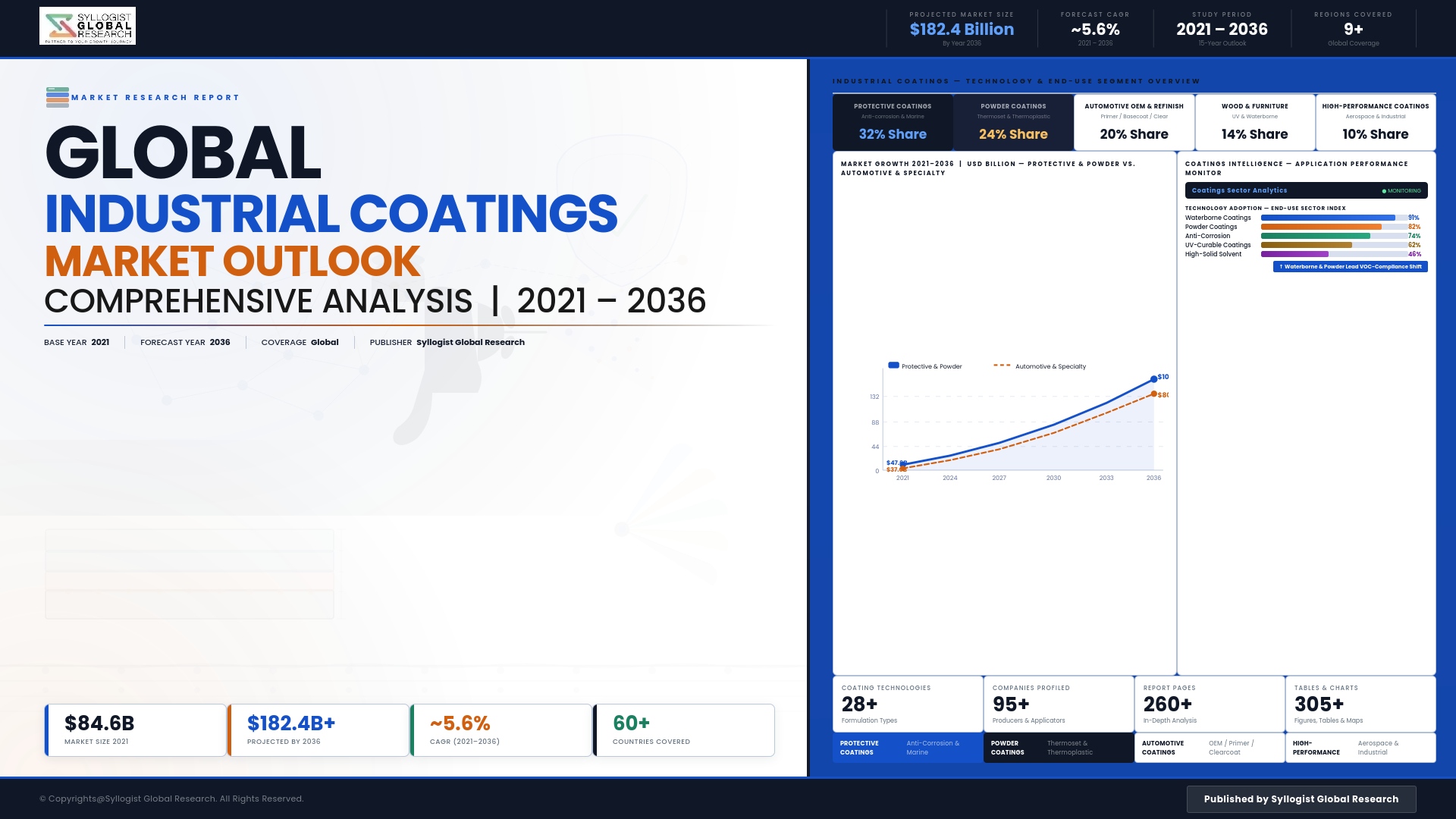
The global industrial coatings market is experiencing a sustained expansion phase underpinned by accelerating infrastructure investment across emerging economies, intensifying corrosion protection requirements driven by aging industrial asset bases in developed markets, and a structural technology migration from solvent-borne to waterborne, powder, and ultraviolet-cure coating systems compelled by tightening volatile organic compound emission regulations and industrial sustainability commitments that are simultaneously reshaping formulation chemistry requirements and elevating per-unit value across the industrial coating product portfolio. The market was valued at approximately USD 84.6 billion in 2025 and is projected to reach USD 127.3 billion by 2034, advancing at a compound annual growth rate of 4.6% through the forecast period, as the convergence of manufacturing sector expansion in Asia-Pacific, energy infrastructure investment globally, and the progressive adoption of high-performance waterborne and powder coating technologies across a widening range of industrial application categories sustains multi-sector demand growth through the forecast horizon.
Corrosion protection coatings represent the largest and most foundational application segment within the industrial coatings market, with the global installed base of steel infrastructure encompassing bridges, pipelines, storage tanks, offshore platforms, and industrial facilities requiring continuous maintenance recoating investment whose aggregate scale is substantially driven by the aging profile of infrastructure constructed during the post-war industrial expansion period in North America, Europe, and Japan. The economic cost of corrosion-related asset degradation, estimated to consume several percentage points of global GDP annually across infrastructure replacement, maintenance expenditure, and operational downtime losses, provides a compelling and enduring demand rationale for advanced corrosion-resistant coating systems that demonstrably extend asset service life and reduce lifecycle maintenance cost relative to conventional paint systems. The accelerating deployment of offshore wind energy infrastructure, onshore renewable energy facilities, and energy transmission networks globally is generating rapidly expanding new-build corrosion protection coating demand across steel structures subject to aggressive marine, atmospheric, and chemical exposure environments where coating system performance durability directly determines asset lifecycle economics and safety compliance.
Powder coating technology is gaining market share at an accelerating pace across general industrial, appliance, architectural aluminum, and automotive component application categories, driven by its zero volatile organic compound emission profile, high transfer efficiency, recyclability of overspray, and ability to deliver uniform film build and mechanical performance characteristics competitive with or superior to liquid coating alternatives across a broad range of substrates and curing temperature constraints. Waterborne coating technology is simultaneously advancing its penetration into applications historically served by solvent-borne systems, as formulation chemistry innovation progressively closes the performance gap between waterborne and solvent-borne systems in demanding corrosion protection, chemical resistance, and exterior durability applications where waterborne limitations had previously constrained adoption. Asia-Pacific dominates global industrial coatings consumption, anchored by the scale of manufacturing output, infrastructure construction, and industrial asset maintenance activity across China, India, South Korea, and Southeast Asia. North America and Europe represent the largest per-capita industrial coating consumption markets, driven by stringent asset maintenance standards, advanced manufacturing sector presence, and regulatory environments that are leading the global transition toward low-emission coating technologies across industrial application categories.
Key Drivers
Expanding Global Infrastructure Investment, Energy Sector Asset Development, and Industrial Facility Construction Generating Sustained New-Build and Maintenance Corrosion Protection Coating Demand
The unprecedented scale of global infrastructure investment encompassing renewable energy facility construction, oil and gas pipeline network expansion, power transmission infrastructure, bridge and highway programs, and port and logistics facility development across Asia-Pacific, the Middle East, and emerging markets is generating new-build corrosion protection coating demand of a magnitude that is sustaining industrial coating market volume growth across protective coating product categories through the forecast period. Simultaneously, the aging infrastructure asset base in North America, Europe, and Japan is generating maintenance recoating demand that provides counter-cyclical revenue stability for industrial coating producers, as the non-discretionary nature of corrosion maintenance investment on safety-critical infrastructure creates demand resilience through construction cycle downturns that would otherwise constrain new-build coating revenues.
Stringent VOC Emission Regulations and Industrial Sustainability Mandates Accelerating Technology Migration Toward Waterborne, Powder, and UV-Cure Coating Systems Across Major Application Markets
The progressive tightening of volatile organic compound emission regulations across the European Union, the United States Environmental Protection Agency frameworks, China National Standard VOC limits, and analogous regulatory programs in South Korea, Japan, and India is compelling industrial coating users and applicators to transition solvent-borne coating systems toward waterborne, powder, and ultraviolet-cure alternatives across application categories where regulatory compliance cost and emission permit constraints are making continued solvent-borne system operation financially untenable. This regulatory-driven technology migration is generating a structural product mix shift within the industrial coatings market toward higher-value low-emission formulations that command premium pricing relative to the solvent-borne systems they replace, driving average selling price elevation that sustains market value growth at rates exceeding underlying volume expansion across the transition period.
Advanced Manufacturing Sector Growth and the Rising Performance Requirements of Next-Generation Industrial, Automotive, and Aerospace Component Coating Applications Driving High-Value Specialty Coating Demand
The expansion of advanced manufacturing output across electric vehicle components, aerospace structures, semiconductor fabrication equipment, industrial robotics, and precision machinery is generating growing demand for industrial coating systems whose performance specifications in thermal resistance, dielectric insulation, chemical inertness, surface hardness, and dimensional stability substantially exceed the capabilities of conventional coating systems and command significant price premiums within specialty functional coating market segments. Automotive OEM transition to electric vehicle platform architectures is creating new coating application requirements for battery enclosure corrosion protection, electric motor component coatings, and high-voltage cable insulation systems that represent structurally new high-value demand categories for industrial coating chemistry innovation and specialty product development investment by leading coating producers.
Key Challenges
Raw Material Price Volatility, Titanium Dioxide and Epoxy Resin Supply Chain Disruption, and Petrochemical Feedstock Cost Inflation Compressing Industrial Coating Supplier Margins
Industrial coating formulations rely on titanium dioxide pigments, epoxy resins, polyurethane intermediates, acrylic monomers, and specialty additives whose procurement costs are subject to commodity market volatility, supply chain concentration risk, and energy cost inflation dynamics that collectively compress industrial coating producer operating margins when raw material cost increases cannot be fully recovered through customer price adjustments within the competitive market dynamics and contractual pricing frameworks governing industrial coating supply relationships. The global titanium dioxide supply market in particular has demonstrated significant price amplitude cycles driven by ilmenite and rutile ore supply dynamics, chloride process capacity constraints, and Chinese production policy changes, creating a raw material cost planning challenge that disproportionately affects coating producers with limited backward integration into pigment manufacturing relative to vertically integrated competitors.
Waterborne and Powder Coating Technology Performance Limitations in Demanding Corrosion Protection, Chemical Resistance, and Low-Temperature Application Environments Constraining Full Solvent-Borne Substitution
Despite substantial formulation chemistry advances, waterborne industrial coating systems continue to exhibit performance limitations in high-humidity application environments, sub-ambient temperature curing conditions, and demanding chemical immersion resistance applications that constrain their substitution for solvent-borne systems across segments including heavy-duty corrosion protection for marine and offshore infrastructure, internal lining of chemical storage tanks, and maintenance recoating of existing structures where substrate surface preparation and ambient condition control standards achievable in a controlled factory environment cannot be replicated in field application. Powder coating technology faces substrate temperature constraint barriers that prevent application to heat-sensitive assemblies and large complex structures where oven curing logistics are impractical, limiting addressable market expansion beyond current application boundaries without continued investment in low-temperature cure chemistry development.
Increasing Coating System Complexity, Customer Application Process Qualification Requirements, and Technical Service Investment Needs Elevating the Cost of Market Entry and Account Retention for Industrial Coating Suppliers
The technical complexity of industrial coating system qualification in demanding application categories including automotive OEM, aerospace, oil and gas, and pharmaceutical manufacturing environments requires coating suppliers to invest in extensive application testing, process chemistry validation, regulatory approval documentation, and ongoing technical service programs whose cost and elapsed time create significant barriers to new supplier qualification and impose substantial account retention investment obligations on incumbent suppliers defending positions against competitive challenges. The increasing integration of coating systems into broader surface treatment process sequences encompassing pretreatment, primer, intermediate, and topcoat layers whose combined performance must meet holistic system qualification standards raises the technical complexity bar for industrial coating suppliers and elevates the total investment required to maintain qualified product portfolios across demanding application market segments.
Market Segmentation
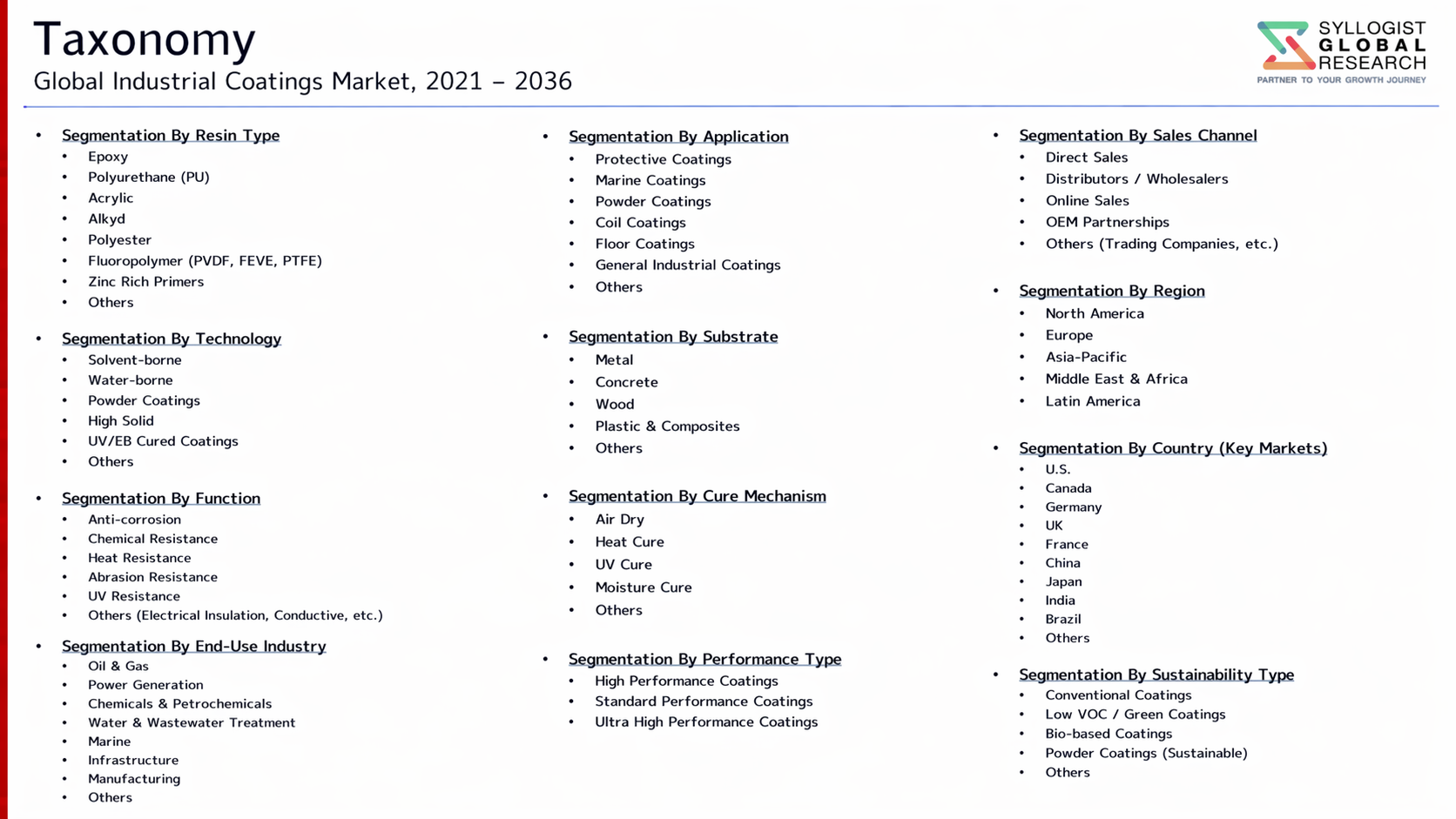
- Segmentation By Technology
- Solvent-Borne Coating Systems
- Waterborne Coating Systems
- Powder Coating Systems
- Ultraviolet and Electron Beam Cure Coatings
- High-Solids and Low-VOC Coating Systems
- Others
- Segmentation By Resin Type
- Epoxy Resin-Based Coatings
- Polyurethane Coatings
- Acrylic Coatings
- Alkyd Coatings
- Fluoropolymer Coatings
- Zinc-Rich and Inorganic Coatings
- Silicone and High-Temperature Coatings
- Others
- Segmentation By Product Type
- Primers and Anticorrosion Coatings
- Intermediate and Build Coatings
- Topcoats and Finish Coatings
- Functional and Specialty Coatings
- Intumescent and Fire-Resistant Coatings
- Marine Antifouling and Hull Coatings
- Others
- Segmentation By Application
- Corrosion Protection and Structural Maintenance
- Chemical and Abrasion Resistance
- Thermal and Heat Management Coatings
- Decorative and Aesthetic Industrial Finishing
- Electrical Insulation and Dielectric Coatings
- Surface Hardening and Wear Resistance
- Others
- Segmentation By End Use Industry
- Oil and Gas Infrastructure and Facilities
- Marine and Offshore Structures
- Automotive and Commercial Vehicle OEM
- Aerospace and Defense Manufacturing
- General Industrial and Heavy Machinery
- Infrastructure and Construction
- Power Generation and Energy Equipment
- Others
- Segmentation By Distribution Channel
- Direct OEM and Project Supply
- Industrial Distributor and Merchant Networks
- Specialist Protective Coating Applicators
- Online Industrial Supply Platforms
- Segmentation By Region
- North America
- Europe
- Asia-Pacific
- Middle East and Africa
- Latin America
All market revenues are presented in USD
Historical Year: 2021-2024 | Base Year: 2025 | Estimated Year: 2026 | Forecast Period: 2027-2034
Key Questions this Study Will Answer
- What is the total global market valuation of the Industrial Coatings Market in 2025, projected through 2034, disaggregated by technology, resin type, and end use industry, enabling coating producers, raw material suppliers, and investors to identify the highest-growth product categories and most durable revenue opportunities across the evolving industrial coatings value chain?
- How are tightening VOC emission regulations across the European Union, the United States, China, and other major markets accelerating the technology migration from solvent-borne to waterborne, powder, and UV-cure coating systems, and which application categories and geographic markets are generating the strongest compliance-driven technology transition momentum through 2034?
- What impact are global infrastructure investment programs, offshore wind energy facility construction, oil and gas asset maintenance requirements, and aging industrial infrastructure in developed markets having on corrosion protection coating demand volumes and product specification requirements across new-build and maintenance recoating application categories?
- Which industrial coating segments, including powder coatings, high-performance waterborne systems, intumescent fire protection coatings, and specialty functional coatings for electric vehicle and aerospace applications, are generating the highest near-term adoption and revenue growth rates, and what performance and sustainability criteria are most critical to product specification in each category?
- How is the competitive landscape structured among global coating majors, regional specialty producers, and raw material-integrated chemical companies, and what innovation investment, low-emission technology portfolio development, application market specialization, and geographic expansion strategies are enabling leading producers to defend and grow market positions across industrial end-use segments?
- What raw material supply chain vulnerabilities, titanium dioxide and epoxy resin price volatility dynamics, and petrochemical feedstock cost pressures are constraining industrial coating producer margins, and how are leading suppliers addressing backward integration, formulation optimization, and customer contract pricing mechanisms to manage input cost volatility and protect profitability?
- Which regional industrial coatings markets, specifically Asia-Pacific, North America, and the Middle East, are expected to generate the most substantial incremental revenue growth through 2034, and what manufacturing sector expansion, infrastructure investment programs, VOC regulatory implementation timelines, and energy industry capital expenditure cycles are shaping coating demand and competitive positioning in each region?
- Product Definition
- Research Methodology
- Research Design & Framework
- Overall Research Approach: Descriptive, Exploratory & Quantitative Mixed-Method Design
- Market Definition & Scope Boundaries: What is Included and Excluded
- Segmentation Framework
- Key Research Assumptions & Limitations
- Secondary Research
- Primary Research Design & Execution
- Data Triangulation & Validation
- Market Sizing & Forecasting Methodology
- Competitive Intelligence Methodology
- Quality Assurance & Peer Review
- Definitions, Abbreviations & Data Notes
- Research Design & Framework
- Executive Summary
- Market Snapshot & Headline Numbers
- Key Findings & Research Highlights
- Market Dynamics
- Regional Market Summary
- Competitive Landscape Snapshot
- Technology & Innovation Highlights
- Market Dynamics
- Drivers
- Restraints
- Opportunities
- Challenges
- Porter’s Five Forces Analysis
- PESTLE Analysis
- Market Trends & Developments
- Emerging Trends
- Technological Developments
- Regulatory & Policy Changes
- Supply Chain & Sourcing Trends
- Manufacturing & Process Trends
- Investment & Funding Activity
- Sustainability & ESG Trends
- Risk Assessment Framework
- Raw Material Supply, Titanium Dioxide & Specialty Resin Price Volatility Risk
- VOC, HAPs & Solvent Emission Regulatory Transition Risk
- Technology Substitution, Waterborne & Powder Coating Adoption Risk
- Product Quality, Film Performance & Warranty Claim Risk
- Capital Investment, Downstream Industry Cyclicality & End-User Demand Risk
- Regulatory Framework & Standards
- VOC Emission, Solvent Content & Air Quality Compliance Frameworks
- REACH, TSCA & Restricted Substance Chemical Registration Requirements
- Food Contact, Can Coating & Bisphenol Regulatory Standards
- Marine Anti-Fouling, Biocide & IMO Environmental Regulations
- Green Finance, ESG Disclosure & Sustainable Coatings Procurement Standards
- Global Industrial Coatings Market Outlook
- Market Size & Forecast by Value
- Market Size & Forecast by Volume (Kilotons and Million Litres)
- Market Size & Forecast by Resin Type
- Epoxy Coatings
- Polyurethane (PU) Coatings
- Acrylic Coatings
- Alkyd Coatings
- Polyester Coatings
- Fluoropolymer Coatings (PVDF, PTFE & FEVE)
- Silicone & Hybrid Silicone Coatings
- Zinc-Rich Primers & Inorganic Coatings
- Vinyl, Chlorinated Rubber & Specialty Resin Coatings
- Market Size & Forecast by Technology
- Solvent-Based Coating Technology
- Water-Based (Waterborne) Coating Technology
- Powder Coating Technology
- UV & Electron Beam (EB) Cured Coating Technology
- High-Solids Coating Technology
- Two-Component (2K) Reactive System Technology
- Electrocoating (E-Coat) & Dip Coating Technology
- High-Performance Hybrid & Smart Coating Technology
- Market Size & Forecast by Form
- Liquid Coating Formulation
- Powder Coating
- Paste & Viscous Formulation
- Aerosol & Spray-Pack Formulation
- Film, Foil & Pre-Coated Sheet
- Market Size & Forecast by Functionality
- Corrosion Protection & Anti-Corrosive Functionality
- Anti-Fouling, Bio-Resistant & Anti-Microbial Functionality
- Heat Resistant, Thermal Barrier & Fire Retardant Functionality
- Chemical, Solvent & Weather Resistance Functionality
- Abrasion, Wear & Mechanical Protection Functionality
- Electrical Insulation, Conductive & EMI Shielding Functionality
- Market Size & Forecast by Application
- Protective Coatings (Oil & Gas, Infrastructure & Steel Structures)
- Marine Coatings & Shipbuilding
- General Industrial OEM & Job Coating
- Coil Coatings (Pre-Painted Metal)
- Wood Coatings (Industrial Furniture & Cabinet)
- Plastic Coatings (Consumer Goods & Automotive Plastic Parts)
- Metal Packaging & Can Coatings
- Heavy Machinery, Agricultural & Construction Equipment Coatings
- Aerospace, Defence & Railway Coatings
- Appliance & White Goods Coatings
- Market Size & Forecast by End-User
- General Industrial OEM & Metal Fabricator
- Marine, Shipyard & Offshore Operator
- Oil & Gas, Infrastructure & Steel Structure Operator
- Heavy Machinery, Construction & Agricultural Equipment Manufacturer
- Aerospace, Defence & Railway OEM
- Appliance, Furniture & Consumer Durable Manufacturer
- Coil Coater, Custom Coater & Contract Application Service Provider
- Market Size & Forecast by Sales Channel
- Direct Supply & Long-Term OEM Contract
- Distributor, Specialty Chemical Trader & Spot Market Sales
- Joint Venture, Licensing & Technology Transfer
- Toll Manufacturing, Custom Formulation & Contract Blending Service
- North America Industrial Coatings Market Outlook
- Market Size & Forecast
- By Value
- By Volume (Kilotons and Million Litres)
- By Resin Type
- By Technology
- By Form
- By Functionality
- By Application
- By End-User
- By Country
- By Sales Channel
- Market Size & Forecast
- Europe Industrial Coatings Market Outlook
- Market Size & Forecast
- By Value
- By Volume (Kilotons and Million Litres)
- By Resin Type
- By Technology
- By Form
- By Functionality
- By Application
- By End-User
- By Country
- By Sales Channel
- Market Size & Forecast
- Asia-Pacific Industrial Coatings Market Outlook
- Market Size & Forecast
- By Value
- By Volume (Kilotons and Million Litres)
- By Resin Type
- By Technology
- By Form
- By Functionality
- By Application
- By End-User
- By Country
- By Sales Channel
- Market Size & Forecast
- Latin America Industrial Coatings Market Outlook
- Market Size & Forecast
- By Value
- By Volume (Kilotons and Million Litres)
- By Resin Type
- By Technology
- By Form
- By Functionality
- By Application
- By End-User
- By Country
- By Sales Channel
- Market Size & Forecast
- Middle East & Africa Industrial Coatings Market Outlook
- Market Size & Forecast
- By Value
- By Volume (Kilotons and Million Litres)
- By Resin Type
- By Technology
- By Form
- By Functionality
- By Application
- By End-User
- By Country
- By Sales Channel
- Market Size & Forecast
- Country-Wise* Industrial Coatings Market Outlook
- Market Size & Forecast
- By Value
- By Volume (Kilotons and Million Litres)
- By Resin Type
- By Technology
- By Form
- By Functionality
- By Application
- By End-User
- By Country
- By Sales Channel
- Market Size & Forecast
- *Countries Analysed in the Syllogist Global Research Portfolio: United States, Canada, Mexico, Germany, France, United Kingdom, Netherlands, Spain, Italy, Norway, Sweden, China, Japan, India, Australia, South Korea, Singapore, Brazil, Chile, Saudi Arabia, UAE, Egypt, South Africa, Israel
- Technology Landscape & Innovation Analysis
- Epoxy & Polyurethane Coating Resin Chemistry Deep-Dive
- Acrylic, Alkyd & Polyester Coating Technology
- Fluoropolymer, Silicone & High-Performance Specialty Coating Technology
- Waterborne & Low-VOC Coating Formulation Technology
- Powder Coating, Electrostatic Application & Curing Technology
- UV/EB-Cured & Radiation Curable Coating Technology
- Anti-Corrosion, Anti-Fouling & Functional Smart Coating Technology
- Patent & IP Landscape in Industrial Coating Technologies
- Value Chain & Supply Chain Analysis
- Resin, Binder & Specialty Polymer Raw Material Supply Chain
- Pigment, Titanium Dioxide & Colourant Supply Chain
- Solvent, Additive & Performance Booster Supply Chain
- Coating Formulation, Manufacturing & Toll Blending Supply Chain
- Industrial OEM, Fabricator & Applicator Procurement Landscape
- Distributor, Specialty Chemical Trader & Job-Coater Supply Channel
- Recycling, Waste Paint Management & Circular Coating Loop
- Pricing Analysis
- Epoxy & Polyurethane Coating Pricing and Cost Structure Analysis
- Acrylic, Alkyd & Polyester Coating Pricing Analysis
- Fluoropolymer & High-Performance Specialty Coating Pricing Analysis
- Powder Coating & Waterborne Coating Pricing Trend Analysis
- Industrial Coating Long-Term Supply Contract, Indexation & Pricing Structure Analysis
- Total Coating Application Cost Economics: Cost per Square Metre & Learning Curve Analysis
- Sustainability & Environmental Analysis
- Lifecycle Assessment (LCA) of Industrial Coatings: Carbon Footprint, Energy Intensity & VOC Emission Across Technology Routes
- Carbon Neutrality & Net Zero Contribution: Pathway to Low-VOC, Waterborne and Powder Coating Adoption
- Responsible Sourcing, Titanium Dioxide Due Diligence & Restricted Substance Elimination
- Environmental Compliance, VOC Emission, Hazardous Waste & Wastewater Consideration in Coating Production
- Regulatory-Driven Sustainability, REACH, Anti-Fouling, SDG 9 (Industry Innovation) & SDG 12 (Responsible Consumption) Alignment & Green Finance Eligibility
- Competitive Landscape
- Market Structure & Concentration
- Market Consolidation Level (Fragmented vs. Consolidated by Resin Type & Geography)
- Top 10 Players Market Share
- HHI (Herfindahl-Hirschman Index) Concentration Analysis
- Competitive Intensity Map by Resin Type, Technology & Geography
- Player Classification
- Integrated Global Paints & Coatings Companies
- Specialist Industrial Coating Manufacturers
- Powder Coating, Electrostatic & Radiation-Cured Technology Specialists
- Marine, Anti-Fouling & Protective Coating Producers
- Coil, Can & Pre-Coated Metal Coating Providers
- Aerospace, Defence & Railway Coating Manufacturers
- Wood, Plastic & Specialty Substrate Coating Suppliers
- Custom Formulation, Toll Blending & Contract Application Specialists
- Competitive Analysis Frameworks
- Market Share Analysis by Resin Type, Technology & Region
- Company Profile
- Company Overview & Headquarters
- Industrial Coating Products & Technology Portfolio
- Key Customer Relationships & Reference Commercial Supply Contracts
- Manufacturing Footprint & Production Capacity
- Revenue (Industrial Coating Segment) & Order Book
- Technology Differentiators & IP
- Key Strategic Partnerships, JVs & M&A Activity
- Recent Developments (Contract Wins, Capacity Expansion, Product Launches)
- SWOT Analysis
- Strategic Focus Areas & Roadmap
- Competitive Positioning Map (Technology Capability vs. Market Penetration)
- Key Company Profiles
- Market Structure & Concentration
- Technology Landscape & Innovation Analysis
- Strategic Output
- Market Opportunity Matrix: By Resin Type, Technology, Application, End-User & Geography
- White Space Opportunity Analysis
- Strategic Recommendations
- Product Portfolio & Technology Investment Strategy
- Manufacturing & Operational Excellence Strategy
- Geographic Expansion & Localisation Strategy
- Customer & End-User Engagement Strategy
- Partnership, M&A & Ecosystem Strategy
- Sustainability & Circular Economy Strategy
- Risk Mitigation & Future Roadmap
- Strategic Priority Matrix & Roadmap
- Near-term (2025-2028)
- Mid-term (2029-2032)
- Long-term (2033-2037)
- Strategic Output