Global Lubricant Additives Market By Additive Type, By Base Oil Compatibility, By Lubricant Type, By Application, By End Use Industry, By Distribution Channel, By Region, Competition, Forecast and Opportunities, 2021-2036F
Market Definition
The Global Lubricant Additives Market encompasses the development, manufacturing, and commercial supply of specialty chemical compounds blended into mineral, synthetic, and bio-based lubricant base oils to impart or enhance functional performance properties including viscosity modification, oxidation resistance, corrosion inhibition, wear protection, extreme pressure performance, detergency, dispersancy, friction modification, and foam suppression. The market includes viscosity index improvers, antiwear agents, antioxidants, detergents, dispersants, friction modifiers, corrosion inhibitors, pour point depressants, extreme pressure additives, and demulsifiers procured by lubricant blenders, automotive OEMs, industrial equipment manufacturers, and marine and aviation lubricant formulators globally.
Market Insights
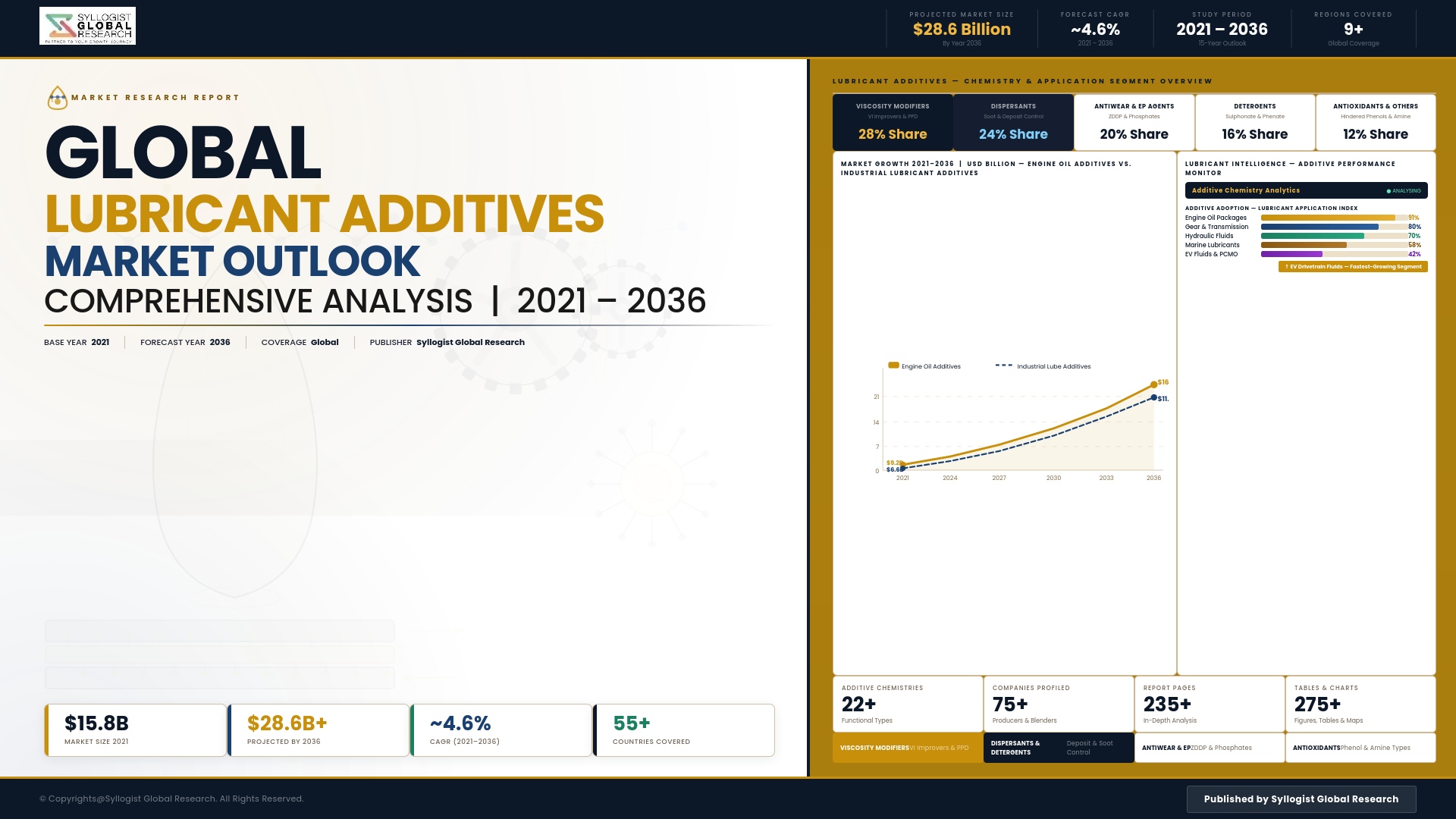
The global lubricant additives market is navigating a period of technology-intensive transformation, driven by the tightening performance specifications of next-generation engine and drivetrain lubricant standards, the expanding adoption of low-viscosity lubricant formulations requiring sophisticated additive chemistries to maintain wear protection and film strength at reduced oil film thickness, and the emergence of electric vehicle drivetrain fluid requirements that are creating structurally new additive demand categories outside the established engine oil and transmission fluid segments that have historically anchored lubricant additive market revenues. The market was valued at approximately USD 18.4 billion in 2025 and is projected to reach USD 27.6 billion by 2034, advancing at a compound annual growth rate of 4.6% through the forecast period, as performance upgrade cycles driven by evolving lubricant specification standards, industrial equipment efficiency mandates, and new mobility technology fluid requirements collectively sustain market value growth despite the long-term volume headwind from internal combustion engine fleet attrition in leading electric vehicle adoption markets.
Engine oil additives constitute the largest segment by value within the lubricant additive landscape, with the continuous evolution of international engine oil performance specifications, including the transition to lower-viscosity grades such as SAE 0W-16 and 0W-8, necessitating additive system reformulations that deliver equivalent or superior antiwear, oxidation stability, and deposit control performance at viscosity levels where conventional additive technologies face fundamental tribological challenges. The detergent and dispersant additive segment, which collectively accounts for the largest share of engine oil additive formulation cost, is experiencing sustained demand from the global commercial vehicle and off-highway equipment fleet where long drain interval requirements and fuel economy improvement mandates are driving lubricant formulators to deploy higher-performance additive treat rates and novel dispersant polymer architectures capable of maintaining cleanliness and soot handling performance across extended service intervals in high-output diesel engine applications. Viscosity index improver polymers are undergoing a technology revolution driven by the shift to lower-viscosity engine oils, with olefin copolymer and hydrogenated styrene-diene polymer architectures being reformulated and supplemented by new polymer designs offering improved shear stability, low-temperature pumpability, and high-temperature film strength contributions that enable low-viscosity formulations to meet the demanding multi-temperature performance requirements of modern engine hardware.
The electric vehicle and hybrid drivetrain fluid segment is emerging as the most strategically consequential new additive demand category within the lubricant additives market, as battery electric vehicle transmission fluids, eDrive thermal management fluids, and electric motor cooling oils require additive formulations with fundamentally different performance profiles than conventional drivetrain lubricants, encompassing high electrical resistivity to prevent stray current damage to copper windings, copper corrosion inhibition to protect electric motor components, low foaming tendency under high-speed gear operation, and optimized friction coefficients for wet clutch systems in hybrid transmission architectures. Industrial lubricant additives serving hydraulic fluids, gear oils, compressor oils, and turbine oils are simultaneously generating steady demand driven by global manufacturing sector expansion, infrastructure construction equipment intensity, and the progressive upgrade of industrial lubricant specifications toward higher performance synthetic formulations in applications where equipment manufacturers specify extended drain intervals and reduced unplanned maintenance as requirements within equipment warranty programs. Asia-Pacific dominates global lubricant additive consumption, driven by the scale of commercial vehicle operation, industrial manufacturing activity, and lubricant blending infrastructure concentrated across China, India, Japan, and South Korea. North America and Europe represent the highest-value per-litre additive markets, characterized by stringent engine oil specification compliance requirements and the leading penetration of premium fully synthetic lubricant formulations commanding higher additive treat rates and performance chemical complexity.
Key Drivers
Evolving Engine Oil Performance Specification Standards and Low-Viscosity Lubricant Grade Transitions Driving Continuous Additive System Reformulation and Upgrade Investment Across the Lubricant Blending Industry
The ongoing evolution of engine oil performance specification standards governing passenger car and commercial vehicle lubricants, including the progressive introduction of ILSAC GF-7, API SP and beyond, and ACEA specification updates that mandate improved fuel economy contribution, oxidation stability, and emission system compatibility, is compelling lubricant blenders to reformulate additive packages in response to each new specification generation and driving recurring investment in additive system development that sustains revenue growth for additive producers across reformulation cycles that typically recur on three-to-five-year intervals. The accelerating transition to ultra-low-viscosity engine oil grades, driven by automotive OEM fuel economy optimization strategies and carbon dioxide emissions compliance requirements, is generating particularly concentrated additive technology development activity as formulating the necessary wear protection and deposit control performance into lower-viscosity oil matrices requires novel antiwear chemistry, high-performance dispersant polymer architectures, and viscosity modifier technologies beyond the capability of additive systems developed for conventional viscosity grades.
Global Industrial Equipment Expansion, Extended Drain Interval Requirements, and Synthetic Lubricant Adoption Elevating Industrial Additive Performance Demand Across Hydraulic, Gear, and Turbine Fluid Applications
The expansion of global manufacturing output, construction equipment intensity in infrastructure development programs, and the proliferation of high-efficiency industrial machinery with demanding lubrication requirements is generating sustained growth in industrial lubricant additive demand across hydraulic fluid, gear oil, compressor oil, and turbine oil application categories where equipment manufacturers are specifying progressively higher performance lubricant formulations to support extended drain intervals, improved equipment reliability, and reduced maintenance cost commitments within equipment warranty programs. The adoption of synthetic base oil lubricants in industrial applications, which requires carefully balanced additive formulations optimized for Group III, IV, and V base oil compatibility rather than conventional mineral oil chemistry, is creating additive reformulation demand that generates recurring revenue for additive producers supplying the industrial lubricant blending market.
Electric Vehicle and Hybrid Drivetrain Fluid Requirements Creating Structurally New High-Value Additive Demand Categories Outside Conventional Engine Oil and Transmission Fluid Application Segments
The rapid global scaling of battery electric vehicle production is generating demand for eDrive fluid additive systems with performance requirements fundamentally distinct from conventional drivetrain lubricant chemistries, encompassing electrical resistivity management, copper and yellow metal corrosion inhibition, thermal stability across high-temperature electric motor cooling cycles, and compatibilty with elastomeric seals and copper windings used in electric motor and power electronics assemblies. Additive producers investing in dedicated eDrive fluid additive chemistry development are positioning to capture premium-priced supply positions in a structurally growing market segment whose per-vehicle additive content value in advanced thermal management fluid systems can exceed that of equivalent conventional drivetrain lubricant formulations, creating a meaningful commercial opportunity that partially offsets the long-term volume decline in conventional engine oil additive demand from ICE fleet attrition.
Key Challenges
Long-Term Internal Combustion Engine Volume Attrition from Accelerating Electric Vehicle Adoption Creating Structural Demand Headwind for Engine Oil Additive Volumes in Leading EV Markets
The accelerating penetration of battery electric vehicles in passenger car markets across China, Europe, and progressively North America is generating a structural long-term headwind for engine oil additive demand volumes as the internal combustion engine vehicle fleet in leading EV adoption markets begins to decline in size relative to historical growth trajectories, reducing the aggregate engine oil consumption base upon which engine oil additive demand depends. While the commercial vehicle, off-highway, and emerging market ICE fleet will sustain engine oil additive volume for an extended transition period, additive producers with high revenue concentration in passenger car engine oil markets face a volume attrition challenge that demands portfolio diversification toward industrial lubricant, eDrive fluid, and specialty application additive segments to maintain revenue growth through the powertrain transition decade.
Phosphorus and Sulfur Content Restrictions in Engine Oil Specifications and Emission System Compatibility Requirements Constraining Established Antiwear and Extreme Pressure Additive Chemistry Utilization
Progressive reductions in permitted phosphorus and sulfur content levels within engine oil performance specifications, driven by catalytic converter and diesel particulate filter poisoning concerns that impose stringent limits on the antiwear and extreme pressure additive chemistries that have historically provided the most cost-effective tribological protection in engine oil formulations, are constraining the deployment of conventional zinc dialkyldithiophosphate antiwear technology and sulfurized extreme pressure additives at treatment levels sufficient to deliver equivalent wear protection performance in formulations meeting current and future specification phosphorus and sulfur limits. Developing alternative antiwear chemistry solutions capable of matching zinc dialkyldithiophosphate performance at reduced phosphorus contribution and acceptable cost represents a persistent formulation challenge that demands continuous additive technology development investment from lubricant additive producers serving the engine oil market.
Raw Material Supply Chain Concentration, Specialty Chemical Feedstock Availability Constraints, and Regulatory Restrictions on Hazardous Additive Precursors Introducing Supply Security and Reformulation Risk
The manufacture of key lubricant additive chemistries including metallic detergents, zinc dialkyldithiophosphates, ashless dispersants, and viscosity index improver polymers relies on specialty chemical feedstock supply chains with geographic concentration and capacity constraints that create procurement security risks when demand surges or supply disruptions affect the availability of critical precursor materials at commercially acceptable price and lead time parameters. Regulatory pressure on specific additive precursor chemistries identified as environmentally persistent, bioaccumulative, or hazardous to aquatic organisms under chemical registration frameworks in the European Union and other jurisdictions is creating reformulation obligations for additive producers whose established product formulations incorporate restricted substances, imposing development cost and transition timelines that add commercial risk to supply continuity for lubricant blender customers dependent on consistent additive package performance across formulation changes.
Market Segmentation
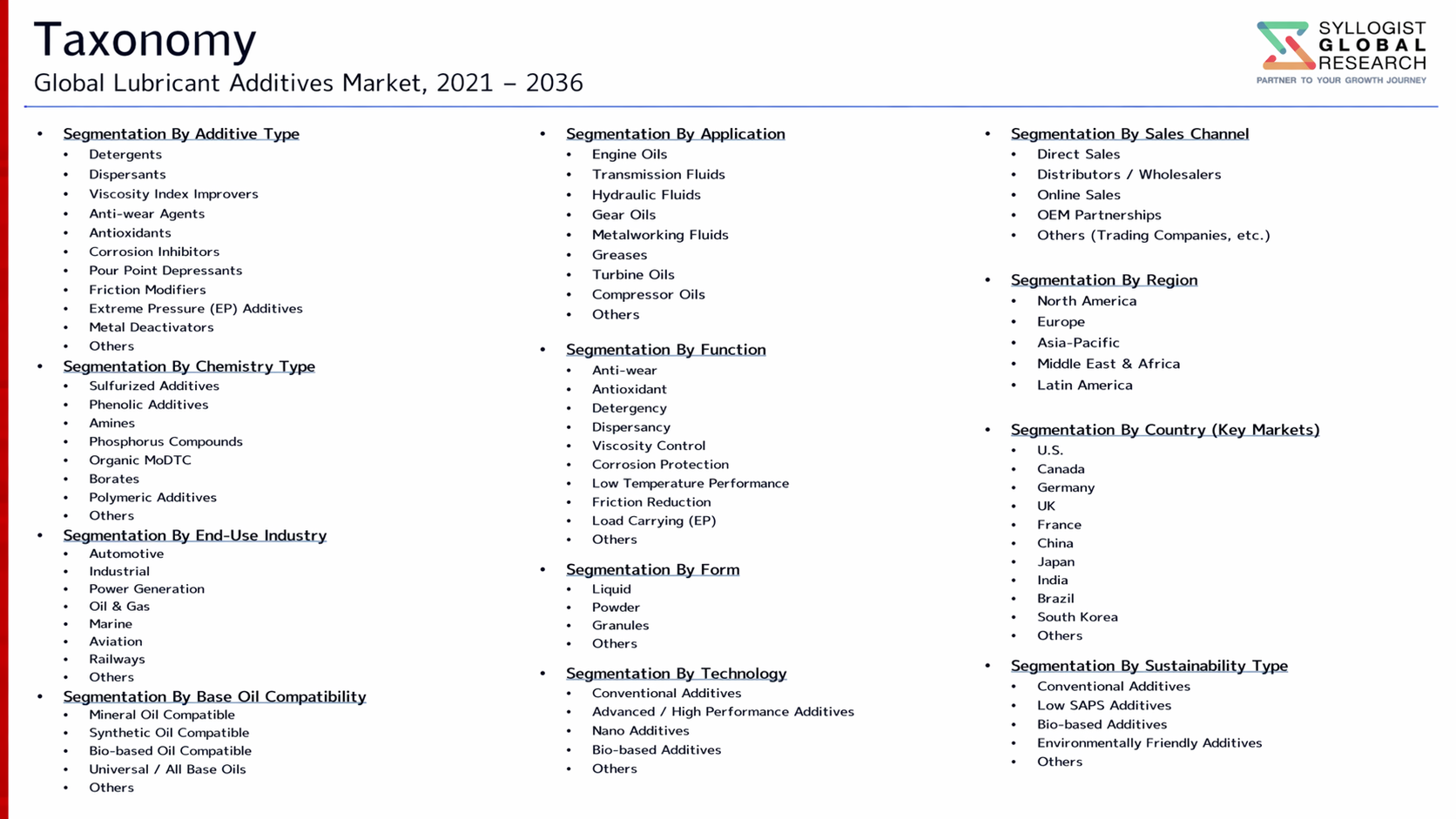
- Segmentation By Additive Type
- Viscosity Index Improvers
- Detergents and Metallic Cleaning Agents
- Dispersants and Ashless Polymers
- Antiwear and Extreme Pressure Additives
- Antioxidants and Oxidation Inhibitors
- Friction Modifiers
- Corrosion and Rust Inhibitors
- Pour Point Depressants
- Foam Inhibitors and Demulsifiers
- Others
- Segmentation By Base Oil Compatibility
- Mineral Base Oil Compatible Additives (Group I and II)
- Hydrocracked and Group III Base Oil Additives
- Polyalphaolefin (Group IV) Synthetic Base Oil Additives
- Ester and Group V Synthetic Base Oil Additives
- Bio-Based and Re-Refined Base Oil Additives
- Segmentation By Lubricant Type
- Engine Oils (Gasoline and Diesel)
- Transmission and Gear Fluids
- Hydraulic Fluids
- Turbine and Compressor Oils
- Grease Formulations
- Marine Lubricants
- Aviation Lubricants
- eDrive and Electric Vehicle Thermal Management Fluids
- Others
- Segmentation By Application
- Passenger Car Engine and Drivetrain Lubrication
- Commercial Vehicle and Heavy-Duty Engine Lubrication
- Industrial Machinery and Equipment Lubrication
- Off-Highway and Construction Equipment Lubrication
- Marine Engine and Stern Tube Lubrication
- Aviation Engine and Hydraulic System Lubrication
- Electric and Hybrid Drivetrain Fluid Applications
- Others
- Segmentation By End Use Industry
- Automotive and Passenger Car Manufacturing
- Commercial Vehicle and Trucking
- Industrial Manufacturing and Processing
- Oil and Gas Extraction and Refining
- Marine and Shipping
- Aerospace and Aviation
- Power Generation and Energy Infrastructure
- Others
- Segmentation By Distribution Channel
- Direct Supply to Lubricant Blenders and Formulators
- Specialty Chemical Distributor Networks
- OEM Approved Additive Package Supply
- Online Chemical Procurement Platforms
- Segmentation By Region
- North America
- Europe
- Asia-Pacific
- Middle East and Africa
- Latin America
All market revenues are presented in USD
Historical Year: 2021-2024 | Base Year: 2025 | Estimated Year: 2026 | Forecast Period: 2027-2034
Key Questions this Study Will Answer
- What is the total global market valuation of the Lubricant Additives Market in 2025, projected through 2034, disaggregated by additive type, lubricant type, and end use industry, enabling additive producers, lubricant blenders, and investors to identify the highest-growth additive categories and most durable revenue opportunities across the evolving lubricant additives value chain?
- How are evolving engine oil specification standards, ultra-low-viscosity lubricant grade transitions, and phosphorus and sulfur content restrictions reshaping antiwear, dispersant, and viscosity modifier additive system requirements, and which additive technology platforms are achieving the performance compliance and cost-effectiveness benchmarks necessary for qualification in next-generation engine oil formulations?
- What specific electrical resistivity, copper corrosion inhibition, thermal stability, and seal compatibility performance requirements are defining eDrive and electric vehicle thermal management fluid additive specifications, and how are leading additive producers structuring technology development and OEM qualification programs to capture commercial positions in this emerging high-value additive segment?
- Which lubricant additive segments, including eDrive fluid additives, high-performance dispersants for extended drain commercial vehicle oils, industrial synthetic lubricant additives, and marine lubricant additive systems, are generating the highest revenue growth and technology investment activity through 2034, and what performance specifications are most critical to premium product differentiation?
- How is the competitive landscape structured among global additive majors, regional specialty additive producers, and vertically integrated petrochemical companies, and what technology portfolio development, OEM approval strategy, lubricant blender partnership, and eDrive fluid positioning approaches are enabling leading producers to sustain market positions through the powertrain electrification transition?
- What long-term ICE fleet volume attrition, phosphorus content restriction, and specialty feedstock supply security challenges are constraining engine oil additive volume and margin trajectories, and how are additive producers managing portfolio rebalancing toward industrial, marine, and eDrive fluid segments to sustain revenue growth through the structural demand transition period?
- Which regional lubricant additive markets, specifically Asia-Pacific, North America, and Europe, are expected to generate the most substantial demand growth through 2034, and what commercial vehicle fleet expansion, industrial manufacturing activity, EV adoption rate trajectories, and lubricant specification upgrade cycles are shaping additive procurement volumes and technology requirements in each region?
- Product Definition
- Research Methodology
- Research Design & Framework
- Overall Research Approach: Descriptive, Exploratory & Quantitative Mixed-Method Design
- Market Definition & Scope Boundaries: What is Included and Excluded
- Segmentation Framework
- Key Research Assumptions & Limitations
- Secondary Research
- Primary Research Design & Execution
- Data Triangulation & Validation
- Market Sizing & Forecasting Methodology
- Competitive Intelligence Methodology
- Quality Assurance & Peer Review
- Definitions, Abbreviations & Data Notes
- Research Design & Framework
- Executive Summary
- Market Snapshot & Headline Numbers
- Key Findings & Research Highlights
- Market Dynamics
- Regional Market Summary
- Competitive Landscape Snapshot
- Technology & Innovation Highlights
- Market Dynamics
- Drivers
- Restraints
- Opportunities
- Challenges
- Porter’s Five Forces Analysis
- PESTLE Analysis
- Market Trends & Developments
- Emerging Trends
- Technological Developments
- Regulatory & Policy Changes
- Supply Chain & Sourcing Trends
- Manufacturing & Process Trends
- Investment & Funding Activity
- Sustainability & ESG Trends
- Risk Assessment Framework
- Base Oil Supply, Group II/III/IV Availability & Price Volatility Risk
- Electric Vehicle Adoption, Engine Oil Demand Disruption & Transition Risk
- Regulatory, API, ACEA, ILSAC & Specification Evolution Compliance Risk
- Product Performance, Field Durability & OEM Approval Risk
- Capital Investment, Additive Chemistry Consolidation & Buyer Concentration Risk
- Regulatory Framework & Standards
- API, ACEA, ILSAC & OEM Engine Oil Specification Frameworks
- REACH, TSCA & Restricted Substance Chemical Registration Requirements
- Phosphorus, Sulphur & Sulphated Ash (SAPS) Emission & Low-SAPS Compliance Standards
- Biodegradability, Aquatic Toxicity & Environmentally Acceptable Lubricant (EAL) Regulations
- Green Finance, ESG Disclosure & Sustainable Lubricant Procurement Standards
- Global Lubricant Additives Market Outlook
- Market Size & Forecast by Value
- Market Size & Forecast by Volume (Kilotons)
- Market Size & Forecast by Additive Type
- Dispersants (PIB Succinimides, Ester & Mannich Dispersants)
- Detergents (Calcium Sulphonates, Magnesium Sulphonates, Phenates & Salicylates)
- Anti-Wear & Extreme Pressure (AW/EP) Additives (ZDDP, Phosphate Esters & Sulphurised Olefins)
- Anti-Oxidants (Phenolic, Aminic & Multi-Functional Anti-Oxidants)
- Viscosity Index Improvers (OCP, PMA, Hydrogenated Styrene-Diene & Olefin Copolymer VIIs)
- Pour Point Depressants & Low-Temperature Flow Improvers
- Corrosion, Rust Inhibitors & Metal Deactivators
- Friction Modifiers (Organic & Molybdenum-Based MoDTC)
- Anti-Foam Agents, Emulsifiers, Demulsifiers & Seal Swell Agents
- Market Size & Forecast by Technology
- Zinc Dialkyldithiophosphate (ZDDP) Chemistry Technology
- Ashless & Low-Ash (Low-SAPS) Chemistry Technology
- Calcium & Magnesium Detergent Chemistry Technology
- Polymer Viscosity Modifier (OCP, PMA & Dispersant-VII) Technology
- Molybdenum & Friction Modifier Chemistry Technology
- Ester-Based & Synthetic Additive Chemistry Technology
- Bio-Derived & Sustainable Lubricant Additive Technology
- Advanced Multi-Functional & Smart Additive Package Technology
- Market Size & Forecast by Form
- Liquid Additive & Concentrate
- Paste & Viscous Formulation
- Powder & Solid Additive
- Pre-Blended Additive Package
- Performance-Graded Finished Additive Component
- Market Size & Forecast by Functionality
- Anti-Wear & Extreme Pressure Functionality
- Oxidation Stability & Thermal Durability Functionality
- Viscosity Control & Shear Stability Functionality
- Dispersancy, Detergency & Engine Cleanliness Functionality
- Corrosion, Rust Protection & Metal Deactivation Functionality
- Friction Modification, Fuel Economy & Energy Efficiency Functionality
- Market Size & Forecast by Application
- Passenger Car Motor Oil (PCMO)
- Heavy-Duty Engine Oil (HDEO)
- Automatic Transmission & Driveline Fluid
- Industrial & Automotive Gear Oil
- Hydraulic Fluid & Power Transmission Fluid
- Metalworking Fluid & Cutting Oil
- Grease (Lithium, Calcium, Polyurea & Specialty Grease)
- Marine, Aviation & Specialty Industrial Lubricant
- Market Size & Forecast by End-User
- Lubricant Blender & Oil Marketer
- Automotive & Heavy-Duty OEM (Factory Fill)
- Industrial, Manufacturing & Process Plant Operator
- Marine, Aviation, Defence & Rail Operator
- Metalworking, Machining & Tool Shop Operator
- Grease Manufacturer & Specialty Lubricant Formulator
- Market Size & Forecast by Sales Channel
- Direct Supply & Long-Term Additive Package Contract
- Distributor, Specialty Chemical Trader & Spot Market Sales
- Joint Venture, Licensing & Technology Transfer
- Toll Manufacturing, Custom Blending & Contract Formulation Service
- North America Lubricant Additives Market Outlook
- Market Size & Forecast
- By Value
- By Volume (Kilotons)
- By Additive Type
- By Technology
- By Form
- By Functionality
- By Application
- By End-User
- By Country
- By Sales Channel
- Market Size & Forecast
- Europe Lubricant Additives Market Outlook
- Market Size & Forecast
- By Value
- By Volume (Kilotons)
- By Additive Type
- By Technology
- By Form
- By Functionality
- By Application
- By End-User
- By Country
- By Sales Channel
- Market Size & Forecast
- Asia-Pacific Lubricant Additives Market Outlook
- Market Size & Forecast
- By Value
- By Volume (Kilotons)
- By Additive Type
- By Technology
- By Form
- By Functionality
- By Application
- By End-User
- By Country
- By Sales Channel
- Market Size & Forecast
- Latin America Lubricant Additives Market Outlook
- Market Size & Forecast
- By Value
- By Volume (Kilotons)
- By Additive Type
- By Technology
- By Form
- By Functionality
- By Application
- By End-User
- By Country
- By Sales Channel
- Market Size & Forecast
- Middle East & Africa Lubricant Additives Market Outlook
- Market Size & Forecast
- By Value
- By Volume (Kilotons)
- By Additive Type
- By Technology
- By Form
- By Functionality
- By Application
- By End-User
- By Country
- By Sales Channel
- Market Size & Forecast
- Country-Wise* Lubricant Additives Market Outlook
- Market Size & Forecast
- By Value
- By Volume (Kilotons)
- By Additive Type
- By Technology
- By Form
- By Functionality
- By Application
- By End-User
- By Country
- By Sales Channel
- *Countries Analysed in the Syllogist Global Research Portfolio: United States, Canada, Mexico, Germany, France, United Kingdom, Netherlands, Spain, Italy, Norway, Sweden, China, Japan, India, Australia, South Korea, Singapore, Brazil, Chile, Saudi Arabia, UAE, Egypt, South Africa, Israel
- Market Size & Forecast
- Technology Landscape & Innovation Analysis
- Dispersant & Detergent Chemistry Deep-Dive (PIB Succinimides, Sulphonates & Salicylates)
- ZDDP, Ashless AW/EP & Extreme Pressure Additive Technology
- Anti-Oxidant Chemistry Technology (Phenolic, Aminic & Multi-Functional)
- Viscosity Index Improver & Polymer Rheology Technology (OCP, PMA & Dispersant-VII)
- Friction Modifier, Molybdenum & Fuel Economy Additive Technology
- Low-SAPS, Low-Phosphorus & Emission-Compatible Additive Technology
- Bio-Derived, Environmentally Acceptable Lubricant (EAL) Additive Technology
- Patent & IP Landscape in Lubricant Additive Technologies
- Value Chain & Supply Chain Analysis
- Base Oil (Group I, II, III, IV & V), PAO & Synthetic Base Stock Supply Chain
- Additive Chemistry, Intermediate & Specialty Raw Material Supply Chain
- Additive Package, Blending & Formulation Manufacturing Supply Chain
- Lubricant Blender, Oil Marketer & Specialty Formulator Procurement Landscape
- Automotive, Industrial & Marine OEM Offtake Channel
- Distributor, Specialty Chemical Trader & Regional Supply Channel
- Used Oil Collection, Re-Refining & Circular Base Oil Loop
- Pricing Analysis
- Dispersant & Detergent Additive Pricing and Cost Structure Analysis
- Anti-Wear, Extreme Pressure & ZDDP Chemistry Pricing Analysis
- Viscosity Index Improver & Polymer Modifier Pricing Trend Analysis
- Friction Modifier, Anti-Oxidant & Specialty Additive Pricing Analysis
- Lubricant Additive Long-Term Supply Contract, Indexation & Pricing Structure Analysis
- Total Finished Lubricant Additive Cost Economics: Cost per Kilogram & Learning Curve Analysis
- Sustainability & Environmental Analysis
- Lifecycle Assessment (LCA) of Lubricant Additives: Carbon Footprint, Energy Intensity & Toxicity Across Chemistry Routes
- Carbon Neutrality & Net Zero Contribution: Pathway to Low-Emission, Fuel-Efficient and Bio-Derived Additive Development
- Responsible Sourcing, Phosphorus & Heavy Metal Due Diligence in Additive Production
- Environmental Compliance, Biodegradability, Aquatic Toxicity & Used Oil End-of-Life Consideration
- Regulatory-Driven Sustainability, Low-SAPS, EAL, SDG 7 (Affordable Energy) & SDG 12 (Responsible Consumption) Alignment & Green Finance Eligibility
- Competitive Landscape
- Market Structure & Concentration
- Market Consolidation Level (Fragmented vs. Consolidated by Additive Type & Geography)
- Top 10 Players Market Share
- HHI (Herfindahl-Hirschman Index) Concentration Analysis
- Competitive Intensity Map by Additive Type, Chemistry & Geography
- Player Classification
- Integrated Oil Major & Full-Range Lubricant Additive Companies
- Specialist Lubricant Additive Package Suppliers
- Dispersant, Detergent & Base Chemistry Manufacturers
- Viscosity Index Improver & Polymer Modifier Producers
- Anti-Wear, ZDDP & Extreme Pressure Additive Specialists
- Friction Modifier, Molybdenum & Performance Additive Innovators
- Bio-Derived, Sustainable & Environmentally Acceptable Additive Developers
- Custom Blending, Toll Manufacturing & Contract Formulation Specialists
- Competitive Analysis Frameworks
- Market Share Analysis by Additive Type, Chemistry & Region
- Company Profile
- Company Overview & Headquarters
- Lubricant Additive Products & Technology Portfolio
- Key Customer Relationships & Reference Commercial Supply Contracts
- Manufacturing Footprint & Production Capacity
- Revenue (Lubricant Additive Segment) & Order Book
- Technology Differentiators & IP
- Key Strategic Partnerships, JVs & M&A Activity
- Recent Developments (Contract Wins, Capacity Expansion, Product Launches)
- SWOT Analysis
- Strategic Focus Areas & Roadmap
- Competitive Positioning Map (Technology Capability vs. Market Penetration)
- Key Company Profiles
- Market Structure & Concentration
- Technology Landscape & Innovation Analysis
- Strategic Output
- Market Opportunity Matrix: By Additive Type, Chemistry, Application, End-User & Geography
- White Space Opportunity Analysis
- Strategic Recommendations
- Product Portfolio & Technology Investment Strategy
- Manufacturing & Operational Excellence Strategy
- Geographic Expansion & Localisation Strategy
- Customer & End-User Engagement Strategy
- Partnership, M&A & Ecosystem Strategy
- Sustainability & Circular Economy Strategy
- Risk Mitigation & Future Roadmap
- Strategic Priority Matrix & Roadmap
- Near-term (2025-2028)
- Mid-term (2029-2032)
- Long-term (2033-2037)
- Strategic Output