Global Mining Equipment Market By Equipment Type, By Automation Level, By Power Source, By Mining Method, By Mineral Type, By End User, By Region, Competition, Forecast & Opportunities, 2021-2036F
Market Definition
The Global Mining Equipment Market encompasses the design, manufacture, distribution, and aftermarket servicing of machinery and systems deployed across surface and underground mining operations, including drilling and blasting equipment, excavators and shovels, haul trucks, loaders, crushing and screening systems, mineral processing machinery, conveying infrastructure, ventilation systems, and safety and monitoring equipment, procured by mining corporations, contract miners, state-owned enterprises, and exploration companies engaged in metallic, non-metallic, coal, and industrial mineral extraction worldwide.
Market Insights
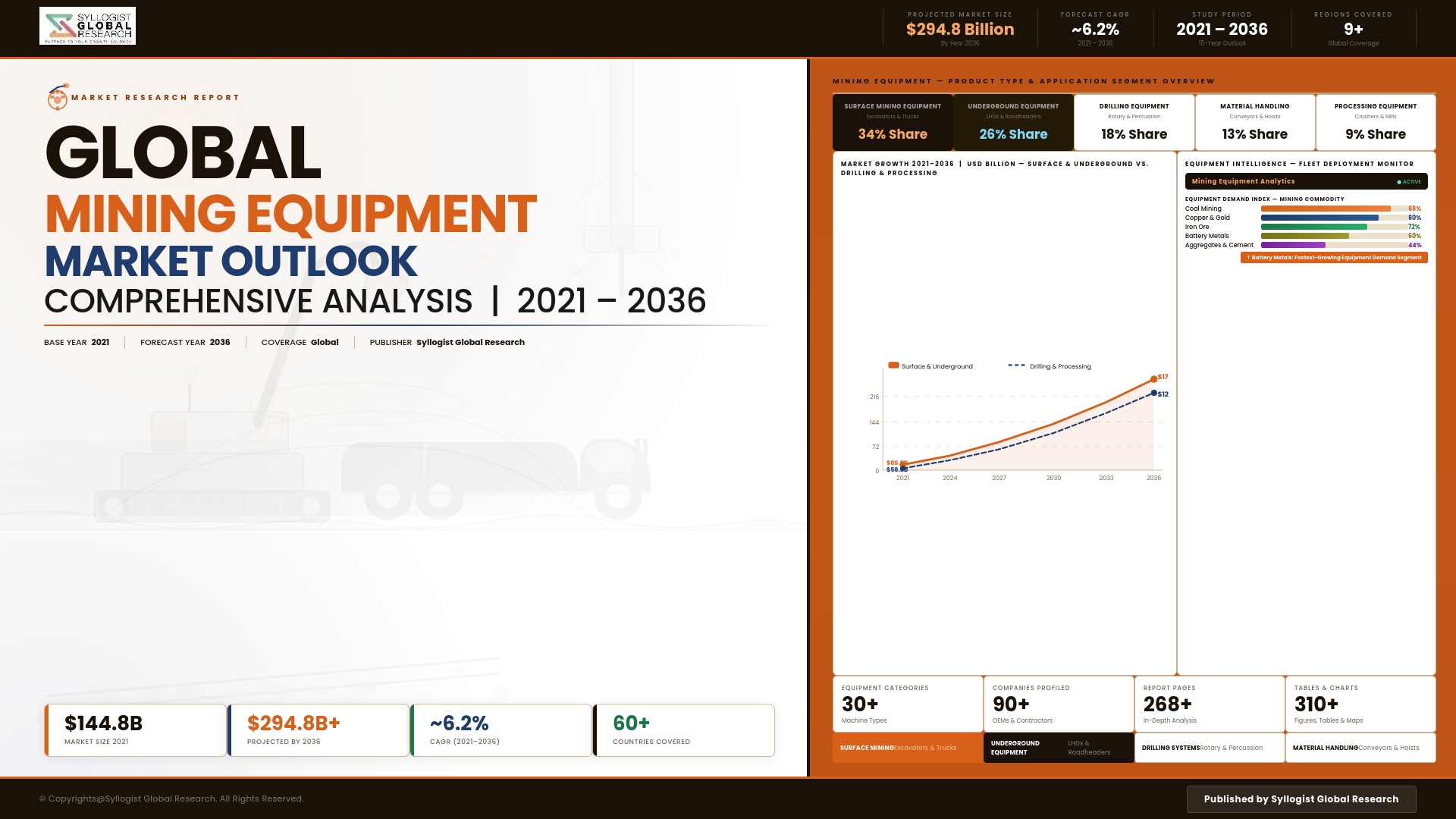
The global mining equipment market is entering a period of accelerated transformation, shaped by the convergence of record-level capital expenditure among major mining corporations, a structural shift toward fleet electrification and autonomous operation, and surging demand for equipment capable of supporting critical minerals extraction at the scale and efficiency levels required by the global clean energy transition. The market was valued at approximately USD 121.6 billion in 2025 and is projected to expand at a compound annual growth rate of 7.2% through 2034, underpinned by the combined force of new mine development in battery metals, fleet modernization programs replacing ageing diesel equipment, and the technology upgrade cycle driven by automation and digitalization investment across the global mining industry.
Capital expenditure among tier-one and mid-tier mining corporations has recovered strongly from the austerity cycle of the preceding decade, driven by elevated commodity prices for copper, gold, lithium, nickel, and iron ore and the strategic imperative to expand production capacity in minerals essential to electric vehicle battery supply chains and renewable energy infrastructure. This reinvestment cycle is translating directly into equipment procurement demand, as operators commission new mine developments, expand operating pit and underground footprints, and replace legacy fleets that were deferred during the capital expenditure restraint period. Haul trucks, hydraulic shovels, and drilling systems represent the largest equipment categories by procurement value, and their replacement and expansion cycles are running concurrently across multiple major mining jurisdictions, creating a sustained multi-year order book for the leading global mining equipment manufacturers.
The electrification of underground and surface mining fleets is emerging as the most consequential structural development shaping equipment investment priorities across the global mining industry, as operators in developed market jurisdictions confront regulatory pressure to eliminate diesel emissions from underground environments, seek to reduce total energy cost exposure by substituting renewable-powered electric drivetrains for diesel powertrains, and respond to corporate carbon reduction commitments requiring measurable Scope 1 emissions reductions from mining operations. Battery electric mining trucks, loaders, drills, and utility vehicles are transitioning from pilot deployment into fleet-scale procurement programs at an accelerating pace, with major original equipment manufacturers committing capital to battery electric powertrain development, charging infrastructure systems, and energy management software platforms that complement the hardware transition. Autonomous haulage systems and remotely operated drilling and loading platforms are simultaneously progressing from selective deployment at technology-leading operations into mainstream adoption among a broader range of mining operators, driven by demonstrated productivity, safety, and operating cost performance advantages relative to conventionally operated equipment.
Asia-Pacific dominates the global mining equipment market by consumption volume, anchored by the scale of Chinese domestic mining operations, Australian iron ore and gold production, and the expanding extractive industries of Indonesia, India, and Mongolia. North America represents the second largest regional market, supported by active copper, gold, potash, and coal mining programs and a strong aftermarket services and parts replacement demand base associated with the large installed equipment fleet across the United States and Canada. Latin America, and specifically Chile, Peru, and Brazil, constitutes the third major regional market, driven by copper, iron ore, and lithium project development activity and fleet expansion investment among both established operators and new project developers entering production across the region.
Key Drivers
Critical Minerals Supply Expansion Imperative Driving New Mine Development and Large-Scale Equipment Procurement Programs Across Battery Metals and Energy Transition Mineral Segments
The structural demand surge for lithium, cobalt, nickel, copper, manganese, and rare earth elements driven by electric vehicle battery manufacturing, grid-scale energy storage deployment, and renewable energy infrastructure construction is compelling mining corporations and governments to fast-track new mine development and expand existing operations at a pace that requires substantial equipment fleet investment across drilling, earthmoving, haulage, and mineral processing categories. National critical minerals strategies in the United States, European Union, Australia, Canada, and India are providing policy support, permitting prioritization, and financing incentives that accelerate project timelines and bring forward equipment procurement demand, expanding the addressable market for mining equipment manufacturers and aftermarket service providers across multiple high-value mineral segments simultaneously.
Fleet Electrification and Autonomous Technology Adoption Driving an Equipment Replacement and Upgrade Cycle That Expands Market Value Beyond Conventional Unit Volume Growth
The transition from diesel-powered to battery electric mining equipment and the progressive deployment of autonomous operation systems are generating a technology-driven equipment replacement cycle that elevates average unit selling prices, expands total addressable procurement value beyond what conventional fleet replacement alone would support, and creates growing demand for ancillary equipment including charging infrastructure, energy management systems, and onboard monitoring and connectivity hardware. Mining operators investing in electrification and automation are committing to multi-year, multi-unit procurement programs that provide revenue visibility for equipment manufacturers and aftermarket service providers, reinforcing investment in battery electric powertrain manufacturing capacity, autonomous systems software development, and integrated fleet management platform capabilities.
Rising Aftermarket Services, Predictive Maintenance, and Parts Replacement Demand Generating Recurring Revenue Growth Alongside Capital Equipment Sales Across the Global Mining Equipment Market
The global installed base of mining equipment represents a large and growing source of recurring aftermarket revenue encompassing replacement parts, consumables, maintenance services, equipment overhauls, and component remanufacturing, with mining operators increasingly adopting total cost of ownership procurement frameworks and long-term service agreements that tie aftermarket revenue directly to original equipment sales. The integration of telematics, IoT condition monitoring, and predictive maintenance software into modern mining equipment fleets is enabling equipment manufacturers and independent service providers to deliver data-driven maintenance programs that reduce unplanned downtime, extend equipment life cycles, and generate sustained services revenue streams that provide margin resilience during periods of capital equipment procurement volatility driven by commodity price cycles.
Key Challenges
Commodity Price Cyclicality and Mining Capital Expenditure Volatility Creating Structural Revenue Uncertainty for Mining Equipment Manufacturers and Supply Chain Partners
The mining equipment industry remains fundamentally exposed to the capital expenditure cycles of mining corporations, which are directly governed by commodity price trajectories, balance sheet conditions, and investor expectations around return on capital, creating periods of sharp procurement contraction during commodity price downturns that compress equipment order books, reduce manufacturing utilization, pressure pricing, and drive consolidation among smaller equipment manufacturers and component suppliers. The uneven distribution of commodity price cycles across different mineral segments means that equipment manufacturers with concentrated exposure to specific commodities face more acute revenue volatility than diversified competitors, creating strategic pressure to broaden product portfolios and geographic market coverage as risk mitigation against single-commodity procurement downturns.
High Capital Cost and Infrastructure Complexity of Battery Electric Fleet Transition Slowing Electrification Adoption Rates Particularly in Remote and Developing Market Mining Operations
The transition to battery electric mining equipment involves capital expenditure substantially exceeding equivalent diesel equipment purchase costs, combined with significant infrastructure investment in underground or surface electrical charging networks, grid power capacity upgrades, and energy storage systems required to support reliable fleet charging operations at production-relevant duty cycles. For mining operators in remote locations with limited grid access, the economics of fleet electrification are further complicated by the need to develop dedicated renewable power generation infrastructure to realize the carbon reduction benefits that justify the electrification investment, creating total project cost complexity that extends decision timelines and constrains adoption rates among operators with tighter capital budgets or shorter remaining mine life horizons.
Global Supply Chain Disruptions, Critical Component Shortages, and Extended Lead Times Constraining Equipment Delivery Schedules and Increasing Procurement Cost Uncertainty for Mining Operators
Mining equipment manufacturing supply chains depend on globally distributed networks of steel, copper, hydraulic components, electronic systems, and increasingly battery cells and electric drivetrain components, and the disruption of these supply networks through geopolitical trade restrictions, logistics capacity constraints, or concentrated supplier production outages can extend equipment delivery lead times materially, elevate component procurement costs, and create operational planning uncertainty for mining operators managing fleet expansion timelines against mine development schedules. The growing incorporation of advanced battery systems, semiconductor-intensive automation hardware, and precision sensor equipment into modern mining machinery is increasing the complexity and geographic concentration of critical component supply chains, amplifying equipment delivery schedule vulnerability to upstream supply disruption events.
Market Segmentation
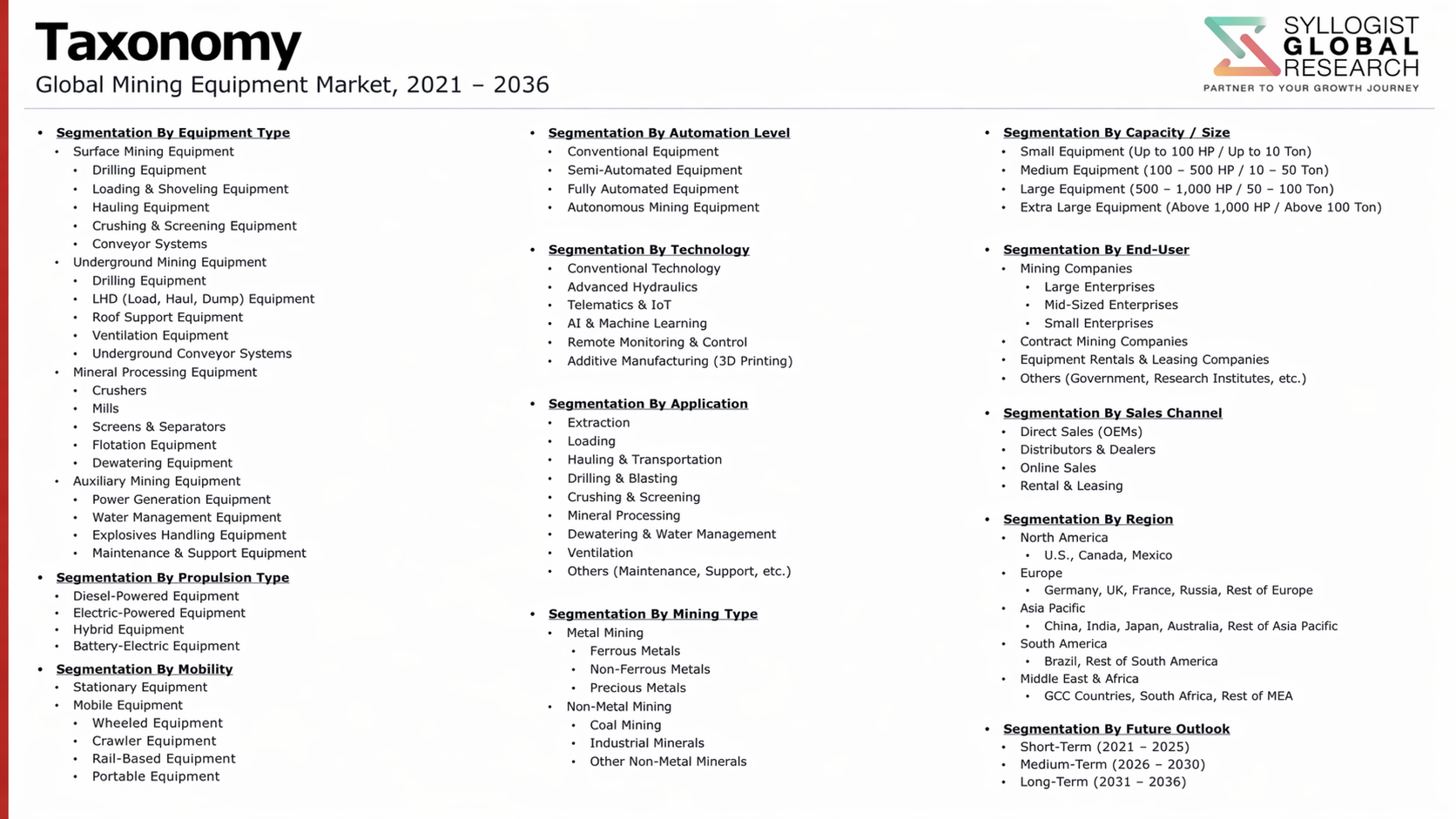
- Segmentation By Equipment Type
- Drilling and Blasting Equipment
- Surface Mining Excavators and Shovels
- Underground Loaders and Haulers
- Mining Haul Trucks and Off-Highway Vehicles
- Crushing, Screening, and Mineral Processing Equipment
- Conveying and Material Handling Systems
- Ventilation and Underground Safety Equipment
- Others
- Segmentation By Automation Level
- Manually Operated Equipment
- Semi-Autonomous and Operator-Assisted Equipment
- Fully Autonomous and Remotely Operated Equipment
- Segmentation By Power Source
- Diesel-Powered Equipment
- Battery Electric Equipment
- Hybrid Diesel-Electric Equipment
- Hydrogen Fuel Cell Equipment
- Grid-Connected Electric Equipment
- Others
- Segmentation By Mining Method
- Open-Pit and Surface Mining
- Underground Hard Rock Mining
- Underground Soft Rock and Coal Mining
- Placer and Alluvial Mining
- In-Situ and Solution Mining
- Others
- Segmentation By Mineral Type
- Metallic Minerals (Copper, Gold, Iron Ore, Nickel, Lithium)
- Coal and Lignite
- Industrial and Construction Minerals
- Phosphates and Potash
- Rare Earth and Critical Minerals
- Others
- Segmentation By End User
- Integrated Major Mining Corporations
- Mid-Tier and Junior Mining Companies
- Contract Mining Operators
- State-Owned Mining Enterprises
- Quarrying and Aggregate Producers
- Others
- Segmentation By Region
- North America
- Europe
- Asia-Pacific
- Latin America
- Middle East and Africa
All market revenues are presented in USD
Historical Year: 2021-2024 | Base Year: 2025 | Estimated Year: 2026 | Forecast Period: 2027-2034
Key Questions this Study Will Answer
- What is the total global mining equipment market valuation in 2025, projected through 2034, segmented by equipment type, mining method, and mineral category, enabling equipment manufacturers, investors, and mining procurement teams to identify the highest-growth product segments and most durable capital expenditure opportunities across the global mining equipment landscape?
- How is the accelerating transition to battery electric and autonomous mining equipment reshaping original equipment manufacturer product development strategies, capital investment priorities, and aftermarket service models, and what adoption timelines, regulatory drivers, and total cost of ownership economics are determining the pace of fleet electrification and automation uptake across different mining types and regions?
- Which mineral extraction segments, specifically copper, lithium, nickel, gold, and iron ore, are generating the highest incremental mining equipment procurement demand through 2034, and how are the distinct operational requirements, mine scale characteristics, and capital investment cycles of each mineral category shaping equipment specification, fleet composition, and procurement volume in each segment?
- How is the competitive landscape structured among global mining equipment original equipment manufacturers, regional equipment producers, and independent aftermarket service providers, and what product portfolio expansion, geographic market entry, digital services development, and acquisition strategies are leading competitors pursuing to strengthen market share across key equipment categories and regions?
- What supply chain vulnerabilities, component availability constraints, and extended delivery lead time risks are most materially affecting mining equipment procurement planning, and how are equipment manufacturers and mining operators adapting inventory strategies, supplier diversification programs, and local content sourcing arrangements to manage supply chain disruption exposure across critical equipment categories?
- Which regional mining equipment markets, specifically Asia-Pacific, Latin America, and Africa, are expected to generate the most significant incremental procurement growth through 2034, and what combinations of new mine development activity, fleet replacement demand, automation adoption, and electrification investment are driving equipment expenditure priorities and original equipment manufacturer market positioning in each region?
- How are aftermarket services, predictive maintenance platforms, and long-term equipment management contracts evolving as a revenue stream for global mining equipment manufacturers, and what digital connectivity, telematics integration, and data analytics capabilities are becoming competitive differentiators in service contract retention and total cost of ownership performance delivery for mining operator customers?
- Product Definition
- Research Methodology
- Research Design & Framework
- Overall Research Approach: Descriptive, Exploratory & Quantitative Mixed-Method Design
- Market Definition & Scope Boundaries: What is Included and Excluded
- Segmentation Framework
- Key Research Assumptions & Limitations
- Secondary Research
- Primary Research Design & Execution
- Data Triangulation & Validation
- Market Sizing & Forecasting Methodology
- Competitive Intelligence Methodology
- Quality Assurance & Peer Review
- Definitions, Abbreviations & Data Notes
- Research Design & Framework
- Executive Summary
- Market Snapshot & Headline Numbers
- Key Findings & Research Highlights
- Market Dynamics
- Regional Market Summary
- Competitive Landscape Snapshot
- Technology & Innovation Highlights
- Market Dynamics
- Drivers
- Restraints
- Opportunities
- Challenges
- Porter’s Five Forces Analysis
- PESTLE Analysis
- Market Trends & Developments
- Emerging Trends
- Technological Developments
- Regulatory & Policy Changes
- Supply Chain & Sourcing Trends
- Manufacturing & Process Trends
- Investment & Funding Activity
- Sustainability & ESG Trends
- Risk Assessment Framework
- Commodity Price Volatility, Mining Cycle Downturn & Capex Reduction Risk
- Supply Chain Disruption, Raw Material Availability & Component Shortage Risk
- Regulatory, Environmental Permitting & Mine Safety Compliance Risk
- Technology Transition, Electrification Readiness & Autonomous Adoption Risk
- Geopolitical Instability, Trade Restrictions & Export Control Risk
- Regulatory Framework & Standards
- Mine Safety Equipment Standards, Operator Certification & Regulatory Frameworks by Jurisdiction
- Environmental Emission, Noise, Vibration & Dust Standards for Mining Machinery
- Equipment Type Approval, CE Marking & Regional Conformity Assessment Frameworks
- Battery-Electric, Autonomous & Tele-operated Equipment Safety Standards & Operational Guidelines
- Green Procurement, ESG Disclosure & Sustainable Mining Equipment Procurement Standards
- Global Mining Equipment Market Outlook
- Market Size & Forecast by Value
- Market Size & Forecast by Volume (Units Sold & Installed Base)
- Market Size & Forecast by Equipment Type
- Surface Mining Equipment (Draglines, Shovels, Surface Drill Rigs & Scrapers)
- Underground Mining Equipment (Longwall, Development & Stoping Equipment)
- Mineral Processing Equipment (Crushers, Grinding Mills, Screens & Classifiers)
- Material Handling & Conveying Equipment (Conveyors, Stackers & Reclaimers)
- Drilling & Blasting Equipment (Rotary, DTH, Top Hammer & Raise Boring Rigs)
- Loading & Hauling Equipment (Excavators, Loaders, Dump Trucks & Articulated Haulers)
- Dewatering, Ventilation & Mine Support Equipment
- Digital, Automation & Fleet Management Solutions for Mining
- Market Size & Forecast by Technology
- Conventional Diesel-Powered Mining Equipment
- Battery-Electric Mining Equipment (BEV)
- Hybrid Diesel-Electric Mining Equipment
- Autonomous & Semi-Autonomous Mining Equipment
- Remote-Controlled & Tele-operated Mining Equipment
- Digital Twin, IoT & AI-Integrated Mining Equipment Platforms
- Market Size & Forecast by Mine Type
- Open-Pit & Surface Mining
- Underground Hard Rock Mining
- Underground Coal Mining
- Placer, Alluvial & In-Situ Mining
- Market Size & Forecast by Commodity Application
- Coal Mining Equipment
- Copper Mining Equipment
- Gold & Silver Mining Equipment
- Iron Ore Mining Equipment
- Potash & Phosphate Mining Equipment
- Lithium, Cobalt & Battery Critical Minerals Mining Equipment
- Nickel, Zinc & Base Metals Mining Equipment
- Construction Aggregates & Industrial Minerals Equipment
- Market Size & Forecast by Power Source
- Diesel-Powered Equipment
- Battery-Electric Equipment
- Hybrid-Powered Equipment
- Grid-Powered (Cable & Trolley) Equipment
- Market Size & Forecast by Application
- Excavation & Drilling
- Loading & Hauling
- Crushing, Grinding & Mineral Processing
- Material Handling & Transportation
- Mine Dewatering & Ventilation
- Safety, Monitoring & Communication
- Market Size & Forecast by End-User
- Large-Scale Diversified Mining Corporations
- Mid-Tier & Junior Mining Companies
- Contract Mining & Mining Services Providers
- Government-Owned & State Mining Enterprises
- Market Size & Forecast by Sales Channel
- Direct OEM Sales
- Dealer & Distributor Network
- Equipment Rental & Leasing
- Used & Remanufactured Equipment Market
- Digital & E-Commerce Sales Platforms
- North America Mining Equipment Market Outlook
- Market Size & Forecast
- By Value
- By Volume (Units Sold & Installed Base)
- By Equipment Type
- By Technology
- By Mine Type
- By Commodity Application
- By Power Source
- By Application
- By End-User
- By Country
- By Sales Channel
- Market Size & Forecast
- Europe Mining Equipment Market Outlook
- Market Size & Forecast
- By Value
- By Volume (Units Sold & Installed Base)
- By Equipment Type
- By Technology
- By Mine Type
- By Commodity Application
- By Power Source
- By Application
- By End-User
- By Country
- By Sales Channel
- Market Size & Forecast
- Asia-Pacific Mining Equipment Market Outlook
- Market Size & Forecast
- By Value
- By Volume (Units Sold & Installed Base)
- By Equipment Type
- By Technology
- By Mine Type
- By Commodity Application
- By Power Source
- By Application
- By End-User
- By Country
- By Sales Channel
- Market Size & Forecast
- Latin America Mining Equipment Market Outlook
- Market Size & Forecast
- By Value
- By Volume (Units Sold & Installed Base)
- By Equipment Type
- By Technology
- By Mine Type
- By Commodity Application
- By Power Source
- By Application
- By End-User
- By Country
- By Sales Channel
- Market Size & Forecast
- Middle East & Africa Mining Equipment Market Outlook
- Market Size & Forecast
- By Value
- By Volume (Units Sold & Installed Base)
- By Equipment Type
- By Technology
- By Mine Type
- By Commodity Application
- By Power Source
- By Application
- By End-User
- By Country
- By Sales Channel
- Market Size & Forecast
- Country-Wise* Mining Equipment Market Outlook
- Market Size & Forecast
- By Value
- By Volume (Units Sold & Installed Base)
- By Equipment Type
- By Technology
- By Mine Type
- By Commodity Application
- By Power Source
- By Application
- By End-User
- By Country
- By Sales Channel
- Market Size & Forecast
- *Countries Analyzed in the Syllogist Global Research Portfolio: United States, Canada, Mexico, Germany, France, United Kingdom, Sweden, Finland, Australia, China, Japan, India, South Africa, Chile, Peru, Brazil, Russia, Kazakhstan, Indonesia, Philippines, Saudi Arabia, UAE, Democratic Republic of Congo, Zambia, Ghana
- Technology Landscape & Innovation Analysis
- Battery-Electric Vehicle (BEV) Technology Deep-Dive for Mining Equipment
- Autonomous Haulage Systems (AHS) & Semi-Autonomous Drilling Technology
- Advanced Crushing, Grinding & High-Pressure Grinding Roll (HPGR) Technology
- Digital Twin, Fleet Management, Predictive Maintenance & AI-Based Operations Technology
- In-Pit Crushing & Conveying (IPCC) & Automated Material Handling Technology
- Hydrogen Fuel Cell & Alternative Propulsion Technology for Mining Equipment
- Real-Time Ore Sensing, Sorting & Grade Control Technology
- Patent & IP Landscape in Mining Equipment Technologies
- Value Chain & Supply Chain Analysis
- Steel, Castings, Forgings & Structural Component Manufacturing Supply Chain
- Engine, Drivetrain, Hydraulics & Powertrain Component Supply Chain
- Battery, Electric Motor, Inverter & Power Electronics Supply Chain for Mining BEV
- Ground Engaging Tools (GET), Wear Parts & Undercarriage Component Supply Chain
- Electronic Control Systems, Sensors & Automation Hardware Supply Chain
- OEM Assembly, Integration & Factory Production Network
- Dealer, Distributor & Aftermarket Parts & Service Channel
- End-of-Life Equipment Remanufacturing & Circular Economy
- Pricing Analysis
- Surface Mining Equipment Capital Cost & Total Cost of Ownership (TCO) Analysis
- Underground Mining Equipment Capital Cost & TCO Analysis
- Battery-Electric Mining Equipment Capex Premium & Lifecycle Cost Comparison vs. Diesel
- Autonomous & Semi-Autonomous Equipment Capex, Payback Period & Productivity Analysis
- Aftermarket Parts, Service Contract & Maintenance Cost Structure Analysis
- Rental & Leasing Rate Structure & Financing Cost Analysis
- Sustainability & Environmental Analysis
- Lifecycle Assessment (LCA) of Mining Equipment: Carbon Footprint, Energy Intensity & Emissions by Equipment Category
- Decarbonisation Pathway: Role of BEV, Hydrogen & Hybrid Equipment in Mine-Site Net Zero Targets
- Noise, Vibration & Particulate Emission Reduction: Technology Solutions & Regulatory Compliance
- Water Use, Tailings Management & Environmental Footprint of Mineral Processing Equipment
- SDG Alignment, ESG Disclosure & Responsible Sourcing Standards for Mining Equipment Manufacturers
- Competitive Landscape
- Market Structure & Concentration
- Market Consolidation Level (Fragmented vs. Consolidated by Equipment Type & Geography)
- Top 10 Players Market Share
- HHI (Herfindahl-Hirschman Index) Concentration Analysis
- Competitive Intensity Map by Equipment Type, Technology & Geography
- Player Classification
- Large Diversified Mining Equipment OEMs (Full-Line Manufacturers)
- Specialist Surface Mining Equipment Manufacturers
- Specialist Underground Mining Equipment Manufacturers
- Mineral Processing Equipment Specialists
- Battery-Electric & Alternative Propulsion Mining Equipment Providers
- Autonomous, Digital & Fleet Management System Providers
- Aftermarket Parts, Service & Remanufacturing Specialists
- Competitive Analysis Frameworks
- Market Share Analysis by Equipment Type, Technology & Region
- Company Profile
- Company Overview & Headquarters
- Mining Equipment Products & Technology Portfolio
- Key Customer Relationships & Reference Mining Project Installations
- Manufacturing Footprint & Production Capacity
- Revenue (Mining Equipment Segment) & Order Backlog
- Technology Differentiators & IP
- Key Strategic Partnerships, JVs & M&A Activity
- Recent Developments (Contract Wins, Capacity Expansion, Product Launches)
- SWOT Analysis
- Strategic Focus Areas & Roadmap
- Competitive Positioning Map (Technology Capability vs. Market Penetration)
- Key Company Profiles
- Market Structure & Concentration
- Technology Landscape & Innovation Analysis
- Strategic Output
- Market Opportunity Matrix: By Equipment Type, Technology, Commodity Application, End-User & Geography
- White Space Opportunity Analysis
- Strategic Recommendations
- Product Portfolio & Technology Investment Strategy
- Manufacturing & Operational Excellence Strategy
- Geographic Expansion & Localisation Strategy
- Customer & End-User Engagement Strategy
- Partnership, M&A & Ecosystem Strategy
- Sustainability & Circular Economy Strategy
- Risk Mitigation & Future Roadmap
- Strategic Priority Matrix & Roadmap
- Near-term (2025-2028)
- Mid-term (2029-2032)
- Long-term (2033-2037)
- Strategic Output