Global Nanomaterials and Advanced Functional Chemicals Market By Material Type, By Functionality, By Application, By End Use Industry, By Form, By Distribution Channel, By Region, Competition, Forecast and Opportunities, 2021-2036F
Market Definition
The Global Nanomaterials and Advanced Functional Chemicals Market encompasses the synthesis, processing, formulation, and commercial supply of engineered materials with at least one dimension in the nanoscale range and high-performance specialty chemicals designed to impart specific functional properties including conductivity, catalytic activity, antimicrobial efficacy, optical responsiveness, mechanical reinforcement, and surface modification capability. The market includes carbon nanotubes, graphene, metal and metal oxide nanoparticles, quantum dots, nano-encapsulated actives, functional coatings, specialty surfactants, and reactive chemical intermediates procured by electronics manufacturers, pharmaceutical developers, energy technology producers, aerospace engineers, and advanced materials companies globally.
Market Insights
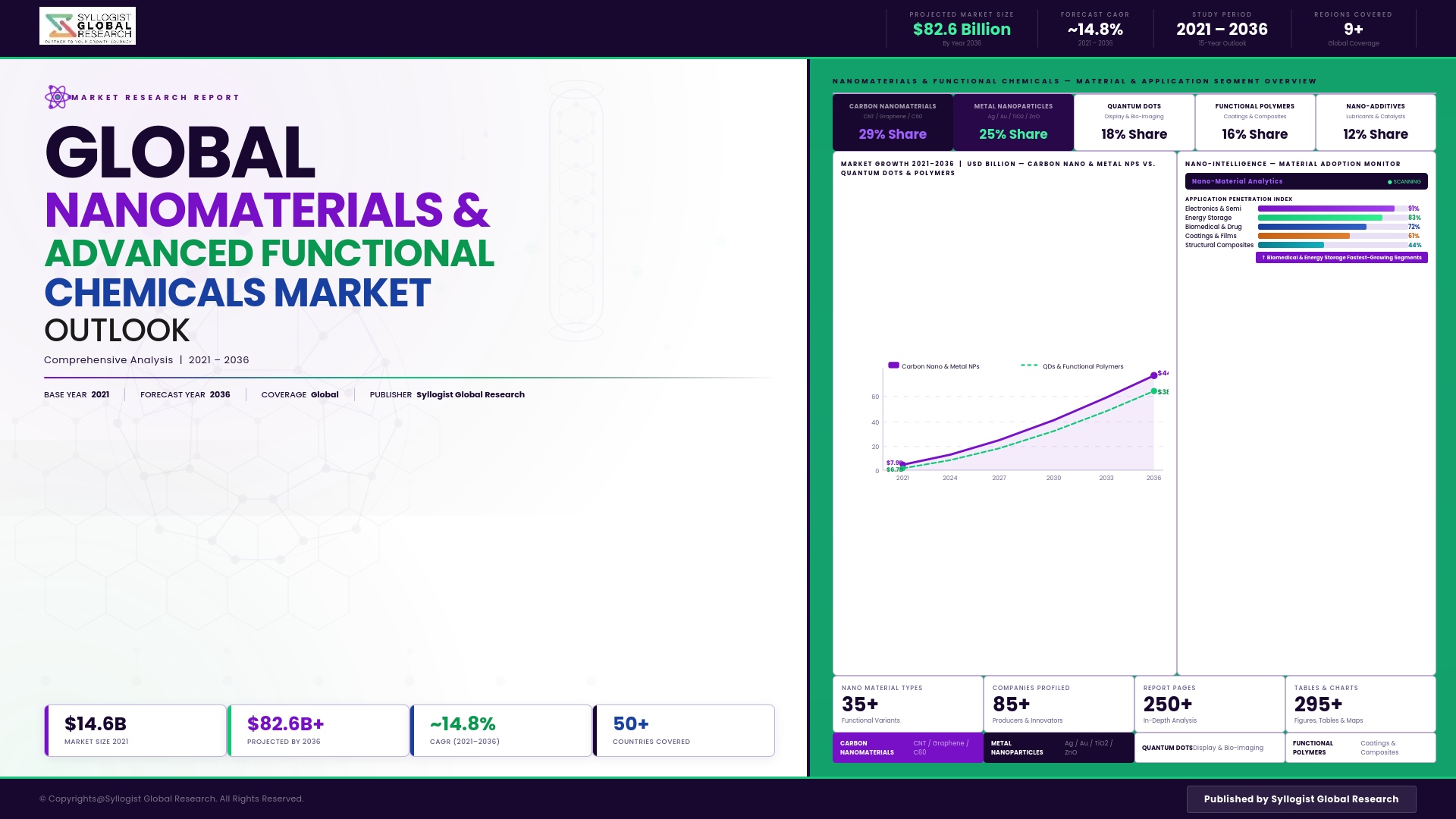
The global nanomaterials and advanced functional chemicals market is entering a phase of accelerated commercial maturation, transitioning from a landscape historically dominated by laboratory-scale synthesis and research-grade production toward one increasingly characterized by industrial-scale manufacturing, application-specific product differentiation, and integration into high-value end-use sectors where the unique physicochemical properties of nanoscale and functionally engineered materials deliver performance improvements that conventional material alternatives cannot replicate. The market was valued at approximately USD 24.3 billion in 2025 and is projected to reach USD 68.9 billion by 2034, advancing at a compound annual growth rate of 12.3% through the forecast period, as demand from the electronics, energy storage, healthcare, aerospace, and advanced coatings sectors converges to sustain multi-industry growth that is structurally decoupled from any single end-use market cycle.
The electronics and semiconductor sector remains the highest-value application domain for advanced nanomaterials, with carbon nanotubes, graphene films, silver nanowires, and conductive nano-inks enabling next-generation flexible electronics, transparent conductive layers for display technologies, sub-nanometer semiconductor interconnect materials, and thermal management solutions for high-density processor packaging architectures that conventional copper and silicon dioxide material systems can no longer address at the performance levels required by advancing node lithography and heterogeneous integration architectures. The energy transition is simultaneously generating transformative demand across multiple nanomaterial categories, with graphene and carbon nanotube additives improving lithium-ion battery electrode conductivity and silicon anode expansion management, nanostructured catalysts enhancing hydrogen fuel cell membrane electrode assembly performance, and metal oxide nanomaterials enabling photovoltaic efficiency improvements and thermoelectric energy harvesting applications that collectively represent a rapidly expanding addressable market for functional nanomaterial producers with demonstrated capability to meet the purity, morphology consistency, and scalable production requirements of energy technology manufacturers.
The pharmaceutical and biomedical application segment is generating particularly high per-unit-value nanomaterial demand, with lipid nanoparticles validated as drug delivery vehicles through mRNA vaccine commercial deployment at global scale, polymeric nano-encapsulation systems enabling targeted oncology therapeutics with improved biodistribution profiles, and nanoparticle contrast agents and diagnostic imaging enhancers representing clinical application categories where regulatory-approved nanomaterial systems command substantial price premiums over commodity chemical alternatives. Advanced functional coatings incorporating nanoparticle additives for antimicrobial surfaces, self-cleaning photocatalytic films, corrosion-resistant industrial coatings, and anti-reflective optical surface treatments represent a broadly accessible commercial application pathway that is driving adoption of nanomaterial formulations across construction, automotive, aerospace, and consumer goods manufacturing without requiring the regulatory complexity associated with pharmaceutical or food contact applications. Asia-Pacific dominates global nanomaterial production capacity, anchored by China, South Korea, Japan, and Taiwan, which collectively host the largest concentration of electronics manufacturing, battery production, and nanomaterial synthesis infrastructure. North America maintains a strong position in high-value pharmaceutical nanomaterials, semiconductor process chemicals, and advanced functional coating systems, while Europe leads in regulatory framework development, sustainable nanomaterial innovation, and specialty chemical formulation for automotive and aerospace applications.
Key Drivers
Electronics and Semiconductor Industry Miniaturization Imperatives and Advanced Packaging Architecture Requirements Creating Sustained High-Value Demand for Functional Nanomaterials Across Multiple Component Categories
The relentless miniaturization trajectory of semiconductor devices, combined with the transition toward heterogeneous integration, three-dimensional chip stacking, and chiplet-based package architectures that impose thermal management, electrical interconnect, and dielectric isolation challenges beyond the capability of conventional materials systems, is generating sustained premium-value demand for carbon nanotube interconnect materials, graphene thermal interface materials, nanoparticle-based low-temperature sintering pastes, and nano-dielectric films whose functional performance properties enable semiconductor packaging engineers to meet the density, thermal, and signal integrity requirements of next-generation processor and memory architectures. The advanced display segment is simultaneously driving demand for silver nanowire transparent conductors, quantum dot color conversion films, and nano-patterned optical enhancement layers that enable the brightness, color gamut, and form factor performance of OLED and microLED display technologies at commercially manufacturable cost points.
Energy Transition Investment Acceleration and the Functional Performance Requirements of Next-Generation Battery, Fuel Cell, and Photovoltaic Technologies Driving Structural Nanomaterial Demand Expansion
The global energy transition investment cycle, encompassing the unprecedented scaling of lithium-ion battery manufacturing for electric vehicles and grid storage, the commercial development of hydrogen fuel cell systems for transport and stationary power, and the continued deployment of advanced photovoltaic technologies, is generating structural demand for nanomaterials whose functional properties directly address the performance, durability, and efficiency limitations of current energy technology architectures. Graphene and carbon nanotube conductive additives enabling higher electrode conductivity at lower loading levels, nanostructured platinum group metal catalysts delivering improved fuel cell activity with reduced precious metal content, and quantum dot photovoltaic absorber materials offering bandgap tunability advantages over conventional silicon are each addressing commercially critical performance improvement requirements that are driving technology developer procurement investment independent of commodity chemical price dynamics.
Pharmaceutical Nanomedicine Validation and Drug Delivery Platform Commercialization Creating a Structurally New High-Value Nanomaterial Application Sector with Regulatory-Protected Revenue Premium
The large-scale regulatory validation of lipid nanoparticle delivery systems through approved mRNA vaccine products has transformed pharmaceutical industry perception of nanomedicine from an experimental research modality into a commercially proven drug delivery platform, catalyzing investment in lipid nanoparticle formulation chemistry, polymeric nanoparticle synthesis, and nanoparticle surface functionalization reagents across a broad pipeline of next-generation therapeutic applications including cancer immunotherapy, gene editing delivery, and siRNA-based disease intervention programs. This pharmaceutical sector validation is creating a structurally new and high-growth nanomaterial application category characterized by regulatory approval barriers that protect commercial revenue premiums for qualified suppliers and generate durable long-term procurement relationships with drug developers that are substantially insulated from commodity market competitive pressure.
Key Challenges
Nanomaterial Toxicology Uncertainty, Regulatory Classification Complexity, and Evolving Worker Safety and Environmental Exposure Frameworks Imposing Compliance Cost and Market Access Constraints
The incomplete scientific consensus on the toxicological profiles, environmental persistence, and biological fate of engineered nanomaterials across the full diversity of particle size, morphology, surface chemistry, and composition dimensions that define commercially relevant nanomaterial product categories is creating a dynamic and increasingly demanding regulatory compliance environment in which producers must invest in extensive characterization, hazard assessment, and exposure monitoring programs without the benefit of established regulatory frameworks providing clear approval pathways or definitive safety thresholds. The European Union nanomaterial definition and registration requirements under REACH, the United States Toxic Substances Control Act nanomaterial reporting rules, and divergent national regulatory frameworks across Asia, Latin America, and the Middle East collectively impose fragmented compliance obligations on global nanomaterial producers that add cost, complexity, and market access uncertainty to international commercial operations.
Industrial-Scale Synthesis Consistency, Nanomaterial Characterization Standardization, and Batch-to-Batch Property Reproducibility Constraining Qualification and Adoption in Regulated End-Use Applications
The transition of nanomaterial production from laboratory synthesis to industrial manufacturing scale introduces significant technical challenges in maintaining the particle size distribution precision, surface area consistency, morphology uniformity, and chemical purity specifications that define the functional performance of nanomaterial products in demanding application environments, with batch-to-batch property variability creating qualification failure risks for end users operating under stringent incoming material acceptance criteria in semiconductor, pharmaceutical, and aerospace supply chains. The absence of universally adopted standard reference materials, characterization methodology protocols, and property reporting requirements across nanomaterial product categories complicates supplier-customer technical communication, impedes meaningful performance comparison across competing products, and creates disputes regarding specification compliance that extend procurement qualification timelines and add commercial friction to nanomaterial adoption in performance-critical applications.
High Production Cost Structures, Energy-Intensive Synthesis Processes, and Sustainable Feedstock Sourcing Requirements Limiting Nanomaterial Price Competitiveness Against Conventional Material Alternatives in Cost-Sensitive Markets
The production economics of many high-performance nanomaterials, including single-walled carbon nanotubes, pristine graphene, platinum group metal nanoparticle catalysts, and pharmaceutical-grade lipid nanoparticle systems, are characterized by energy-intensive synthesis processes, stringent quality control requirements, and low production yields relative to raw material inputs that generate unit costs substantially exceeding conventional material alternatives and constraining adoption to applications where the performance premium justifies the cost differential. Sustainability-driven pressure to reduce carbon footprint and eliminate hazardous synthesis reagents across nanomaterial production processes is simultaneously imposing process chemistry reformulation requirements that add development cost and may compromise performance characteristics, creating a dual challenge of cost reduction and sustainability compliance that demands continued process innovation investment from nanomaterial producers competing for cost-sensitive industrial application markets.
Market Segmentation
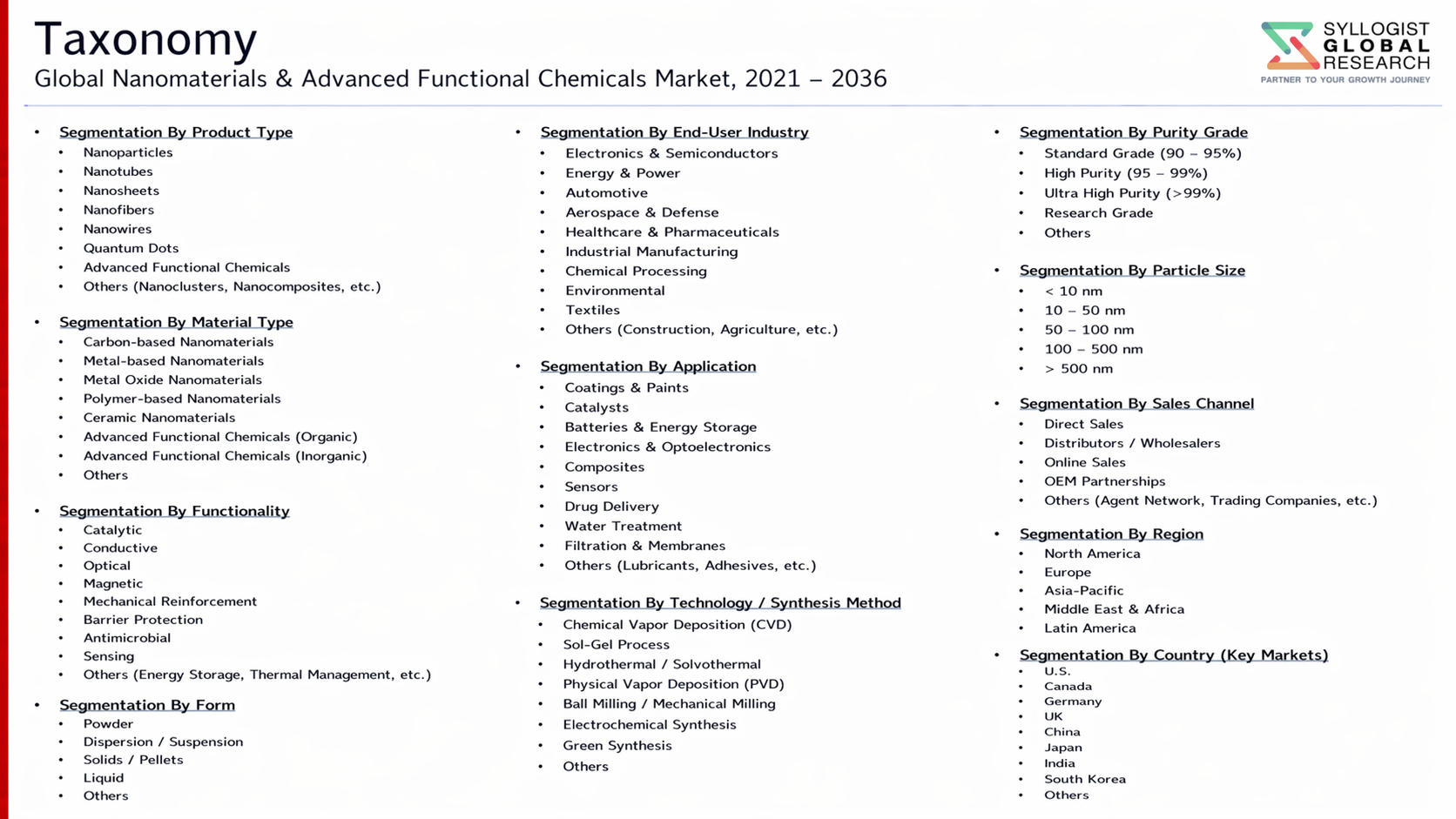
- Segmentation By Material Type
- Carbon-Based Nanomaterials (CNT, Graphene, Fullerenes, Carbon Black)
- Metal and Metal Alloy Nanoparticles (Silver, Gold, Copper, Platinum)
- Metal Oxide Nanoparticles (TiO2, ZnO, Fe2O3, CeO2, Al2O3)
- Semiconductor Quantum Dots and Nanocrystals
- Polymeric and Lipid Nanoparticles
- Nano-Clays and Silica Nanostructures
- Advanced Functional Specialty Chemicals and Reactive Intermediates
- Others
- Segmentation By Functionality
- Electrically Conductive and Semiconductive Materials
- Catalytic and Photo-Catalytic Materials
- Antimicrobial and Biocidal Functional Materials
- Optical and Luminescent Functional Materials
- Mechanical Reinforcement and Structural Materials
- Thermal Management and Heat Transfer Materials
- Surface Modification and Adhesion Promotion Chemicals
- Others
- Segmentation By Application
- Electronics and Semiconductor Manufacturing
- Energy Storage and Conversion Systems
- Pharmaceutical Drug Delivery and Nanomedicine
- Functional Coatings and Surface Treatment
- Catalysis and Chemical Process Optimization
- Environmental Remediation and Water Treatment
- Structural Composites and Advanced Materials
- Others
- Segmentation By End Use Industry
- Electronics, Semiconductor, and Display Manufacturing
- Energy and Battery Technology
- Pharmaceutical and Biotechnology
- Aerospace and Defense
- Automotive and Transportation
- Construction and Infrastructure
- Paints, Coatings, and Adhesives
- Others
- Segmentation By Form
- Dry Powder and Granular Nanomaterials
- Aqueous Dispersion and Colloidal Suspension
- Solvent-Based Dispersion and Nano-Ink Formulations
- Masterbatch and Composite Pre-Blended Forms
- Encapsulated and Surface-Functionalized Forms
- Segmentation By Distribution Channel
- Direct Supply Agreements with Industrial Manufacturers
- Specialty Chemical Distributor Networks
- E-Commerce and Online Scientific Supply Platforms
- Research Institution and Laboratory Supply Channels
- Segmentation By Region
- North America
- Europe
- Asia-Pacific
- Middle East and Africa
- Latin America
All market revenues are presented in USD
Historical Year: 2021-2024 | Base Year: 2025 | Estimated Year: 2026 | Forecast Period: 2027-2034
Key Questions this Study Will Answer
- What is the total global market valuation of the Nanomaterials and Advanced Functional Chemicals Market in 2025, projected through 2034, disaggregated by material type, functionality, and end use industry, enabling chemical producers, technology developers, and investors to identify the highest-growth material categories and most durable revenue opportunities across the advanced materials value chain?
- How are the electronics and semiconductor, energy storage, and pharmaceutical sectors structuring procurement and qualification programs for high-performance nanomaterials, and which material types and functional property profiles are generating the highest application-specific demand growth and per-unit revenue premiums across major end-use industry categories through 2034?
- What regulatory frameworks governing nanomaterial registration, worker safety, environmental exposure, and product labeling are shaping market access complexity across the European Union, the United States, and Asia-Pacific, and how are leading producers managing multi-jurisdictional compliance obligations while maintaining commercially viable production economics and international market reach?
- Which nanomaterial and advanced functional chemical segments, including lipid nanoparticle drug delivery systems, graphene energy applications, quantum dot display materials, and nanostructured catalysts, are generating the highest technology investment and commercialization activity, and what performance and production scalability benchmarks are most critical to achieving mainstream industrial adoption?
- How is the competitive landscape structured among global specialty chemical majors, dedicated nanomaterial producers, university spinout companies, and vertically integrated industrial conglomerates, and what synthesis technology, scale-up capability, application development, and customer qualification strategies are enabling leading producers to build defensible market positions across high-value nanomaterial categories?
- What synthesis cost structure challenges, batch-to-batch consistency requirements, and sustainable production imperatives are constraining nanomaterial adoption in cost-sensitive industrial markets, and how are producers advancing process chemistry innovation, green synthesis routes, and standardized characterization frameworks to expand addressable market penetration beyond premium performance applications?
- Which regional nanomaterials and advanced functional chemicals markets, specifically Asia-Pacific, North America, and Europe, are expected to generate the most substantial incremental production investment and demand growth through 2034, and what electronics manufacturing concentration, energy transition investment, pharmaceutical innovation activity, and regulatory framework development are shaping competitive dynamics and supplier positioning in each region?
- Product Definition
- Research Methodology
- Research Design & Framework
- Overall Research Approach: Descriptive, Exploratory & Quantitative Mixed-Method Design
- Market Definition & Scope Boundaries: What is Included and Excluded
- Segmentation Framework
- Key Research Assumptions & Limitations
- Secondary Research
- Primary Research Design & Execution
- Data Triangulation & Validation
- Market Sizing & Forecasting Methodology
- Competitive Intelligence Methodology
- Quality Assurance & Peer Review
- Definitions, Abbreviations & Data Notes
- Research Design & Framework
- Executive Summary
- Market Snapshot & Headline Numbers
- Key Findings & Research Highlights
- Market Dynamics
- Regional Market Summary
- Competitive Landscape Snapshot
- Technology & Innovation Highlights
- Market Dynamics
- Drivers
- Restraints
- Opportunities
- Challenges
- Porter’s Five Forces Analysis
- PESTLE Analysis
- Market Trends & Developments
- Emerging Trends
- Technological Developments
- Regulatory & Policy Changes
- Supply Chain & Sourcing Trends
- Manufacturing & Process Trends
- Investment & Funding Activity
- Sustainability & ESG Trends
- Risk Assessment Framework
- Raw Material Supply, Nano-Precursor Availability & Geopolitical Risk
- Technology Obsolescence, Scale-Up & Commercialisation Risk
- Regulatory, EHS & Nano-Specific Safety Compliance Risk
- Product Quality, Batch Consistency & Nano-Scale Characterisation Risk
- Capital Investment, Customer Adoption & Market Acceptance Risk
- Regulatory Framework & Standards
- Nanomaterial Registration, REACH, TSCA & Chemical Inventory Compliance Frameworks
- Nano-Specific Labelling, Worker Exposure & Occupational Safety Standards
- Food Contact, Cosmetic & Biomedical Nanomaterial Safety & Efficacy Requirements
- End-of-Life, Nano-Waste Disposal & Environmental Release Regulations
- Green Finance, ESG Disclosure & Sustainable Advanced Materials Procurement Standards
- Global Nanomaterials & Advanced Functional Chemicals Market Outlook
- Market Size & Forecast by Value
- Market Size & Forecast by Volume (Tons and Kilotons)
- Market Size & Forecast by Material Type
- Carbon-Based Nanomaterials (Carbon Nanotubes, Graphene, Graphene Oxide, Fullerenes & Carbon Dots)
- Metal & Metal Oxide Nanoparticles (Silver, Gold, Copper, Zinc Oxide, Titanium Dioxide, Iron Oxide & Cerium Oxide)
- Silica, Alumina & Ceramic Nanomaterials
- Quantum Dots (Cadmium-Based, Indium Phosphide, Perovskite & Carbon Quantum Dots)
- Nanoclays, Nanocellulose & Bio-Derived Nanomaterials
- Nanowires, Nanofibres & Dendritic Nanostructures
- Conductive Polymers & Functional Smart Polymers (PEDOT:PSS, Polyaniline & Self-Healing Polymers)
- Functional Specialty Coatings, Anti-Microbial & Anti-Corrosion Advanced Chemicals
- Phase-Change, Thermal Interface & Shape-Memory Functional Materials
- Market Size & Forecast by Technology
- Chemical Vapour Deposition (CVD) & Physical Vapour Deposition (PVD)
- Sol-Gel & Wet Chemical Synthesis
- Hydrothermal & Solvothermal Synthesis
- Electrochemical & Plasma-Assisted Synthesis
- Top-Down Mechanical Milling & Exfoliation Process
- Self-Assembly & Template-Based Nanofabrication
- Green & Bio-Mediated Synthesis Routes
- Continuous Flow & Scalable Nano-Manufacturing Process
- Market Size & Forecast by Form
- Dry Powder & Granulated Nanomaterials
- Dispersion, Slurry & Colloidal Suspension
- Film, Sheet & Coated Surface Material
- Paste, Ink & Printable Formulation
- Composite Masterbatch & Pelletised Nanocomposite
- Market Size & Forecast by Functionality
- Electrical & Electronic Functionality (Conductive, Semiconducting & Dielectric)
- Optical & Photonic Functionality (Transparent, Luminescent & Light-Absorbing)
- Thermal Functionality (Thermal Management, Insulating & Phase-Change)
- Mechanical & Structural Functionality (Reinforcing, Self-Healing & Shape-Memory)
- Chemical Functionality (Catalytic, Anti-Microbial & Anti-Corrosion)
- Biomedical Functionality (Drug Delivery, Imaging & Diagnostic)
- Market Size & Forecast by Application
- Electronics, Semiconductors & Printed Electronics
- Energy Storage, Solar PV & Fuel Cell Applications
- Healthcare, Drug Delivery, Diagnostic & Biomedical Imaging
- Automotive, Aerospace & Defence Composites
- Paints, Coatings, Adhesives & Sealants
- Construction, Cement & Structural Composite
- Textiles, Apparel & Functional Fabric
- Packaging, Food Contact & Barrier Film
- Water Treatment, Environmental Remediation & Air Purification
- Cosmetics, Personal Care & Consumer Products
- Market Size & Forecast by End-User
- Electronics & Semiconductor Manufacturer
- Automotive, Aerospace & Industrial OEM
- Pharmaceutical, Biotech & Medical Device Company
- Paint, Coating, Adhesive & Sealant Formulator
- Construction Material & Infrastructure Developer
- Consumer Goods, Cosmetic & Personal Care Brand
- Research Institution, Academic & Government Laboratory
- Market Size & Forecast by Sales Channel
- Direct Supply & Long-Term Offtake Contract
- Distributor, Specialty Chemical Trader & Spot Market Sales
- Joint Venture, Licensing & Technology Transfer
- Toll Manufacturing, Custom Synthesis & Contract R&D Service
- North America Nanomaterials & Advanced Functional Chemicals Market Outlook
- Market Size & Forecast
- By Value
- By Volume (Tons and Kilotons)
- By Material Type
- By Technology
- By Form
- By Functionality
- By Application
- By End-User
- By Country
- By Sales Channel
- Market Size & Forecast
- Europe Nanomaterials & Advanced Functional Chemicals Market Outlook
- Market Size & Forecast
- By Value
- By Volume (Tons and Kilotons)
- By Material Type
- By Technology
- By Form
- By Functionality
- By Application
- By End-User
- By Country
- By Sales Channel
- Market Size & Forecast
- Asia-Pacific Nanomaterials & Advanced Functional Chemicals Market Outlook
- Market Size & Forecast
- By Value
- By Volume (Tons and Kilotons)
- By Material Type
- By Technology
- By Form
- By Functionality
- By Application
- By End-User
- By Country
- By Sales Channel
- Market Size & Forecast
- Latin America Nanomaterials & Advanced Functional Chemicals Market Outlook
- Market Size & Forecast
- By Value
- By Volume (Tons and Kilotons)
- By Material Type
- By Technology
- By Form
- By Functionality
- By Application
- By End-User
- By Country
- By Sales Channel
- Market Size & Forecast
- Middle East & Africa Nanomaterials & Advanced Functional Chemicals Market Outlook
- Market Size & Forecast
- By Value
- By Volume (Tons and Kilotons)
- By Material Type
- By Technology
- By Form
- By Functionality
- By Application
- By End-User
- By Country
- By Sales Channel
- Market Size & Forecast
- Country-Wise* Nanomaterials & Advanced Functional Chemicals Market Outlook
- Market Size & Forecast
- By Value
- By Volume (Tons and Kilotons)
- By Material Type
- By Technology
- By Form
- By Functionality
- By Application
- By End-User
- By Country
- By Sales Channel
- Market Size & Forecast
- *Countries Analysed in the Syllogist Global Research Portfolio: United States, Canada, Mexico, Germany, France, United Kingdom, Netherlands, Spain, Italy, Norway, Sweden, China, Japan, India, Australia, South Korea, Singapore, Brazil, Chile, Saudi Arabia, UAE, Egypt, South Africa, Israel
- Technology Landscape & Innovation Analysis
- Carbon-Based Nanomaterial (CNT, Graphene & Graphene Oxide) Technology Deep-Dive
- Metal & Metal Oxide Nanoparticle Synthesis & Surface Functionalisation Technology
- Quantum Dot, Nanowire & Nano-Optoelectronic Material Technology
- Conductive Polymer, Self-Healing & Smart Functional Material Technology
- Nanocomposite, Masterbatch & Polymer Reinforcement Technology
- Functional Coating, Anti-Microbial & Anti-Corrosion Surface Technology
- Biomedical Nanomaterial, Drug Delivery & Nano-Diagnostic Technology
- Patent & IP Landscape in Nanomaterial and Advanced Functional Chemical Technologies
- Value Chain & Supply Chain Analysis
- Nano-Precursor, Specialty Metal Salt & Raw Material Supply Chain
- Nanomaterial Synthesis, Functionalisation & Purification Manufacturing Supply Chain
- Specialty Functional Chemical, Conductive Polymer & Smart Material Production Supply Chain
- Dispersion, Formulation & Masterbatch Compounding Supply Chain
- Industrial OEM, Electronics & Biomedical Customer Procurement Landscape
- Distributor, Specialty Chemical Trader & Research Supply Channel
- Recycling, Nano-Waste Treatment & Circular Material Recovery
- Pricing Analysis
- Carbon Nanotube, Graphene & Graphene Oxide Pricing and Cost Structure Analysis
- Metal & Metal Oxide Nanoparticle Pricing and Margin Analysis
- Quantum Dot & High-Purity Specialty Functional Material Pricing Analysis
- Conductive Polymer, Self-Healing & Smart Functional Material Pricing Trend Analysis
- Nanomaterial Long-Term Supply Contract, Indexation & Pricing Structure Analysis
- Total Advanced Functional Material Cost Economics: Cost per Kilogram & Learning Curve Analysis
- Sustainability & Environmental Analysis
- Lifecycle Assessment (LCA) of Nanomaterials & Advanced Functional Chemicals: Carbon Footprint, Energy Intensity & Water Footprint Across Synthesis Routes
- Carbon Neutrality & Net Zero Contribution: Pathway to Green Synthesis and Low-Impact Nanomaterial Manufacturing
- Responsible Nano-Safety, Worker Exposure & Environmental Release Due Diligence
- Environmental Compliance, Nano-Waste Management & Bioaccumulation Consideration in Functional Chemical Production
- Regulatory-Driven Sustainability, REACH Nano Annex, SDG 9 (Industry Innovation) & SDG 12 (Responsible Consumption) Alignment & Green Finance Eligibility
- Competitive Landscape
- Market Structure & Concentration
- Market Consolidation Level (Fragmented vs. Consolidated by Material Type & Geography)
- Top 10 Players Market Share
- HHI (Herfindahl-Hirschman Index) Concentration Analysis
- Competitive Intensity Map by Material Type, Functionality & Geography
- Player Classification
- Integrated Specialty Chemical & Advanced Material Companies
- Specialist Carbon Nanomaterial (CNT & Graphene) Producers
- Metal & Metal Oxide Nanoparticle Manufacturers
- Quantum Dot, Nanowire & Optoelectronic Material Developers
- Conductive Polymer, Self-Healing & Smart Material Innovators
- Functional Coating, Anti-Microbial & Anti-Corrosion Chemical Suppliers
- Biomedical Nanomaterial & Drug Delivery Platform Providers
- Custom Synthesis, Toll Manufacturing & Contract R&D Specialists
- Competitive Analysis Frameworks
- Market Share Analysis by Material Type, Functionality & Region
- Company Profile
- Company Overview & Headquarters
- Nanomaterials & Advanced Functional Chemical Products & Technology Portfolio
- Key Customer Relationships & Reference Commercial Applications
- Manufacturing Footprint & Production Capacity
- Revenue (Nanomaterials & Functional Chemical Segment) & Order Book
- Technology Differentiators & IP
- Key Strategic Partnerships, JVs & M&A Activity
- Recent Developments (Contract Wins, Capacity Expansion, Product Launches)
- SWOT Analysis
- Strategic Focus Areas & Roadmap
- Competitive Positioning Map (Technology Capability vs. Market Penetration)
- Key Company Profiles
- Market Structure & Concentration
- Technology Landscape & Innovation Analysis
- Strategic Output
- Market Opportunity Matrix: By Material Type, Functionality, Application, End-User & Geography
- White Space Opportunity Analysis
- Strategic Recommendations
- Product Portfolio & Technology Investment Strategy
- Manufacturing & Operational Excellence Strategy
- Geographic Expansion & Localisation Strategy
- Customer & End-User Engagement Strategy
- Partnership, M&A & Ecosystem Strategy
- Sustainability & Circular Economy Strategy
- Risk Mitigation & Future Roadmap
- Strategic Priority Matrix & Roadmap
- Near-term (2025-2028)
- Mid-term (2029-2032)
- Long-term (2033-2037)
- Strategic Output