Market Definition
The Global Urban Mining and E-Waste Metals Recovery Market encompasses the collection, aggregation, preprocessing, hydrometallurgical and pyrometallurgical processing, refining, and commercial resale of secondary metals recovered from end-of-life electronic and electrical equipment, spent batteries, printed circuit boards, photovoltaic panels, and other technology-embedded waste streams that collectively constitute what is termed the urban mine, referring to the vast and geographically distributed inventory of valuable metals accumulated within the built environment and consumer technology infrastructure of modern cities and industrial economies. Urban mining distinguishes itself from conventional waste management through its deliberate resource recovery orientation, targeting the extraction of economically valuable metals including gold, silver, platinum group metals, copper, palladium, indium, gallium, germanium, cobalt, lithium, nickel, and rare earth elements from discarded devices and equipment at concentrations that frequently exceed those of primary ore deposits by factors of ten to one hundred, making electronic waste among the richest and most heterogeneous secondary metal feedstock streams accessible to the metals recovery industry globally. The market encompasses the complete urban mining value chain including informal and formal collection networks, reverse logistics and aggregation infrastructure, manual and automated dismantling and preprocessing operations, smelting and refining facilities utilizing flash smelting, copper smelting with precious metal capture, hydrometallurgical leaching, solvent extraction and electrowinning, bioleaching, and direct recycling of battery active materials, as well as the trading, certification, and downstream distribution of recovered secondary metals to refiners, battery manufacturers, electronics producers, and commodity metal markets. Key participants include e-waste collection and dismantling companies, integrated metal recyclers and smelters, battery recycling specialists, precious metal refiners, original equipment manufacturer take-back programs, urban mining technology developers, reverse logistics operators, commodity trading houses, and national and regional regulatory bodies administering extended producer responsibility frameworks.
Market Insights
The global urban mining and e-waste metals recovery market was valued at approximately USD 38.6 billion in 2025 and is projected to reach USD 84.2 billion by 2034, advancing at a compound annual growth rate of 9.1% over the forecast period from 2027 to 2034, propelled by the exponential growth in end-of-life electronic waste generation, the structural increase in critical mineral content of modern consumer and industrial electronics driven by electrification and digitalization trends, the tightening of extended producer responsibility legislation across the European Union, East Asia, and increasingly across emerging markets, and the rapidly expanding commercial value of battery metal recovery from the first generation of end-of-life lithium-ion batteries emerging from electric vehicle and consumer electronics fleets deployed over the past decade. Global e-waste generation reached approximately 62.4 million metric tons in 2025, equivalent to approximately 7.8 kilograms per person globally, with only approximately 22.3% of total e-waste volume processed through formal and environmentally sound recovery channels, leaving approximately 48.5 million metric tons of e-waste annually either landfilled, incinerated, or handled through informal sector operations that recover metals through environmentally damaging processes including open burning of cables, acid stripping without exhaust treatment, and amalgam processing that release toxic substances including dioxins, furans, mercury, lead, and hexavalent chromium into local environments in receiving communities predominantly located in West Africa, South and Southeast Asia, and Latin America. The aggregate metal value embedded within the global annual e-waste stream is estimated at approximately USD 62 billion at 2025 metal prices, of which only approximately USD 14 billion is formally recovered through recognized recycling channels, identifying a material value recovery gap of approximately USD 48 billion annually that represents the fundamental commercial opportunity driving investment in urban mining technology, collection infrastructure, and processing capacity expansion globally.
The battery metals recovery segment, encompassing lithium, cobalt, nickel, manganese, and copper recovery from end-of-life lithium-ion batteries originating from electric vehicles, stationary energy storage systems, and consumer electronics, represents the single most commercially dynamic and strategically significant sub-segment within the global urban mining market, growing at approximately 24.6% annually in 2025 as the first large-scale cohort of electric vehicle battery packs reaching end-of-life generates a rapidly expanding secondary battery feedstock stream whose contained metal value and critical mineral supply chain significance are attracting substantial investment from automotive original equipment manufacturers, battery producers, chemical companies, and dedicated battery recycling technology developers. The global electric vehicle battery pack retirement volume is projected to reach approximately 1.4 million metric tons of spent battery material annually by 2034, compared to approximately 280,000 metric tons in 2025, generating a battery recycling feedstock ramp of extraordinary pace and commercial scale that is underpinning multi-billion-dollar capacity expansion investments across North America, Europe, and China by companies including Li-Cycle, Redwood Materials, Umicore, BASF, Fortum, Ganfeng Lithium, and CATL’s recycling subsidiaries. Hydrometallurgical battery recycling processes, which dissolve battery active materials in acid solutions and selectively recover lithium, cobalt, nickel, and manganese through solvent extraction, precipitation, and electrowinning steps, are gaining commercial preference over pyrometallurgical smelting for battery-specific applications because of their higher lithium recovery rates of approximately 80% to 90% versus 0% to 20% for smelting routes, ability to produce battery-grade precursor cathode active material directly rather than requiring downstream chemical upgrading, and lower energy consumption per unit of recovered metal, positioning hydrometallurgical specialists as the preferred technology platform for the rapidly growing electric vehicle battery recycling value chain.
Printed circuit board and precious metals recovery constitutes the highest unit-value component of the broader urban mining market, with printed circuit boards from computers, smartphones, and telecommunications equipment containing gold at concentrations of approximately 200 to 350 grams per metric ton, silver at approximately 1,500 to 2,500 grams per metric ton, and palladium at approximately 100 to 200 grams per metric ton, concentration levels that are respectively 50 to 100 times, 10 to 20 times, and 30 to 60 times richer than exploitable primary ore grades for these metals, making printed circuit board processing among the most economically attractive urban mining activities per unit of material processed and sustaining robust investment in advanced mechanical separation, sensor-based sorting, and integrated smelting and precious metal refining capabilities by leading urban mining operators. Umicore’s integrated metals smelter and refinery in Hoboken, Belgium, processes approximately 350,000 metric tons of complex secondary raw materials annually including printed circuit boards, spent catalysts, battery black mass, and precious metal-bearing industrial residues, recovering 17 metals through its proprietary Valorec process that combines copper smelting with precious metal capture in a single integrated metallurgical flow sheet, representing the global benchmark for urban mining processing efficiency and metal recovery completeness. The rare earth element and technology metal recovery segment, targeting indium from flat panel displays, gallium and germanium from semiconductor waste, cobalt from superalloys and hard metal grinding sludge, and platinum group metals from spent automotive catalytic converters, is growing rapidly as supply chain managers in the electronics, clean energy, and defense sectors seek to supplement primary supply with domestically sourced secondary material to reduce exposure to geographically concentrated and geopolitically sensitive primary supply chains.
The geographic distribution of urban mining and e-waste metals recovery capacity is highly uneven, with Europe and North America hosting the majority of formal, environmentally certified, and technologically advanced processing capacity while generating proportionally less e-waste per unit of formal processing capacity than East and Southeast Asia, creating regional supply-demand imbalances in e-waste feedstock availability that are driving international e-waste trade flows subject to Basel Convention restriction and stimulating regional processing capacity investment in Asia-Pacific markets to capture locally generated feedstock value within domestic urban mining value chains. China represents both the world’s largest e-waste generating nation at approximately 15.2 million metric tons in 2025 and the location of the largest concentration of urban mining processing capacity globally, with established recycling industrial parks in Guiyu, Taizhou, and Longtang employing advanced mechanical shredding, eddy current separation, density separation, and pyrometallurgical processing at commercial scale, supplemented by a formal recycling fund system under China’s Waste Electrical and Electronic Equipment regulations that charges manufacturers a recycling fee at point of sale and subsidizes formal collection and processing through a government-administered disbursement mechanism. The European Union’s revised Waste Electrical and Electronic Equipment Directive, which sets collection rate targets of 65% of average electrical and electronic equipment placed on the market over the preceding three years, and the Battery Regulation adopted in 2023 which mandates minimum recycled content thresholds of 6% for cobalt, 6% for lithium, 6% for lead, and 6% for nickel in new batteries from 2031 rising to substantially higher levels by 2036, collectively establish the most comprehensive and commercially consequential regulatory framework for urban mining globally, directly creating a mandatory demand stream for certified secondary battery metals that is underpinning European battery recycling capacity investment at unprecedented scale.
Key Drivers
Explosive Growth in End-of-Life Electric Vehicle Battery Volumes Creating an Unprecedented Critical Mineral Secondary Supply Opportunity for Urban Mining Operators
The retirement of the first large-scale generation of electric vehicle battery packs from the global electric vehicle fleet deployed between 2015 and 2024 is creating a rapidly expanding and commercially transformative feedstock stream for urban mining operators, with end-of-life electric vehicle battery volumes projected to grow from approximately 280,000 metric tons in 2025 to approximately 1.4 million metric tons by 2034, generating a battery recycling feedstock ramp whose pace, scale, and contained metal value are stimulating multi-billion-dollar processing capacity investments by a diverse ecosystem of automotive original equipment manufacturers, battery producers, chemical companies, and dedicated recycling technology developers seeking to secure secondary material supply for battery remanufacturing and precursor cathode active material production. The contained metal value of the projected 2034 end-of-life electric vehicle battery feedstock stream is estimated at approximately USD 18.4 billion annually at 2025 metal prices, with nickel sulfate, cobalt sulfate, lithium carbonate or lithium hydroxide, and manganese sulfate recoverable from hydrometallurgical processing of battery black mass representing battery-grade precursor materials that command significant price premiums over equivalent primary refined metal grades, as their direct suitability for precursor cathode active material synthesis without intermediate chemical upgrading reduces the processing cost and carbon footprint of recycled content battery production relative to primary metal sourcing pathways. Major automotive manufacturers including Volkswagen, Renault, BMW, Stellantis, and General Motors have established captive or partnership battery recycling operations specifically designed to recapture contained metals from their own electric vehicle warranty return and end-of-life programs, signaling a strategic shift in the automotive sector toward vertical integration of battery material circularity as a supply chain resilience and regulatory compliance imperative that drives dedicated investment in urban mining processing technology and capacity.
Mandatory Extended Producer Responsibility Legislation and Recycled Content Mandates Across Major Economies Creating Legally Binding Demand Streams for Formally Recovered Secondary Metals
The legislative expansion of extended producer responsibility frameworks across the European Union, United Kingdom, United States, Japan, South Korea, India, and China is systematically converting voluntary corporate sustainability ambitions for secondary material use into legally mandated collection targets, recycled content thresholds, and material recovery rate obligations that create commercially reliable and growing demand streams for formally processed urban mining outputs, providing the regulatory market certainty required to justify the substantial long-term capital investments in collection infrastructure, preprocessing facilities, and advanced metallurgical processing capacity that define the urban mining industry’s capacity scaling requirements. The European Union Battery Regulation of 2023 establishes the global regulatory benchmark for mandatory recycled content in battery manufacturing, requiring new industrial and electric vehicle batteries to incorporate minimum recycled content of 6% for cobalt, 6% for lithium, 6% for lead, and 6% for nickel by 2031, rising to 12% for cobalt, 12% for lithium, 7% for lead, and 15% for nickel by 2036, creating a progressively expanding mandatory demand stream for certified secondary battery metals from European battery manufacturers whose compliance requires sourcing from traceable and formally certified urban mining operators. India’s E-Waste Management Rules, progressively strengthened since their initial 2016 promulgation, now mandate producer registration, collection target achievement, and channelization certificates that require formal recycling proof for covered product categories including computers, mobile phones, televisions, and large household appliances, covering a rapidly growing consumer electronics market that generated approximately 3.2 million metric tons of e-waste in 2025, establishing a statutory demand foundation for formal urban mining processing capacity expansion within India’s domestic recycling sector.
Critical Mineral Supply Chain Diversification Imperatives and Geopolitical Sourcing Risks Elevating the Strategic Value of Domestically Recovered Secondary Metal Supply
The concentration of primary critical mineral supply in a small number of geopolitically sensitive countries, including cobalt in the Democratic Republic of Congo, rare earth elements in China, lithium in Chile and Argentina, and nickel in Indonesia and the Philippines, is creating a strategic imperative among governments and corporations in North America, Europe, Japan, and South Korea to develop alternative secondary supply sources through urban mining that are geographically distributed, domestically accessible, and insulated from the export restriction, political instability, and supply disruption risks that characterize concentrated primary supply chains. The United States Inflation Reduction Act’s domestic content and free trade agreement sourcing requirements for battery critical minerals, which determine whether electric vehicles qualify for consumer tax credits and manufacturers qualify for production tax credits, have directly elevated the commercial value of domestically recovered secondary lithium, cobalt, nickel, and manganese in the United States market by enabling recycled material to satisfy domestic content qualification thresholds that cannot be met through primary material procurement from non-free-trade-agreement countries including China and the Democratic Republic of Congo. China’s export controls on gallium and germanium implemented in August 2023 and on graphite in October 2023, combined with its licensing restrictions on rare earth element processing technology exports, have provided a concrete demonstration of the supply disruption risk associated with critical mineral supply concentration that has accelerated government and corporate investment in urban mining as a supply security measure, with the European Union’s Critical Raw Materials Act explicitly recognizing recycling and urban mining as strategic supply chain components and setting a target of meeting at least 15% of the EU’s annual consumption of strategic raw materials from recycled sources by 2030.
Key Challenges
Dominance of Informal Sector Collection and Processing in Major E-Waste Generating Regions Diverting High-Value Feedstock from Formal Urban Mining Operations and Creating Environmental Harm
The persistent dominance of informal sector collection and rudimentary processing activities across major e-waste generating markets in South and Southeast Asia, Sub-Saharan Africa, and Latin America represents the most structurally damaging challenge to the development of a safe, efficient, and commercially optimized global urban mining industry, as informal operators who collect and process e-waste through open burning, acid leaching without effluent treatment, and mechanical stripping without dust control capture an estimated 60% to 70% of total global e-waste volume at extraction efficiencies for precious metals that are substantially lower than formal processing benchmarks, destroying significant metal value while creating severe occupational health and environmental contamination impacts in the communities that host informal processing activities. Informal sector operators maintain a structural competitive advantage over formal recyclers in e-waste collection through their willingness to pay higher collection prices to consumers and waste dealers, enabled by their avoidance of formal sector cost obligations including worker health and safety compliance, environmental licensing and effluent treatment investment, transportation and handling regulation compliance, and corporate tax obligations, creating a systematically uneven competitive field in which formal operators cannot match informal collection prices without operating at a loss, making feedstock aggregation and source material security a persistent commercial vulnerability for formal urban mining businesses in markets where informal sector activity is prevalent. Regulatory enforcement capacity in major e-waste generating developing economies remains insufficient to meaningfully disrupt informal sector operations at the scale required to redirect substantial e-waste volumes into formal processing channels, with enforcement resource constraints, corruption, and the livelihood dependency of large informal recycling worker populations on continued informal sector operations collectively limiting the effectiveness of legislative prohibition approaches absent comprehensive alternative livelihood development programs.
Rapid Evolution of Consumer Electronics and Battery Design Complexity Increasing Material Heterogeneity and Processing Difficulty for Urban Mining Operators
The accelerating pace of innovation in consumer electronics design, battery chemistry, and material science is progressively increasing the technical complexity and processing cost of urban mining operations by generating an expanding and increasingly heterogeneous waste stream in which individual product categories contain novel material combinations, miniaturized component architectures, adhesive bonding and encapsulation designs that resist mechanical disassembly, and new battery chemistries with distinct and incompatible hydrometallurgical processing requirements that challenge the operational flexibility and capital efficiency of existing urban mining processing infrastructure. Modern smartphone designs incorporate over 60 different elements from the periodic table within a single device weighing less than 200 grams, with individual components including the display assembly, printed circuit boards, battery, camera modules, and speakers each containing distinct material combinations whose efficient separation and individual recovery requires multi-stage preprocessing, sensor-based sorting, and selective chemical treatment steps that add processing cost and complexity relative to the simpler material compositions of legacy electronics generations. Battery chemistry diversification presents a particular processing challenge, as the commercial deployment of lithium iron phosphate, nickel manganese cobalt, nickel cobalt aluminum, lithium manganese iron phosphate, and emerging solid-state battery chemistries with distinct cathode active material compositions, electrolyte systems, and cell formats creates a feedstock mix requiring either flexible multi-chemistry processing lines capable of handling variable inputs at reduced throughput efficiency, or separate dedicated processing streams for each chemistry type whose individual volumes may be insufficient to justify dedicated capital investment until specific battery chemistry end-of-life volumes reach commercial processing scale, creating capacity utilization and capital efficiency challenges for battery recyclers investing ahead of the full chemistry diversification ramp.
High Capital and Operating Cost of Advanced Hydrometallurgical Processing, Hazardous Material Handling Obligations, and Logistics Economics of Dispersed Low-Density Waste Feedstock Streams
The economics of formal urban mining operations are structurally challenged by the combination of high capital and operating costs of the advanced metallurgical processing infrastructure required to achieve industry-leading metal recovery rates and battery-grade output quality specifications, the hazardous material handling, wastewater treatment, and air emissions control obligations associated with processing complex electronic waste streams containing lead, cadmium, mercury, hexavalent chromium, brominated flame retardants, and fluorinated electrolyte solvents, and the inherently unfavorable logistics economics of aggregating the dispersed, low-density, and geographically distributed e-waste feedstock streams generated by millions of individual consumer and business endpoints into sufficiently concentrated and consistent volume flows to sustain continuous operation of capital-intensive processing facilities at commercially viable capacity utilization rates. Hydrometallurgical battery recycling facilities capable of processing 20,000 to 50,000 metric tons of battery black mass annually require capital investments of approximately USD 200 to USD 500 million including shredding and black mass production, leaching and purification circuit construction, solvent extraction and electrowinning equipment installation, and wastewater treatment and effluent management systems, with processing operating costs of approximately USD 1,800 to USD 3,200 per metric ton of battery input that must be recovered through a combination of processing gate fees charged to battery holders and the sale value of recovered metals, creating a two-sided revenue model whose profitability is highly sensitive to metal price cycles, battery chemistry input composition variability, and the competitive dynamics of gate fee pricing as recycling capacity additions increase competitive pressure on processing margin structures across North American and European battery recycling markets.
Market Segmentation
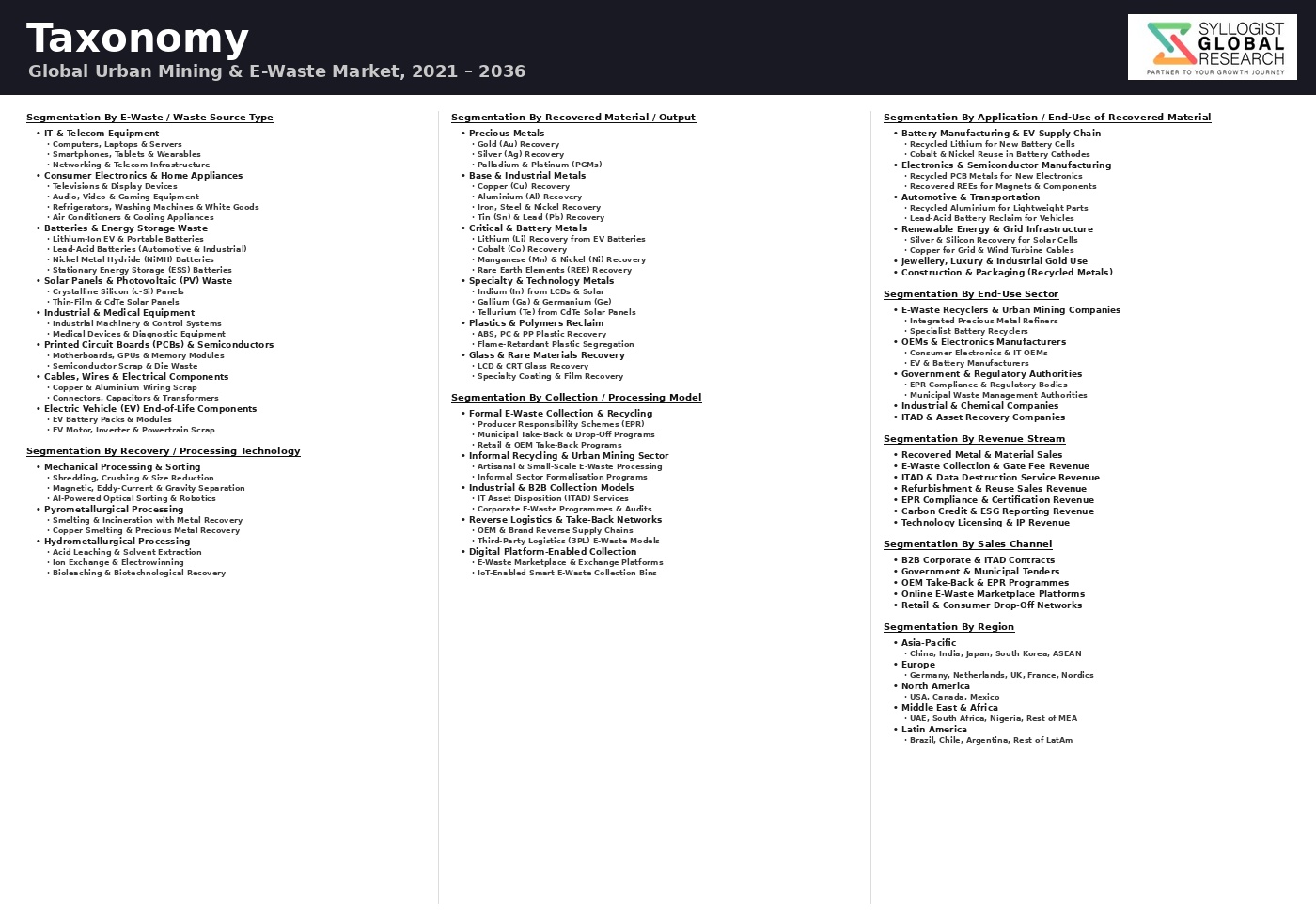
- Segmentation By Waste Stream and Source Material
- Printed Circuit Boards and Electronic Assemblies
- End-of-Life Lithium-Ion Batteries (Electric Vehicle, Consumer Electronics, and Stationary Storage)
- Spent Lead-Acid Batteries
- Cathode Ray Tube and Flat Panel Display Glass
- Electrical Cables and Copper-Bearing Scrap
- Spent Automotive Catalytic Converters
- Photovoltaic Panel End-of-Life Waste
- Hard Disk Drives, Memory Modules, and Semiconductor Devices
- Small and Large Household Appliances
- Others
- Segmentation By Recovered Metal
- Gold
- Silver
- Palladium and Platinum Group Metals
- Copper
- Cobalt
- Lithium
- Nickel
- Manganese
- Indium, Gallium, and Germanium
- Rare Earth Elements
- Others (Tin, Lead, Aluminum, and Zinc)
- Segmentation By Processing Technology
- Pyrometallurgical Smelting and Refining
- Hydrometallurgical Leaching, Solvent Extraction, and Electrowinning
- Mechanical Preprocessing and Physical Separation (Shredding, Eddy Current, and Density Separation)
- Direct Recycling and Battery Active Material Recovery
- Bioleaching and Biotechnological Metal Recovery
- Integrated Pyrometallurgical and Hydrometallurgical Hybrid Processes
- Others
- Segmentation By Source Device Category
- Information Technology Equipment (Computers, Servers, and Laptops)
- Mobile Phones and Portable Consumer Electronics
- Electric Vehicle Battery Packs and Modules
- Consumer Appliances and Household Electronics
- Telecommunications Infrastructure Equipment
- Industrial Electronics and Control Systems
- Medical Devices and Laboratory Equipment
- Photovoltaic and Renewable Energy Equipment
- Others
- Segmentation By Collection and Processing Channel
- Formal Certified Urban Mining and Recycling Operators
- Original Equipment Manufacturer Take-Back and Producer Responsibility Programs
- Municipal and Government-Operated Collection Programs
- Retail and Reverse Logistics Take-Back Schemes
- Informal Sector Collection and Processing
- Others
- Segmentation By End-Use of Recovered Metals
- Battery Manufacturing and Precursor Cathode Active Material Production
- Electronics and Semiconductor Fabrication
- Jewelry and Precious Metal Fabrication
- Automotive and Industrial Catalysis
- Specialty Alloy and Metal Product Manufacturing
- Commodity Metal Markets and Trading
- Others
- Segmentation By Region
- North America
- Europe
- Asia-Pacific
- Middle East and Africa
- Latin America
All market revenues are presented in USD
Historical Year: 2021-2024 | Base Year: 2025 | Estimated Year: 2026 | Forecast Period: 2027-2034
Key Questions this Study Will Answer
- What is the total global market valuation of the Urban Mining and E-Waste Metals Recovery Market in the base year 2025, and what is the projected market size and compound annual growth rate through 2034, disaggregated by waste stream including printed circuit boards, end-of-life lithium-ion batteries, spent catalytic converters, photovoltaic panel waste, and electrical cable scrap, and by recovered metal including gold, silver, palladium, copper, cobalt, lithium, nickel, manganese, and rare earth elements, to enable urban mining operators, battery recycling technology developers, precious metal refiners, original equipment manufacturers with take-back obligations, critical mineral investors, and extended producer responsibility compliance managers to identify which waste streams and recovered metal categories will generate the largest absolute revenue growth and the most commercially resilient recovery economics across the forecast period to 2034?
- How is the projected ramp in end-of-life electric vehicle battery volumes from approximately 280,000 metric tons in 2025 to approximately 1.4 million metric tons by 2034 expected to reshape the competitive landscape, processing technology investment priorities, capital deployment scale, and recovered metal output mix of the global battery recycling sector, and what are the comparative economics, metal recovery rates, output quality specifications, and carbon footprint profiles of hydrometallurgical direct recycling, pyrometallurgical smelting, and hybrid processing approaches across the key lithium-ion battery chemistry types including nickel manganese cobalt, lithium iron phosphate, and nickel cobalt aluminum that will collectively define the commercially dominant battery recycling technology platforms and operator competitive positions through 2034?
- What are the specific collection rate obligations, recycled content mandates, traceability and due diligence requirements, and penalty provisions of the European Union Battery Regulation, the European Union Waste Electrical and Electronic Equipment Directive, the United States Inflation Reduction Act battery material sourcing provisions, China’s Waste Electrical and Electronic Equipment regulations, India’s E-Waste Management Rules, and other major extended producer responsibility frameworks, and how are these regulatory requirements collectively creating mandatory and commercially quantifiable demand streams for certified secondary metals from urban mining operations that are underpinning long-term processing capacity investment decisions by formal urban mining operators across major generating and processing regions globally?
- What is the current operational capacity, processing technology platform, waste stream specialization, recovered metal output portfolio, key customer and offtake relationships, geographic footprint, and strategic investment program of the leading global urban mining and e-waste metals recovery operators including Umicore, Aurubis, Boliden, Veolia, Sims Metal, Li-Cycle, Redwood Materials, Retriev Technologies, Ganfeng Lithium recycling operations, and CATL-affiliated battery recycling subsidiaries, and how are these market participants differentiating their commercial propositions through processing technology efficiency, battery-grade precursor cathode active material output quality, environmental certification credentials, supply chain transparency platforms, and integrated reverse logistics and collection network capabilities?
- What are the structural barriers preventing the formalization of informal e-waste collection and processing sectors in major developing economy e-waste generation markets including India, Nigeria, Ghana, Indonesia, Vietnam, and Brazil, and what policy interventions including extended producer responsibility enforcement strengthening, informal sector operator registration and technology upgrade support programs, international e-waste trade restriction enforcement under the Basel Convention, consumer awareness and collection incentive schemes, and blended finance mechanisms for formal processing capacity investment are most effective in redirecting e-waste feedstock from informal to formal urban mining channels in ways that improve metal recovery efficiency, eliminate environmental contamination, and protect the health of waste worker communities while developing commercially sustainable formal urban mining industries in these rapidly growing e-waste generation markets?
- Product Definition
- Research Methodology
- Research Design & Framework
- Overall Research Approach: Descriptive, Exploratory & Quantitative Mixed-Method Design
- Market Definition & Scope Boundaries: What is Included and Excluded
- Segmentation Framework
- Key Research Assumptions & Limitations
- Secondary Research
- Primary Research Design & Execution
- Data Triangulation & Validation
- Market Sizing & Forecasting Methodology
- Competitive Intelligence Methodology
- Quality Assurance & Peer Review
- Definitions, Abbreviations & Data Notes
- Research Design & Framework
- Executive Summary
- Market Snapshot & Headline Numbers
- Key Findings & Research Highlights
- Market Dynamics
- Regional Market Summary
- Competitive Landscape Snapshot
- Technology & Innovation Highlights
- Market Dynamics
- Drivers
- Restraints
- Opportunities
- Challenges
- Porter’s Five Forces Analysis
- PESTLE Analysis
- Market Trends & Developments
- Emerging Trends
- Technological Developments
- Regulatory & Policy Changes
- Supply Chain & Sourcing Trends
- Manufacturing & Process Trends
- Investment & Funding Activity
- Sustainability & ESG Trends
- Risk Assessment Framework
- E-Waste Feedstock Supply & Quality Risk
- Regulatory, Compliance & Transboundary Shipment Risk
- Technology & Processing Yield Risk
- Commodity Price & Market Demand Risk
- Environmental, Health, Safety & Reputational Risk
- Regulatory Framework & Standards
- E-Waste Extended Producer Responsibility (EPR), Collection Targets & Take-Back Scheme Regulations
- Basel Convention, Hazardous Waste & Transboundary E-Waste Shipment Control Regulations
- Battery Regulation, End-of-Life Battery Collection Mandate & Recycled Content Requirements
- Critical Raw Material, Strategic Metal Recycling Policy & Supply Chain Due Diligence Frameworks
- Environmental Emission Standards, Worker Health Regulations & Facility Certification for E-Waste Processing
- Global Urban Mining & E-Waste Metals Recovery Market Outlook
- Market Size & Forecast by Value
- Market Size & Forecast by Volume (Metric Tonnes of E-Waste Processed & Metals Recovered)
- Market Size & Forecast by Recovered Metal Type
- Precious Metals (Gold, Silver, Platinum & Palladium)
- Base Metals (Copper, Aluminium, Iron & Steel, Lead, Zinc & Tin)
- Battery & Critical Metals (Lithium, Cobalt, Nickel & Manganese)
- Rare Earth Elements (REEs): NdFeB Magnet Alloys, Heavy & Light REEs
- Specialty & Technology Metals (Indium, Gallium, Germanium, Tellurium & Selenium)
- Market Size & Forecast by E-Waste / Urban Mine Source
- Consumer Electronics: Smartphones, Laptops, Tablets & Wearables
- IT Infrastructure & Data Centre Equipment: Servers, Networking & Storage Devices
- Large & Small Household Appliances (White Goods & Brown Goods)
- End-of-Life EV Battery Packs & Battery Energy Storage Systems (BESS)
- Solar Photovoltaic (PV) Panels & Wind Turbine Components
- Printed Circuit Boards (PCBs) & Electronic Components
- End-of-Life Vehicles (ELV): Non-Battery Electronics & Catalytic Converters
- Industrial, Medical & Defence Electronic Waste
- Market Size & Forecast by Recovery Technology
- Mechanical Pre-Processing (Shredding, Eddy Current, Magnetic & Gravity Separation)
- Pyrometallurgical Processing (Smelting, Incineration & Pyrolysis with Metal Recovery)
- Hydrometallurgical Processing (Leaching, Solvent Extraction & Electrowinning)
- Integrated Pyro-Hydrometallurgical Hybrid Processing
- Direct Battery Recycling & Closed-Loop EV Battery Recovery (Black Mass Processing)
- Biometallurgy & Bioleaching (Bacterial, Fungal & Enzymatic Recovery)
- Market Size & Forecast by Processing Stage
- Collection, Reverse Logistics & Aggregation
- Pre-Processing, Manual Dismantling & Sorting
- Primary Mechanical Processing
- Metallurgical Processing (Pyrometallurgical & Hydrometallurgical)
- Refining, Metal Recovery & Final Product Certification
- Market Size & Forecast by End-Use Application of Recovered Metals
- Battery & Energy Storage Manufacturing (Recycled Li, Co, Ni, Mn)
- Electronics & Semiconductor Manufacturing (Recycled Au, Ag, Cu, In, Ga)
- Automotive & Transportation (Recycled Cu, Al, Pb, PGMs from Catalysts)
- Renewable Energy Technology Manufacturing (Recycled REEs, In, Te, Cu)
- Construction, Infrastructure & General Engineering (Recycled Al, Fe, Cu)
- Jewellery, Luxury Goods & Investment (Recycled Au, Ag, Pt)
- Market Size & Forecast by End-User
- Integrated Metals & Mining Companies with Urban Mining Divisions
- Specialist E-Waste Recyclers & Urban Mining Operators
- EV Battery Recycling Specialists
- IT Asset Disposition (ITAD) & Data Destruction Companies
- Government & Municipal E-Waste Collection & Processing Programmes
- Market Size & Forecast by Sales Channel
- B2B Metal Offtake Agreements (Recycler to Smelter & Refiner)
- Extended Producer Responsibility (EPR) Scheme & Take-Back Programme Supply
- Direct OEM Closed-Loop Supply Agreements (Battery & Electronics Manufacturers)
- Spot Market, Commodity Exchange & Metal Trading Platform
- North America Urban Mining & E-Waste Metals Recovery Market Outlook
- Market Size & Forecast
- By Value
- By Volume (Metric Tonnes of E-Waste Processed & Metals Recovered)
- By Recovered Metal Type
- By E-Waste / Urban Mine Source
- By Recovery Technology
- By Processing Stage
- By End-Use Application of Recovered Metals
- By End-User
- By Country
- By Sales Channel
- Market Size & Forecast
- Europe Urban Mining & E-Waste Metals Recovery Market Outlook
- Market Size & Forecast
- By Value
- By Volume (Metric Tonnes of E-Waste Processed & Metals Recovered)
- By Recovered Metal Type
- By E-Waste / Urban Mine Source
- By Recovery Technology
- By Processing Stage
- By End-Use Application of Recovered Metals
- By End-User
- By Country
- By Sales Channel
- Market Size & Forecast
- Asia-Pacific Urban Mining & E-Waste Metals Recovery Market Outlook
- Market Size & Forecast
- By Value
- By Volume (Metric Tonnes of E-Waste Processed & Metals Recovered)
- By Recovered Metal Type
- By E-Waste / Urban Mine Source
- By Recovery Technology
- By Processing Stage
- By End-Use Application of Recovered Metals
- By End-User
- By Country
- By Sales Channel
- Market Size & Forecast
- Latin America Urban Mining & E-Waste Metals Recovery Market Outlook
- Market Size & Forecast
- By Value
- By Volume (Metric Tonnes of E-Waste Processed & Metals Recovered)
- By Recovered Metal Type
- By E-Waste / Urban Mine Source
- By Recovery Technology
- By Processing Stage
- By End-Use Application of Recovered Metals
- By End-User
- By Country
- By Sales Channel
- Market Size & Forecast
- Middle East & Africa Urban Mining & E-Waste Metals Recovery Market Outlook
- Market Size & Forecast
- By Value
- By Volume (Metric Tonnes of E-Waste Processed & Metals Recovered)
- By Recovered Metal Type
- By E-Waste / Urban Mine Source
- By Recovery Technology
- By Processing Stage
- By End-Use Application of Recovered Metals
- By End-User
- By Country
- By Sales Channel
- Market Size & Forecast
- Country-Wise* Urban Mining & E-Waste Metals Recovery Market Outlook
- Market Size & Forecast
- By Value
- By Volume (Metric Tonnes of E-Waste Processed & Metals Recovered)
- By Recovered Metal Type
- By E-Waste / Urban Mine Source
- By Recovery Technology
- By Processing Stage
- By End-Use Application of Recovered Metals
- By End-User
- By Country
- By Sales Channel
- Market Size & Forecast
*Countries Analyzed in the Syllogist Global Research Portfolio: United States, Canada, Mexico, Germany, France, United Kingdom, Netherlands, Belgium, Sweden, Norway, Japan, South Korea, China, India, Australia, Singapore, Thailand, Indonesia, Philippines, Brazil, Chile, Nigeria, Ghana, South Africa
- Technology Landscape & Innovation Analysis
- Hydrometallurgical Processing Technology Deep-Dive
- Acid & Alkaline Leaching Technology for PCB, E-Waste & Black Mass Metal Dissolution: Sulphuric, Nitric, Aqua Regia & Chloride Leach System Design, Selectivity Control & Safety Management
- Solvent Extraction & Ion Exchange Technology for Precious & Critical Metal Separation from Complex E-Waste Leachates: Reagent Selection, Mixer-Settler Design & Scrubbing Efficiency
- Electrowinning & Electrorefining Technology for High-Purity Copper, Gold & Silver Recovery from E-Waste Leach Solutions: Cell Design, Current Efficiency & Product Purity
- Lithium & Battery Metal Hydrometallurgy: Direct Lithium Recovery, Cobalt-Nickel-Manganese Separation from Black Mass Leach Liquors & Precursor Cathode Active Material (pCAM) Production
- Bioleaching & Biotechnology for E-Waste Metal Recovery: Fungal, Bacterial (Acidithiobacillus) & Enzymatic Leaching Systems for Low-Grade E-Waste Fractions & REE-Bearing Scrap
- Pyrometallurgical Processing Technology (Smelting, Pyrolysis, Plasma Arc & Incineration with Metal Recovery)
- Mechanical Pre-Processing, Automated Sorting & AI-Driven Dismantling Technology
- Direct Battery Recycling, Black Mass Processing & Closed-Loop EV Battery Recovery Technology
- Solar PV Panel, NdFeB Magnet & Rare Earth Element Recovery Technology
- Precious Metal Refining, Fire Assay & High-Purity Recovery Technology
- Digital Urban Mining Platform, AI-Based Sorting Robotics & E-Waste Traceability Technology
- Patent & IP Landscape in Urban Mining & E-Waste Metals Recovery
- Hydrometallurgical Processing Technology Deep-Dive
- Value Chain & Supply Chain Analysis
- E-Waste Collection, Reverse Logistics, Aggregation & Informal Sector Integration
- Pre-Processing, Dismantling, Shredding & Sorting Equipment Manufacturer Supply Chain
- Pyrometallurgical & Hydrometallurgical Processing Technology & Reagent Supply Chain
- Specialist E-Waste Recycler, Urban Mining Operator & Secondary Smelter Landscape
- Refiner, Secondary Metal Producer & OEM Closed-Loop Integration
- Recovered Metal Offtake, Commodity Trading & Battery Circular Economy Loop
- Residue Treatment, Hazardous Waste Disposal & Zero-Waste Strategy
- Pricing Analysis
- Precious Metal (Gold, Silver, Platinum & Palladium) Recovery from E-Waste Pricing Analysis
- Base Metal (Copper, Aluminium, Iron & Lead) Recovery from E-Waste Pricing Analysis
- Battery Metal (Lithium, Cobalt & Nickel) Black Mass & Recovered Metal Pricing Analysis
- E-Waste Processing Fee, Gate Fee & Tipping Fee Structure Analysis
- Rare Earth Element & Specialty Metal Recovery Pricing Analysis
- Total Urban Mining Project Economics & Recovered Metal Value vs. Virgin Material Benchmark
- Sustainability & Environmental Analysis
- Lifecycle Assessment (LCA) of Urban Mining & E-Waste Recovery vs. Primary Metal Extraction
- Carbon Footprint, GHG Emission Reduction & Circular Economy Contribution of E-Waste Recycling
- Hazardous Substance Management, Worker Health, Community Safety & Informal Sector Impact
- Extended Producer Responsibility (EPR) Compliance, Critical Raw Material Resilience & Circular Economy Policy Alignment
- Regulatory-Driven Sustainability, Digital Product Passport & Responsible Sourcing Certification
- Competitive Landscape
- Market Structure & Concentration
- Market Consolidation Level (Fragmented vs. Consolidated by Metal Type, Technology & Geography)
- Top 10 Players Market Share
- HHI (Herfindahl-Hirschman Index) Concentration Analysis
- Competitive Intensity Map by Recovered Metal, E-Waste Source & Geography
- Player Classification
- Integrated Metals & Mining Companies with Urban Mining & Recycling Divisions
- Specialist E-Waste Recyclers & Full-Service Urban Mining Operators
- EV Battery Recycling & Black Mass Processing Specialists
- IT Asset Disposition (ITAD), Data Destruction & Enterprise Electronics Recyclers
- Precious Metal Secondary Smelters & Refiners
- Municipal, Government-Operated & NGO E-Waste Collection & Processing Programmes
- E-Waste Processing Equipment, Sorting Technology & Reagent Suppliers
- Reverse Logistics, Collection Platform & Informal Sector Formalisation Companies
- Competitive Analysis Frameworks
- Market Share Analysis by Recovered Metal Type, Technology & Region
- Company Profile
- Company Overview & Headquarters
- Urban Mining & E-Waste Recovery Products, Services & Technology Portfolio
- Key Customer Relationships, OEM Partnerships & Offtake Agreements
- Processing Facility Footprint & Annual E-Waste Throughput Capacity
- Revenue (Urban Mining & E-Waste Segment) & Backlog
- Technology Differentiators & IP
- Key Strategic Partnerships, JVs & M&A Activity
- Recent Developments (Capacity Expansion, Product Launches, Certifications)
- SWOT Analysis
- Strategic Focus Areas & Roadmap
- Competitive Positioning Map (Technology Capability vs. Market Penetration)
- Key Company Profiles
- Market Structure & Concentration
- Technology Landscape & Innovation Analysis
- Strategic Output
- Market Opportunity Matrix: By Recovered Metal Type, E-Waste Source, Recovery Technology & Geography
- White Space Opportunity Analysis
- Strategic Output
- Strategic Recommendations
- Product Portfolio & Technology Investment Strategy
- Manufacturing & Operational Excellence Strategy
- Geographic Expansion & Localisation Strategy
- Customer & OEM Engagement Strategy
- Partnership, M&A & Ecosystem Strategy
- Sustainability & Circular Economy Strategy
- Risk Mitigation & Future Roadmap
- Strategic Priority Matrix & Roadmap
- Near-term (2025–2028)
- Mid-term (2029–2032)
- Long-term (2033–2037)